
Hogan's dislike of the hook looks like it came down to unpredictability, not the direction itself.
This piece looks at the physics behind that — why a hook is harder to predict.
One note up front: some of this piece could not be confirmed with numbers. Those parts are marked as such.
1. A closed face reduces loft
This is the starting point.
A clubface is angled back. That angle is loft. But when the face closes, loft goes down with it.
You can check this yourself. Take an iron and close the face. The leaning surface stands up — you can see it happen.
Here's a precise term worth using: the angle stamped on a club is static loft. What actually acts on the ball at impact is dynamic loft.
On a hook, dynamic loft is reduced, because the face is closed.
2. So it launches low
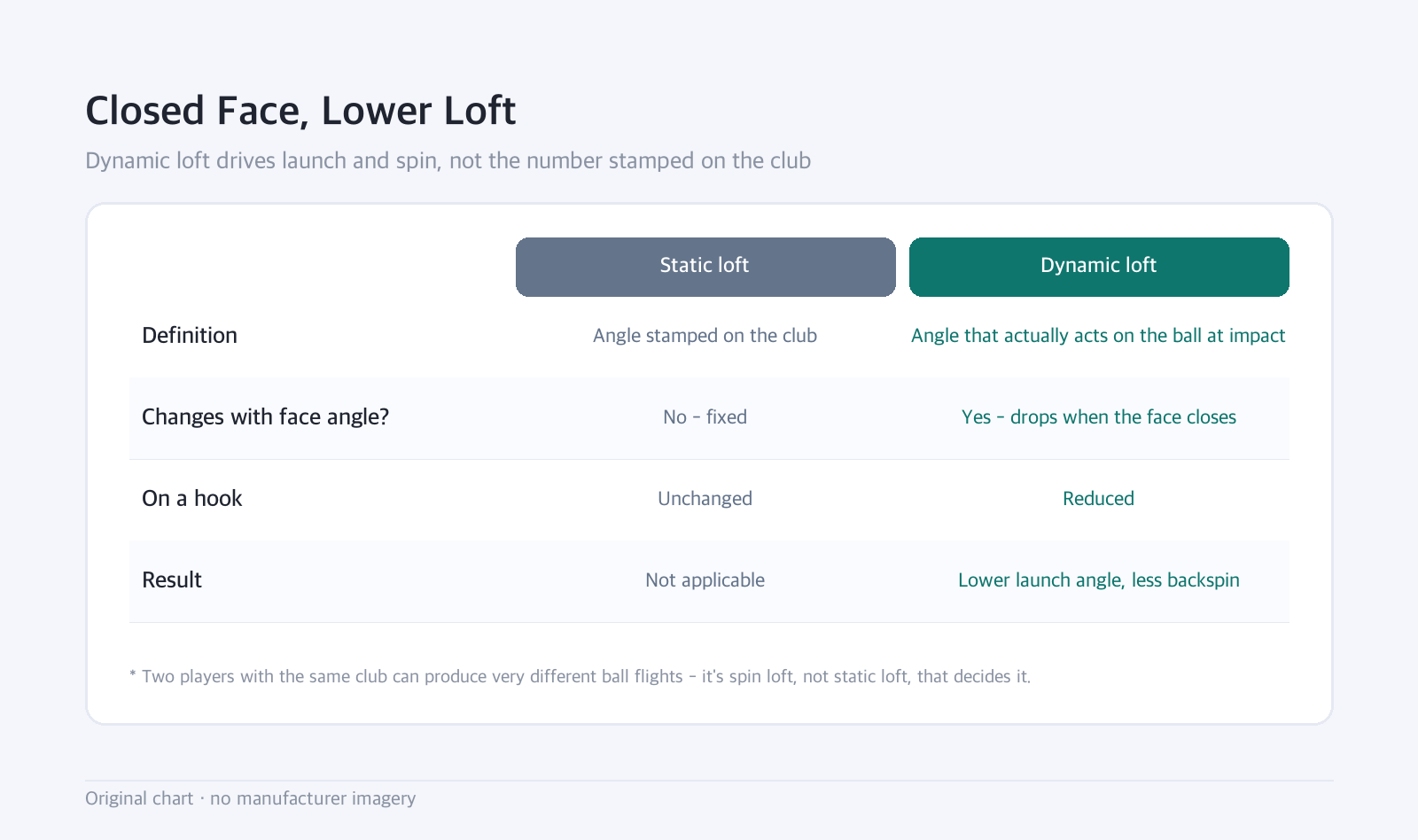
Reduced loft brings two things with it.
Launch angle drops. The ball flies lower.
Backspin drops. The spin that lifts and holds the ball up is reduced.
There's a more precise concept worth introducing here: spin loft — dynamic loft minus attack angle. This is the value that actually determines launch and spin.
That's why two players using the same club can produce completely different ball flights. It's spin loft, not static loft, that determines it.
3. Low and low-spin balls run far
What happens when a ball with low launch and low backspin lands?
Less stopping force. Backspin is what grips the ball after landing, and there's less of it. On top of that, the shallow angle of descent means it strikes the ground at a flatter, more forward-moving angle.
So it moves more after landing.
To be direct about this: we won't claim "a hook always runs farther" as a fixed rule.
The mechanism checks out — a shallow attack angle reducing spin and increasing rollout is a confirmed relationship. But we could not confirm numbers tying the hook itself to rollout distance. It also varies heavily with lie and ground conditions.
So we're only stating this as a tendency.
4. That's why it's hard to calculate
This connects back to the slice.
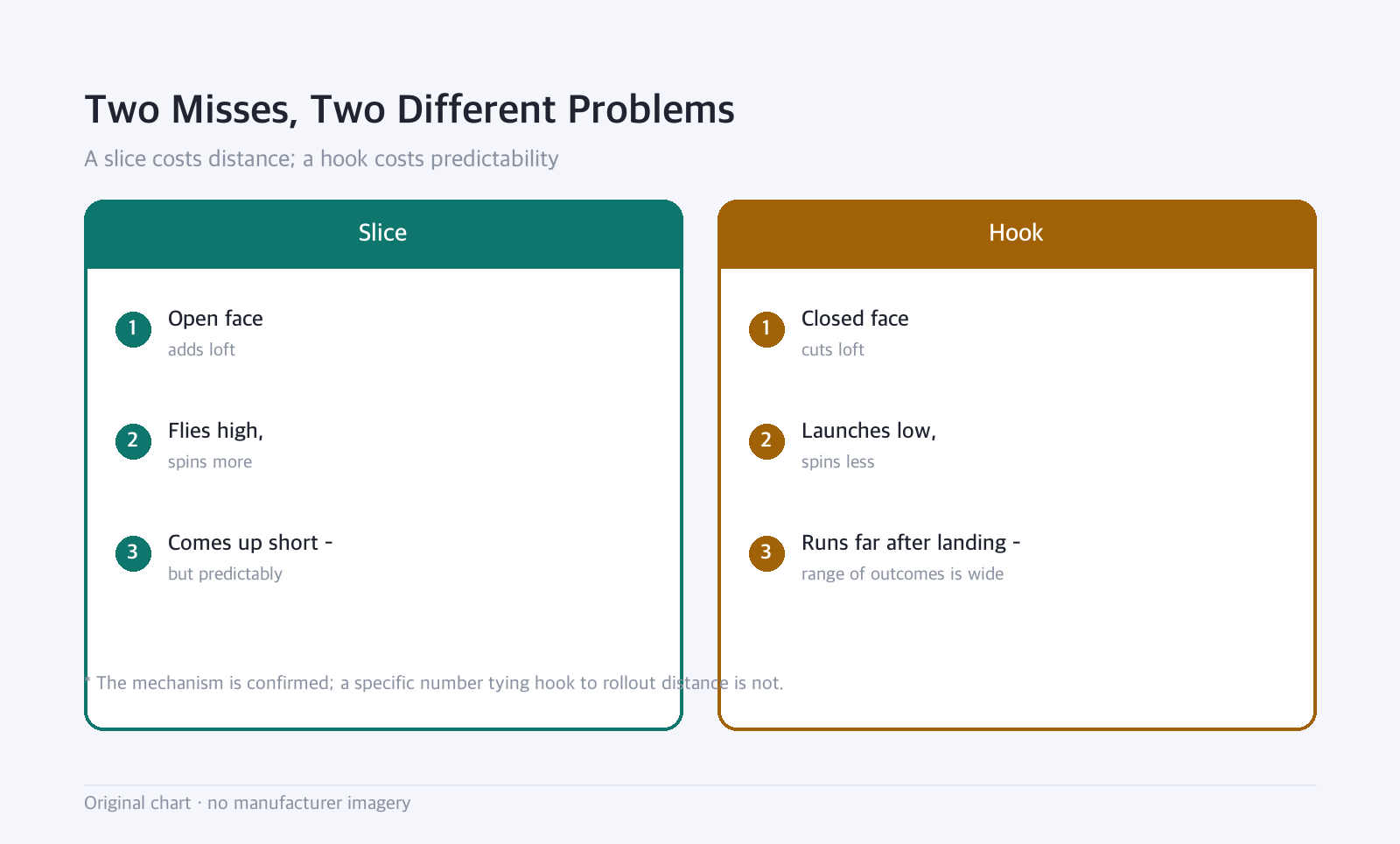
A slice generally does the opposite. An open face adds loft, raising launch angle and increasing spin. So it flies high and comes up short.
Coming up short is a real cost. But where it stops is comparatively predictable.
A hook is different. It launches low and moves a lot after landing. The range of where it might stop is wide.
Comparing the two misses this way separates their character:
- Slice — you lose distance. But the range of outcomes is narrow.
- Hook — you may not lose distance at all. But the range of outcomes is wide.
This is why the latter is more troubling for a professional. The problem isn't going left — it's not knowing how far it'll go.
5. How this applies to amateurs
Carrying this over directly isn't right, as noted separately. Here's a practical standard instead.
Judge it by the hole in front of you.
- A hole with trouble on the left — a hook's wide range of outcomes becomes a direct liability. Here, a hook is genuinely worse.
- A hole wide left and tight right — a hook's smaller distance loss can actually work in your favor.
- An approach into the green — you need stopping power. A low, low-spin ball is at a disadvantage on the green.
Whether a miss is good or bad isn't fixed — it depends on the situation.
One more thing: a hook is especially costly with irons. You need the ball to hold the green, and stopping power is reduced. A hooked driver and a hooked iron carry different kinds of cost.
6. Who this is useful for
- Golfers who've started missing left — this explains why the score gets worse even when distance doesn't drop.
- Golfers whose irons aren't holding the green — a closed face reducing loft may be the cause.
- Golfers choosing which miss to leave available — the right answer changes hole to hole.
- Golfers who read launch monitor numbers — check for a pattern of low launch paired with low spin.
This is less useful for:
- Golfers whose miss is to the right — that's covered in the slice pieces.
- Golfers looking for hard numbers — the rollout portion of this piece is stated only as a tendency.
7. What we could not confirm
- A number tying the hook to rollout distance — the mechanism is explained, but we could not confirm a value.
- The relationship between closed-face angle and loft reduction — this varies by club, and we could not confirm a standard formula.
- A real comparison of scoring cost between hook and slice — no statistics found.
- The range of rollout variation across ground conditions.
In one line
A closed face reduces loft, and reduced loft means lower launch and less spin.
That reduces stopping power on landing, widening the range of where the ball might stop.
A slice costs distance but stays predictable. A hook may not cost distance, but it's hard to predict. So whether a miss is "good" or "bad" isn't fixed — it depends on the hole.
This piece summarizes general instruction concepts and is not personalized coaching advice. Ball flight fixes depend on individual swing mechanics — a launch monitor session or certified instructor can confirm what applies to you.