A slice can be split into four distinct causes, each producing the same rightward curve through a different swing fault (covered separately). Now we go the other way.
The hook.
But this side works differently from the slice. Nobody wants a slice, but some players actually want a ball that curves left. That's a draw.
So the first question is this: where does a draw end and a hook begin?
1. It's not a matter of degree
The common explanation splits them by amount of curve. A little curve is a draw, a lot is a hook.
That's not wrong, exactly. But this standard gives you nothing to fix. How much counts as "a lot" differs from person to person, and it doesn't tell you what to actually work on.
Using the nine-window ball-flight framework (clubface angle relative to swing path, and starting direction relative to target) changes the picture entirely.
They land in different boxes.
2. What the windows show
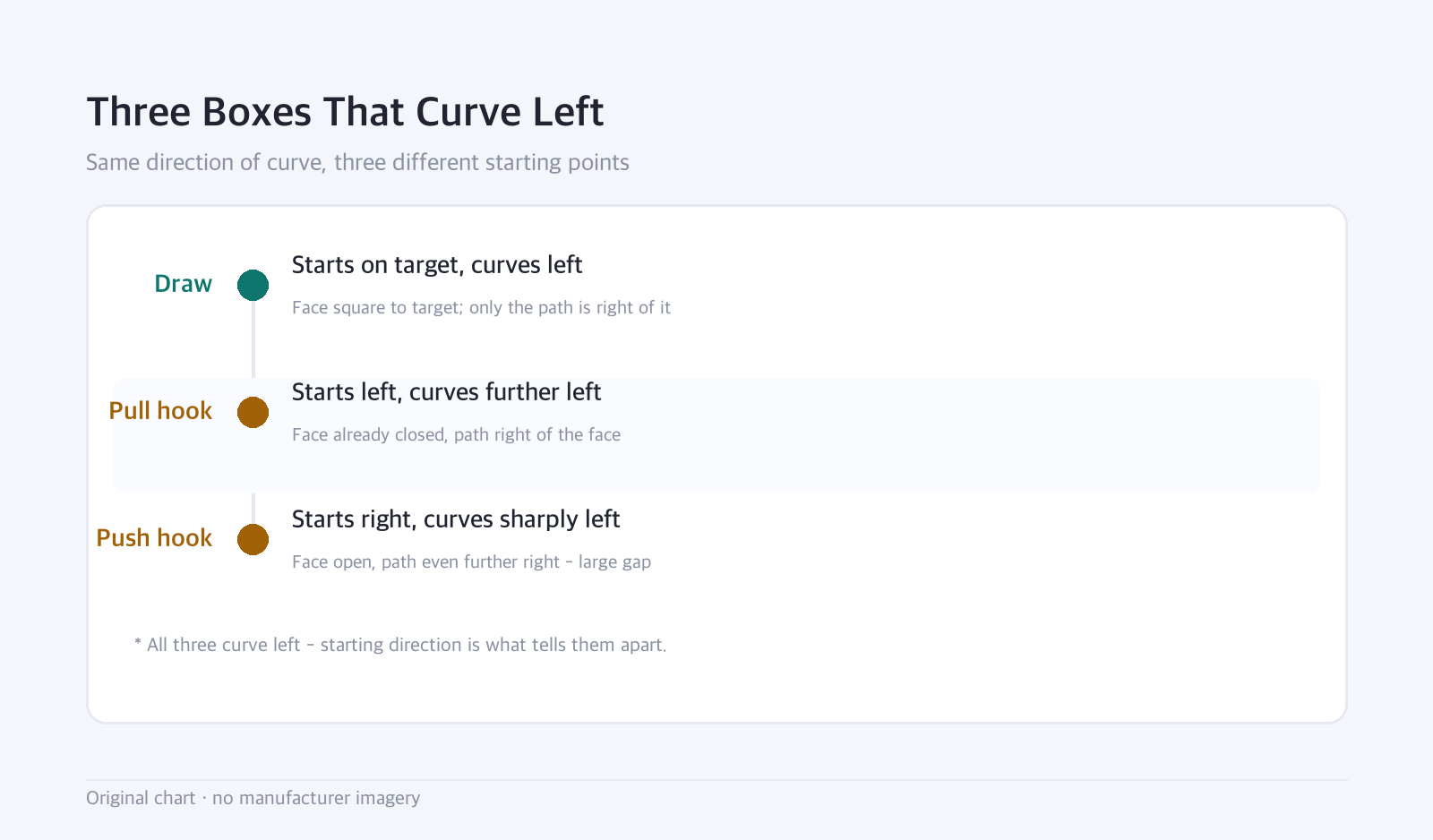
Draw — the ball starts on target and curves left. The face is square to the target; only the path is right of it.
Hook — the ball starts right and curves left. The face was already open relative to the target, and the path is further right still. This is the push hook box in the nine-window chart.
Pull hook — the ball starts left and curves further left. The face is closed, and the path is right of the face.
All three curve left. But the starting direction differs.
That's where the practical distinction comes from. Where a left-curving ball starts tells you whether that shot is a controlled shape or a miss.
3. So the boundary is starting direction
To summarize:
- Starts on target, curves left → a draw. The face is under control.
- Starts left, goes further left → a pull hook. The face is already closed.
- Starts right, curves sharply left → a push hook. Both face and path are right, with a large gap between them.
What separates a draw from a hook isn't how much the ball curves — it's whether the face is under control.
This standard is practical for a reason: the amount of curve changes with wind and lie every time, but starting direction doesn't.
4. Why this distinction matters
Trying to hit a draw and getting a hook instead happens constantly.
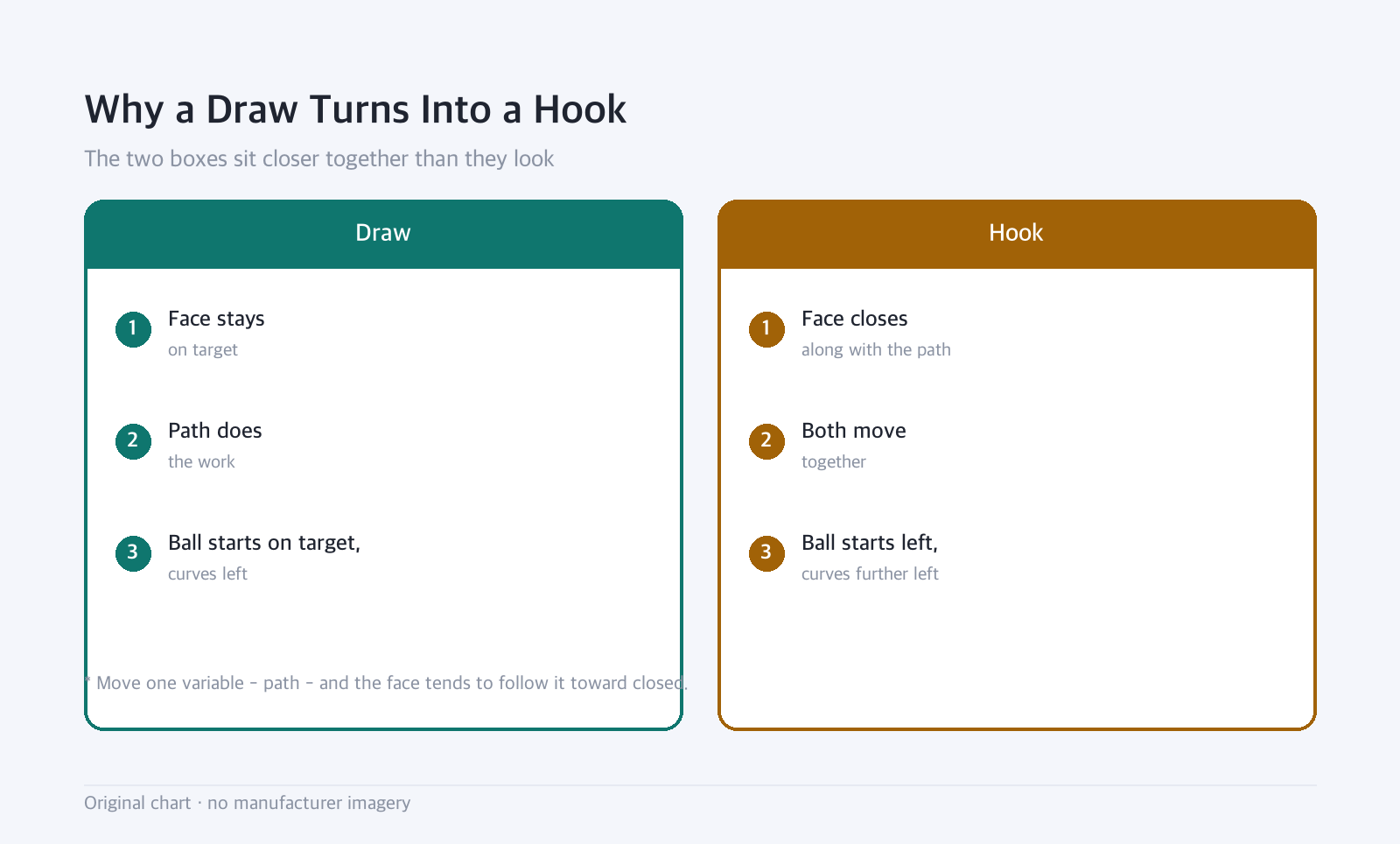
Given the definitions above, that's not a coincidence. A draw keeps the face on target and lets the path do the work. But the motion that rotates the path rightward tends to close the face along with it.
If the face stays on target, it's a draw. If the face closes along with the path, it's a hook. The gap between the two boxes is smaller than it looks.
The reverse happens too. Try to fix a hook by opening the face, and now you push it — a ball starting right.
Move one variable, and the other tends to move with it. That's what makes left-curving shots hard to manage.
5. Checking which box your ball is in
The same method used to diagnose a slice applies here: ten starting directions.
Pick a target and hit ten balls. Don't track where they land — track only where each one starts, sorted into right, center, or left.
- Mostly center, curving left → a draw. Adjust your aim and you can play it as is.
- Mostly left → a pull hook. The face is closed.
- Mostly right, curving sharply left → a push hook. The gap between face and path is large.
The fix differs for each. Each cause is covered separately, in more detail.
6. One thing worth clarifying up front
A draw is not automatically better.
It's widely said that a draw carries farther than a fade. But that claim comes with conditions attached — it depends on spin and launch angle at a given swing speed, and those vary by player.
We could not confirm hard numbers on this. So we won't build this piece on the premise that a draw is inherently the better shot.
The point here is bringing a left-curving ball under control. Whether you then shape it into a draw or a fade is a separate decision.
7. Who this is useful for
- Golfers trying to hit a draw and getting a hook instead — the two boxes sit closer together than expected; that's the starting point.
- Golfers who fixed a slice and picked up a left miss — that's a known side effect, covered separately.
- Golfers unsure whether their left-curving ball is good or bad — starting direction is what separates them.
- Golfers who want to check this on the range — ten balls is enough to place a shot in its box.
This is less useful for:
- Golfers who only miss to the right — that's covered in the slice pieces.
- Golfers whose shot shape changes constantly — sorting into boxes requires a consistent pattern.
8. What we could not confirm
- The actual distance gap between a draw and a fade — widely discussed, but too many variables to confirm a number.
- A standard angle threshold separating a draw from a hook — no fixed value exists.
- The actual ratio of hooks to slices among amateurs — we found no data.
In one line
A draw and a hook are separated not by how much the ball curves, but by whether the face is under control.
That's confirmed by starting direction. A ball that starts on target and curves left is a draw; one that already starts left or right is a different box entirely.
The two boxes sit close together, because the motion that rotates the path tends to close the face with it. Move one variable, and the other tends to follow.
This piece summarizes general instruction concepts and is not personalized coaching advice. Ball flight fixes depend on individual swing mechanics — a launch monitor session or certified instructor can confirm what applies to you.