Two earlier pieces laid out the background: ball starting direction is set almost entirely by the clubface, and curve is set by the gap between face and path — a relationship first modeled by physicist Theodore Jorgensen in 1994 (the D-Plane) and later confirmed by radar launch monitors. Now for the practical part.
How to work backward from where a shot flew to what actually happened at impact.
No launch monitor required. What's needed is the habit of separating two things: where it started, and where it curved.
1. Separate the two
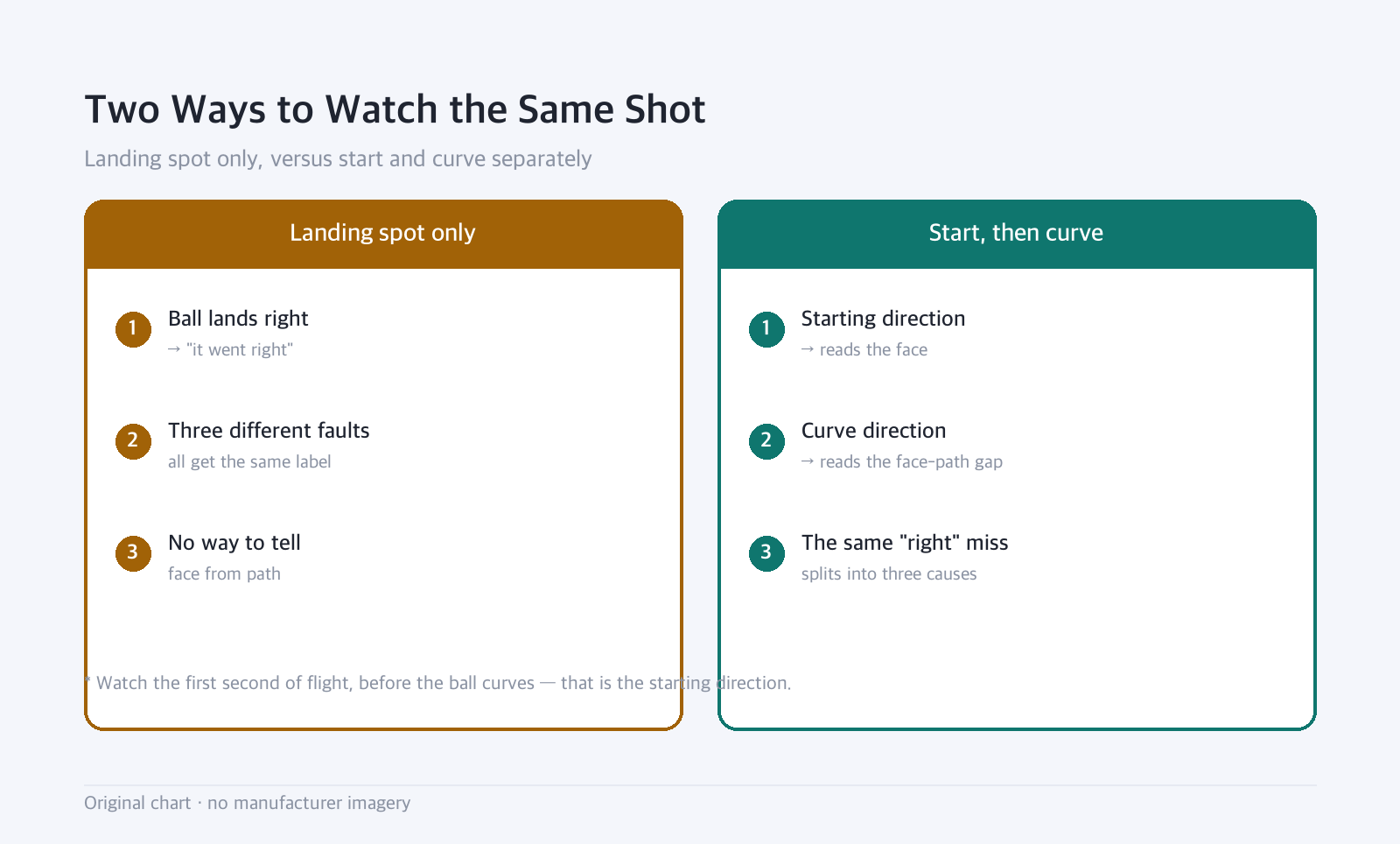
Most golfers only look at where the ball landed. "It went right" — and that's the end of it.
But there's more than one way for a ball to end up right of target.
- Starting right, and curving further right.
- Starting on line, and curving right.
- Starting left, and curving sharply right.
These three are completely different at impact. Under the old law, all three get lumped together.
So build this habit first: watch where the ball is pointed in its first second in the air, before it curves. Curve comes second.
2. Starting direction is a window into the face
The first rule from the corrected model: starting direction is almost entirely the face.
That gives you:
- Started right → at impact, the face was open.
- Started left → the face was closed.
- Started on target → the face was roughly square.
One common misread is worth flagging here.
"I slice it, so my face must be open" doesn't automatically follow. A slice that starts left had a closed face. What was open wasn't the face itself — it was the relationship between face and path.
3. Curve is the gap between face and path
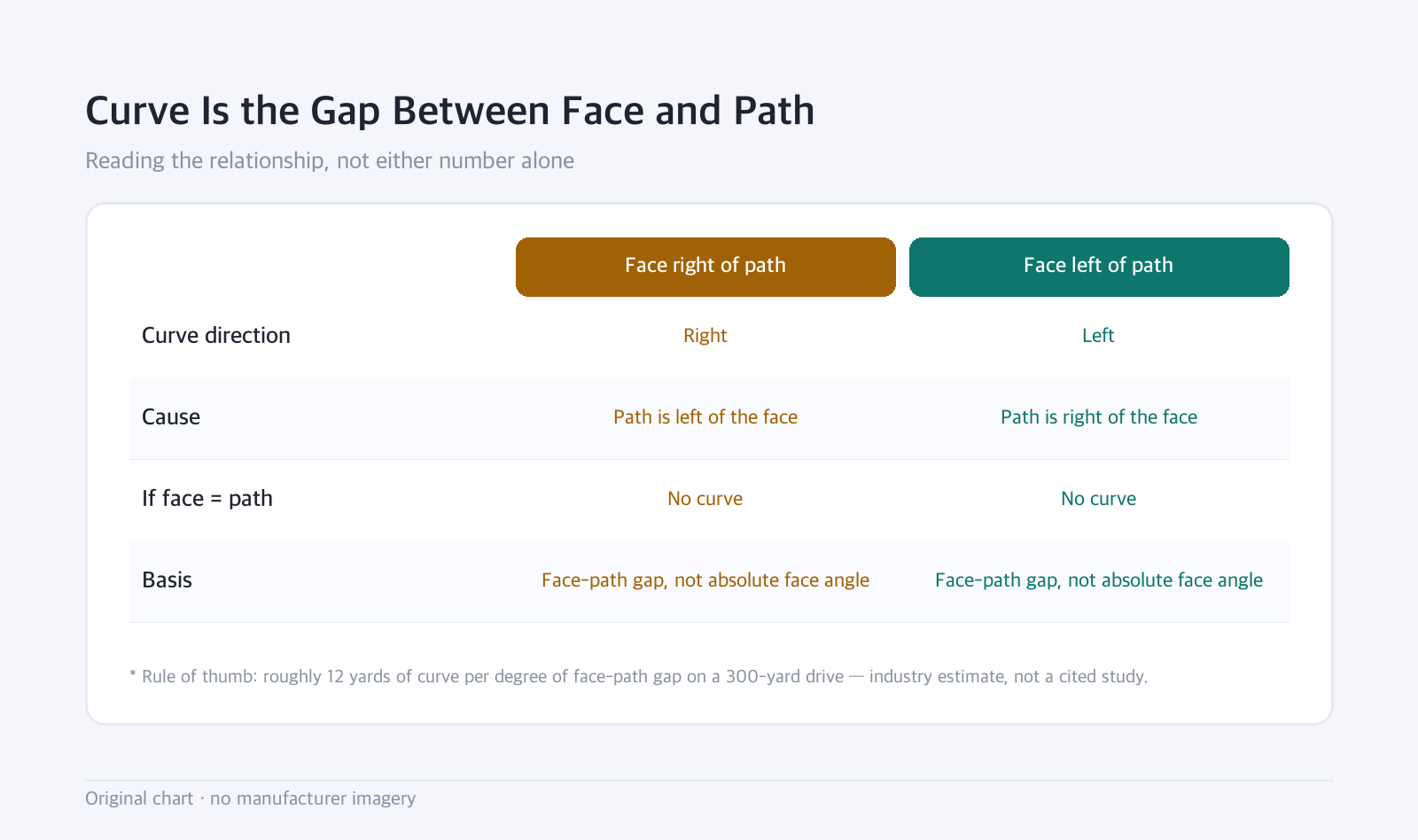
The second rule: curve is the difference between face and path.
Read it this way:
- Face right of path → the ball curves right.
- Face left of path → the ball curves left.
- The two match → no curve.
What matters is that this relationship is relative. Even if the face is open to the target line, if the path is open even more, the ball still curves left.
It's the difference, not the absolute angle, that shapes the shot.
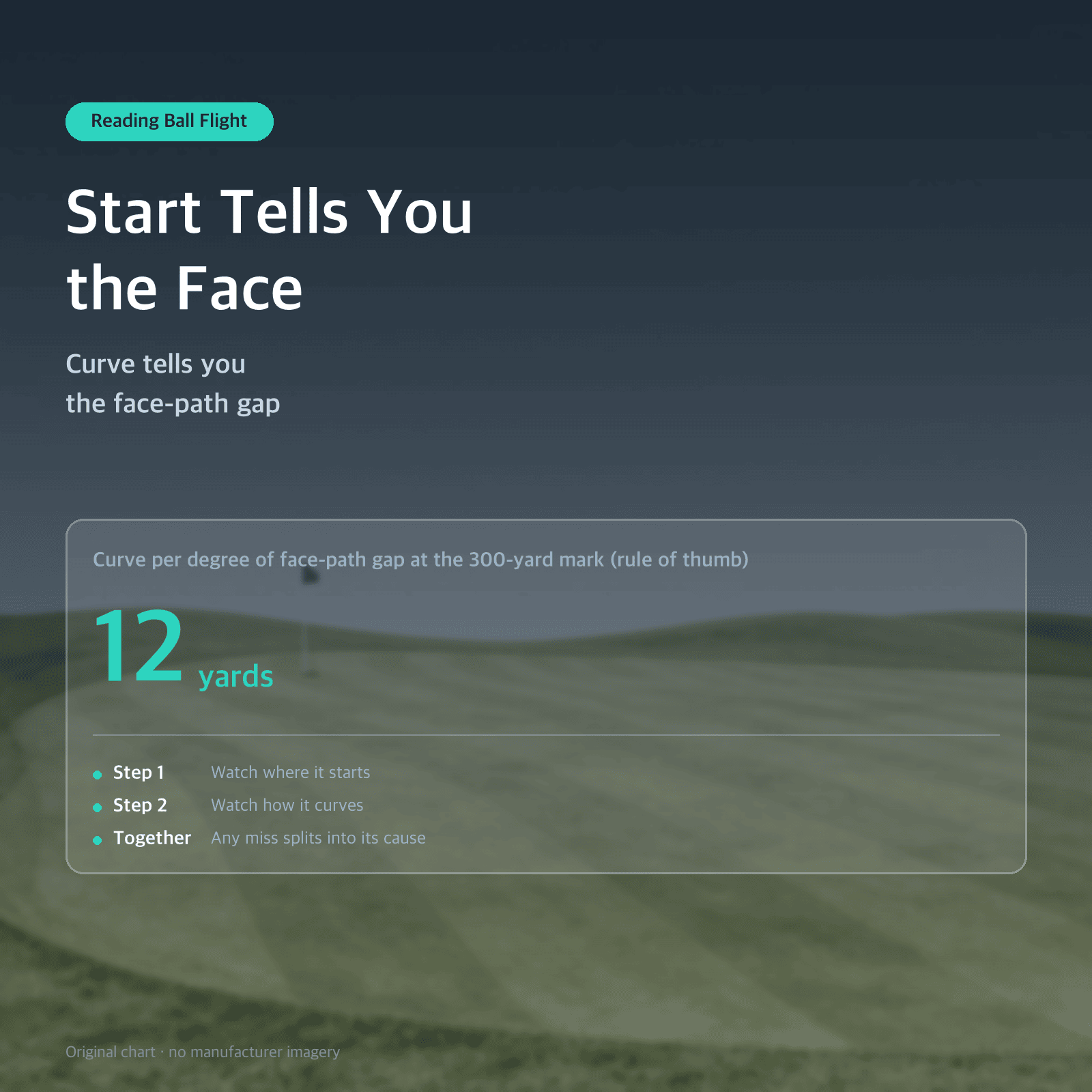
There's a rule of thumb used with launch monitor data: for every 1 degree of gap between face and path, the ball curves roughly 12 yards by the 300-yard mark.
That figure is an industry rule of thumb, not something drawn from a published study. But it's enough to build a sense that 1 degree is not a small amount.
4. Reading three misses in practice
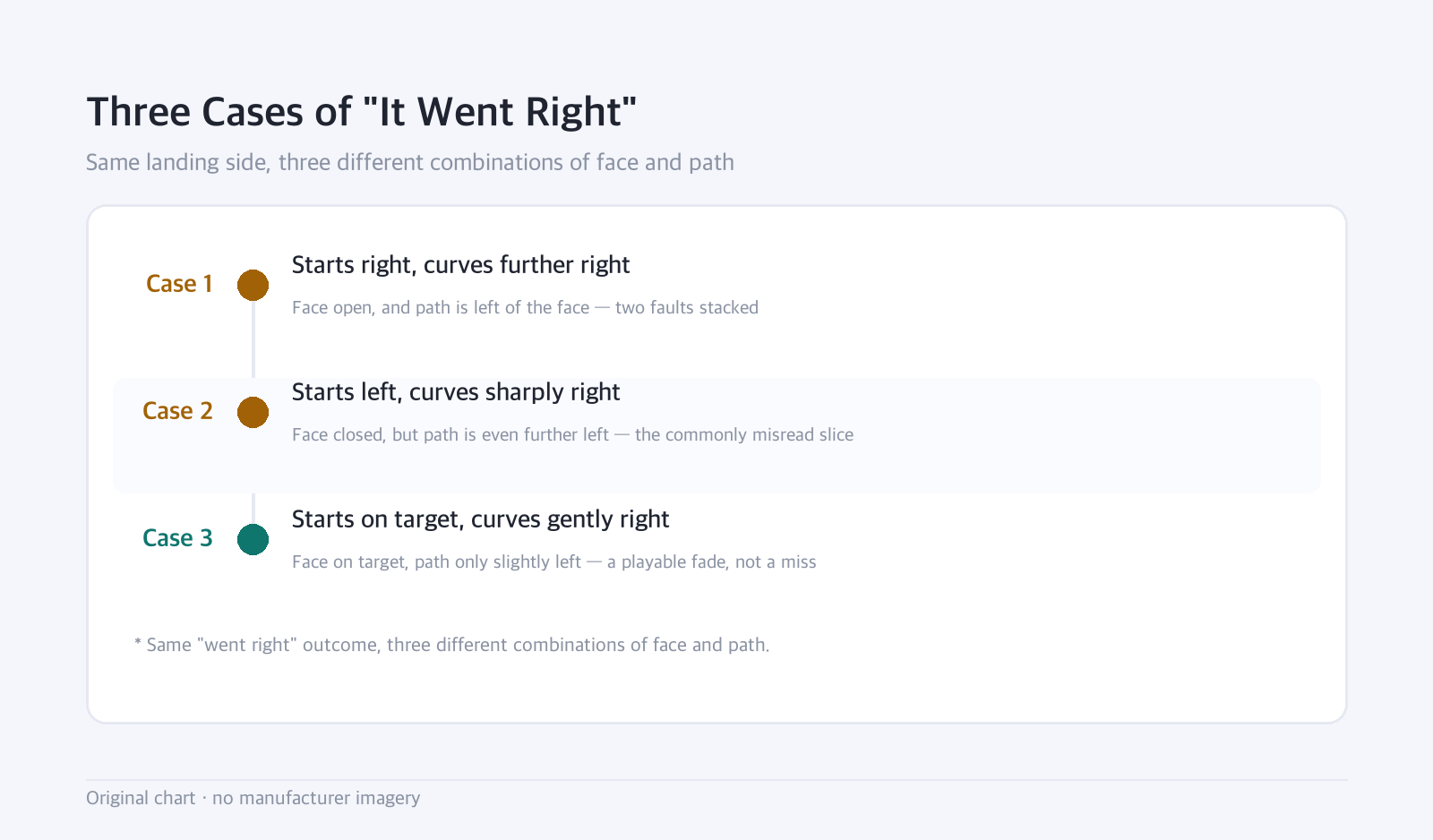
First: a ball that starts right and curves further right.
Starting right means the face was open. Curving further right means the path was left of the face. Both the face was open and the path came from outside to in — two faults stacked on top of each other.
Second: a ball that starts left and curves sharply right.
Starting left means the face was closed. But curving sharply right means the path was far further left than the face. The face was actually in reasonable shape — but the path was coming from outside to in even more severely.
Third: a ball that starts on target and curves gently right.
The face was on target and the path was only slightly left. This isn't a miss — it's a fade. Just aim for it, and it's a shot you can play with.
Treat all three with the same fix, and none of them get fixed.
5. So what do you work on first
This piece is a diagnostic framework, not a set of corrections. But one principle about sequencing is worth stating here.
Fix starting direction first.
Two reasons. The face can be checked on its own through starting direction. The path, by contrast, can only be read against the face. It's easier to fix the one you can verify independently first.
And in practice, fixing the path often drags the face along with it. The reverse is less true.
Fixes broken down by specific fault are covered in a separate piece.
Minimum definitions, for readers coming in cold
Club path is the direction the clubhead travels through impact. Face angle is the direction the clubface points at impact, relative to the target line. Starting direction tracks the face; curve tracks the gap between the two.
6. Who this is useful for
- Golfers who practice alone with no launch monitor — separating start direction from curve gets you halfway to a diagnosis without any equipment.
- Golfers who keep applying the same fix without results — you may be applying one remedy to faults with different causes.
- Golfers who read launch monitor numbers — this is exactly how to read face angle and club path as a gap, not two separate figures.
- Golfers trying to tell a fade from a slice — starting direction is what separates them.
This is less useful for:
- Golfers whose ball flight varies shot to shot — this framework needs a consistent pattern to read. Start by checking contact quality instead.
- Golfers who mis-hit frequently — this framework assumes center contact. That's covered in a further piece.
7. What we could not confirm
- The original source of the "1 degree = 12 yards" figure — we could confirm only that it's an industry rule of thumb.
- How much this ratio shifts by club — the direction (more loft, less sideways curve) seems right, but we could not confirm specific numbers.
- How accurately amateur golfers can judge starting direction by eye — we could not find data on this.
In one line
Starting direction tells you about the face; curve tells you about the gap between face and path.
"It went right" on its own tells you nothing. The moment you split it into where it started and where it curved, the same miss splits into three distinct causes.
Diagnosis has to split before the fix can.
This piece summarizes general instruction concepts and is not personalized coaching advice. Ball flight fixes depend on individual swing mechanics — a launch monitor session or certified instructor can confirm what applies to you.