A slice happens. The ball curves off to the right.
The lesson you'll usually hear is: "Your swing path is coming from outside to in."
That explanation was the foundation of golf instruction for decades. Then, in the late 2000s, it was overturned.
This piece covers what got overturned, how, and what difference it makes on the range right now.
1. What the old law said
The explanation that sat in instruction manuals for years came down to two sentences:
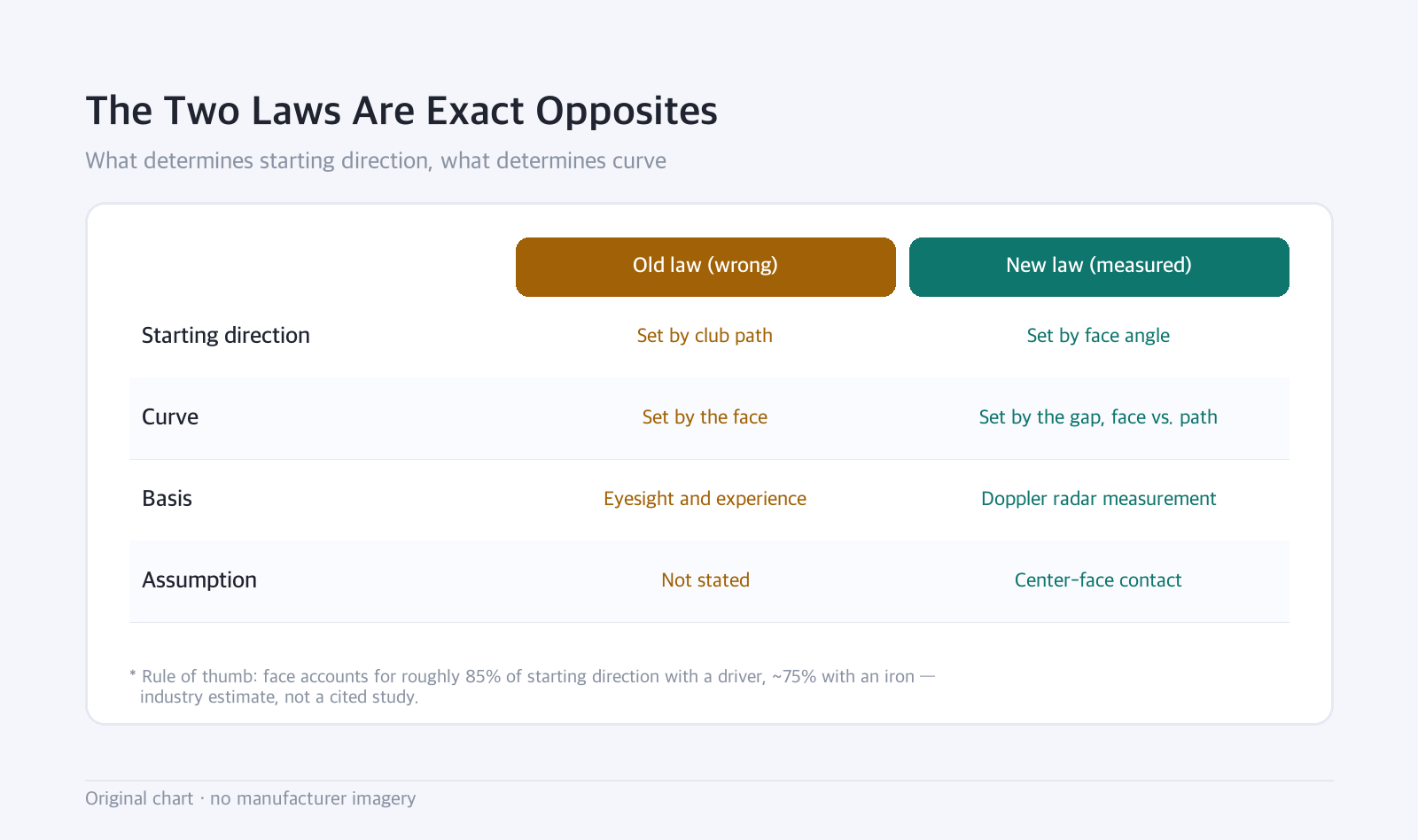
- The direction the ball starts is determined by the club's path.
- How the ball curves is determined by the face.
From there comes a very familiar fix.
If the ball starts right, that means the path came from outside to in, so the fix is: swing more from the inside out.
The logic is clean. And it's wrong.
2. It was the reverse
What measurement confirmed was exactly the opposite relationship:
- The direction the ball starts is determined by the face.
- How the ball curves is determined by the difference between face and path.
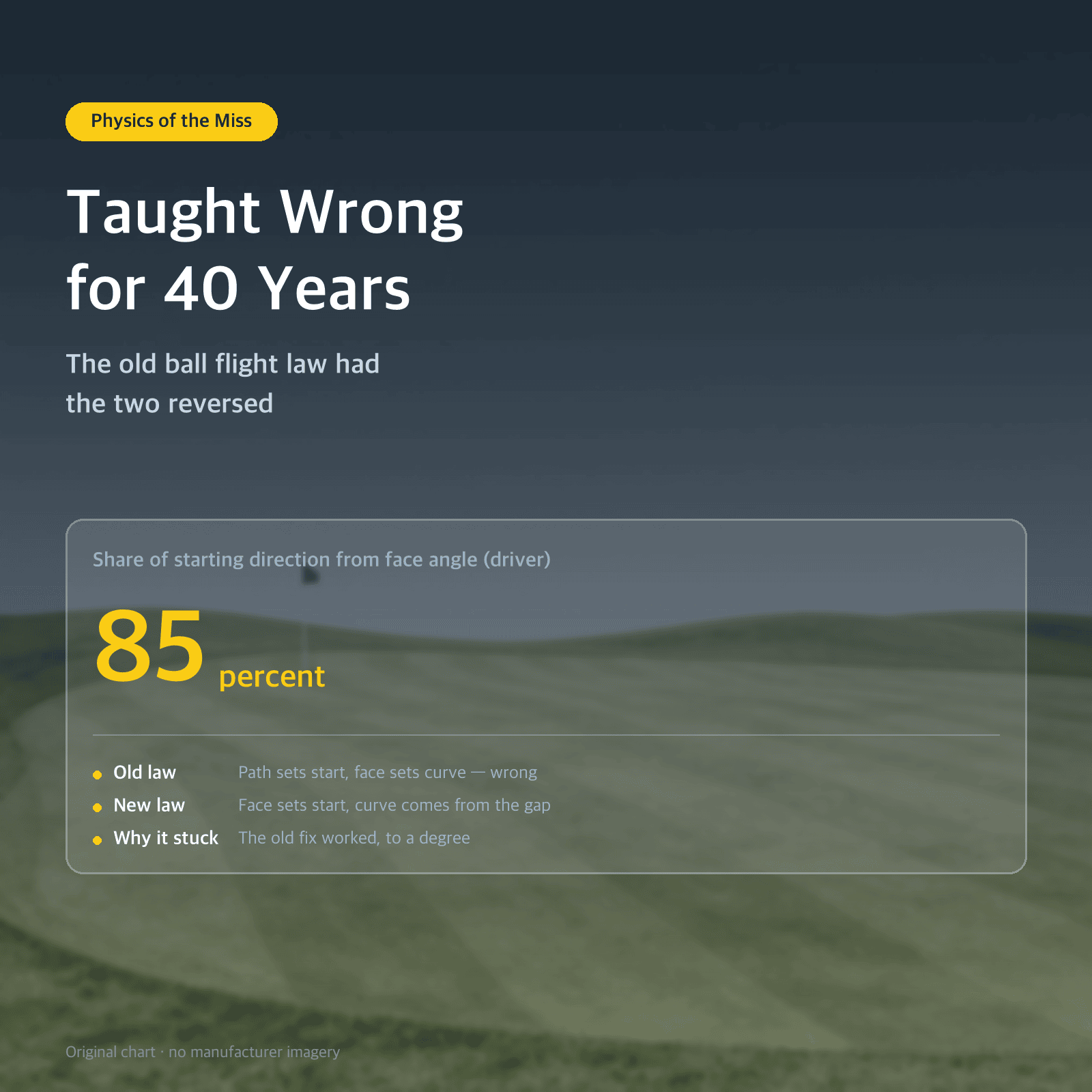
A rule of thumb commonly used in teaching and measurement circles holds that face angle accounts for roughly 85 percent of starting direction with a driver, and about 75 percent with an iron.
That figure is an industry rule of thumb, not a number pulled from a published study. The precise ratio matters less than the direction of the claim: starting direction is almost entirely determined by the face.
3. Which flips the fix
Here's the part that matters. When the underlying law flips, the fix for the same miss flips with it.
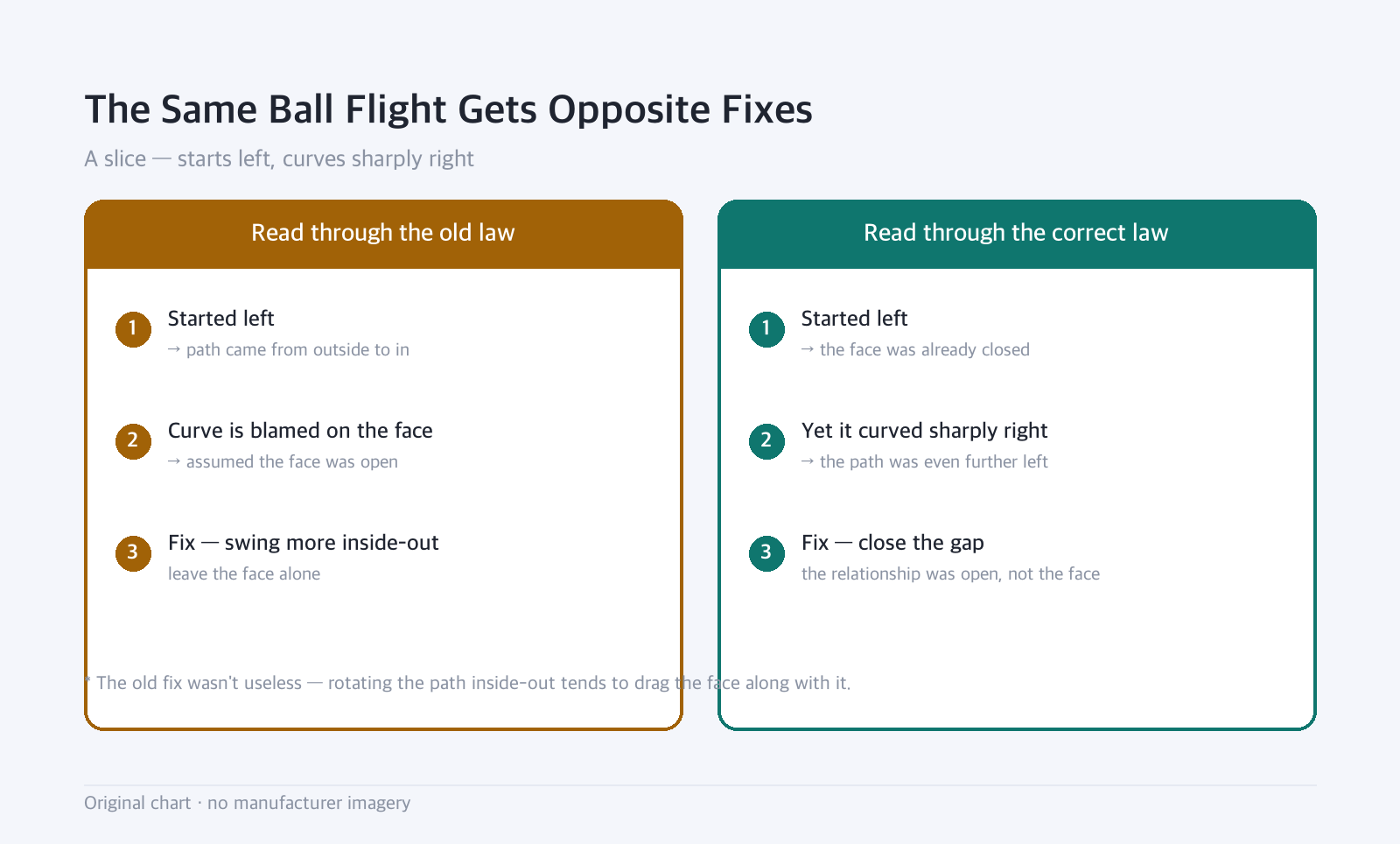
Take a slice — the ball starts left and curves sharply right.
Read through the old law: starting left means the path came from outside to in, so the path needs to move from inside to out.
Read through the correct law: starting left means the face was already pointing left. If the ball still curved sharply right, that means the path was even further left than the face.
The fix comes out reversed. Rotating the path more inside-out, following the old law, might reduce the slice somewhat, but as long as the face itself goes untouched, half the problem remains.
The same shot was given opposite corrections — and that actually happened in practice.
4. Why it went unnoticed for so long
This section leans more on circumstance than confirmed fact, and it's flagged as such.
Because the eye can't tell the difference.
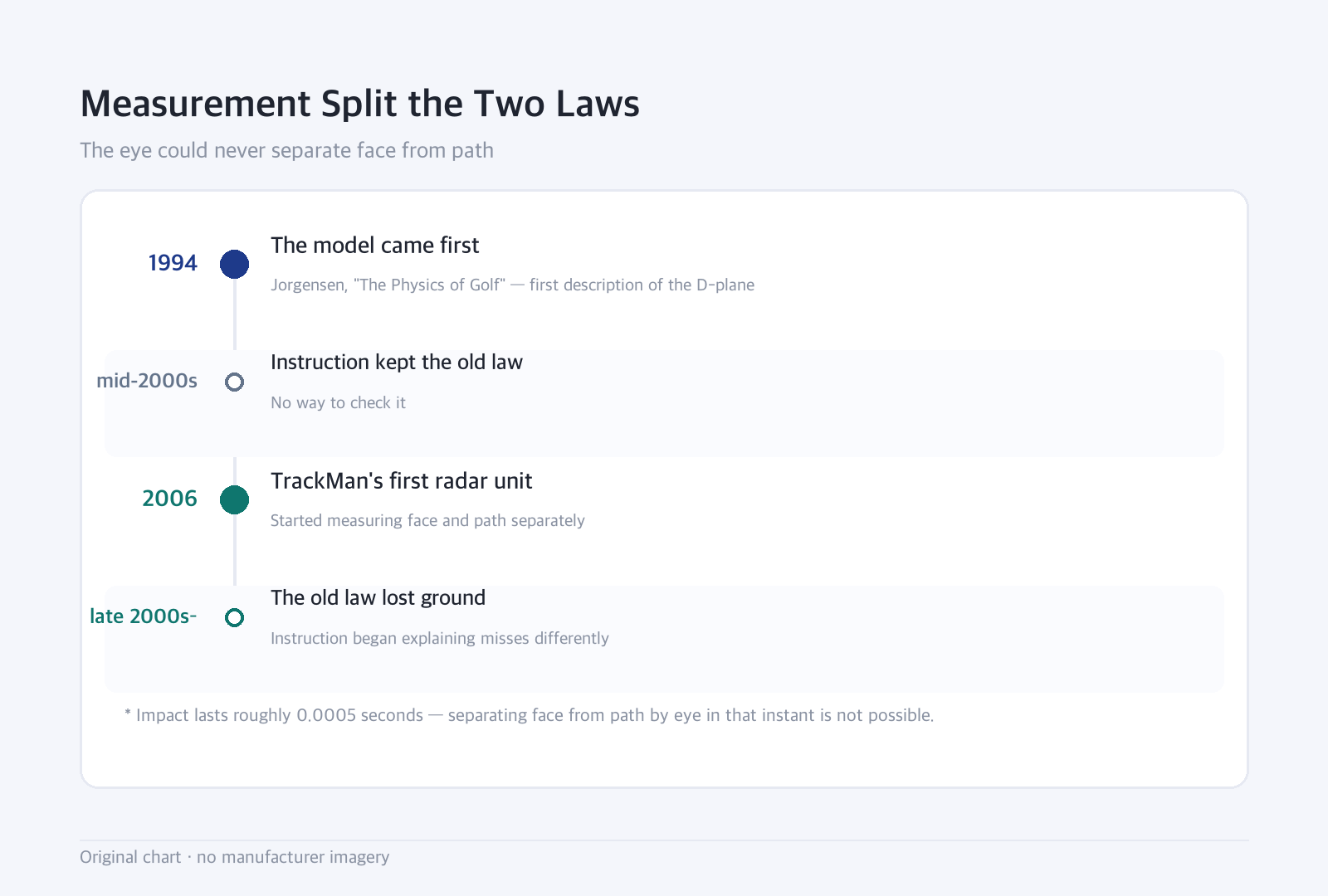
Impact lasts roughly 0.0005 seconds. In that instant, how many degrees open the face was, and which direction the club was traveling, are impossible to separate by eye.
On top of that, the fix prescribed by the old law worked, to some degree. Rotating the path inside-out tends to bring the face along with it. When results improve, it's easy to believe the explanation was correct.
Improved results are not proof that the explanation was correct. That's the single most important sentence in this piece.
5. What settled it
Doppler radar.
Once radar launch monitors such as TrackMan and FlightScope started measuring club path and face direction separately, the relationship between the two showed up as actual numbers.
TrackMan's first radar model launched in 2006. Instruction started changing after that.
But there's a chapter before that one. The person who first described this model wasn't an equipment company — it was a physicist, in 1994.
That story is covered in a separate piece.
Minimum definitions, for readers coming in cold
Two terms matter throughout this series: club path is the direction the clubhead is traveling through impact. Face angle is the direction the clubface is pointing at impact, relative to the target line. The relationship between the two — not either one alone — is what determines curve.
6. Who this is useful for
- Golfers who take lessons but can't get their ball flight to hold — if the explanation you were given rests on the old law, the fix may be misdirected.
- Golfers learning from videos on their own — this is why older and newer videos sometimes say the opposite thing.
- Golfers who look at launch monitor numbers — this is why face angle and club path show up as separate figures.
This is less useful for:
- Golfers who want to fix a slice right now — this piece is a framework for reading the cause; specific fixes by category are covered in a separate piece.
- Golfers whose ball flight is already stable — if it's working, there's no need to disturb it with theory.
7. What we could not confirm
- When and by whom the old law was first formalized — we could not confirm a specific author or year.
- The original source of the 85 percent / 75 percent figures — we could confirm only that they are industry rules of thumb.
- When the corrected model became standard in instruction — this varies by country and organization.
In one line
The ball is sent by the face, and the difference between face and path makes it curve.
The old law had these two reversed. It survived as long as it did because the fix it prescribed worked, to a degree.
A fix working is not the same as an explanation being correct. What separated the two was measurement.
This piece summarizes general instruction concepts and is not personalized coaching advice. Ball flight fixes depend on individual swing mechanics — a launch monitor session or certified instructor can confirm what applies to you.