
A separate piece covers how the old ball flight law was overturned: the ball's starting direction is set by the clubface, and its curve is set by the gap between face and path.
That piece traced the turning point to the Doppler radar launch monitors that arrived in 2006.
But there's a chapter before that one. The model behind it had already been published twelve years earlier.
1. A physicist's golf book
Theodore Jorgensen was a physicist. His book, titled The Physics of Golf, was published in 1994.
This book first described a concept and term now widely used: the D-Plane. It's a model that predicts the direction a ball starts and how it will curve.
One clarification is worth making here, since a common misconception shows up in golf content:
The claim that "TrackMan created the D-Plane" is incorrect.
Jorgensen built the model. The launch monitor company confirmed it through measurement. Building something and confirming it are two different things.
2. What the D-Plane says
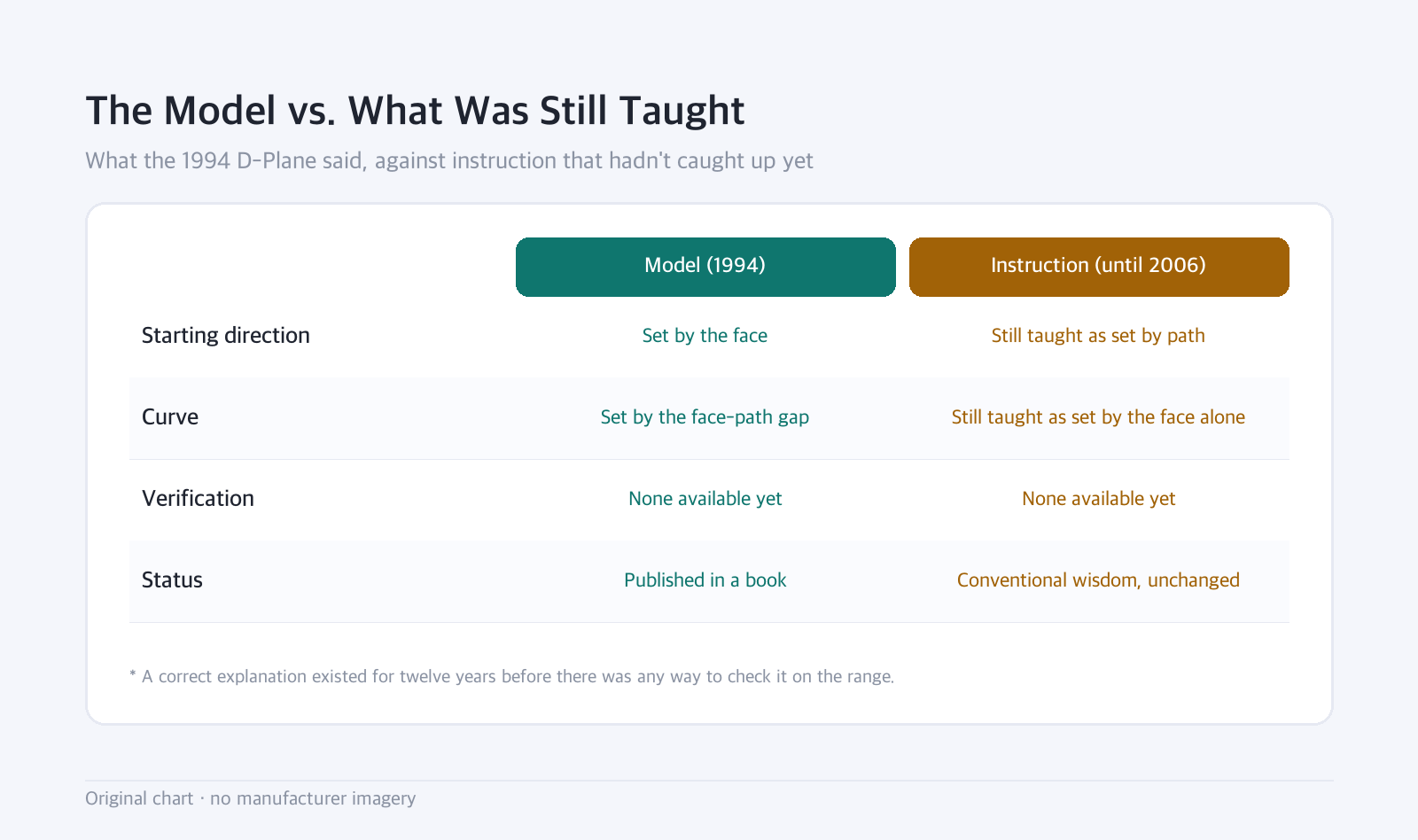
The "D" refers to a plane. In essence, the model says this:
The direction the club travels and the direction the face points together define a plane, and the ball's spin axis sits perpendicular to that plane.
That sounds abstract, but the takeaway for a golfer is simple:
- Starting direction leans heavily toward the face.
- Curve is produced by the gap between face and path.
- If the two match, the ball doesn't curve.
The third point matters most in practice. Even if the path comes from outside to in, if the face is pointed exactly along that same direction, the ball won't curve at all. It simply flies straight left.
That's a conclusion the old law could never have produced.
3. It took twelve years
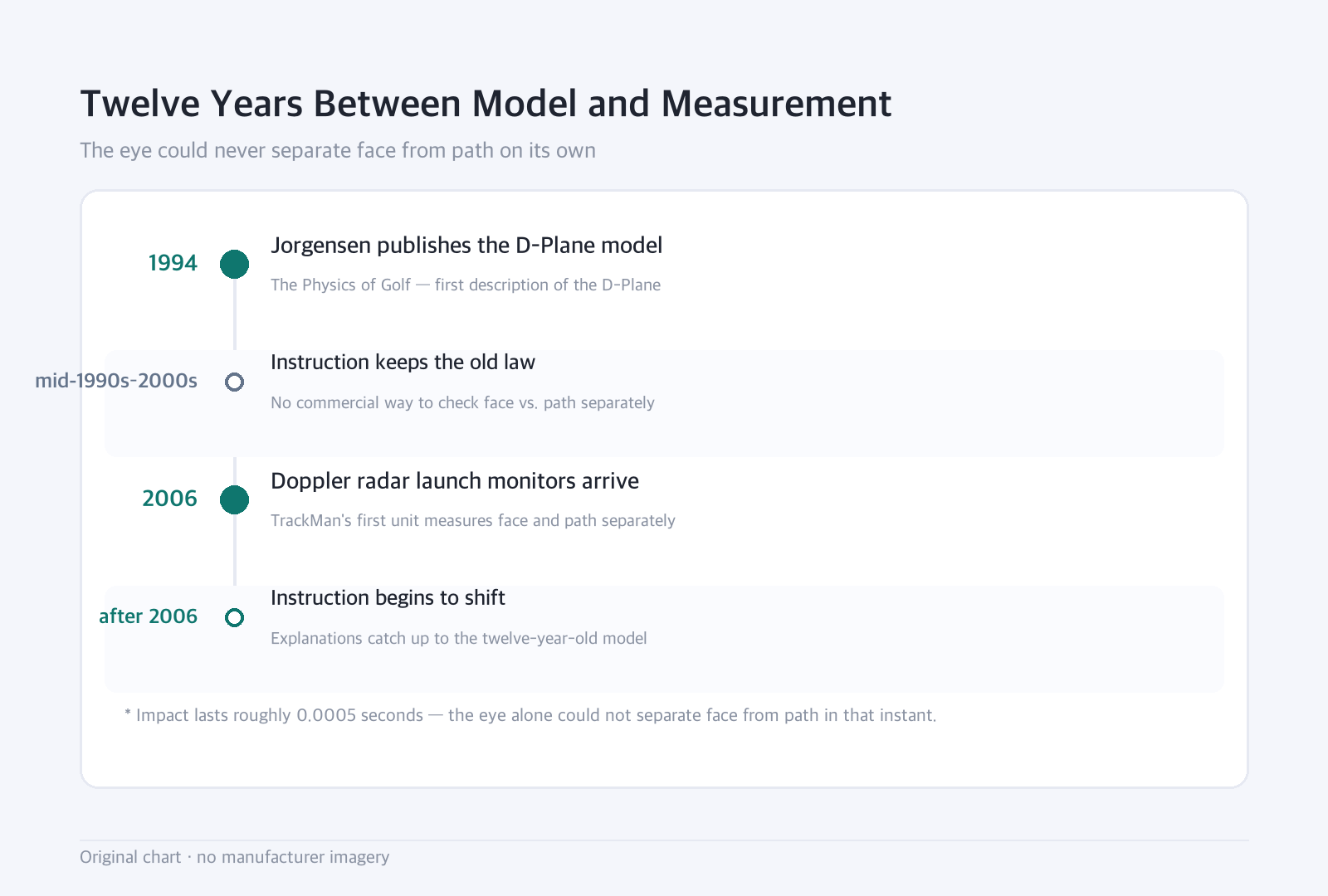
The model appeared in 1994. The launch monitor appeared in 2006.
In between, instruction largely stuck with the old law. Why twelve years?
From here, this is inference, kept separate from what's confirmed.
Confirmed: the model was published as a book in 1994, and radar measurement became commercially available in 2006.
Inference: a physical model, on its own, doesn't change instruction. As covered in a separate piece, the face direction and club direction at the moment of impact cannot be separated by eye. Even if a model is correct, without a way to verify it on the range, it stays a claim in a book.
What can't be measured can't be taught.
4. A pattern seen before
The same shape has shown up repeatedly in pieces covering golf history: a technology or fact appears first, and the rule or accepted wisdom that governs it follows a step behind.
Here, the order is slightly different. The explanation came first, and confirmation came late.
A correct explanation doesn't get accepted just for being correct. A way to confirm it has to exist before conventional wisdom changes. Jorgensen's twelve-year gap is exactly that.
Minimum definitions, for readers coming in cold
Club path is the direction the clubhead travels through impact. Face angle is the direction the clubface points at impact, relative to the target line. The D-Plane model says these two together — not either alone — determine both starting direction and curve.
5. What's different now
Modern indoor simulators (TrackMan, GCQuad, and similar systems) and range launch monitors now display club path and face angle as separate figures.
If you've seen a screen with two numbers side by side, that's why they're split — because of the D-Plane.
- Face angle — where the ball will start.
- Club path — the reference line for which way it will curve.
- The gap between them — how much it will curve.
How to read all three together is covered in a separate piece.
6. Who this is useful for
- Golfers who regularly check launch monitor data — understanding why those figures are split changes how you read them.
- Golfers hearing conflicting lesson theories — the split often comes down to whether the source is the 1994 model or the older conventional wisdom.
- Golfers curious where golf concepts actually originate — worth knowing where a frequently cited idea actually comes from.
This is less useful for:
- Golfers without access to a launch monitor — the concept still applies, but there's no way to verify it with numbers.
- Golfers who want a fix right now — this piece is background; diagnosis is covered separately.
7. What we could not confirm
- The experimental basis Jorgensen used to build the D-Plane — we could not confirm the specific argument from the original text.
- How instruction responded between 1994 and 2006 — whether it was ignored or simply unknown, we could not determine.
- Any verification attempts before radar measurement — such as high-speed photography — we could not confirm whether any existed.
- What exactly "D" stands for — multiple explanations circulate, and we could not settle on one.
In one line
The D-Plane is a model a physicist built in 1994; the launch monitor companies were the ones who confirmed it.
A correct explanation existed, and it still took twelve years. The missing piece was a way to verify it.
What can't be measured can't be taught. Once measurement became possible, one long-standing explanation gave way entirely.
This piece summarizes general instruction concepts and is not personalized coaching advice. Ball flight fixes depend on individual swing mechanics — a launch monitor session or certified instructor can confirm what applies to you.