Golf instruction books lean heavily on one particular chart: the nine-window ball flight chart.
Three starting directions crossed with three curve directions make nine boxes, each labeled with a shot shape — straight, draw, fade, hook, slice, pull, push.
The chart itself still holds up. What no longer holds up is the explanation attached to each box, if that explanation rests on the old ball-flight model.
This piece refills the nine boxes.
1. Fixing the two axes first
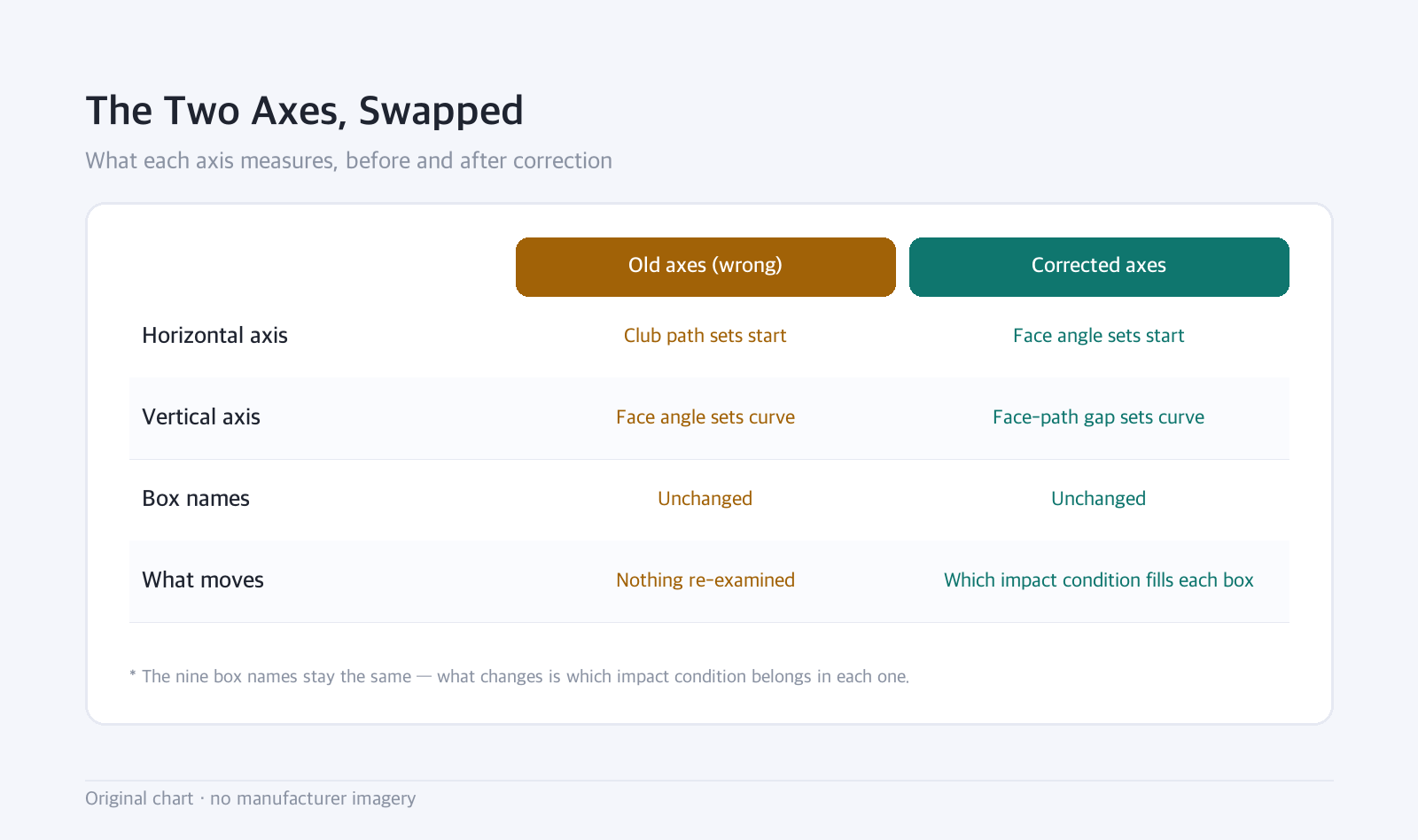
The old chart's axes were:
- Horizontal — club path sets the starting direction
- Vertical — face angle sets the curve
The corrected axes are:
- Horizontal — face angle sets the starting direction
- Vertical — the gap between face and path sets the curve
The box names stay the same, but with the axes swapped, the impact conditions that belong in each box change.
2. Three boxes that start left
Starting left means the face was closed at impact. From there, the boxes split.
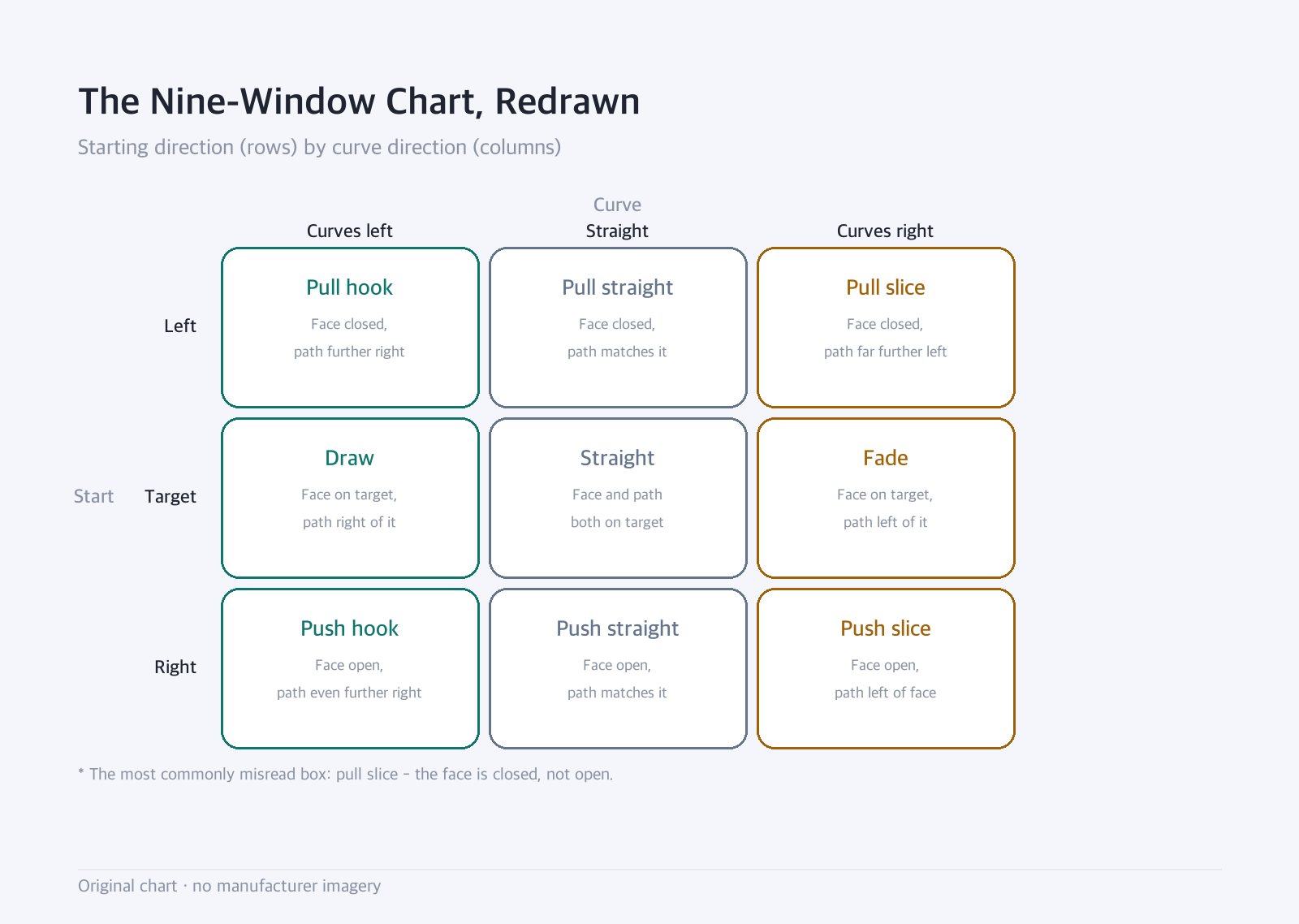
Pull hook — starts left and curves further left. The face is closed, and the path is even further right than the face.
Pull straight — travels dead straight, but left. The face is closed and the path matches it closely enough that there's no curve — just a left starting line.
Pull slice — starts left and curves sharply right. The face is closed, but the path is far further left still.
The third one is the most common among amateurs, and the one most often misread by the old model, because the face is already closed, yet the golfer gets told to close the face further.
3. Three boxes that start right
Starting right means the face was open.
Push slice — starts right and curves further right. The face is open, and the path is further left than the face.
Push straight — travels dead straight, but right. The face is open and the path matches it.
Push hook — starts right and curves left. The face is open, but the path is even further right. This comes from a swing that moves strongly from inside to outside the target line.
4. Three boxes that start on target
Starting on target means the face was square to the target. From here, the curve is entirely down to the path.
Straight — face and path both matched the target.
Fade — face matched the target, path was left of it.
Draw — face matched the target, path was right of it.
One practical conclusion follows from this.
An intentional draw or fade is built by setting the face on target and using the path to shape the curve. A hook or slice as a mishit, by contrast, usually starts with the face already off.
The same curve direction can come from different causes. Trying to hit a draw and getting a hook instead isn't a coincidence — the two shots live in different boxes.
5. How to actually use the chart
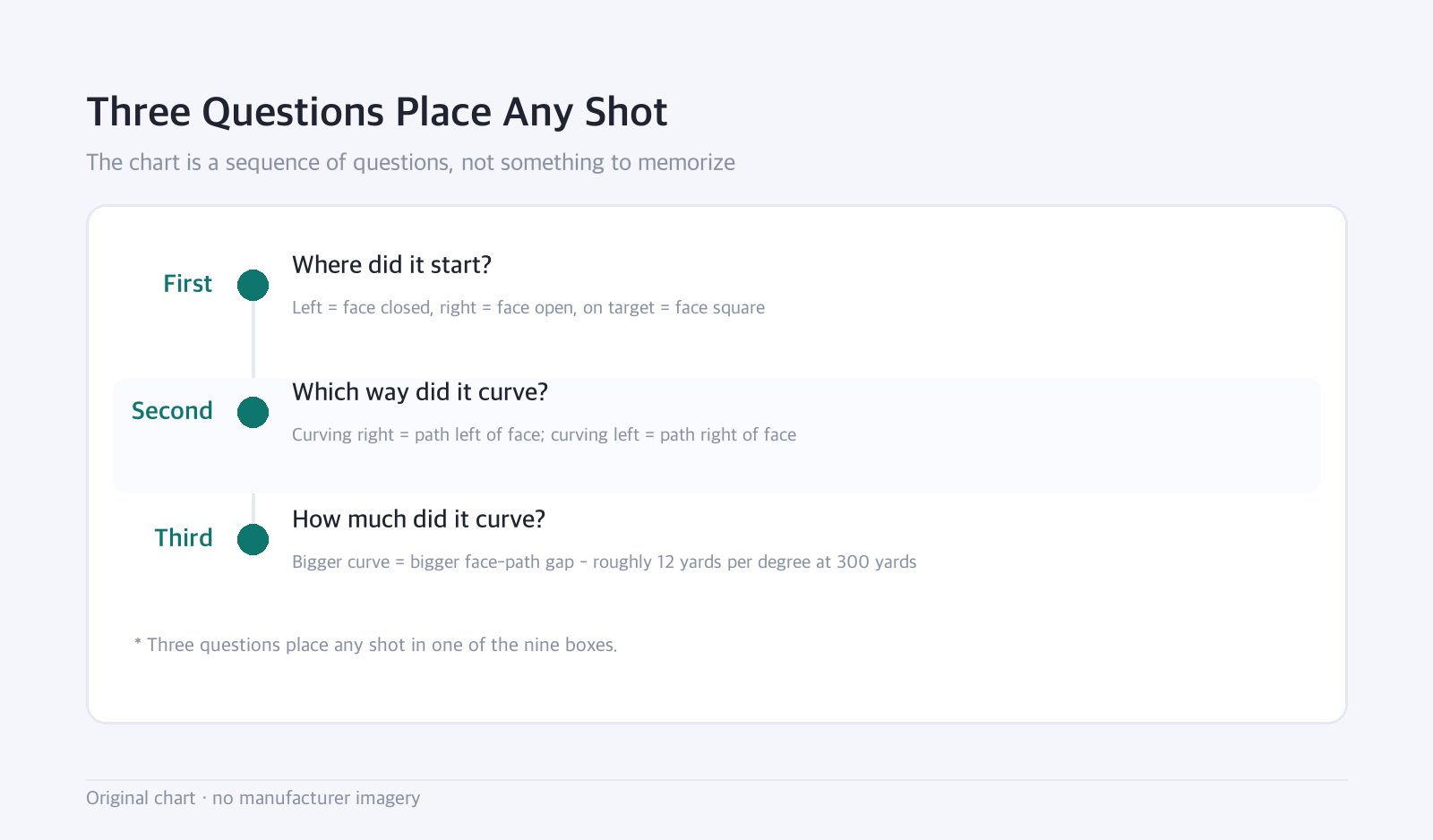
The chart isn't something to memorize — it's a sequence of questions.
First, where did it start? Left means the face was closed, right means it was open, on-target means it matched.
Second, which way did it curve? Curving right means the path was left of the face; curving left means the path was right of the face.
Third, how much did it curve? A big curve means a big gap between the two. As a rough guide covered separately: roughly 1 degree equals about 12 yards over a 300-yard carry. A 30-yard curve is not a small gap.
Those three questions place any shot in one of the nine boxes. The chart doesn't need to be memorized.
6. Who this is useful for
- Golfers who've seen this chart before — the box names are unchanged, but the cause behind each one has moved.
- Golfers trying to hit a draw and getting a hook — the two live in different boxes, and that's the starting point for sorting them out.
- Golfers keeping a practice log — logging starting direction instead of "went right" makes patterns visible.
- Golfers talking to an instructor — naming the starting direction speeds up diagnosis.
This is less useful for:
- Golfers whose shots land in all nine boxes over one round — with no consistent pattern, the chart doesn't read cleanly. Contact location is worth checking first.
- Golfers working on the short game — this chart concerns full-swing shot shapes.
7. What we could not confirm
- When the nine-window chart was first drawn up — we could not trace its origin.
- Whether the English names for each box are used consistently — usage varies by source.
- The actual distribution of amateur misses across the nine boxes — no statistics turned up.
- How the distribution differs by club — a separate piece looks at the physical reasons for driver-versus-iron differences.
In one line
The nine boxes are unchanged, but what fills each one has moved.
Once the axes are corrected to face angle and the face-path gap, three questions — where it started, which way it curved, and by how much — place any shot in its box.
The most commonly misread box is a slice that starts left and curves sharply right. That ball's face was not open. It was closed.
This piece summarizes general instruction concepts and is not personalized coaching advice. Ball flight fixes depend on individual swing mechanics — a launch monitor session or certified instructor can confirm what applies to you.