
One piece in this series turns to a person rather than a mechanism.
Ben Hogan. And a line he left behind about the hook.
This piece is unusual for the series for one reason: the well-known golf stories we've fact-checked so far mostly had no documentary backing. This one does.
1. The track record so far
We've checked three widely repeated golf stories elsewhere in this work.
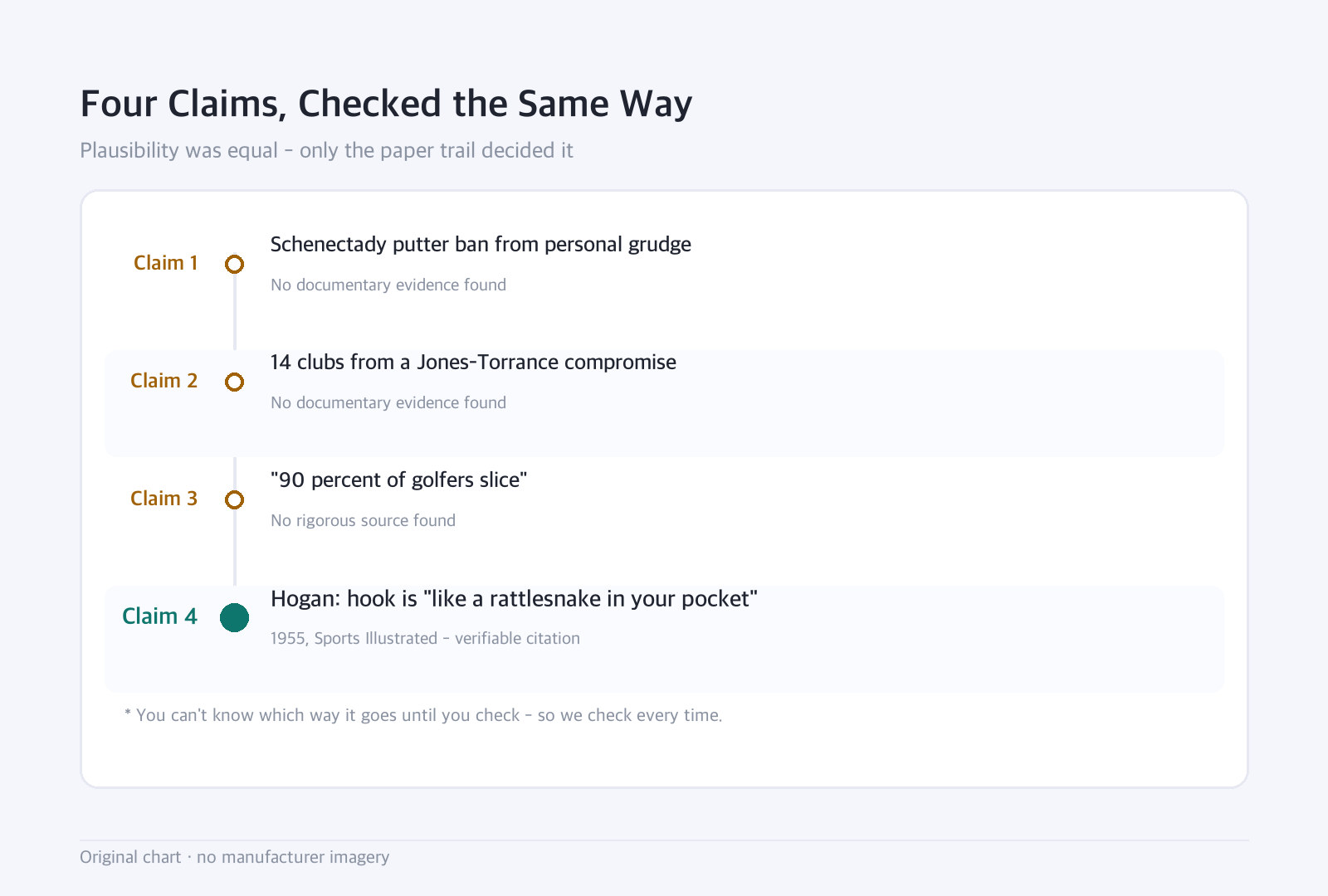
- The theory that the Schenectady putter ban stemmed from personal grudge — no documentary evidence found.
- The theory that 14 clubs came from a Bobby Jones / Tony Torrance compromise — no documentary evidence found.
- The claim that "90 percent of golfers slice" — no rigorous source found.
Three times in a row, the backing wasn't there. So we went in with the same expectation this time.
This time, it was there.
2. 1955, Sports Illustrated
Hogan discussed the hook in a 1955 Sports Illustrated interview.
One line from it is still quoted today. He described the hook as "like a rattlesnake in your pocket."
The publication and year are specific, and the quote is documented. A verifiable citation.
Worth noting: the difference between the first three claims and this one wasn't how plausible each one sounded. All four sounded plausible. The difference was whether it actually turned up when checked.
You can't know which way it goes until you check. So we check every time.
3. Why he disliked it so much
The language is charged. There's a reason.
Hogan reportedly went through a period of struggling with the hook himself.
And the swing he later built was reportedly structured to rule out the left side — from the left hand and wrist positioning onward, the whole setup is said to have been built to produce a fade, not a hook.
From here on, this is interpretation, and we're separating it out as such.
What's confirmed: Hogan described the hook in strongly negative terms, and his swing was fade-oriented.
The interpretation: for a competitive player, a hook isn't just a ball going left. It's a shot that's hard to predict. A hook launches low and moves more after landing. Where it stops is harder to calculate.
For someone whose livelihood depends on every stroke, a miss you can't calculate is worse than one that's simply off-line.
4. But don't carry this over as a general rule
Worth being careful here.
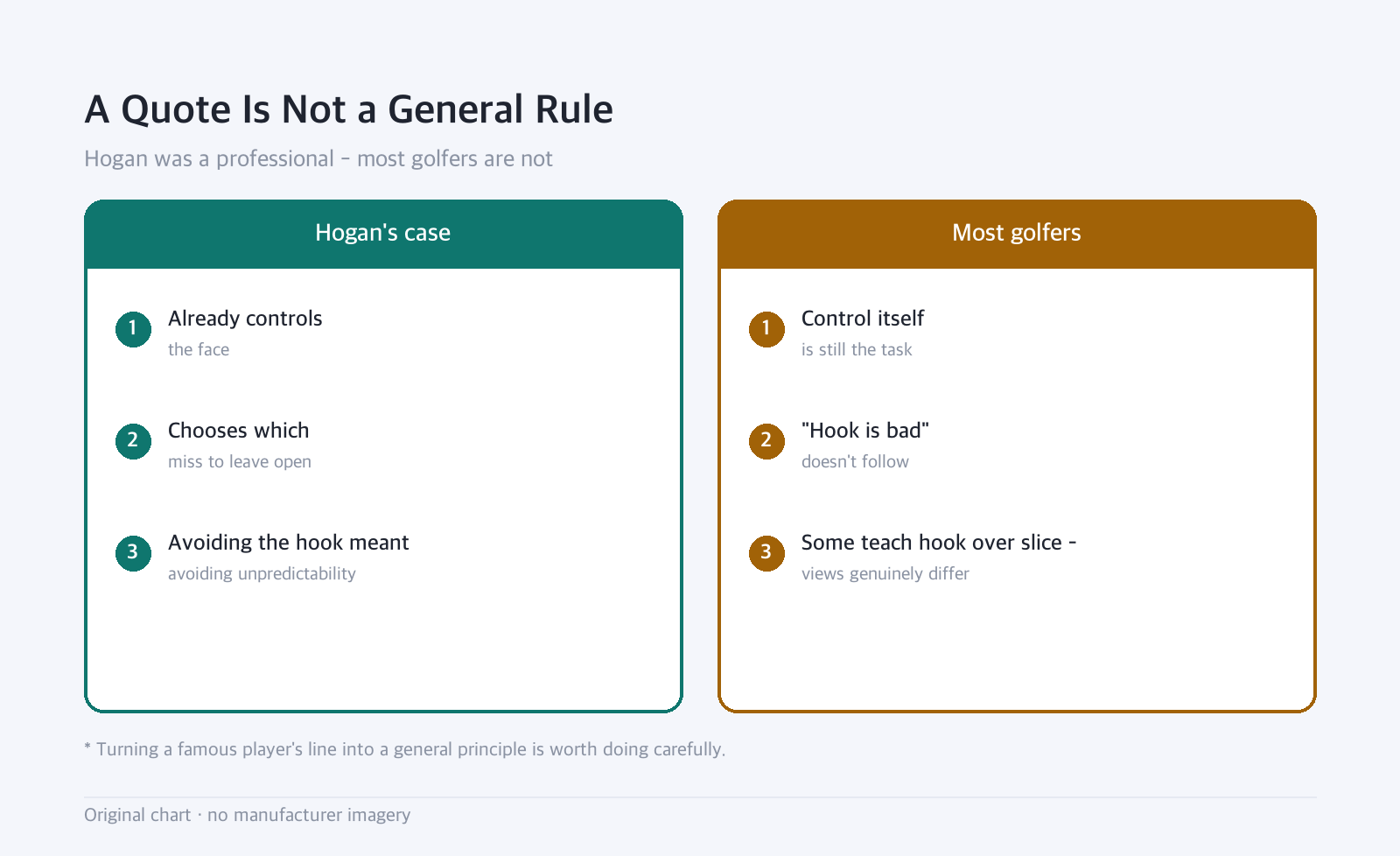
Hogan was a professional. Most golfers are not.
A professional's miss and an amateur's miss are different problems. A professional can already control the face, and chooses, from that baseline, which miss to leave available. For an amateur, control itself is still the task.
So "Hogan hated the hook, therefore the hook is bad" doesn't follow.
As covered separately, left-curving shots include the draw. And within teaching circles, there's a view that a hook is a better miss than a slice — the reasoning being that it at least indicates the player is releasing the club. Others disagree.
Neither view is something to settle here. But turning a famous person's line into a general principle is worth doing carefully.
5. What's worth keeping from this
Even so, one thing is worth taking from this story.
Misses come in different kinds, and some are easier to calculate than others.
Hogan avoiding the hook looks less like a dislike of the left side and more like avoiding unpredictability. That framing applies to amateurs too.
Choosing which miss to leave available is something players actually do as skill develops. And the basis for that choice isn't "which is better" — it's "which is more predictable."
A separate piece looks at why the hook is harder to calculate, from a physics standpoint.
6. Who this is useful for
- Golfers who often encounter golf quotes — some are sourced, some aren't, and they're mixed together.
- Golfers curious whether a hook or a slice is the "better" miss — opinions differ and it's conditional.
- Golfers new to the idea of managing which miss to leave available — choosing your miss direction is itself a skill.
This is less useful for:
- Golfers currently trying to fix a hook — this piece is background; the fixes are covered elsewhere.
- Golfers looking for swing theory — Hogan's swing mechanics themselves are outside the scope here.
7. What we could not confirm
- The full context of the interview — we did not confirm what surrounded the quoted line.
- The specific years of Hogan's own struggle with the hook.
- The primary source behind the claim that Hogan's swing was fade-oriented — widely repeated, but we did not confirm it against original material.
- Which miss actually costs more strokes, hook or slice — opinions diverge and we found no statistics.
In one line
This quote turned out to be real. 1955, Sports Illustrated — a specific publication, a specific year.
Unlike the first three cases, the difference wasn't how plausible the story sounded. It was whether it actually checked out. So we check every time.
And Hogan's avoidance of the hook looks less like disliking the left side and more like avoiding what he couldn't calculate. A separate piece looks at that physics.
This piece summarizes general instruction concepts and is not personalized coaching advice. Ball flight fixes depend on individual swing mechanics — a launch monitor session or certified instructor can confirm what applies to you.