
The limit is fourteen clubs — not ten, not fifteen. Fourteen.
We looked into where that number came from.
There is no settled answer. One story circulates widely, and there is no documentary evidence behind it.
1. Theory one — it came from a standard set composition
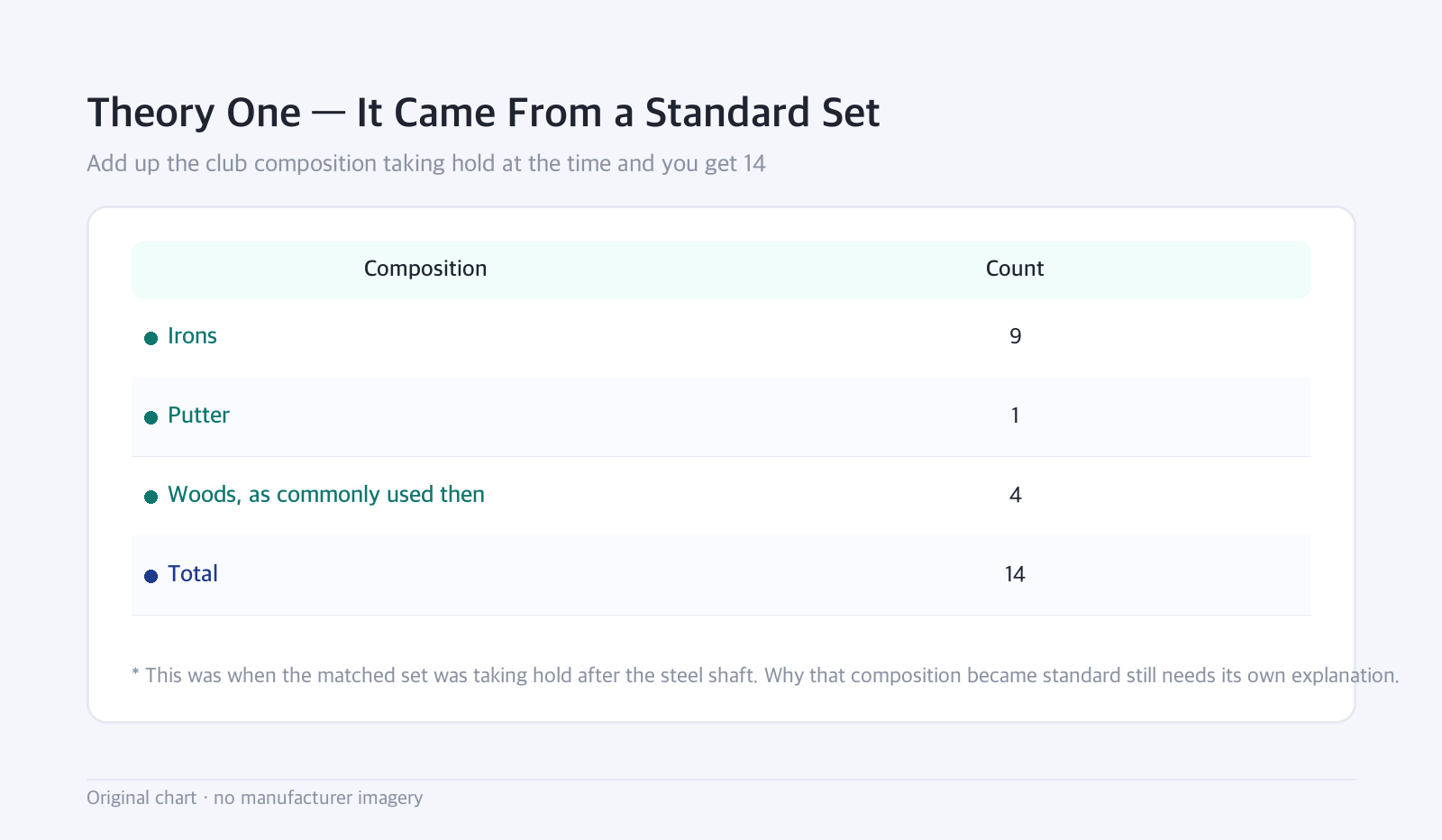
The first explanation works by addition.
The club composition that was becoming standard at the time adds up like this:
- 9 irons
- 1 putter
- 4 woods, as commonly used then
Total: 14.
This was the period when the matched set was taking hold, following the adoption of the steel shaft — nine irons as a coordinated set was becoming the norm.
The theory holds that this standard composition simply became the ceiling.
It's a clean explanation. But it still leaves open why that particular composition became standard in the first place.
2. Theory two — a conversation between two people
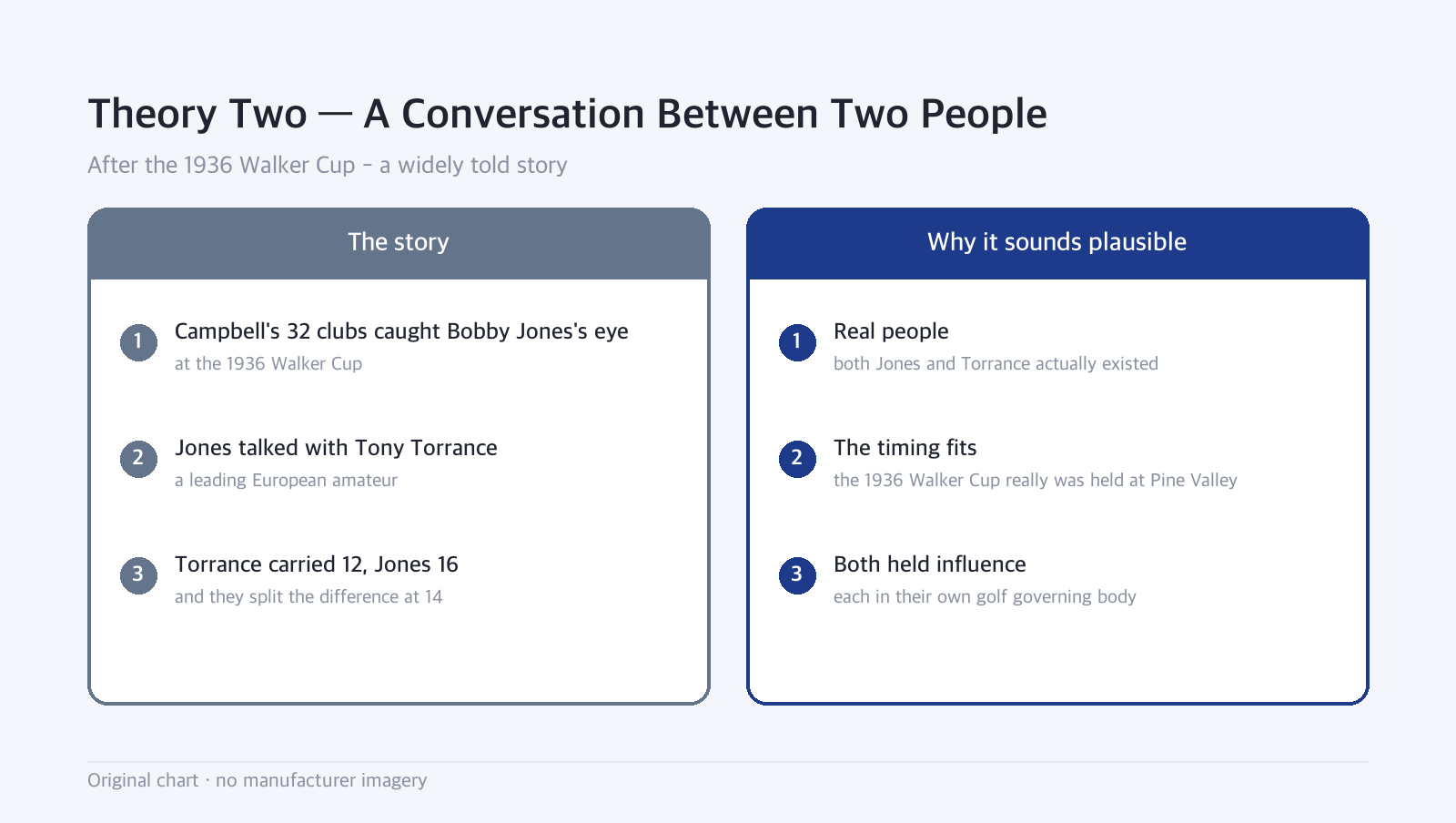
The second is the widely told story.
At the 1936 Walker Cup, American player Scotty Campbell was carrying thirty-two clubs — the same match where his bag drew notice, as covered separately — and it reportedly caught Bobby Jones's attention.
After the event, Jones is said to have talked with Tony Torrance, a leading European amateur of the time.
The two compared how many clubs they each carried:
- Torrance — 12
- Jones — 16
And, the story goes, they split the difference at 14.
It's a well-constructed story — real people, the right period, and both men held influence in their respective golf governing bodies at the time.
3. But there is no documentary evidence
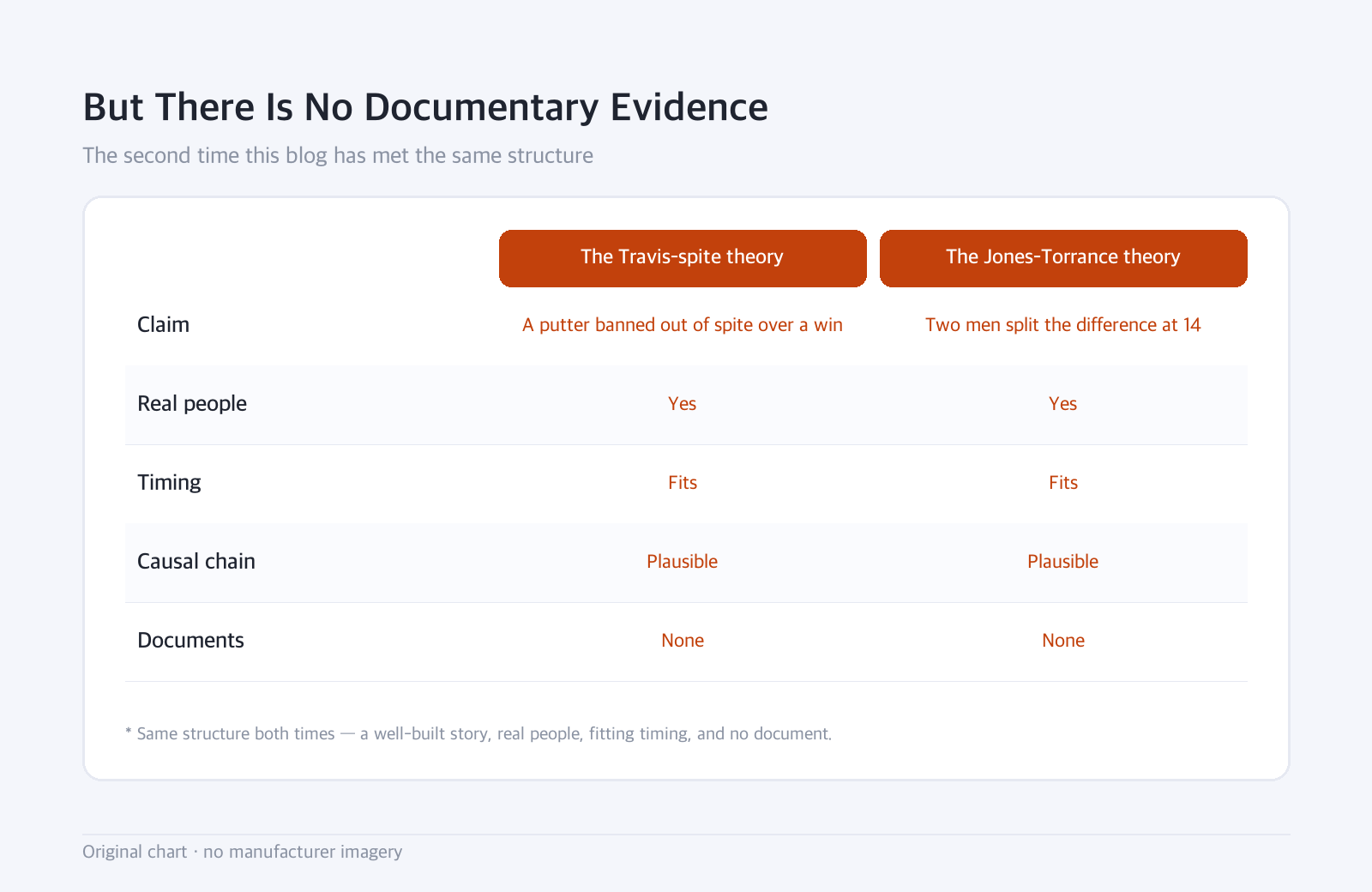
Sources covering this story converge on the same point.
There is no documentary evidence backing the Jones–Torrance conversation.
That both men held influential positions is true. But any record that the conversation happened, and that it led to the rule, has not been confirmed.
A similar case turns up elsewhere in golf history: the claim that a 1910 putter ban stemmed from personal spite over an American's win at a British championship — that story also lacks supporting evidence.
The two stories share a structure:
- A real person is named
- The timing lines up
- The causal chain sounds plausible
- But there's no document
4. Why do stories like this keep appearing
From here on this is inference, marked as such.
Rules rarely come with an explanation attached. A rule text says "you may not carry more than 14" — it doesn't say why. Law generally doesn't explain its own reasoning.
But people want a reason. A story fills the gap where an explanation is missing.
And the better story survives. "A committee reviewed several proposals and settled on 14" is less memorable than "two legends split the difference over a conversation."
This paragraph is inference, not something we're presenting as confirmed fact.
5. What's confirmed and what isn't
Confirmed:
- Scotty Campbell was carrying 32 clubs at the 1936 Walker Cup
- Lawson Little carried up to 30 clubs
- The 1935 U.S. Open field averaged 18 clubs
- The 14-club limit was written into the rules — and the two governing bodies did not start it together. It took effect at the USGA on 1 January 1938 and at the R&A on 1 May 1939, a gap of about sixteen months
- Jones and Torrance both held influence in their era's golf governing bodies
Not confirmed:
- Whether the conversation between the two actually took place
- Whether that conversation influenced the rule decision
- How the number 14 was actually decided
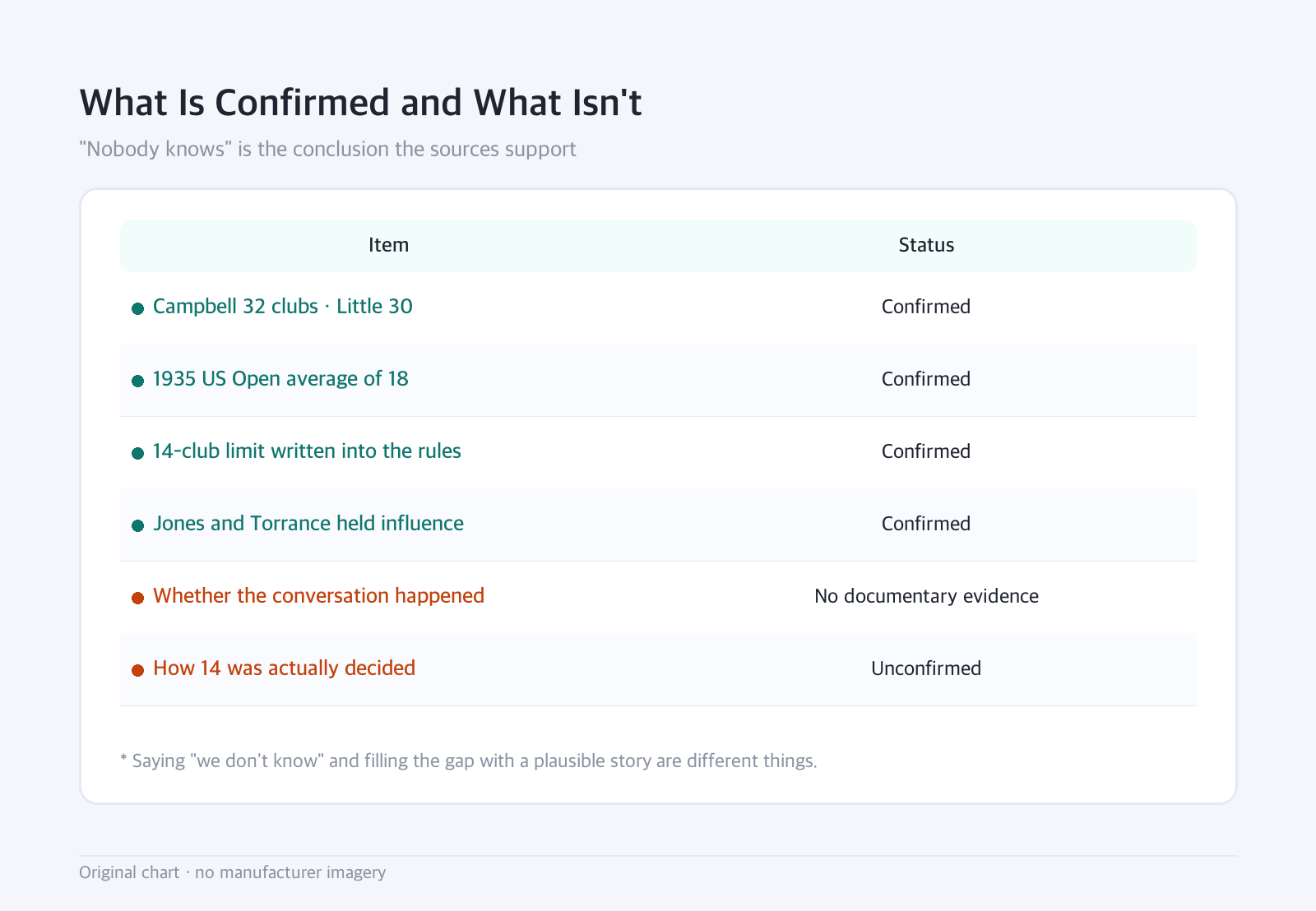
"Nobody knows" is the conclusion the sources support. Multiple sources state it that way.
That can look like an unsatisfying answer. But saying "we don't know" and filling the gap with a plausible-sounding story are different things. The story is easier to read, but it can be wrong.
6. Who this is useful for
- Golfers curious about the number 14 — there's no settled answer, only two competing accounts.
- Golfers who enjoy golf history — a well-constructed story and a confirmed fact aren't the same thing.
- Golfers looking for the rationale behind a rule — rule text usually doesn't state its reasoning.
- Golfers who've heard "Bobby Jones decided it" — that claim comes with a documented lack of evidence.
Less useful for:
- Golfers who want a practical answer — not knowing why fourteen doesn't stop you from deciding how to fill fourteen slots.
- Anyone who just enjoys the story — this kind of scrutiny takes the fun out of it.
7. What we could not confirm
- Any meeting minutes or official record settling on 14 — this would answer the question directly, and we could not find one.
- The original source of the Jones–Torrance story — we could not confirm when it first circulated.
- Other numbers considered at the time — whether 12 or 16 were candidates, unconfirmed.
- The basis for the set-composition theory — when nine irons became standard, unconfirmed.
- Any statement from either man himself — whether either commented on this directly, unconfirmed.
This piece does not prove the Jones–Torrance story false. It goes only as far as: no documentary evidence supporting the claim could be found.
In one line
Why fourteen? Nobody knows for certain.
Two explanations circulate: a set-composition theory (9 irons + 1 putter + 4 woods = 14), and a conversation theory (Bobby Jones at 16, Tony Torrance at 12, splitting the difference after the 1936 Walker Cup).
The second story has no documentary evidence behind it — the same structure as other unverified golf-history claims.
Rules rarely state their own reasoning, and stories fill the space where explanation is missing.
This piece goes as far as separating what's confirmed from what isn't — no further.
This piece summarizes general instruction concepts and is not personalized coaching advice. Ball flight fixes depend on individual swing mechanics — a launch monitor session or certified instructor can confirm what applies to you.