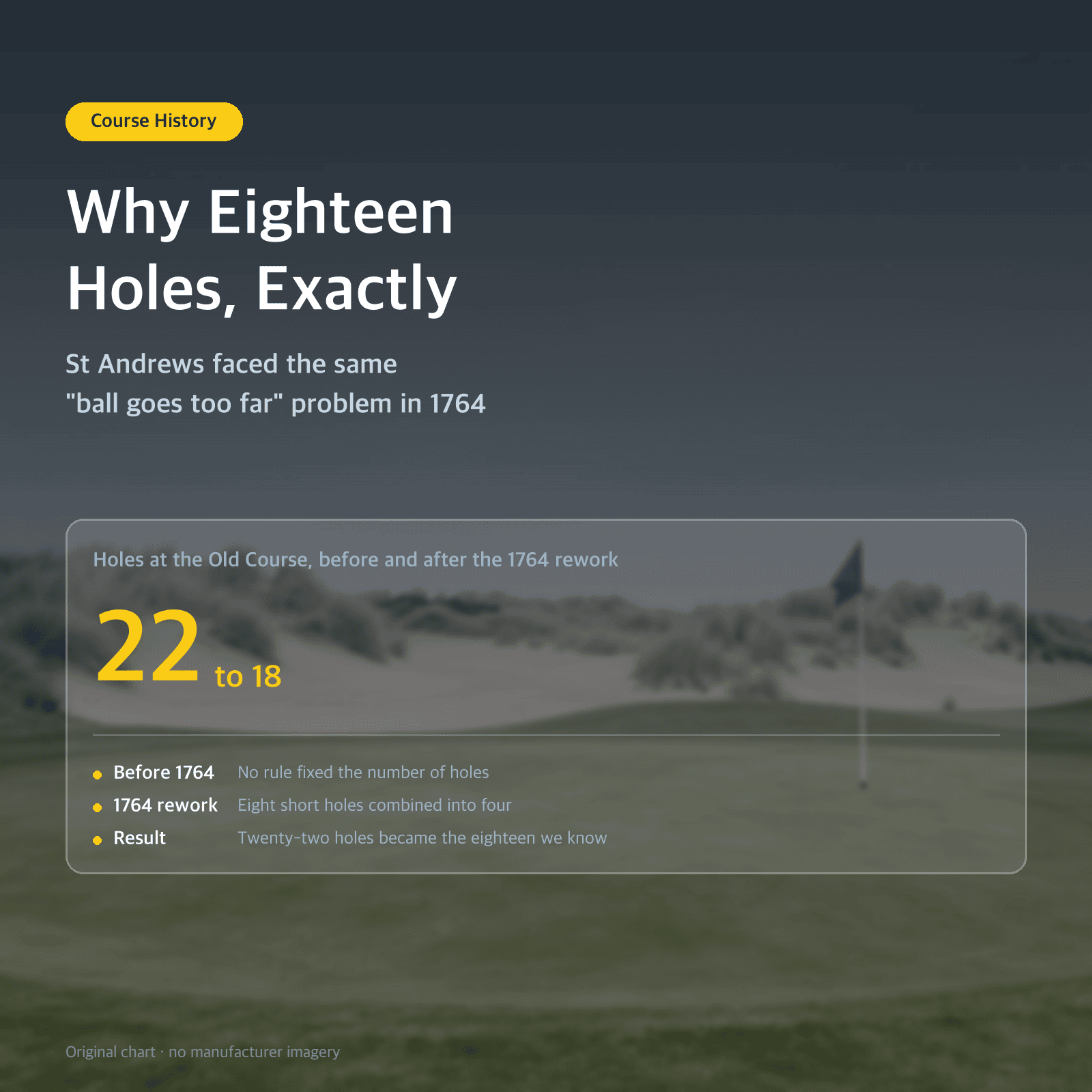
One of the most common debates in golf right now is that the ball goes too far. In 2023, a rollback of the ball itself was announced.
It looks like a new problem. But tracing the record back, it isn't.
The same problem existed in 1764. And the response back then is what gave us eighteen holes — something we now take for granted.
1. It started as twenty-two holes
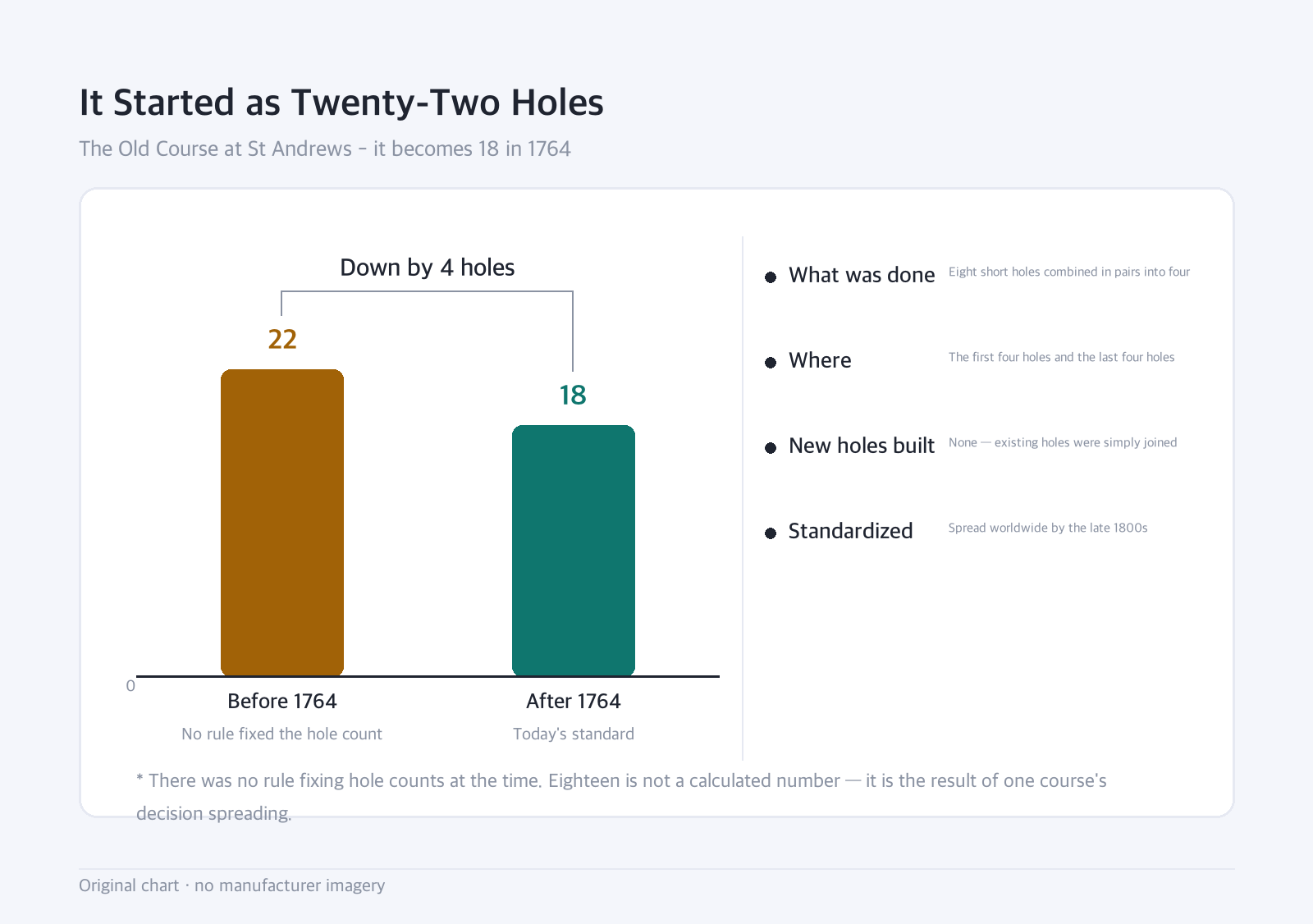
The Old Course at St Andrews wasn't eighteen holes from the start. It was twenty-two.
That looks strange by today's standard, but at the time there was no rule fixing the number of holes. Courses were built to fit the land, and the hole count varied accordingly.
Eighteen holes became standard not because a rule said so, but because one course's decision spread.
2. 1764 — holes get combined
In 1764, the Society of St Andrews Golfers reworked the course.
Here's how:
- The first four holes and the last four holes were judged too short.
- Those eight holes were combined in pairs into four longer holes.
- Two on the way out, two on the way back.
Twenty-two holes minus four became eighteen.
The math checks out: eight short holes reduced to four means four holes disappear. Twenty-two minus four is eighteen.
No new holes were built. Existing holes were simply joined.
3. Why did they feel short
This is the part worth pausing on.
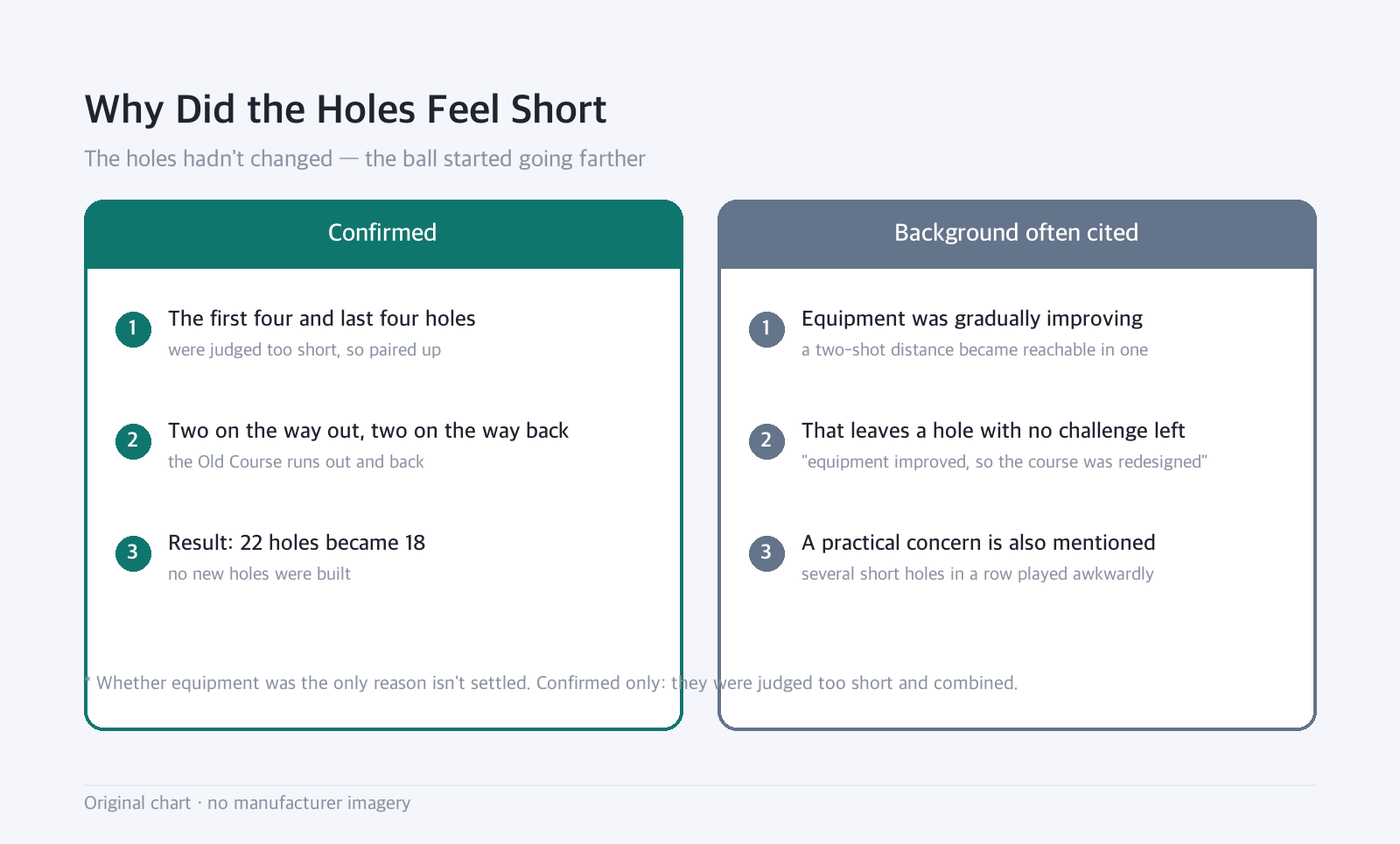
The holes hadn't gotten shorter. The holes stayed the same — the ball started going farther.
This was a period when golf equipment was gradually improving. As clubs and balls got better, distances that once took two shots could be covered in one. A hole like that stops presenting any challenge.
Equipment improvement driving a course redesign is the explanation that follows from this. Whether it was the only reason is harder to settle — a practical concern about several short holes in a row being inconvenient to play also gets mentioned.
What's confirmed is only that the holes were judged too short and were combined.
Worth adding: the Old Course at St Andrews runs out and back — you play to one end and return along the same strip of land. That means the first four holes and the last four are, in effect, the same ground played in opposite directions. Reworking that stretch changes the outward and inward nines together, which is why the record describes it as "two out, two in."
4. And it became the standard
St Andrews switching to eighteen holes didn't mean other courses followed immediately.
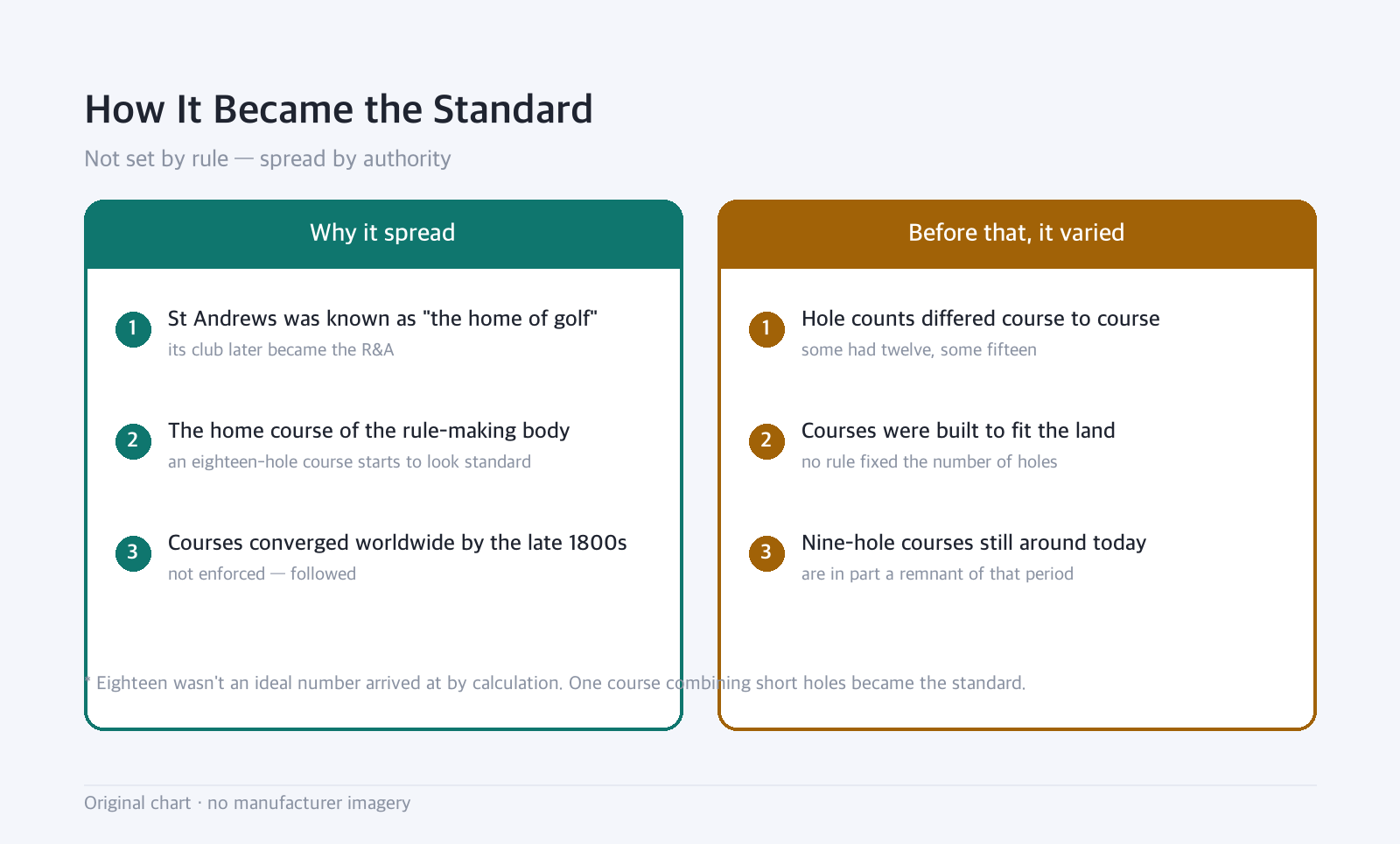
For a while, hole counts stayed inconsistent from course to course — some had twelve, some fifteen. The nine-hole courses still around today are, in part, a remnant of that period.
What spread it was authority. St Andrews was known as "the home of golf," and the club there later became the R&A. When the organization that governs the rules plays its home course at eighteen holes, that number starts to look like the standard.
By the late 19th century, courses worldwide had converged on eighteen.
So eighteen holes isn't a number arrived at by calculation. It's the result of one course combining its short holes, which then became the standard.
5. The same problem kept coming back
The 1764 response was to change the course. The ball went farther, so the holes were made longer.
The same problem has recurred since, but the response has changed.
- 1898 — a rubber-core ball appears, flying up to 250 yards (229 m). No restriction followed at the time.
- 1998 — the spring effect of driver faces gets capped. Regulation begins to target equipment.
- 2010 — groove specifications on wedges change to reduce spin from the rough.
- 2023 — a rollback of the ball itself is announced.
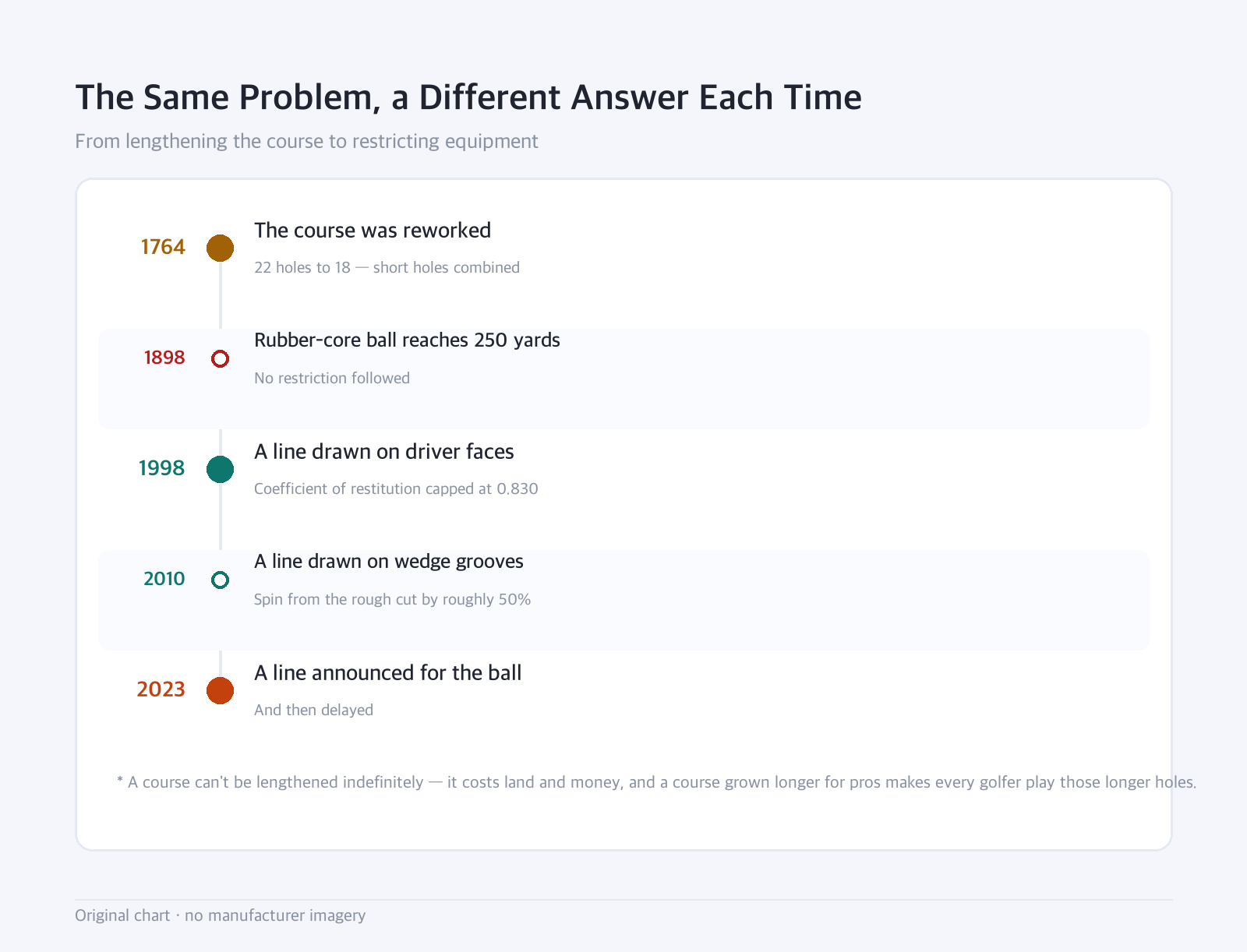
The response shifted from lengthening courses to restricting equipment. Courses can't be extended indefinitely — it takes land, money, and adds to round times.
And lengthening a course means every golfer pays the cost. If pros hit it far and the course grows longer as a result, the weekend golfer on that same course has to play the longer holes too. That's part of why the response shifted toward restricting equipment instead.
6. Who this is useful for
Based on what could be confirmed:
- Golfers following the ball rollback debate — the same problem existed 260 years ago. It isn't a new debate.
- Golfers curious why a round is eighteen holes — it's not a calculated number, it's the result of one course's decision spreading.
- Golfers interested in course design — combining short holes into longer ones was actually used as a method.
- Golfers curious about golf history — the push and pull between equipment, courses, and rules starts here.
This is less useful for:
- Golfers who only need current rules — the number of holes isn't set by rule.
- Golfers who mainly play nine-hole courses — eighteen being standard doesn't rule out other formats.
7. What we could not confirm
- The original record of the 1764 decision — we did not directly examine the society's own documents.
- Exactly which holes were combined with which — we could only confirm "the first four" and "the last four."
- How far balls and clubs actually traveled at the time — no measurement record was found.
- Whether equipment improvement was the only reason — some sources describe it that way, but it isn't settled.
- The specific timeline of how eighteen holes spread to other courses.
- A layout of the course during its twenty-two-hole period.
In one line
Eighteen holes isn't a calculated number. It's the result of St Andrews combining eight short holes into four in 1764, reducing twenty-two holes to eighteen.
Behind it was the problem that the ball was going farther than before — the same problem behind today's ball rollback debate.
What changed is the response. Then, the course was reworked. Now, equipment is restricted.
The dates and events here come only from confirmed sources, and anything unconfirmed is marked as such.
This piece summarizes general instruction concepts and is not personalized coaching advice. Ball flight fixes depend on individual swing mechanics — a launch monitor session or certified instructor can confirm what applies to you.