
Before the 14-club limit existed, players in the 1930s sometimes carried thirty clubs or more, with the average around eighteen.
But why would carrying more clubs be a problem at all? It's the player's own money, and their own bag.
Three concerns were raised at the time, and looking at them now, the three are of quite different character.
1. It reduces the role of skill
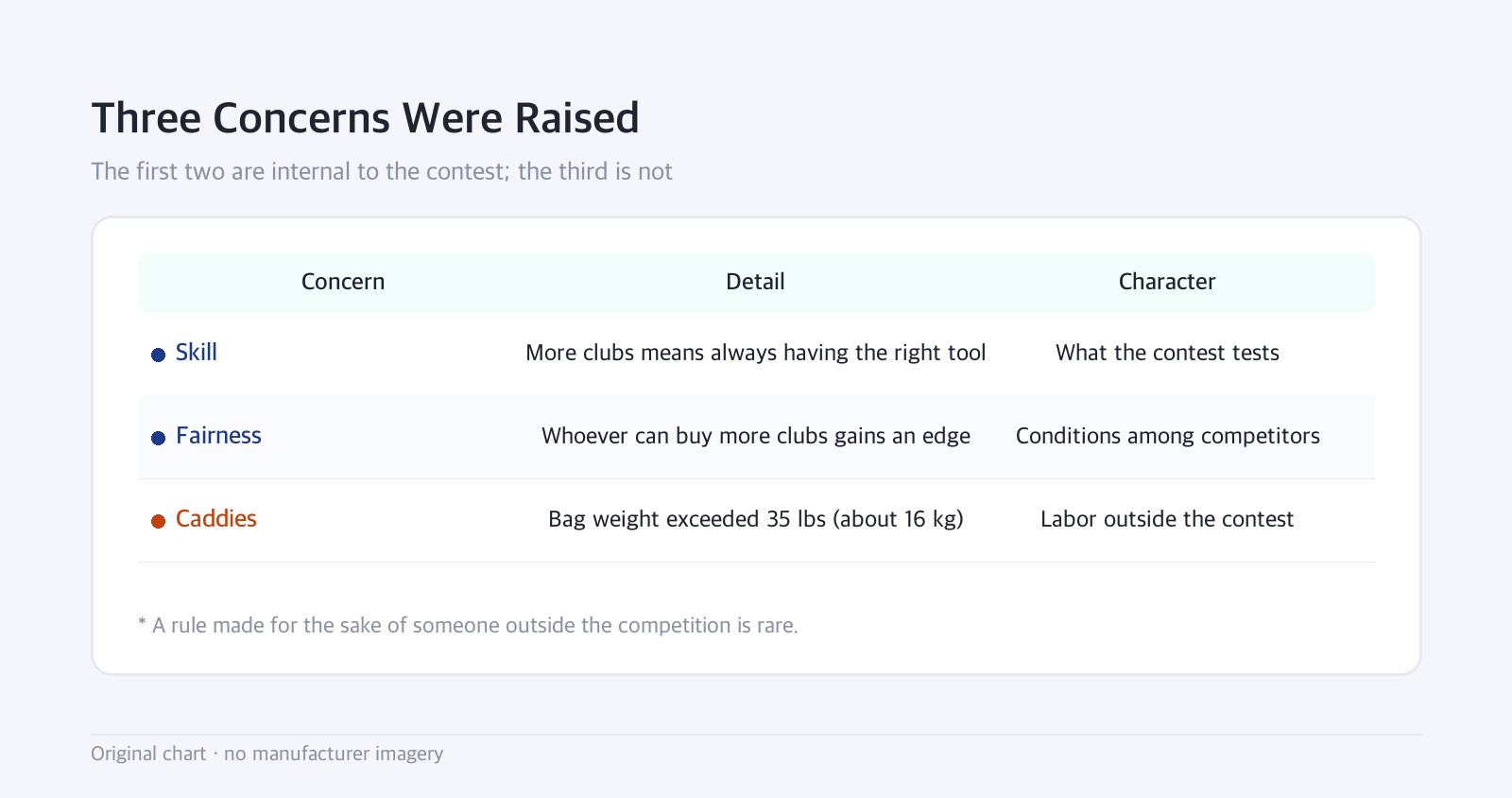
The first concern was about the nature of the game itself.
With many clubs, a player can always pull the exact tool for the situation: a low club to go under a tree, a specific club to clear a high bunker lip.
With fewer clubs, a player has to solve the situation with what they have — adjusting the swing, the ball position, or the shot shape when the loft isn't a perfect match.
Rule-makers decided the latter is golf — a contest of what you can do with the tools you have, not a contest of tool selection.
This judgment is still debatable: choosing clubs well is arguably also a skill. But that's the call that was made, and it has held since.
2. It favors wealthier golfers
The second concern was about fairness.
Clubs cost money. Equipping thirty clubs costs more than twice what fourteen does.
Without a limit, whoever can spend more gains an edge. Two players of equal skill could differ simply in equipment count.
This concern is interesting for one reason: golf was already an expensive sport. In the featherie-ball era, a single ball could cost more than a club. Even so, "wealthier players gaining an advantage" was treated as a problem worth fixing.
In other words, fairness within the competition and access to the game itself were treated as separate issues. The logic was that, among those who made it to the event, conditions should be equal.
3. Caddie bags exceeded 35 pounds
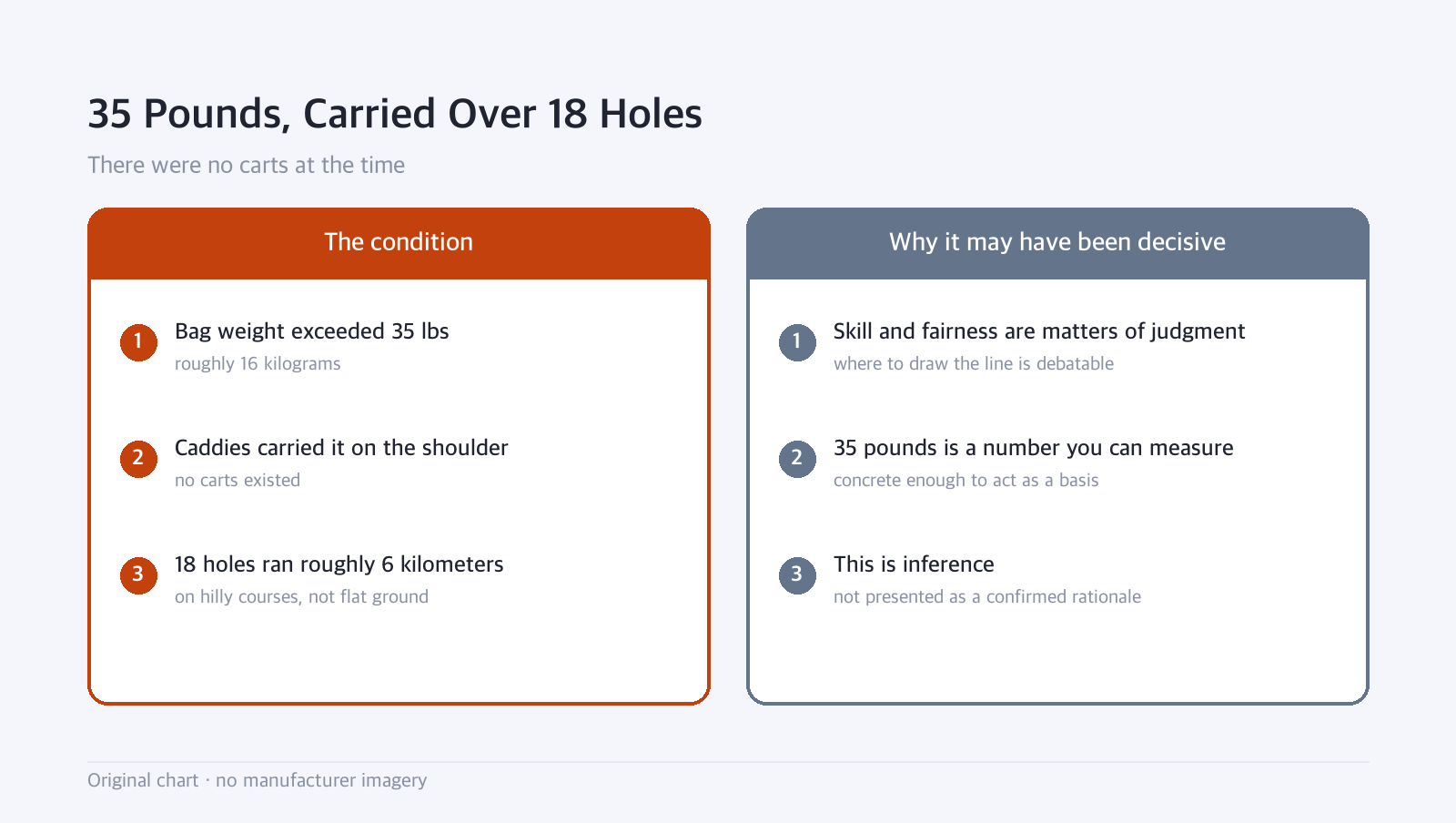
The third concern was different in kind — it was about people, not the contest.
More clubs meant heavier bags. Records from the period cite bags exceeding 35 pounds — roughly 16 kilograms.
There were no carts. Caddies carried that weight on their shoulders for 18 holes.
That's 16 kilograms carried over roughly 6 kilometers — not on flat ground, but on courses with hills, and sometimes multiple rounds in a day.
This is a case of a competition rule made for a reason outside the competition. Skill and fairness are concerns internal to the contest; the caddie's burden is not.
4. Three concerns, three different characters
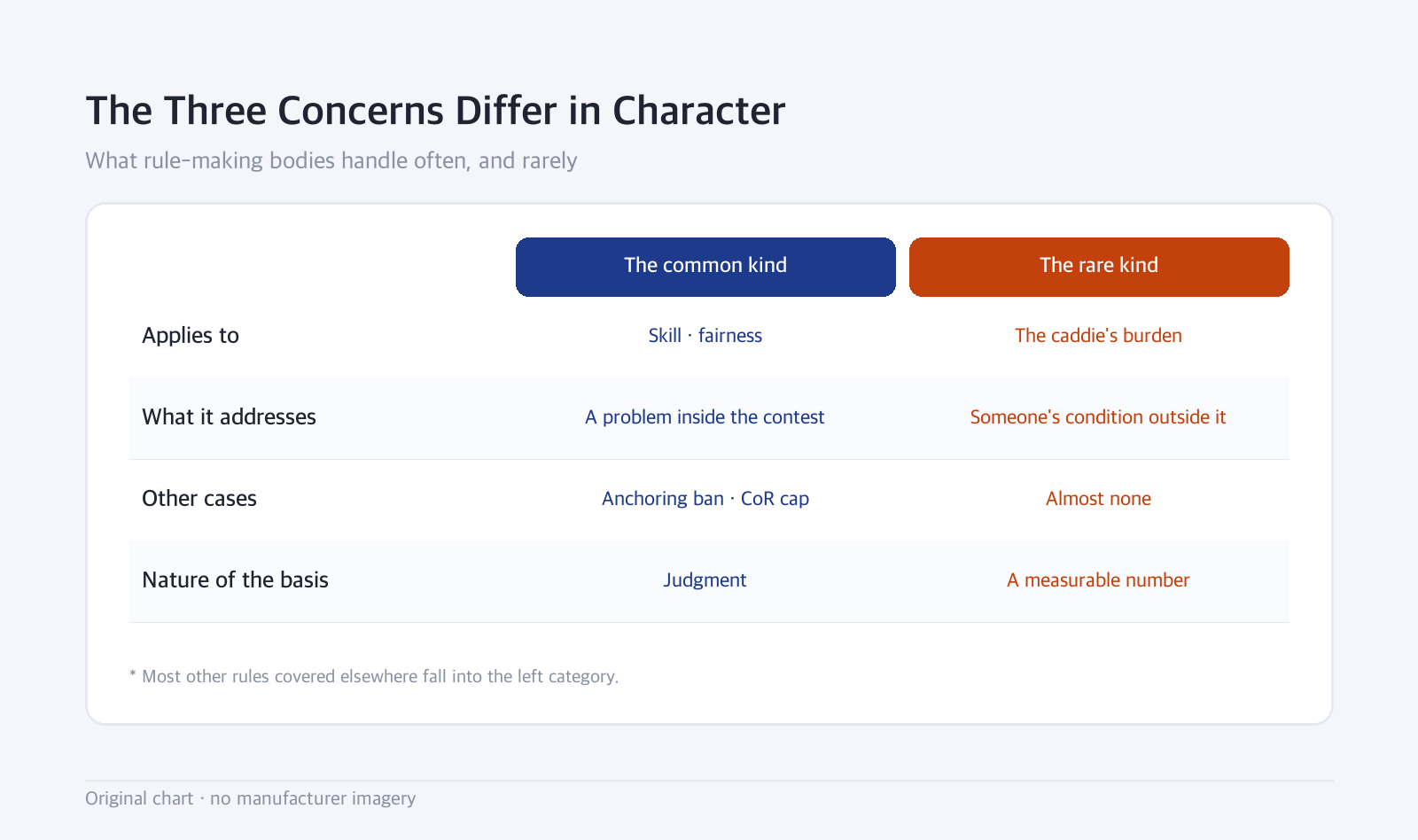
To summarize:
- Skill — a judgment about what the game is supposed to test
- Fairness — a matter of equalizing conditions among competitors
- Caddies — a labor condition for someone outside the contest
The first two are the kind of thing rule-making bodies routinely address. Bans such as the anchoring rule or the coefficient-of-restitution cap fall into the same two categories.
The third is rare. Rules made for the sake of someone outside the competition itself are uncommon.
Yet the third was probably the most concrete of the three. Skill and fairness are matters of judgment, but 35 pounds is a number you can measure.
That last point is inference, not something we could confirm as documented rationale.
The rule that settled these concerns did not land in both places at once. The 14-club limit took effect at the USGA on 1 January 1938 and at the R&A on 1 May 1939 — roughly sixteen months apart. Whatever weight each body gave the three concerns, they did not act on the same timetable.
5. Do these concerns still hold today
Checked against today's conditions:
Skill — still holds. Working with fourteen clubs for every situation is the same condition it always was.
Fairness — partly holds. Club count is now equal, but differences remain in club quality and fitting. The simplest gap — sheer number — was removed.
Caddies — the condition has changed. Carts are now common, and fewer players carry their own bag by hand.
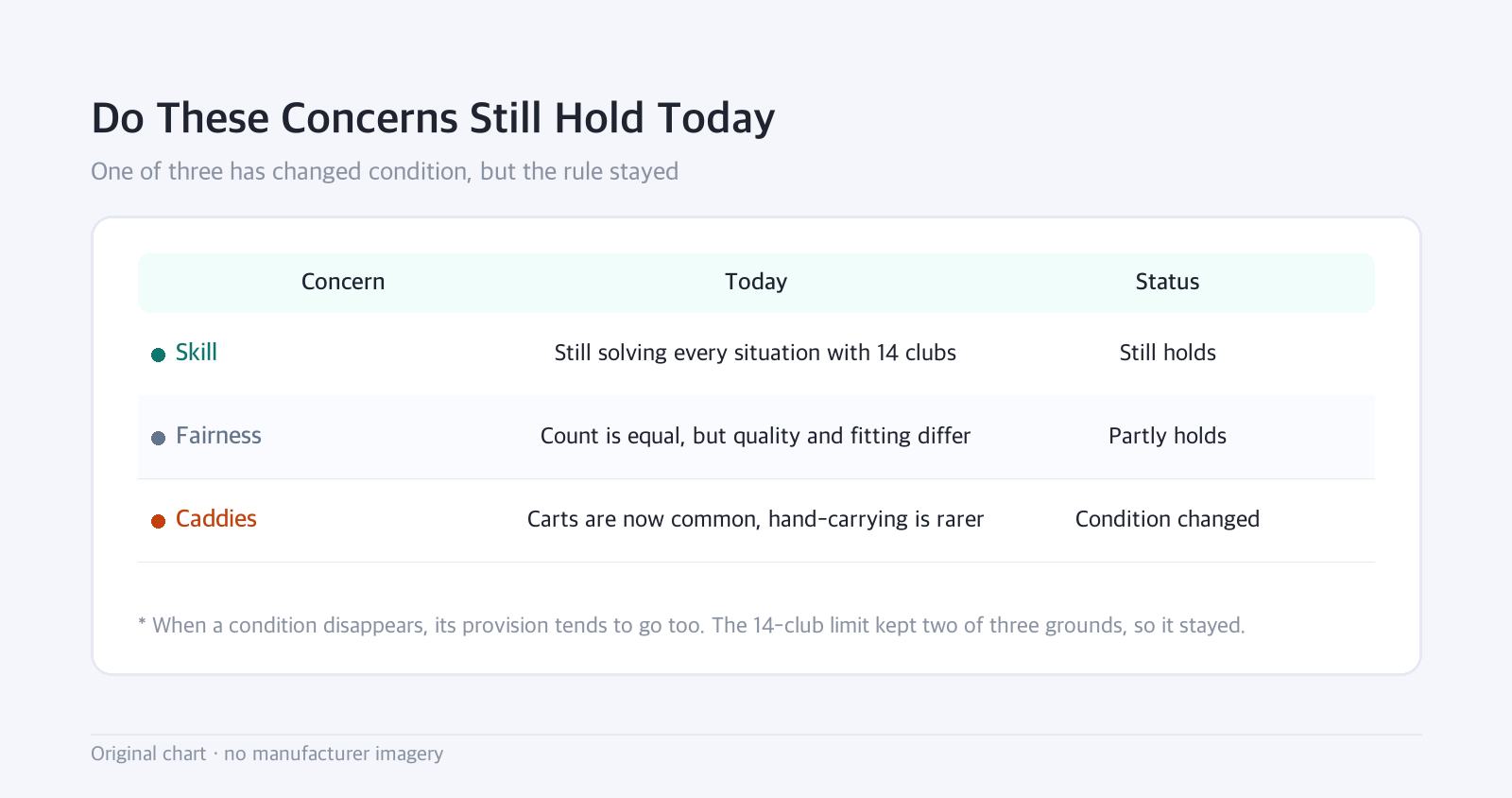
One of the three original conditions has changed, but the rule remains. This tracks a pattern seen elsewhere in golf rule-making: when the underlying condition disappears, the specific provision tends to go with it, while provisions rooted in a broader principle tend to survive. The 14-club limit falls in the surviving category.
Even with one of three grounds gone, the other two remain, so the provision stays. And once a number is settled, changing it carries its own cost.
6. Who this is useful for
- Golfers curious about the rationale for the 14-club limit — two of the three concerns were about the contest, one was about a person.
- Golfers thinking through their bag setup — "solve it with what you have" is the premise behind this rule.
- Golfers curious about the character of golf's rules — this is a rare case of a rule made for a reason outside the competition.
- Golfers who carry their own bag — bag weight was a serious enough issue to shape a rule a century ago.
Less useful for:
- Golfers who just need the current rule — the number fourteen is all that matters practically.
- Golfers who always use a cart — the third concern no longer matches current conditions.
7. What we could not confirm
- The exact wording of the three concerns in any official document — we could confirm the gist, not the original text.
- How the 35-pound figure was measured — average or maximum, unconfirmed.
- Contemporary discussion of caddie working conditions.
- Which concern was decisive — we could confirm only that all three were raised together.
- The counterarguments — we could not confirm the case made by those opposed to a limit.
- The price of a single club and the total cost of a thirty-club set at the time.
In one line
Three concerns drove the club-count limit: it reduced the role of skill, it favored wealthier golfers, and caddie bags exceeded 35 pounds.
The first two are internal to the contest; the third is about someone outside it — a rare basis for a rule.
Today, one of the three has changed: carts now exist. The rule stayed anyway.
The figures here come from confirmed sources; inference is marked as inference.
This piece summarizes general instruction concepts and is not personalized coaching advice. Ball flight fixes depend on individual swing mechanics — a launch monitor session or certified instructor can confirm what applies to you.