
Today the limit is 14 clubs. It's a rule, and breaking it in competition carries a penalty.
But the rule wasn't always there. Until the 1930s, there was no limit at all. Records from the period show what that meant in practice.
1. Lawson Little — thirty clubs
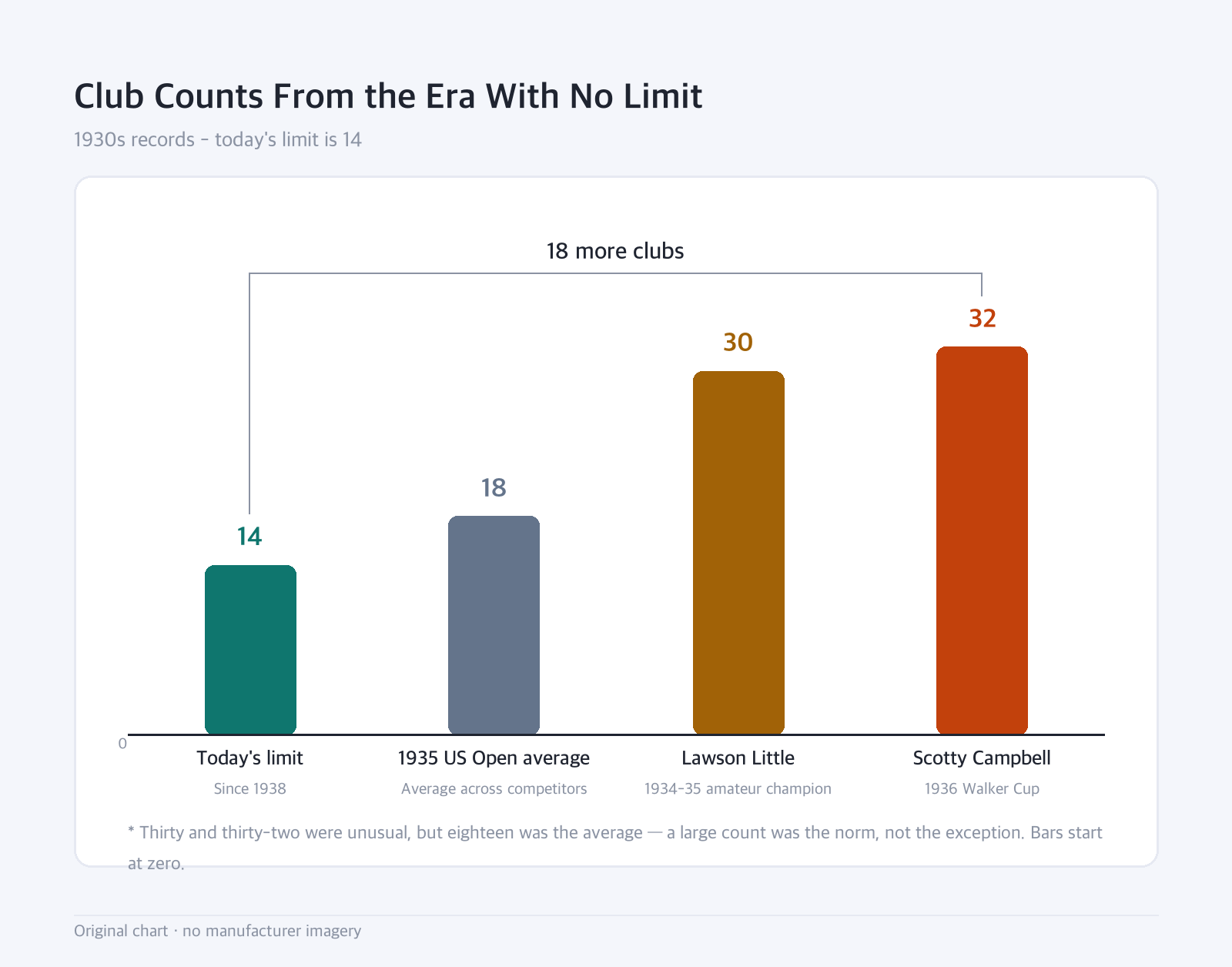
Lawson Little won both the U.S. Amateur and the British Amateur in 1934 and 1935 — as elite an amateur record as existed at the time.
He carried up to thirty clubs.
By today's standard that's hard to picture. Fourteen already fills a bag; this was more than double.
2. The 1936 Walker Cup — thirty-two clubs
An even more extreme case is on record.
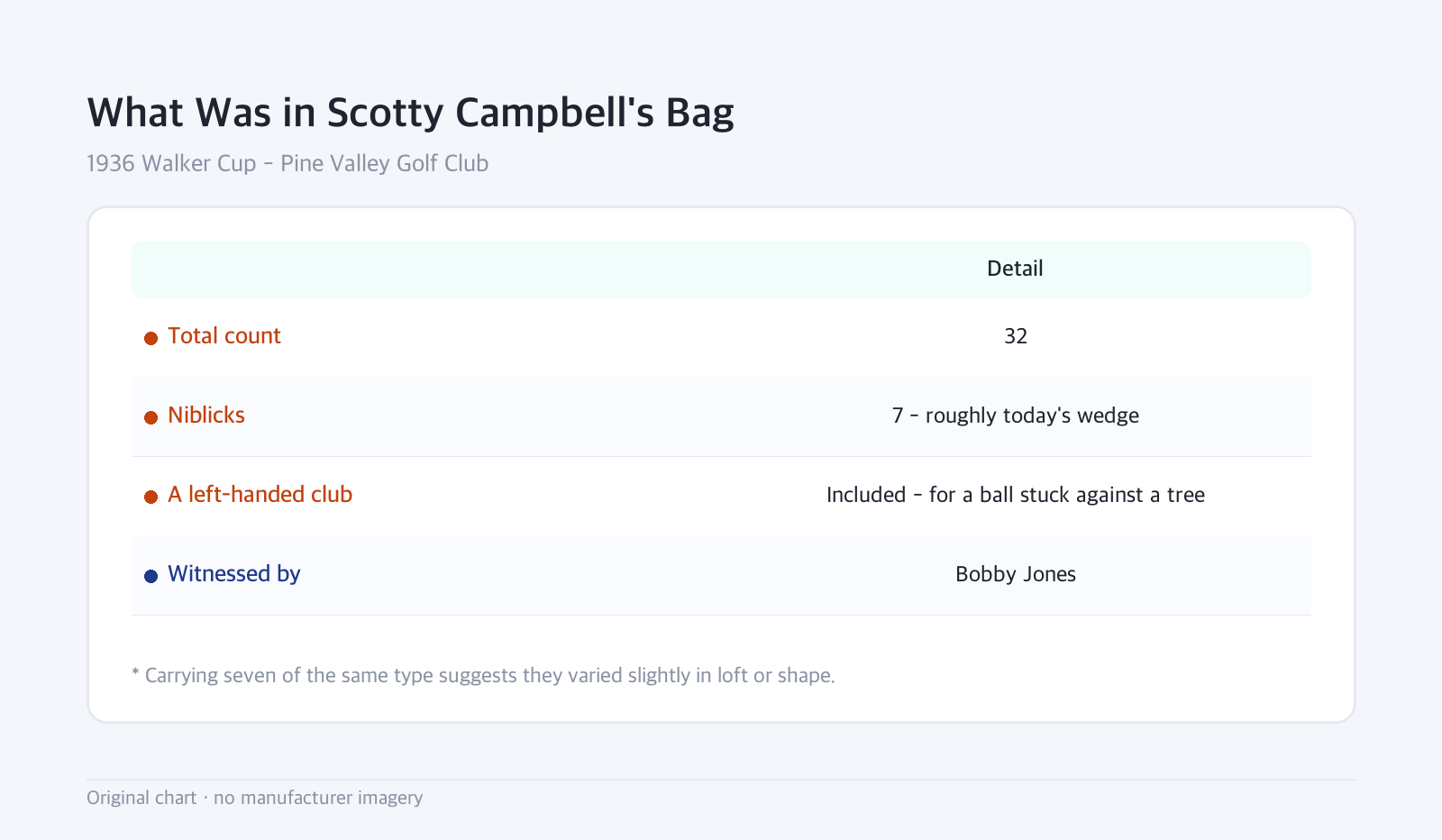
The 1936 Walker Cup was played at Pine Valley Golf Club. American player Scotty Campbell was carrying thirty-two clubs.
The composition is notable.
- It included a left-handed club
- It included seven niblicks
A niblick is roughly today's wedge. Carrying seven of the same type suggests they varied slightly in loft or shape.
The likely reason for the left-handed club: a ball stuck against a tree or obstruction where a right-handed swing wasn't possible. Some players of the era carried a mixed right- and left-handed set for exactly this situation.
3. The average was eighteen
The extreme cases weren't isolated. A broader figure shows the general state of things.
A 1935 U.S. Open survey found the average bag held eighteen clubs.
Thirty or thirty-two clubs was unusual. Eighteen was the average — four more than today's limit of fourteen.
In other words, a large club count wasn't an eccentric few — it was the normal condition.
4. Why this happened
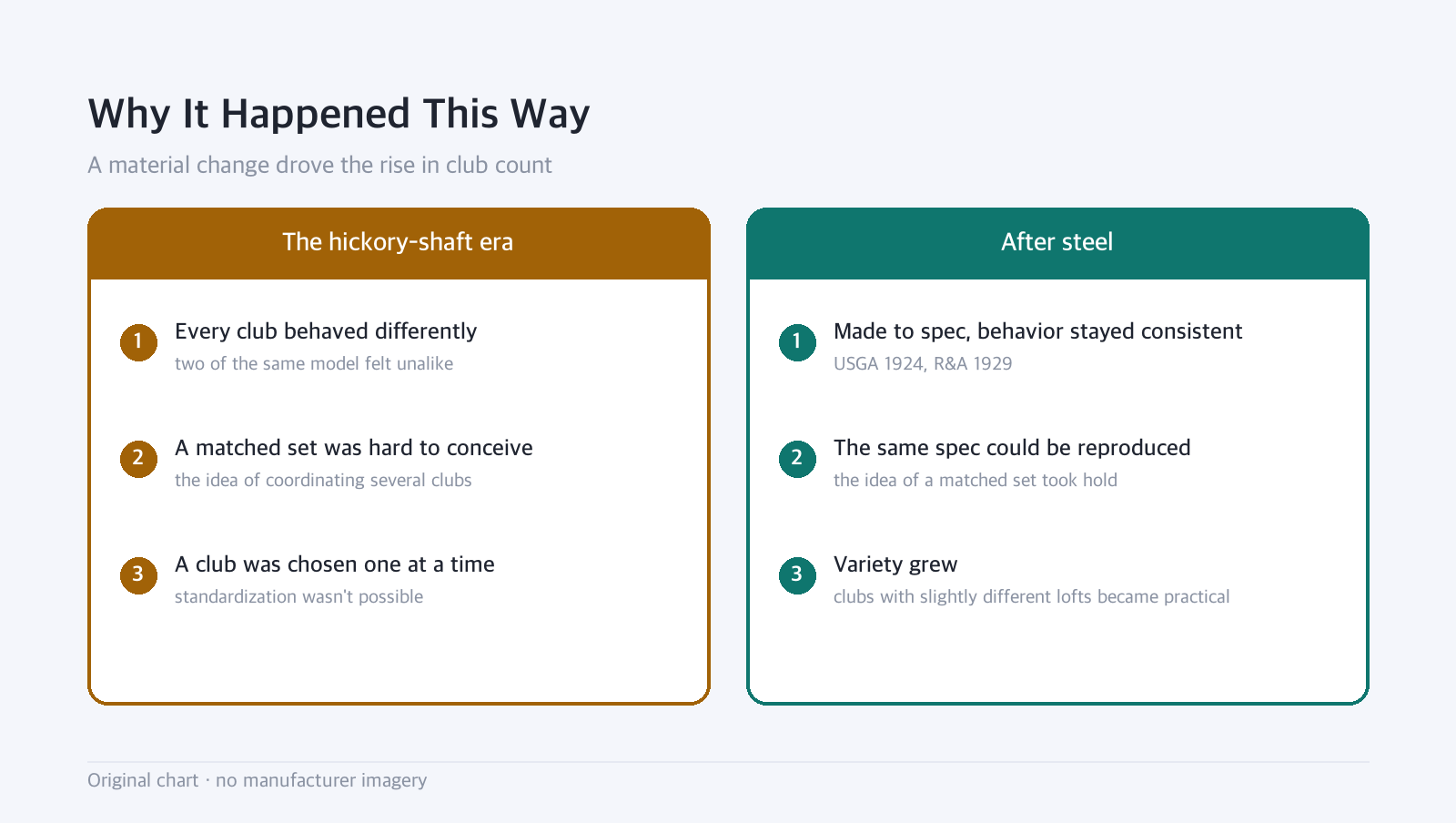
This connects to a material change: the steel shaft, permitted by the USGA in 1924 and by the R&A in 1929.
In the hickory-shaft era, no two clubs behaved the same way. Buy two of the same model and they'd feel different. That made it hard to even conceive of matching several clubs into a coordinated set.
Steel, made to spec, behaves consistently. Once the same specification could be produced repeatedly, the idea of a matched set became possible.
And because clubs became easier to make, variety grew. Carrying several clubs with slightly different lofts became practical.

A material change drove a rise in club count. That rise, in turn, drove a limit.
This pattern — a technical advance forcing a rules response — recurs through golf history: face manufacturing advances forced a coefficient-of-restitution cap; square grooves forced a groove-specification rewrite.
When something new becomes possible, someone has to decide how far to allow it.
5. So what was the actual problem
Carrying many clubs wasn't necessarily a problem on its own — whether to regulate it was actually debated at the time.
Three concerns were raised. They deserve their own treatment, but briefly:
- It reduced the role of skill
- It favored wealthier golfers
- It burdened the caddie
The third survives as a hard number: bags exceeded 35 pounds — roughly 16 kilograms.
There were no carts at the time. Caddies carried that weight on their shoulders for 18 holes.
The limit did not arrive everywhere at once. It took effect at the USGA on 1 January 1938 and at the R&A on 1 May 1939 — about sixteen months apart. For that stretch the same player faced different rules depending on which body's competition they had entered.
6. Who this is useful for
- Golfers who find the 14-club limit restrictive — in the era without a limit, the average was eighteen.
- Golfers thinking through their bag setup — the question of what to include and what to leave out goes back to the 1930s.
- Golfers interested in equipment history — the steel shaft created the concept of a matched set, and that in turn created a club-count problem.
- Golfers weighing how many wedges to carry — one player carried seven niblicks at once.
Less useful for:
- Golfers who just need the current rule — the limit today is fourteen.
- Casual round players — the club-count limit is a competition rule.
7. What we could not confirm
- How Lawson Little's thirty clubs were composed — we could confirm the total count only.
- The full composition of Campbell's thirty-two — we could confirm the left-handed club and the seven niblicks, not the rest.
- The method and sample behind the 1935 U.S. Open survey — we could confirm the average of eighteen, not the survey design.
- The price of a single club at the time.
- How common it was for players to carry a mixed left-/right-handed set.
- The loft spread across the seven niblicks.
In one line
Until the 1930s, golf had no limit on the number of clubs.
Lawson Little carried thirty; Scotty Campbell at the 1936 Walker Cup carried thirty-two, including a left-handed club and seven niblicks.
And the average U.S. Open competitor in 1935 carried eighteen. A large number wasn't the exception — it was the norm.
The steel shaft created the concept of a matched set, and that concept created the club-count problem.
The figures here come from confirmed sources; anything we could not confirm is marked as such.
This piece summarizes general instruction concepts and is not personalized coaching advice. Ball flight fixes depend on individual swing mechanics — a launch monitor session or certified instructor can confirm what applies to you.