
A companion piece, covered separately, looked at provisions from the 1744 rules that have disappeared: teeing the ball beside the previous hole, propping it on sand, and counting a broken club as a stroke.
This one looks at the opposite side — provisions that are essentially unchanged after 282 years.
And it ends by returning to a provision that ties directly back to that first piece.
1. Article 12 — Farthest from the hole plays first
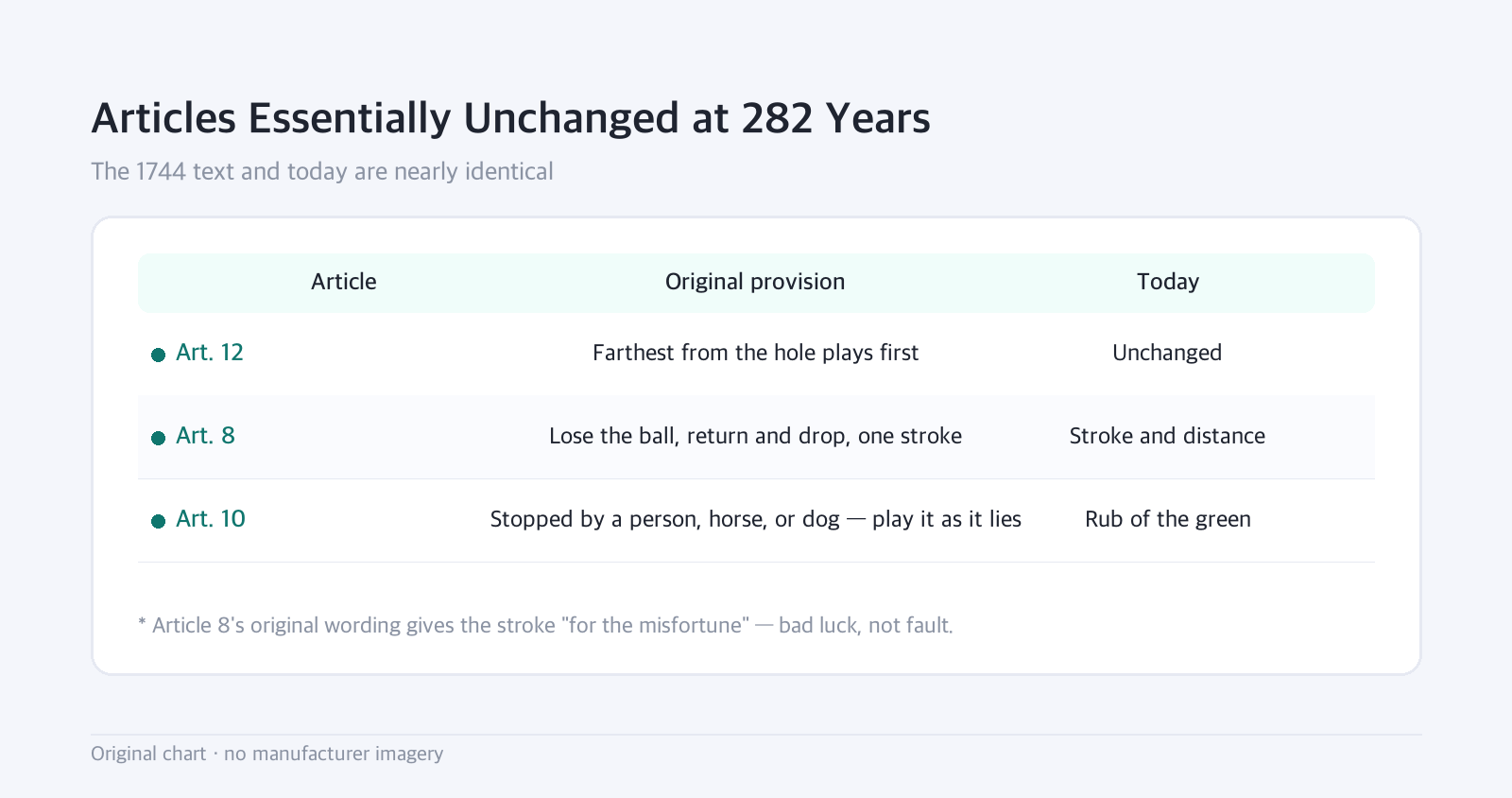
He whose Ball lyes farthest from the Hole is obliged to play first.
The player farthest from the hole plays first.
That is still the rule today. An order that feels natural on any round was already written into the earliest formal rules.
It isn't hard to guess why this one survived. The problem it solves doesn't change even when equipment does. When several people are playing the same hole, not having an agreed order creates danger and confusion — whether the shafts are wood or carbon makes no difference.
2. Article 8 — Lose your ball, go back to where you played
If you should lose your ball... you are to go back to the spot where you struck last and drop another ball and allow your adversary a stroke for the misfortune.
Lose the ball, return to the spot you last played from, drop another, and give your opponent one stroke.
The structure is the same as today's stroke-and-distance. You lose both distance and a stroke.
It is often cited as one of the harshest provisions in golf — and it has been there since 1744. The same treatment has held for 282 years.
The wording is notable too. It says "for the misfortune" — a stroke given not for a fault, but for bad luck.
3. Article 10 — Stopped by something, play it where it lies
If a Ball be stopp'd by any person, Horse, Dog, or any thing else, The Ball so stop'd must be play'd where it lyes.
A ball stopped by a person, horse, dog, or anything else is played from where it stopped.
This is the same idea behind today's "rub of the green": chance events aren't reversed, play continues from the result.
The mention of horses and dogs is a marker of the era — it wasn't unusual for animals to be on the course.
4. What stayed and what disappeared
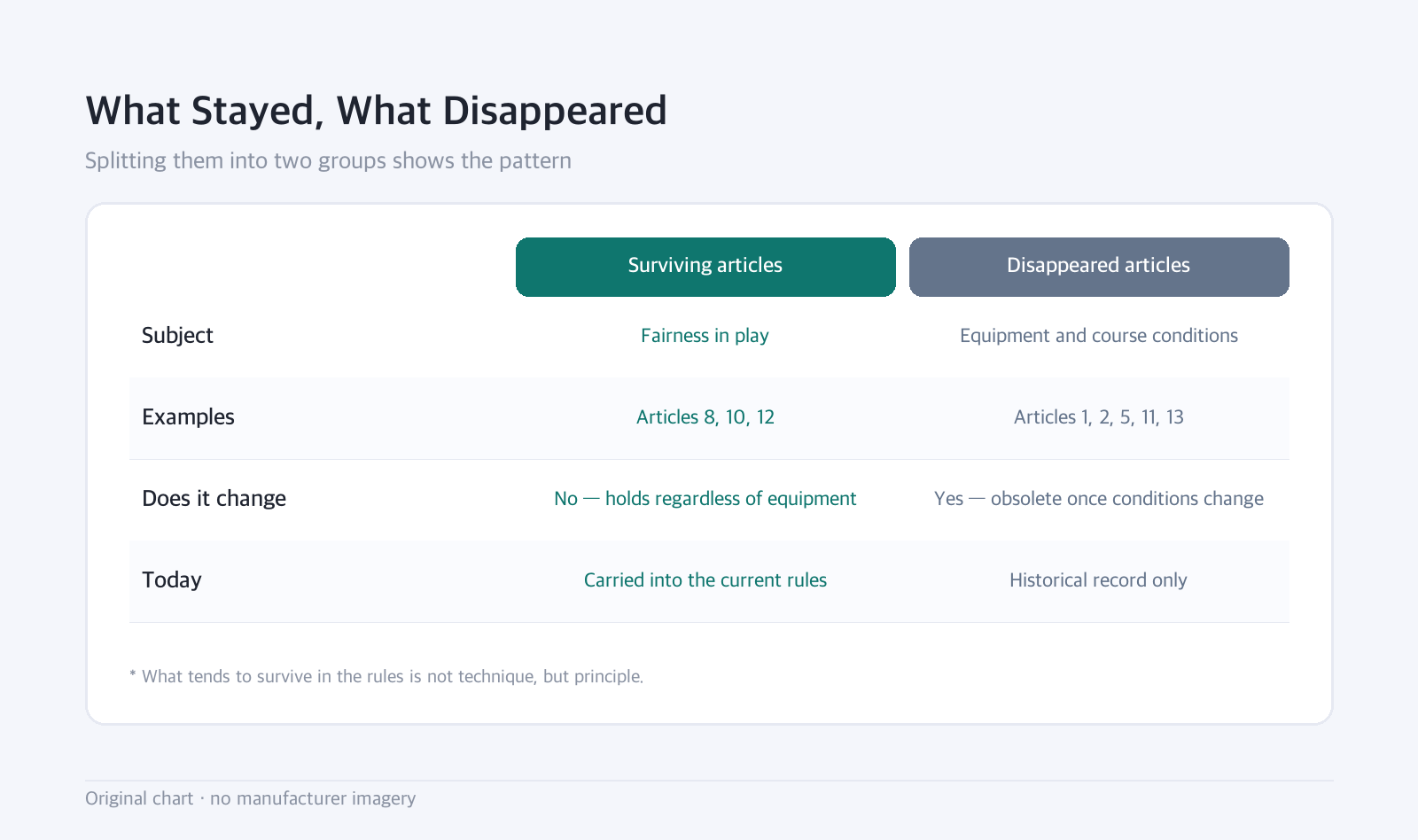
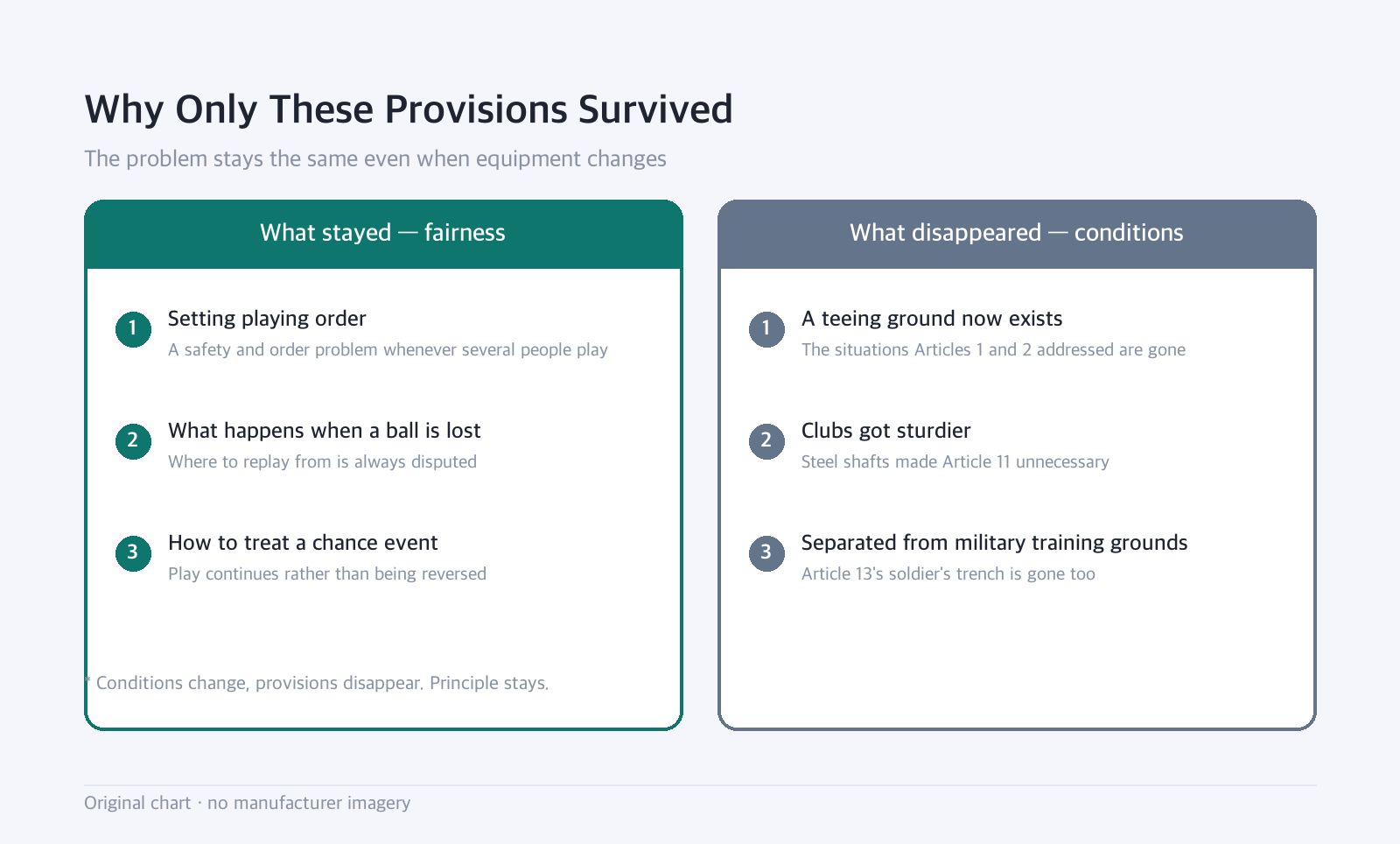
Split the provisions into two groups and a pattern shows up.
The disappeared provisions were mostly about equipment and course conditions. Once tee pegs existed, courses had teeing grounds, and clubs got sturdier, those provisions became unnecessary.
The surviving provisions are about fairness in play — how to set order, what happens when a ball is lost, how to treat an accidental interference. These are problems that persist regardless of equipment.
When conditions change, provisions disappear. When something is a matter of principle, it stays.
5. And Article 13 — a soldier's trench
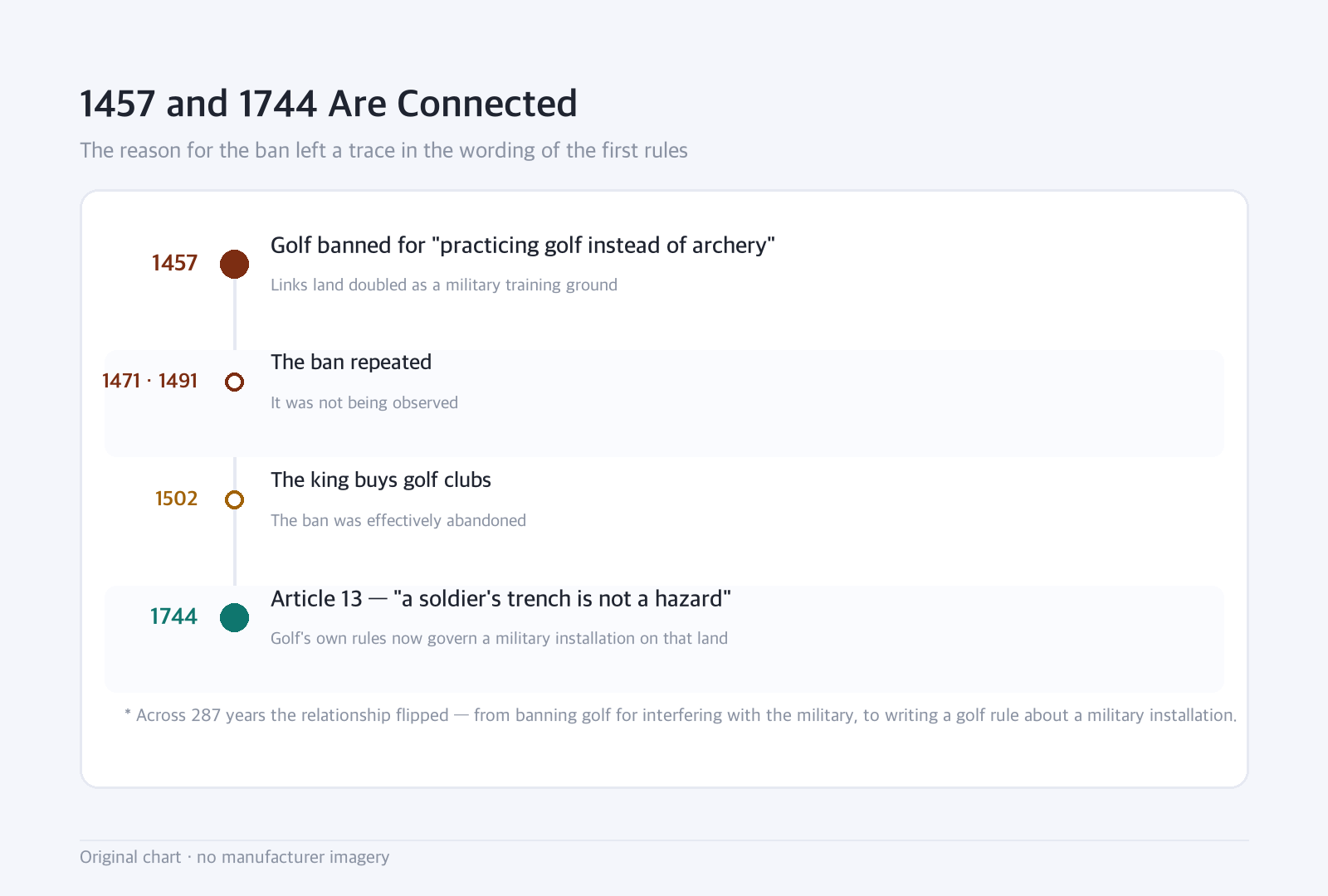
Finally, a provision that connects back to a companion piece covered separately.
Neither Trench, Ditch or Dyke, made for the preservation of the Links, nor the Scholar's Holes or the Soldier's Lines, shall be accounted a Hazard
A "soldier's trench" was not treated as a hazard.
That means golf courses had soldiers' trenches on them — and it was common enough to require a rule.
This connects back to 1457.
Golf had been banned that year for one reason: people were practicing golf instead of archery. It was a matter of national defense.
It was the same land. Links ground served as both a golf course and a military training ground. In 1457 the two uses collided and golf was banned; 287 years later, in 1744, the rules of golf were themselves settling how to treat military installations on the course.
The reason for the original ban left a trace in the wording of the first formal rules.
6. Who this is useful for
Based on what could be confirmed:
- Golfers curious why the rules take the shape they do — the surviving provisions are almost entirely about fairness.
- Golfers who find stroke-and-distance harsh — this treatment has held for 282 years.
- Golfers curious about playing order — "farthest plays first" was already in the earliest rules.
- Anyone interested in the history of links courses — how that land was used is preserved in the text.
This is less useful for:
- Golfers who need an exact modern ruling — this piece is a comparison against the 1744 provisions.
- Golfers who play ready golf — order is often applied more flexibly today to keep play moving.
7. What we could not confirm
- The specific form and use of a "soldier's trench" — we could confirm only that it appears in the text.
- What "Scholar's Holes" refers to — we could not confirm this.
- When each provision took its current form — we could not trace the amendment history between 1744 and today.
- A direct documentary link between the 1457 ban and Article 13 — the shared land is clear, but we found no source proving a direct connection between the two documents.
- Whether stroke-and-distance was ever altered along the way.
In one line
Three provisions from 1744 — farthest plays first, lose the ball and go back, a ball stopped by something is played where it lies — are still in effect today. 282 years and counting.
What disappeared were provisions about equipment and course conditions. What survived were provisions about fairness.
And Article 13 mentions a "soldier's trench." On the same land that was banned from golf in 1457 for interfering with archery practice, 287 years later the rules of golf were themselves deciding whether a military installation counted as a hazard.
The quotations here are drawn from confirmed sources; anything we could not confirm is marked as such.
This piece summarizes general instruction concepts and is not personalized coaching advice. Ball flight fixes depend on individual swing mechanics — a launch monitor session or certified instructor can confirm what applies to you.