
The first written rules of golf, from 1744, ran to thirteen articles. Some of them read almost like today's rules. Others describe a game that no longer exists.
This piece looks at the ones that disappeared.
The very first article is already unrecognizable.
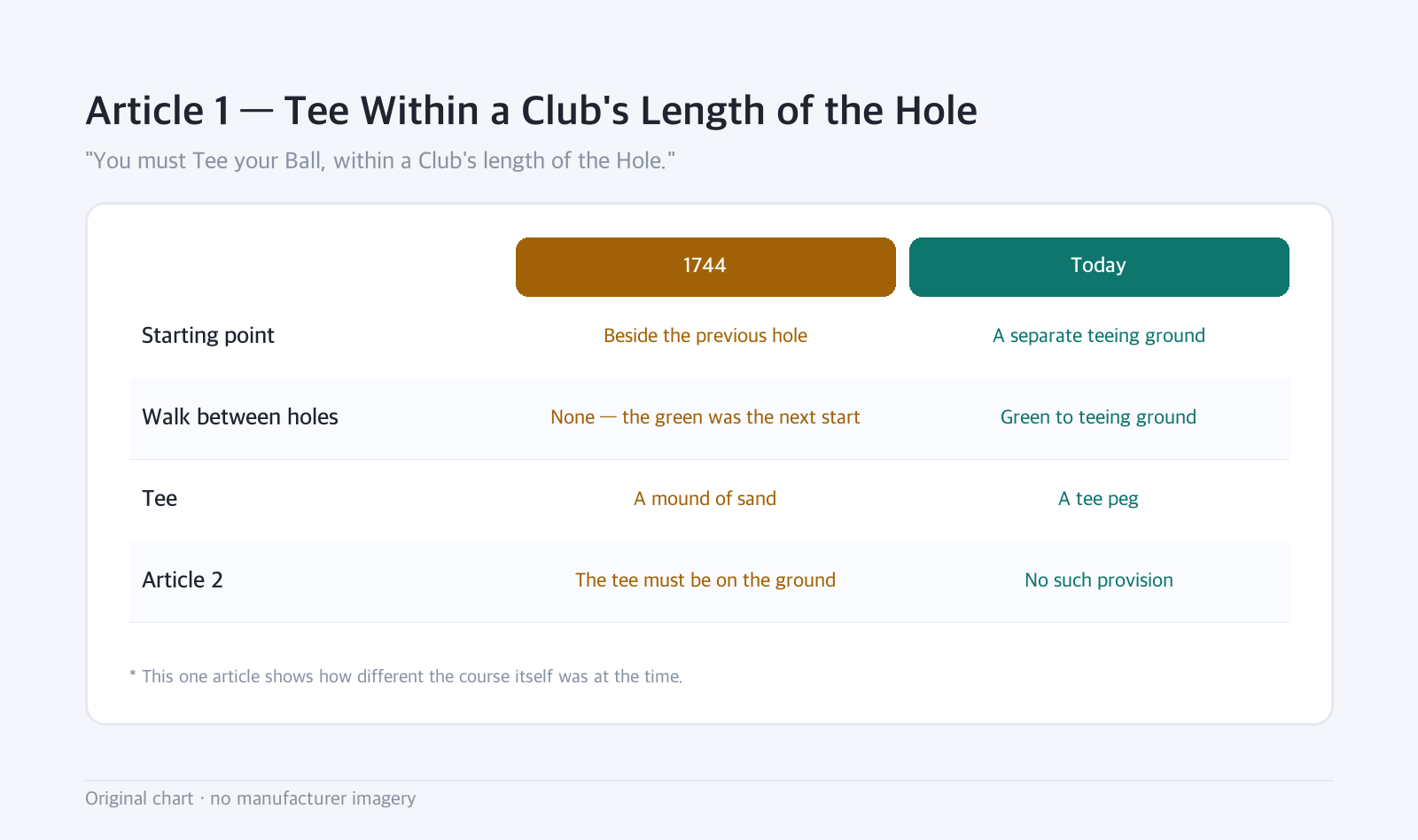
1. Article 1 — Tee your ball within a club's length of the hole
The original text reads:
You must Tee your Ball, within a Club's length of the Hole.
That means the ball was teed up within one club-length of the hole you had just finished.
The difference from today is immediate. There was no teeing ground. Once a hole was finished, the next one was struck from right beside that hole's cup.
Separate teeing areas built into a course came later. At the time, there was no walking gap between holes — the green itself was the starting point for the next hole.
This single article says a great deal about what a course looked like then.
2. Article 2 — The tee must be on the ground
Your Tee must be upon the Ground.
Read today, this sounds obvious — a tee, by definition, goes into the ground.
But there were no tee pegs at the time. "Teeing" the ball meant building a small mound of sand and setting the ball on top of it.
This article requires that mound to sit on the ground — apparently to prevent players from propping the ball up any other way.
Wooden and plastic tee pegs would not appear for a long time yet.
3. Article 5 — Fall in the water, tee up, use any club
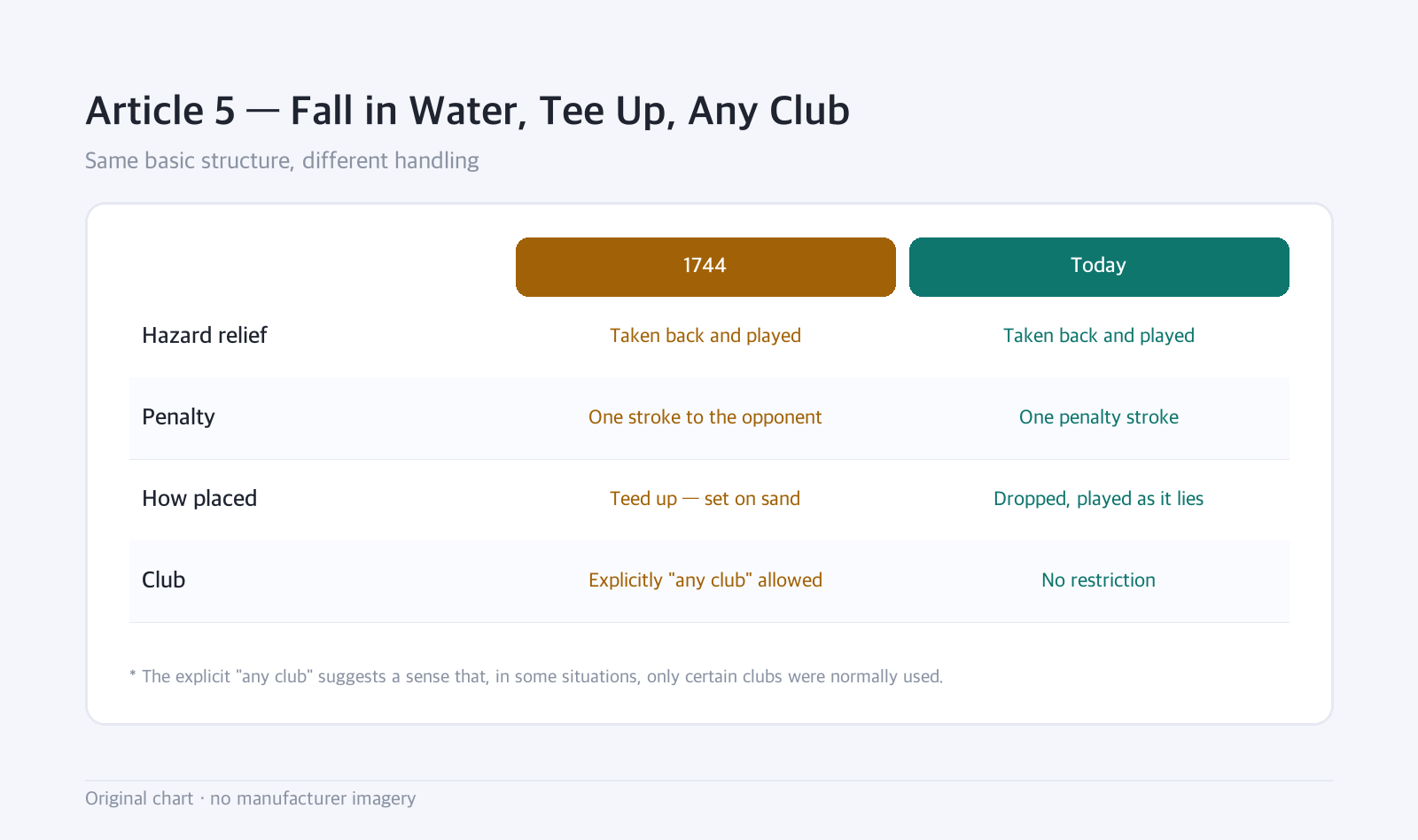
If your Ball comes among watter, or any wattery filth, you are at liberty to take out your Ball & bringing it behind the hazard and Teeing it, you may play it with any Club and allow your Adversary a Stroke
This governs a ball that lands in water or mud. Compared with today:
- In common — the ball is taken back behind the hazard and played, with a one-stroke penalty. The basic structure is the same.
- Different — the ball is teed up. It is not simply placed; it is set on a mound of sand and struck from there.
- Different — the rule explicitly allows any club.
Today the ball is dropped and played as it lies. Teeing it up is not permitted.
The phrase "any club" is also worth noting. It suggests there was an existing sense that, depending on the situation, only certain clubs were normally allowed.
4. Article 11 — A broken club still counts as one stroke
If you draw your Club in order to Strike & proceed so far in the Stroke, as to be bringing down your Club; If then, your Club shall break, in any way, it is to be Accounted a Stroke.
If the club breaks after the downswing has started, it counts as a full stroke.
The mere existence of this article is informative in itself. It means clubs broke often enough to need a rule about it.
Shafts at the time were wood — each one different, sensitive to humidity, prone to torque. Breaking mid-swing was common enough to require its own provision.
Steel shafts would not be permitted until 180 years later.
5. Article 13 — A soldier's trench is not a hazard
The most striking article of the thirteen.
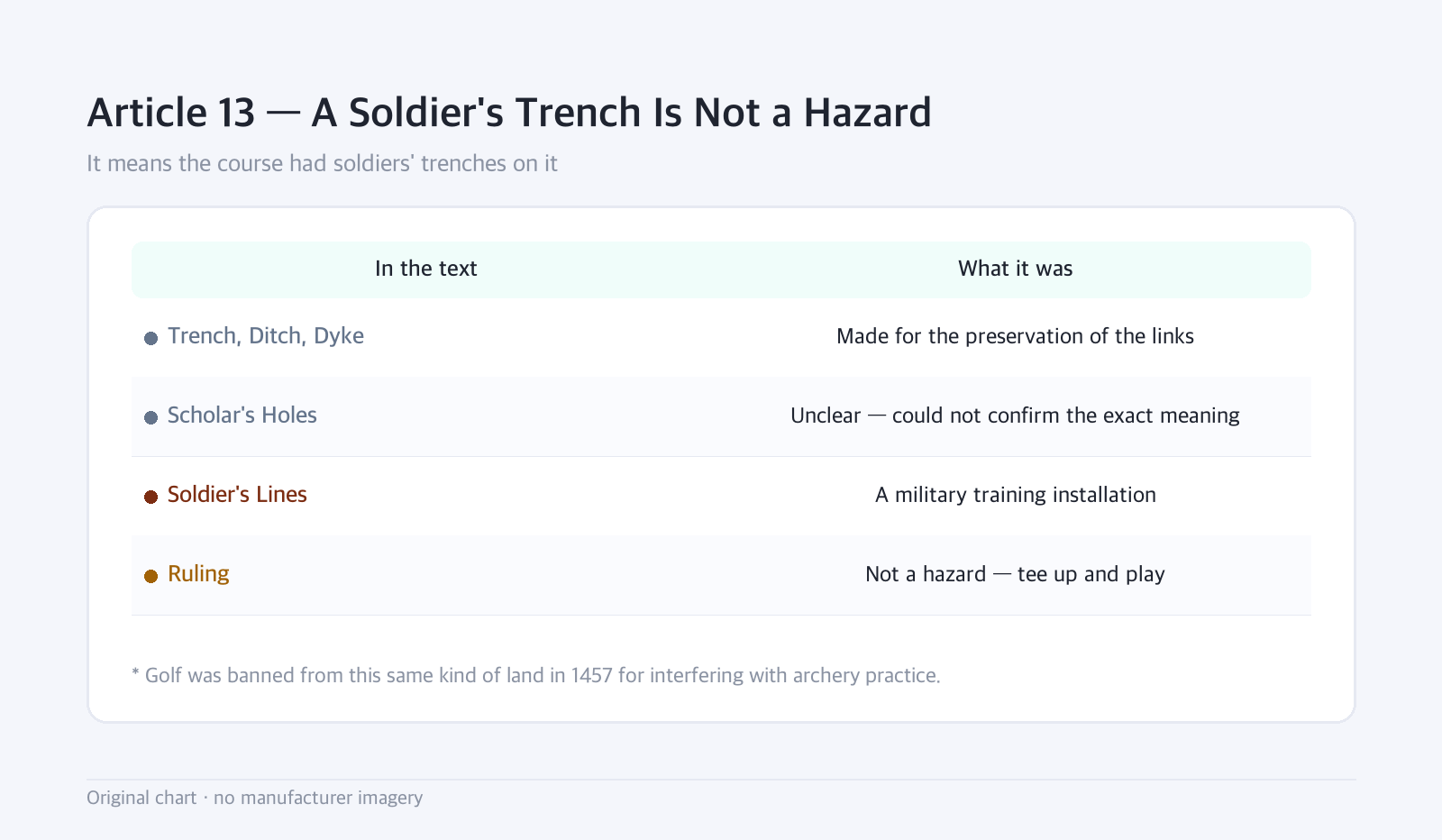
Neither Trench, Ditch or Dyke, made for the preservation of the Links, nor the Scholar's Holes or the Soldier's Lines, shall be accounted a Hazard
Ditches and dykes built to preserve the links, along with "Scholar's Holes" and "Soldier's Lines," were not to count as hazards.
That means the course had soldiers' trenches on it.
This connects to an earlier chapter of the story covered separately: golf was banned in 1457 because it drew people away from archery practice. Links land was a golf course and a military training ground at the same time.
Across 287 years, the relationship flipped. Golf was first banned for interfering with military training; later, the rules of golf were writing provisions for what to do about military installations sitting on the course.
6. What these articles tell us
Put the disappeared articles together and the conditions of the time come into view.
- No teeing ground on the course (Article 1)
- No tee pegs (Article 2)
- Balls set up on mounds of sand (Articles 2 and 5)
- Clubs broke often (Article 11)
- The course and a military training ground shared the same land (Article 13)
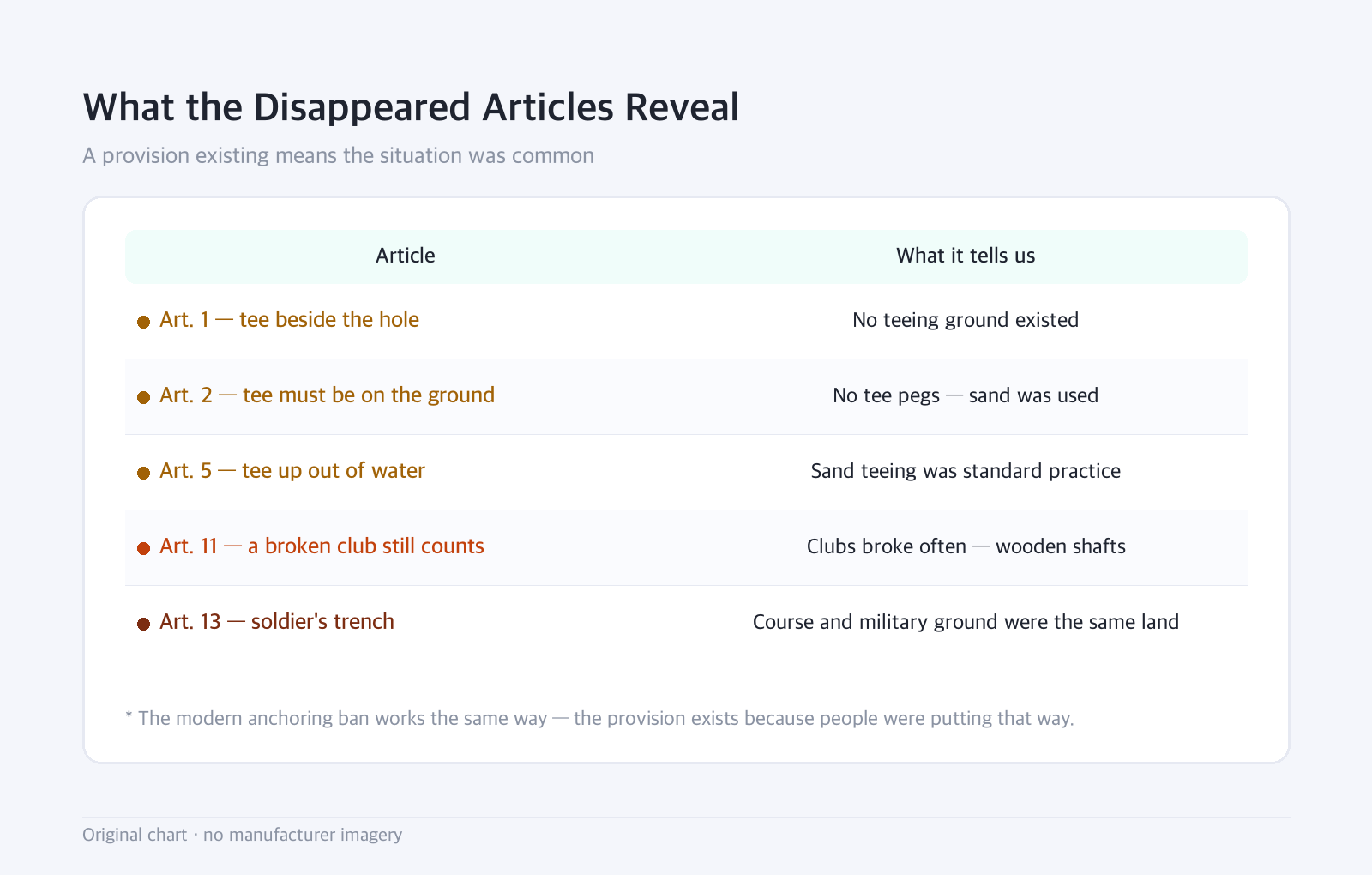
Rules address what was actually happening at the time. Which provisions existed tells you less than why they were needed.
The same logic applies to the modern anchoring ban: the provision exists because people were putting that way.
7. Who this is useful for
Based on what could be confirmed:
- Golfers curious about how golf courses evolved — there was a time before teeing grounds existed.
- Golfers reading the modern rules — a provision's existence tells you the situation it addresses was common.
- Golfers interested in equipment history — broken clubs were common enough to warrant a rule.
- Anyone interested in links courses — how that land was used is preserved in the wording itself.
This is less useful for:
- Golfers who need a current ruling — none of these provisions carry any force today.
- Golfers curious which 1744 provisions are still in effect — that is covered separately.
8. What we could not confirm
- When a formal teeing ground first appeared — we could not confirm this.
- What "Scholar's Holes" precisely referred to — it appears connected to a school or students, but we could not confirm the specifics.
- The exact method used to build a sand tee.
- How often clubs actually broke — we could confirm only that the provision existed.
- What Article 5's "any club" was meant to address.
- When individual articles were amended over time.
In one line
The first article of the 1744 rules was "tee your ball within a club's length of the hole." There was no teeing ground — play began wherever the previous hole had ended.
There were no tee pegs, so balls were set up on mounds of sand, and clubs broke often enough that a rule had to account for it.
And the course had soldiers' trenches on it.
Rules address what was actually happening at the time. Read the provisions, and the era comes into view.
The quotations here are drawn from confirmed sources; anything we could not confirm is marked as such.
This piece summarizes general instruction concepts and is not personalized coaching advice. Ball flight fixes depend on individual swing mechanics — a launch monitor session or certified instructor can confirm what applies to you.