Four branches have now been covered separately. This piece gives the sequence.
What to check first, what to check later. And one last point at the end that matters most in this series.
For readers new to this series: a slice happens when the clubface is right of the swing path at impact, for a right-handed golfer, and the same slice can trace to four distinct causes — grip, face, path, and the body (early extension).
1. The ordering principle
Check whatever is cheapest to check, first.
Cheap here means time and equipment. A single club at home is the cheapest check; video or a launch monitor is the most expensive.
One more rule. Rule out causes lower in the chain first. If the body is the cause and only the hands get fixed, the problem comes back.
The two principles sometimes conflict. So the order below is: clear the cheap ones first, but drop to the lower-chain causes if results stay unstable.
2. Five steps
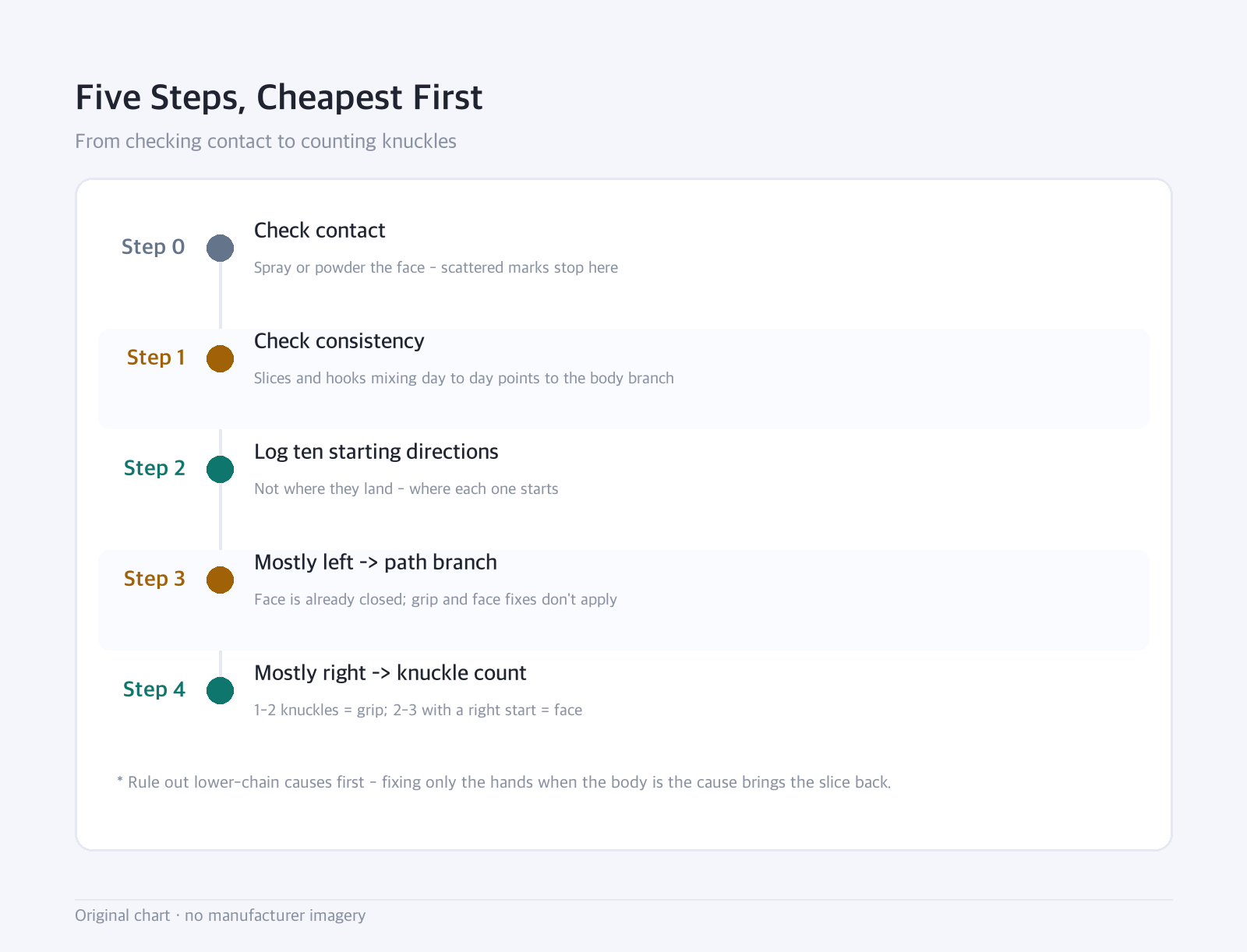
Step 0 — check contact. As covered separately, spray or powder the face and check whether the marks cluster in one spot. If scattered, stop here. Branches can't be sorted while contact location itself is inconsistent.
Step 1 — check consistency. If slices and hooks mix from day to day, and fat and thin shots show up too, suspect branch four (the body) first. It comes before direction work.
Step 2 — log ten starting directions. Not where they land — just where they start. Three buckets: right, center, left.
Step 3 — mostly left points to branch three (path). The face is already closed. Grip and face fixes don't apply here.
Step 4 — mostly right means count knuckles. One to two knuckles is branch one (grip); two to three knuckles with a rightward start is branch two (face).
3. Laid out as a table
| What you see | Branch |
|---|---|
| Marks scattered | Contact first — branch check on hold |
| Inconsistent day to day, contact also unstable | Body (branch 4) |
| Starts left, curves sharply right | Path (branch 3) |
| Starts right, one to two knuckles | Grip (branch 1) |
| Starts right, two to three knuckles | Face (branch 2) |
What to look at, and where it points.
Some cases straddle two branches. When that happens, clear the cheaper one first, and check again — for example, neutralize the grip, then see what remains.
4. And now, a note about aim
This is the point this series most wants to make.
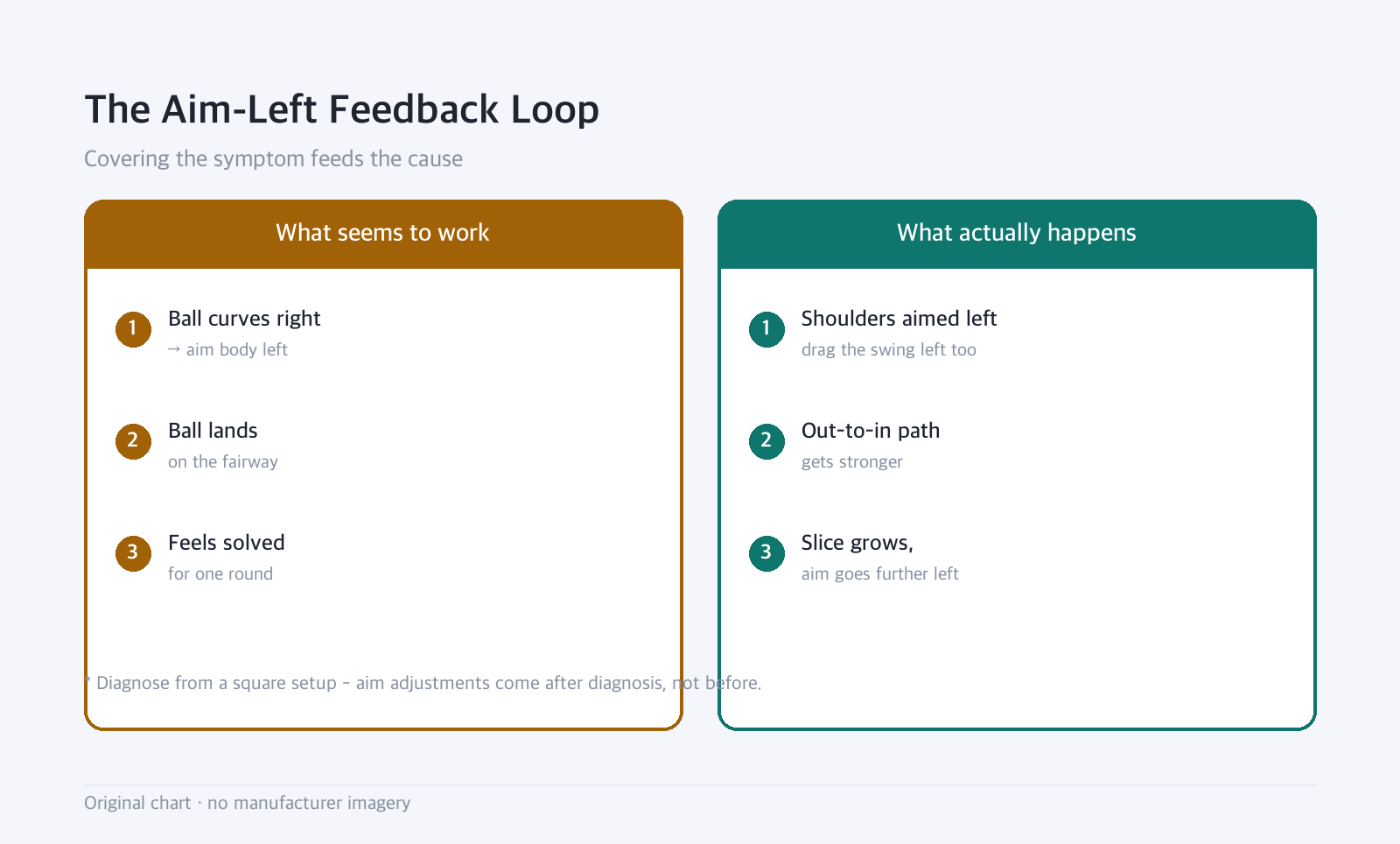
A slice leads naturally to aiming left. Knowing the ball will curve right, the golfer sets up left in advance.
Within a single round, this works. The ball genuinely ends up on the fairway.
But here's the problem.
When the body faces left, the swing follows that direction too. With the shoulders aimed left, the club rides down that same line. The out-to-in path gets stronger.
The slice gets bigger, so the aim goes further left, so the path goes further left still.
It becomes a loop. Covering the symptom feeds the cause.
5. And three things fall out of line
Aiming left carries one more side effect.
Most golfers, when aiming left, only rotate the body. The face is often left pointing at the target, since the ball still has to reach it.
And ball position naturally drifts back, relative to the body, as the body rotates.
The result: body left, face at target, ball back. Three things pointing three different places.
In that state, sorting branches gets harder too. Aim needs to be reset before diagnosis, not after — that's the reason.
6. So, in practice
Diagnose from a square setup. Line up body and face both to the target line. Only from there does the ball's actual behavior split cleanly into branches.
Aim adjustments come after diagnosis is done. And there's an order to that too.
As noted earlier in this series, fixing the curve first, then adjusting direction, is generally easier. Curve isn't solved by aim; direction is.
Doing it the other way round feeds the loop described above.
Aiming left to get through a round isn't a bad thing on its own. Just know it isn't a fix. That's the difference between first aid and treatment.
7. Who this is useful for
- Golfers unsure where to start checking — five steps sort the branch.
- Golfers who've been aiming left for a long time — they may already be inside the loop.
- Golfers who want to sort things out before a lesson — knowing the branch speeds up the conversation.
- Golfers deciding what to check at the range — ten shots is enough.
This is less useful for:
- Golfers who already know their face and path from a launch monitor — the working-backward steps aren't needed.
- Golfers intentionally hitting a fade — this sequence concerns a slice as a mishit.
8. What we could not confirm
- How closely aim correlates with path, in degrees — the mechanism is explained, but we could not confirm how much the path follows.
- How to handle cases straddling multiple branches at once — this is practical instruction-floor knowledge, and we could not confirm a fixed sequence.
- The accuracy of self-diagnosis — no data verifying how often this sequence gets it right. Use it as a sorting framework.
In one line
The order is cheapest first. Contact → consistency → ten starting directions → knuckle count. That's enough to place a slice in one of the four branches.
And aiming left builds a loop. The slice leads to aiming left, aiming left pushes the path further left, and the slice gets bigger.
Covering a symptom lets the cause grow. Using it as first aid is fine. Just know it isn't a fix.
A separate piece looks at the opposite side — the boundary between hook and draw.
This piece summarizes general instruction concepts and is not personalized coaching advice. Ball flight fixes depend on individual swing mechanics — a launch monitor session or certified instructor can confirm what applies to you.