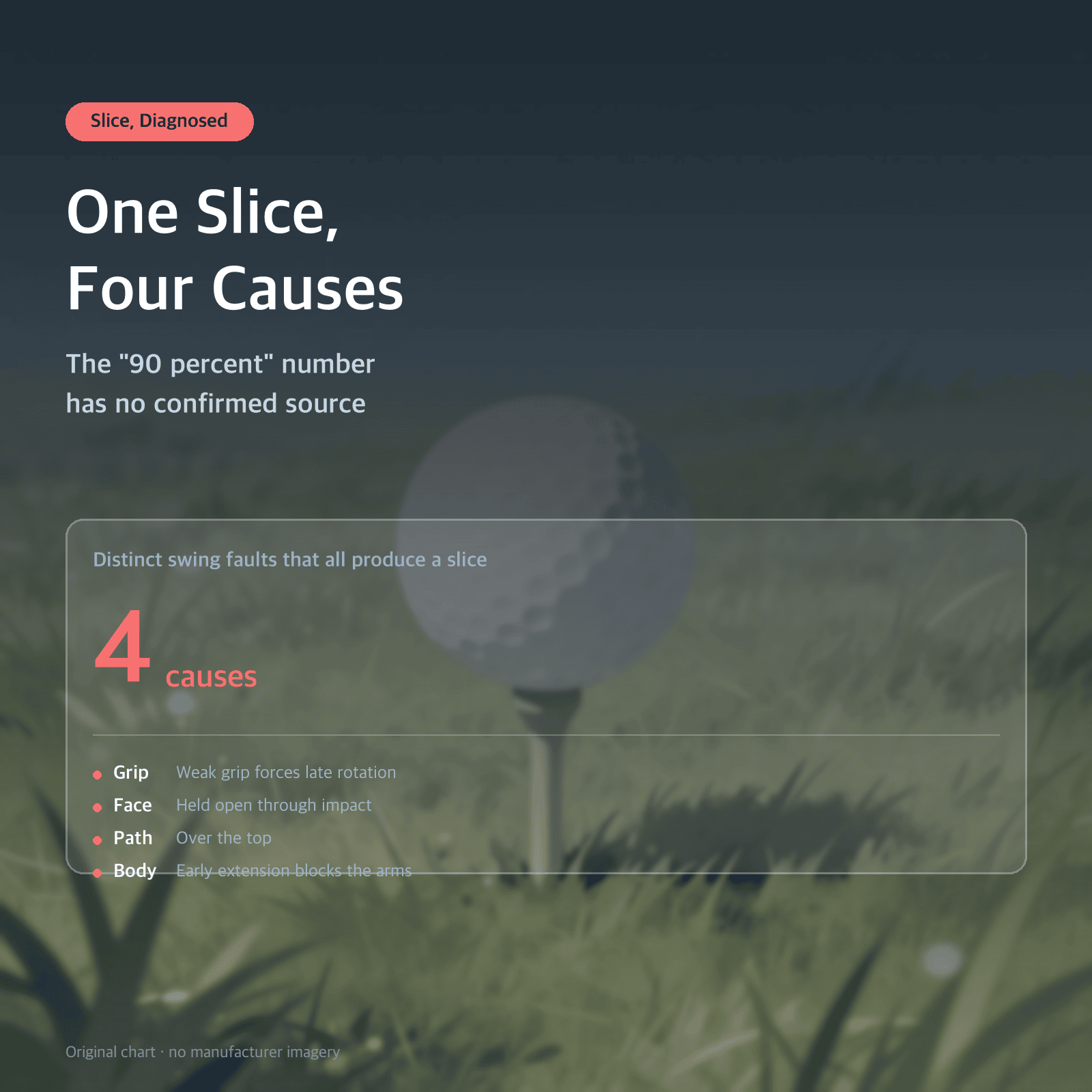
We now move from the ball-flight laws covered separately into an actual miss-hit. First up: the slice.
Content about fixing a slice is everywhere, and most of it starts with a fix: move your wrists this way, your shoulders that way.
Here we reverse the order. We start with diagnosis, because the same slice can need very different fixes depending on where it comes from.
1. Checking a number we see constantly
"90 percent of golfers slice the ball."
This line shows up so often it has become conventional wisdom. So we went looking for its source.
We could not find a rigorous source for this figure.
It appears to be a number repeated in marketing copy, including YouTube ads, more than in any study. We could not find a case where the methodology, sample, or even the definition of "slice" was specified alongside it.
What we could confirm is different: a Golf Digest study reportedly found that about 84 percent of golfers with a handicap of 20 or higher showed a tendency to slice. Even so, we could not verify the original study text ourselves, so we are keeping this qualified as "approximately."
The gap between the two numbers isn't really about size — it's about scope. The 84 percent figure comes with a condition: handicap 20 or higher. The 90 percent figure comes with no condition at all.
2. The third time we've run into this pattern
We've encountered the same structure twice before, in golf-history pieces:
- The Schenectady putter grudge story — the claim that the putter's ban stemmed from personal spite. No documentary evidence.
- The Bobby Jones / Tony Torrance compromise story — the idea that 16 and 12 clubs were split down the middle to land on 14. No documentary evidence.
And now a third case.
All three share something: they sound plausible, they're widely repeated, and once you go looking, there's nothing behind them.
To be clear, the point here is not to deny that slicing happens. It plainly is common among amateurs. The point is drawing a line between what's confirmed and what isn't.
3. One definition of a slice
With the number out of the way, on to the substance.
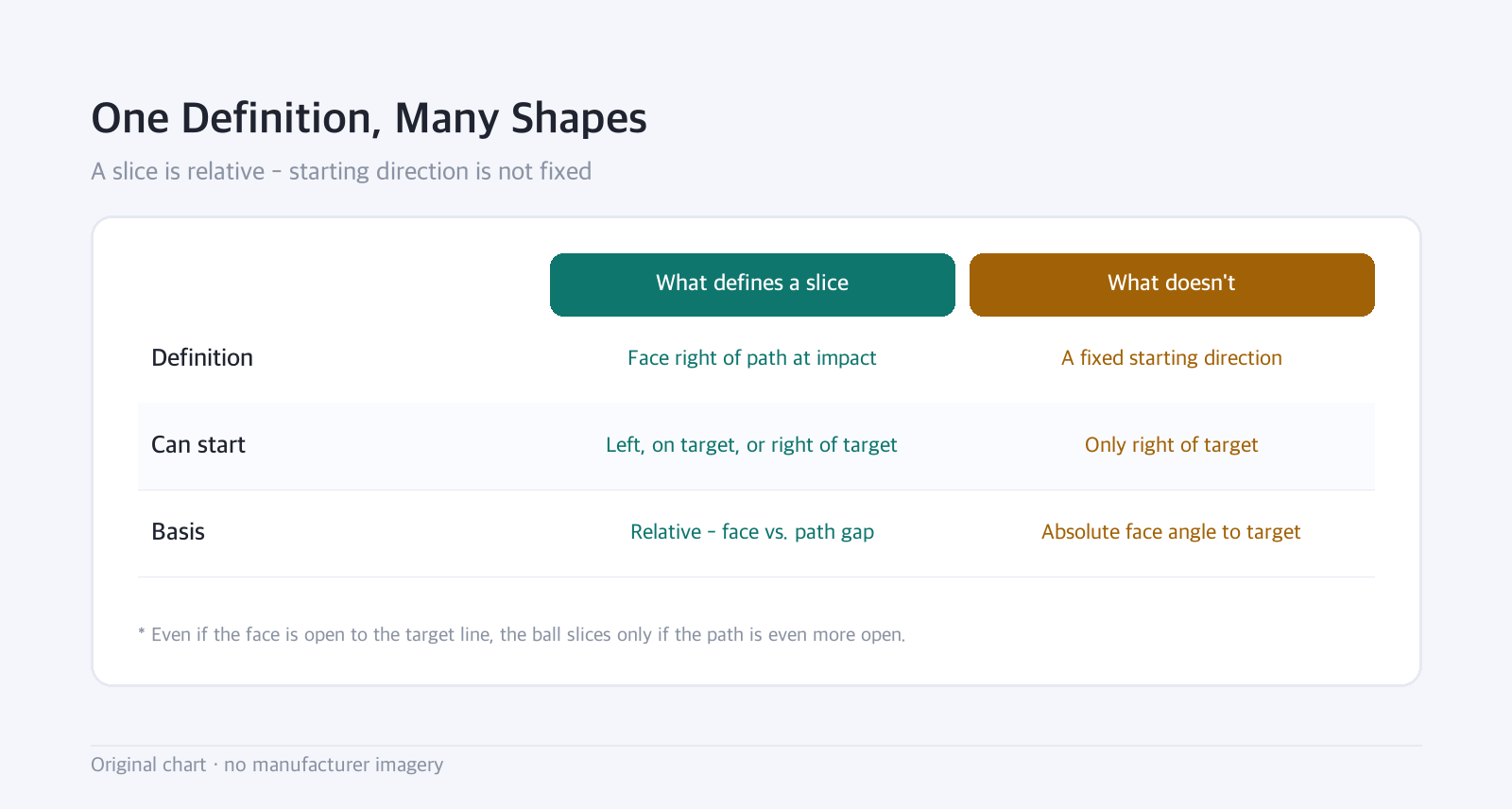
We're using the same baseline set out in the ball-flight laws piece: a slice happens when the clubface is right of the swing path (for a right-handed golfer).
Two points worth restating here.
First, it's relative, not absolute. Even if the face is open to the target line, if the path is even more open, the ball still curves left to right.
Second, that means the starting direction isn't fixed. A slice can start left of target, start on target, or start right of target.
One definition, but many shapes. That's the first reason a slice is hard to fix.
4. Four distinct causes
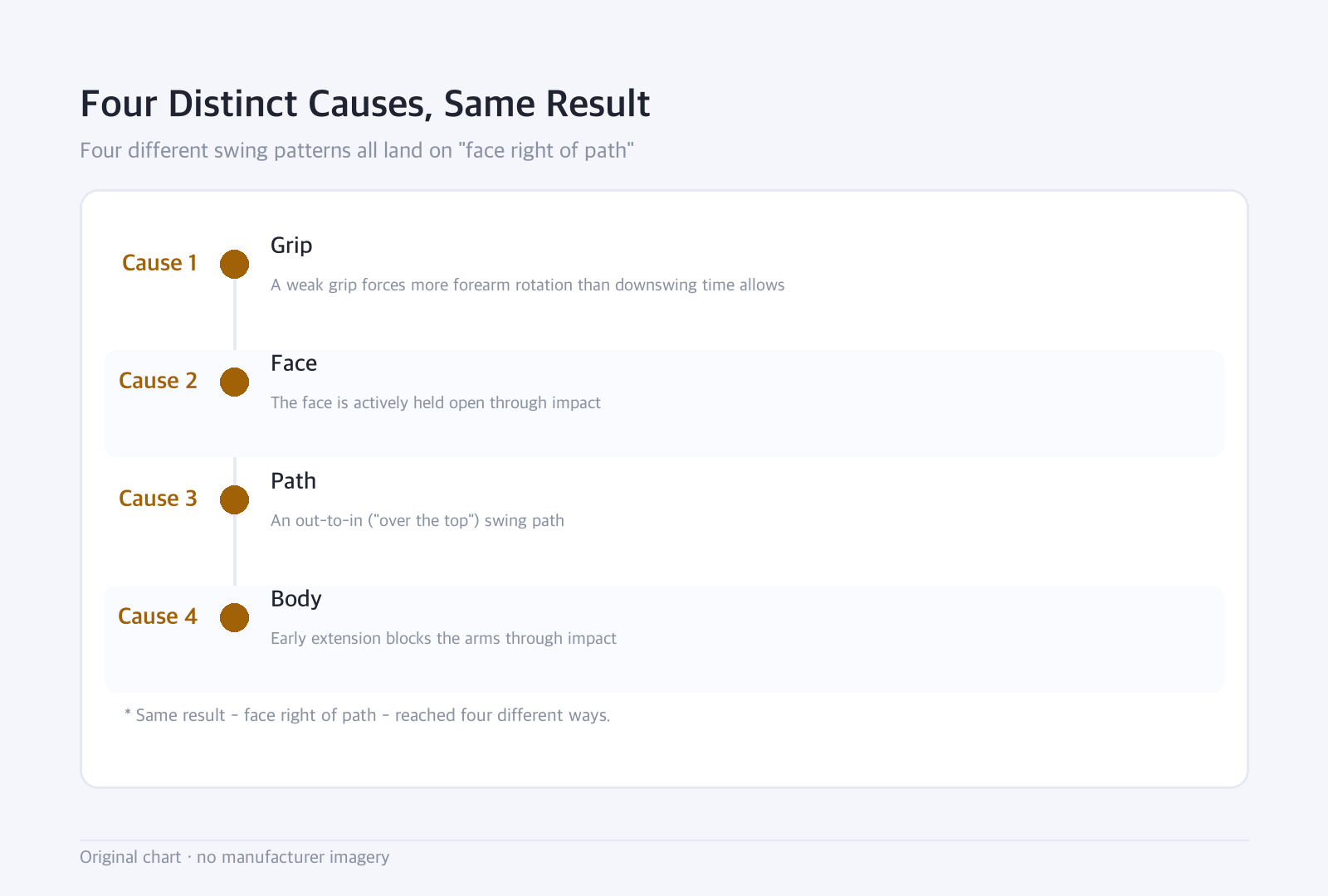
Four different swing patterns all produce the same result — face right of path — but through different routes.
Cause one — Grip. A weak grip, with the left hand rotated too far toward the target. From this position, squaring the face at impact requires far more forearm and wrist rotation. If there isn't enough time, the face arrives open.
Cause two — Face. Not the grip, but actively holding the face open through impact. This is usually the core issue behind a chronic, repeatable slice.
Cause three — Path. An out-to-in path, commonly called "over the top." The downswing is started with the upper body instead of the lower body, sending the club above the correct plane.
Cause four — Body. Early extension. The hips push toward the ball and the rib cage lifts, and the body blocks the arms' path through impact.
5. Why the same fix doesn't work for everyone
Line the four up and it becomes clear why a slice so often resists correction.
Tell someone whose real issue is grip to "swing more from the inside," and the path improves while the face stays open.
Tell someone whose real issue is path to "grip it stronger," and now they hook it.
Give arm-and-hand cues to someone whose real issue is the body, and neither changes, because the body is still blocking the way.
The fix isn't wrong — the cause was misidentified. Each one is a correct fix for its own cause.
6. One common misconception, addressed early
"Every slice comes from swinging over the top" is not true.
Recall the nine-window ball-flight chart: one box is the push slice — starting right and curving further right.
That shot's path is not outside-to-in. If anything, the path is inside-to-out, but the face was open even further than the path.
You can swing inside-to-out and still slice. Over the top is only one of four causes.
7. How to use this piece
Related pieces cover each of these four causes individually, along with the signs that tell you which one is yours.
A later piece covers sequencing — what to check first and what to leave for later.
You don't need to read all of them. Find your cause, and read only that one.
8. Who this is useful for
- Golfers who have tried to fix a slice more than once and had it stick around — the fix may have targeted the wrong cause, not a bad fix.
- Golfers who feel like every lesson video says something different — each one is often addressing a different cause.
- Golfers who only slice with the driver — the piece on gear effect is worth reading first.
- Golfers curious where golf statistics actually come from — this is the story behind the "90 percent" number.
This is less useful for:
- Golfers whose ball flight changes shot to shot — isolating a single cause requires a consistent pattern.
- Golfers who need a fix before their next round — a quick fix isn't the goal here.
9. What we could not confirm
- The original source of the "90 percent" figure — we could only confirm that it looks like marketing copy.
- The original Golf Digest study behind the 84 percent figure — we could not verify the sample size or the definition of slice used.
- The actual distribution across the four causes — we found no data on which cause is most common.
- Slice rates specific to any single country or region — no such study turned up.
In one line
A slice has one definition but four causes.
That's why the same fix works for some golfers and not others. The fix wasn't wrong — the cause was misdiagnosed.
And the widely cited 90 percent figure turned out to have no confirmed source behind it — the third time we've run into a popular claim with nothing to back it up.
This piece summarizes general instruction concepts and is not personalized coaching advice. Ball flight fixes depend on individual swing mechanics — a launch monitor session or certified instructor can confirm what applies to you.