The second cause is the face.
Before getting into it, one term needs fixing: "square."
Get this wrong and diagnosis can be perfectly accurate while the fix still misses.
For readers new to this series: a slice happens when the clubface is right of the swing path at impact, for a right-handed golfer. The same slice can trace to four distinct causes; this piece covers the second.
1. Square to what?
"Square the face" gets said constantly, and it's usually taken to mean perpendicular to the target line.
Read against the corrected ball-flight model, that reading is only half right.
- Face relative to the target line determines where the ball starts.
- Face relative to the path determines whether it curves.
A slice is a problem of the second kind. It happens when the face is right of the path.
Which means: a face perfectly perpendicular to the target line can still produce a slice, if the path is further left than the face.
2. So what should "square" actually mean
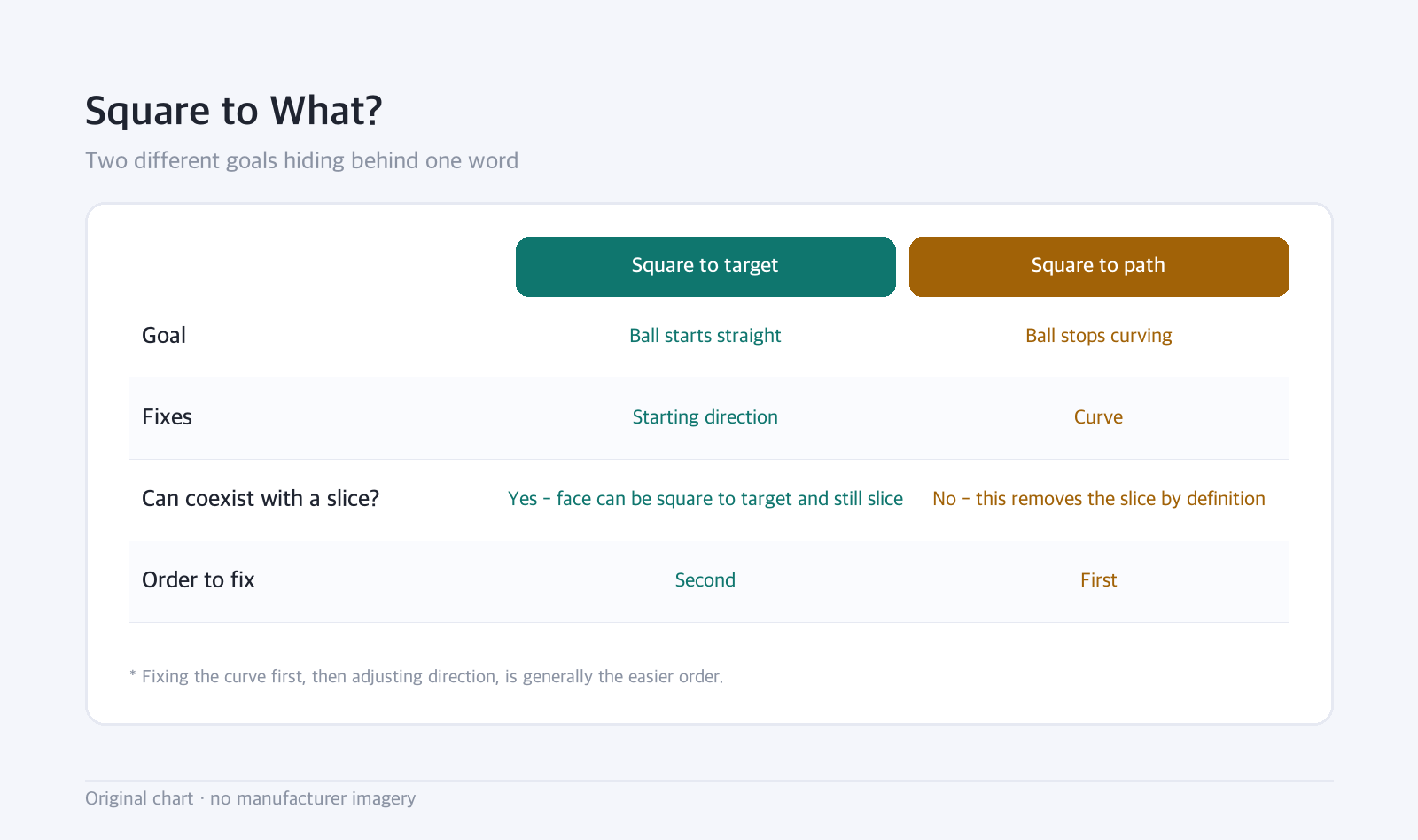
Laid out plainly:
- Want it to start straight? Square the face to the target.
- Want it to stop curving? Square the face to the path.
- Want both? Square face and path both to the target.
These are three different goals. Removing a slice and hitting the ball straight are not the same task.
That produces a practical conclusion. Leaving the path where it is and squaring only the face to it removes the slice. The ball then goes dead left instead.
Direction can be adjusted by aim. Curve cannot. Fixing the curve first, then adjusting direction, is generally the easier order.
3. Signs that this is your branch
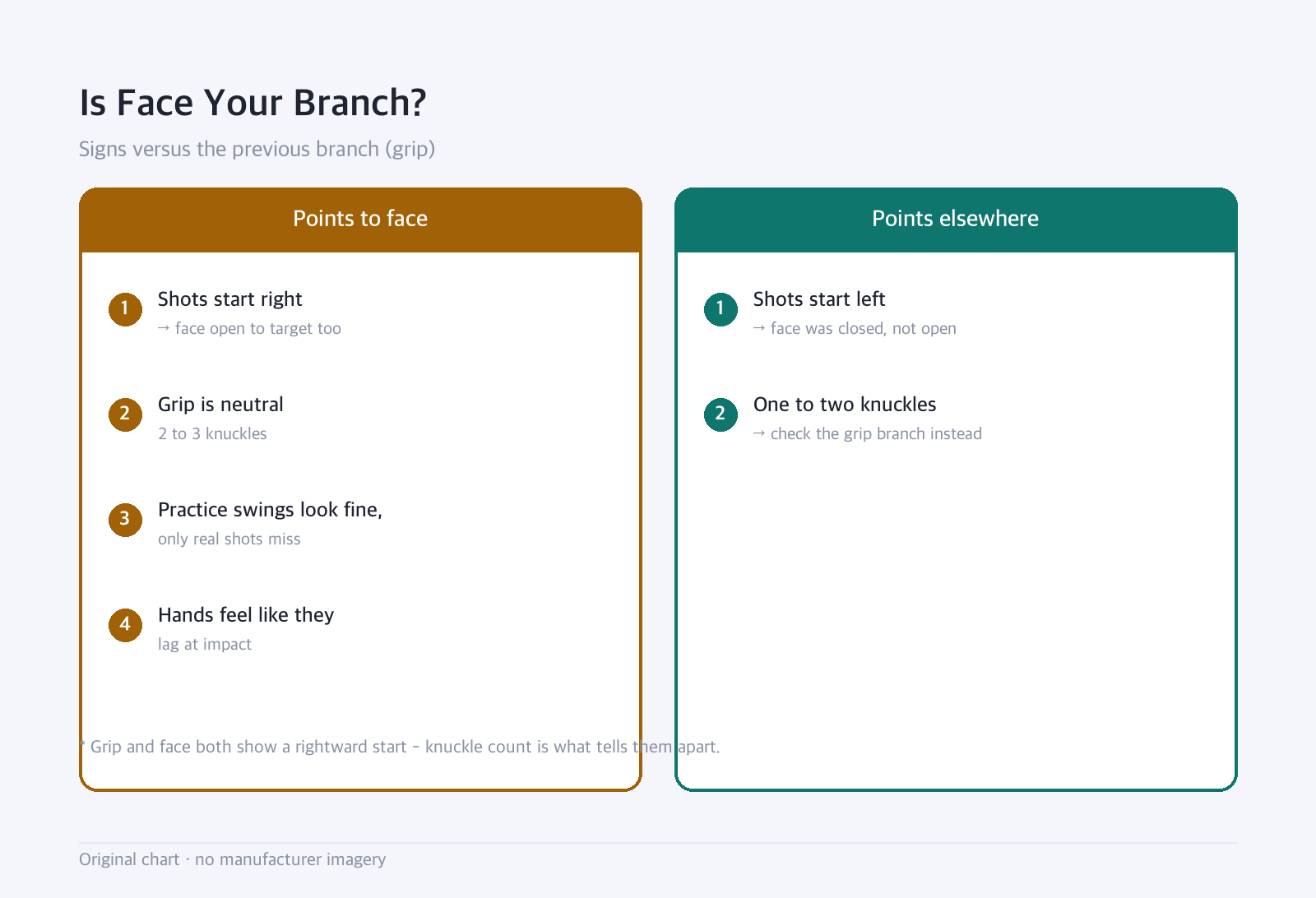
If this is the branch, these tend to show up:
- Shots start right — the face is open relative to the target too.
- The grip is neutral — two to three knuckles, per the previous branch.
- Practice swings look fine; only real shots go wrong.
- A sensation of the hands lagging behind the club at impact.
If instead shots start left, the face was closed — this isn't the branch.
Here's the line separating this piece from the previous one: grip and face both show up as a rightward starting direction. The difference is knuckle count. One to two knuckles points to grip; two to three knuckles with a rightward start points here.
4. Why the face doesn't return
From here on, causes branch into several possibilities, and this leans more on common teaching explanations than confirmed fact. Flagging that clearly.
Commonly cited factors:
- Body rotation stalling at impact while the arms keep moving forward alone
- Trying to hold a wrist angle in a way that locks up face rotation along with it
- The arms firing early from a strong urge to make contact
The common thread: all of them reduce the time or room available to return the face.
So the fix for this branch is usually not "rotate the face more" but "create the conditions to let it rotate." The next two pieces — path and the body — cover those conditions.
5. What can be checked here
There's no way to measure face angle without a launch monitor. But working backward from starting direction is possible.
Try this on the range.
Pick one target and hit ten shots. Track only the starting direction, not where they land. Three buckets: right, center, left.
- Mostly right — the face is consistently open. This is either this branch or the grip branch.
- Mostly left — the face is closed. That points to the next piece, the path branch.
- Scattered — face control isn't consistent yet. Contact location is worth checking first.
Ten shots is enough. Sorting causes into a branch doesn't need a large sample.
6. Who this is useful for
- Golfers who found "square the face" ambiguous — which square it is matters.
- Golfers who fixed their grip and still slice — this is the next branch to check.
- Golfers who want to separate hitting it straight from stopping the curve — they're different jobs.
- Golfers self-diagnosing at the range — ten shots is enough to split branches.
This is less useful for:
- Golfers whose shots start left — check the path, not the face.
- Golfers who already know their face angle from a launch monitor — the working-backward method here isn't needed.
7. What we could not confirm
- The distribution of specific causes behind a face that doesn't return — the items above are commonly cited in instruction, not a verified ranking.
- The accuracy of judging starting direction by eye.
- How much practice-swing face angle differs from real-swing face angle — often discussed, but we could not confirm figures.
In one line
There are two kinds of "square." Square to the target sets direction; square to the path sets curve.
A slice is the second kind. A face perfectly perpendicular to the target can still slice.
And the fix for this branch is usually not "rotate the face more" but "create the room to let it rotate." That room is the subject of the next two pieces.
This piece summarizes general instruction concepts and is not personalized coaching advice. Ball flight fixes depend on individual swing mechanics — a launch monitor session or certified instructor can confirm what applies to you.