The third branch is path.
This is the branch people think of first when they hear "slice," and it's where the term "over the top" comes from.
But as noted earlier in this series, this is one of four branches. And whether this is your branch splits on where the ball starts.
For readers new to this series: a slice happens when the clubface is right of the swing path at impact, for a right-handed golfer. The same slice can trace to four distinct causes; this piece covers the third.
1. What out-to-in actually means
Path is the direction the clubhead travels through impact.
Out-to-in is a path where the clubhead comes in from outside the target line and cuts back inside as it exits. For a right-handed golfer, the path points left.
If the face is right of that path, a slice results.
But here's the important part: out-to-in by itself is not a slice. If the face matches that path, the ball goes dead left. That's the "pull straight" box covered in the nine-window chart.
Path sets direction. The gap between face and path sets the curve.
2. Signs that this is your branch
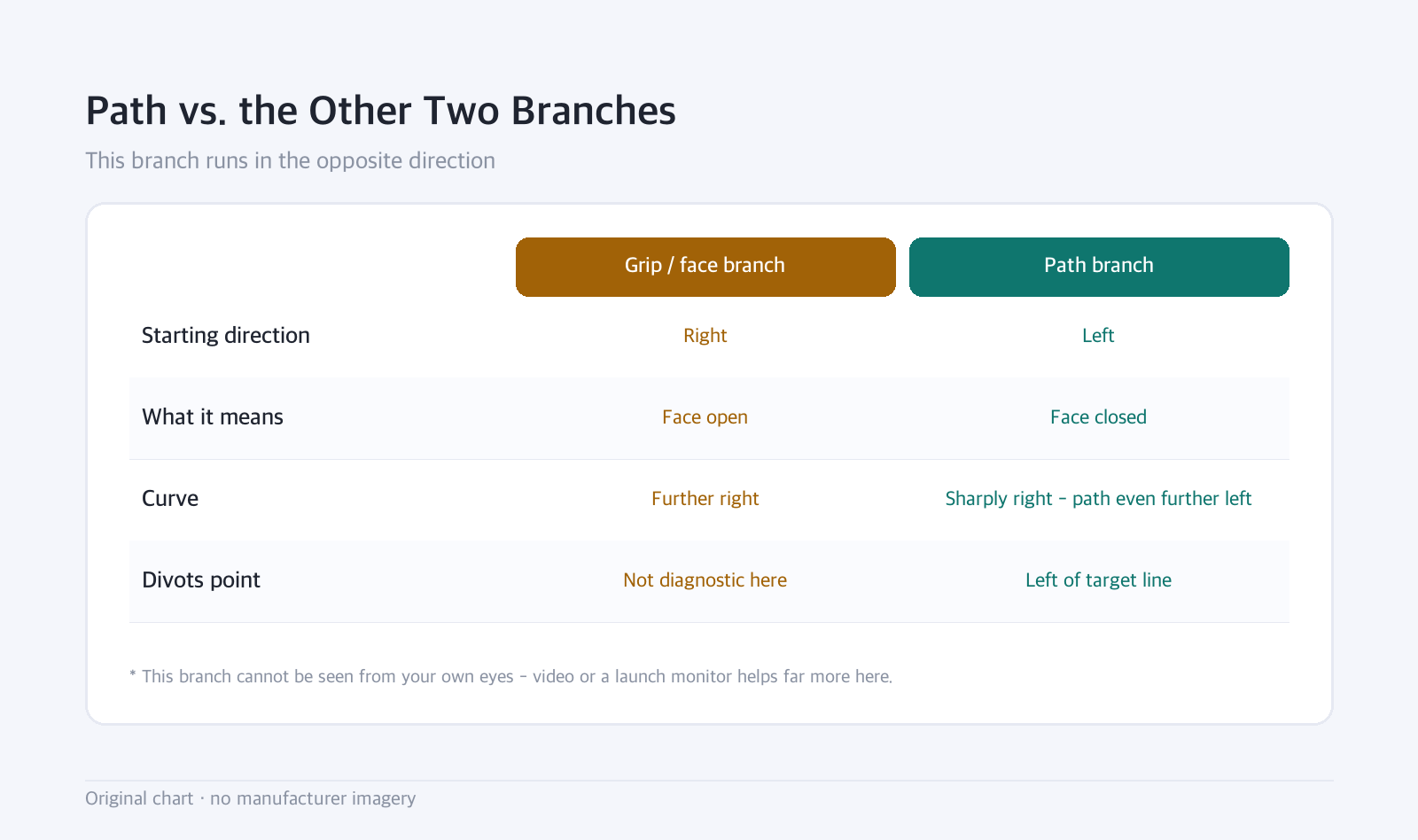
This branch's signs run opposite to the previous two.
- Shots start left — meaning the face was closed.
- Yet the ball curves sharply right — the path is far further left than the face.
- Divots point left of the target line.
- The leftward start is more pronounced with irons than the driver.
If this combination fits, neither grip nor face is the branch. This golfer's face is already closed. Strengthening the grip further from here pushes the shot into a hook.
The pattern flagged elsewhere in this series as "the most commonly misread box" is exactly this case.
3. It starts at the shoulders
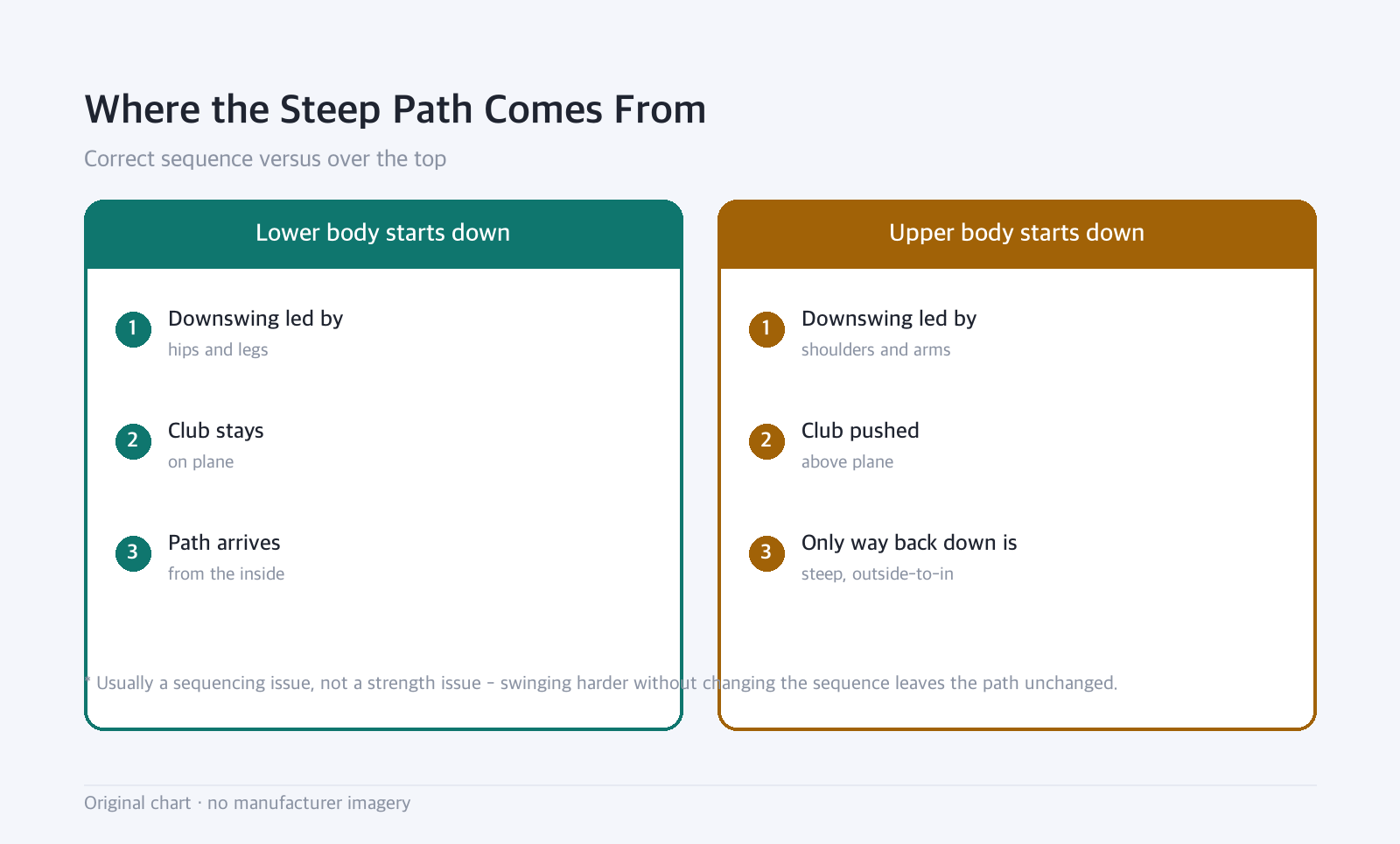
The common teaching explanation for why over the top happens concerns the sequence that starts the downswing.
Starting the downswing with the upper body — shoulders and arms — instead of the lower body pushes the club above its natural plane. From there, the only path back down is steep and outside-to-in.
That's the origin of the name "over the top" — the club is what goes over, and the shoulders are what send it there.
Worth noting: this is usually explained as a sequencing problem, not a strength problem. Trying to swing hard can push someone toward starting with the upper body, but easing off the effort without changing the sequence leaves the path unchanged.
4. Common traps in this branch
First, "swing more from the inside" can overcorrect.
Rotating the path rightward reduces the slice. But for a golfer whose face was already closed, once the path swings past the face, it flips into a hook. The direction reverses — the problem doesn't disappear.
Second, aiming left feeds this branch.
A slice leads to aiming left, and aiming the body left drags the swing along with it. The out-to-in path gets worse. A later piece covers this feedback loop on its own.
Third, this branch is the hardest to fix alone.
Grip is visible. Face can be worked out from starting direction. But path can't be seen from your own eyes. Video or a launch monitor helps far more here than with the other branches.
5. What can be checked
Without a launch monitor, two things help.
Divot direction. Hit an iron off turf and check which way the divot points. Pointing left of the target line means the path is left. This is one of the few clues visible to the naked eye.
Video from behind. Filmed from directly behind the target line, the club's downswing route is visible. From face-on or side-on, this branch is hard to see.
If both are unavailable, the ten-shot starting-direction log from the previous piece still splits the branches. Mostly left points here.
6. Who this is useful for
- Golfers who start left and curve sharply right — this is the branch.
- Golfers who strengthened their grip and started hooking — the branch may have been misidentified.
- Golfers who've never checked divot direction — it's one of the few clues visible without equipment.
- Golfers deciding whether to take a lesson — this branch is the hardest to fix solo.
This is less useful for:
- Golfers whose shots start right — go to the two previous pieces.
- Golfers who only slice with the driver — check the piece on gear effect first.
7. What we could not confirm
- How well-verified the sequencing explanation for over the top is — it's a standard teaching explanation, and we could not confirm experimental backing.
- How closely divot direction correlates with actual club path — it's used as a directional indicator, but we could not confirm the margin of error.
- Success rates for self-correction — no data turned up.
In one line
Out-to-in by itself isn't a slice. If the face matches that path, the ball goes dead left.
Whether this is your branch splits on whether the ball starts left. Starting left and curving sharply right means the face was already closed. A grip fix here flips it into a hook.
And this branch can't be seen from your own eyes. Divots and video from behind are about the only clues available.
This piece summarizes general instruction concepts and is not personalized coaching advice. Ball flight fixes depend on individual swing mechanics — a launch monitor session or certified instructor can confirm what applies to you.