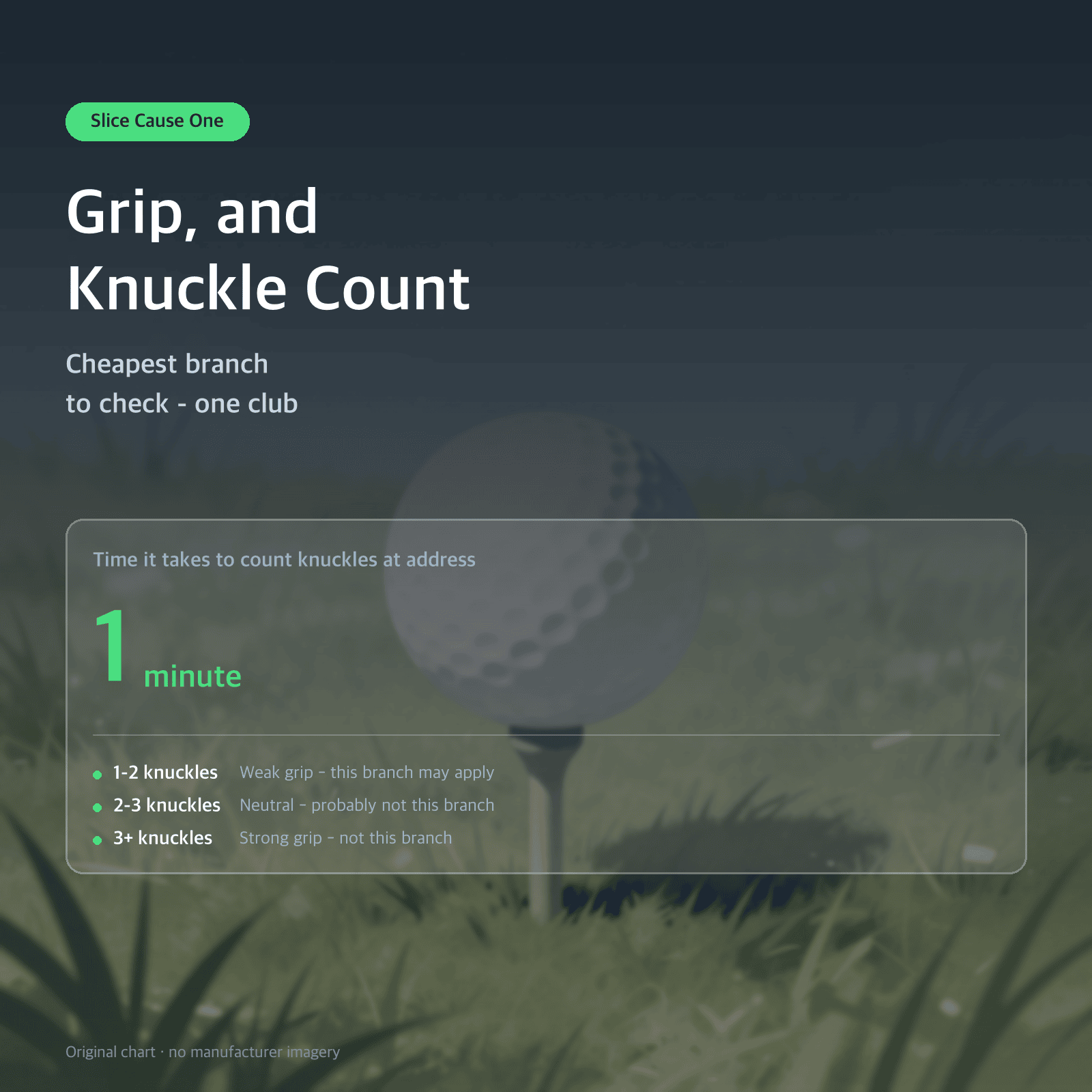
First of four causes: grip.
There's a reason to start here. It's the easiest to check, and fixing it doesn't require changing the swing.
And if grip is the actual cause but the swing gets changed instead, the swing gets worse while the slice stays.
For readers new to this series: a slice happens when the clubface is right of the swing path at impact, for a right-handed golfer. The same slice can come from four distinct causes, and this piece covers the first.
1. What a weak grip actually means
The terms first. "Weak" and "strong" have nothing to do with grip pressure.
They describe which way the hands are rotated on the club. For a right-handed golfer, a left hand rotated toward the target is a weak grip; rotated the other way is a strong grip.
Nothing to do with how hard you're holding it. A weak grip can be gripped tightly.
2. How to check — count knuckles
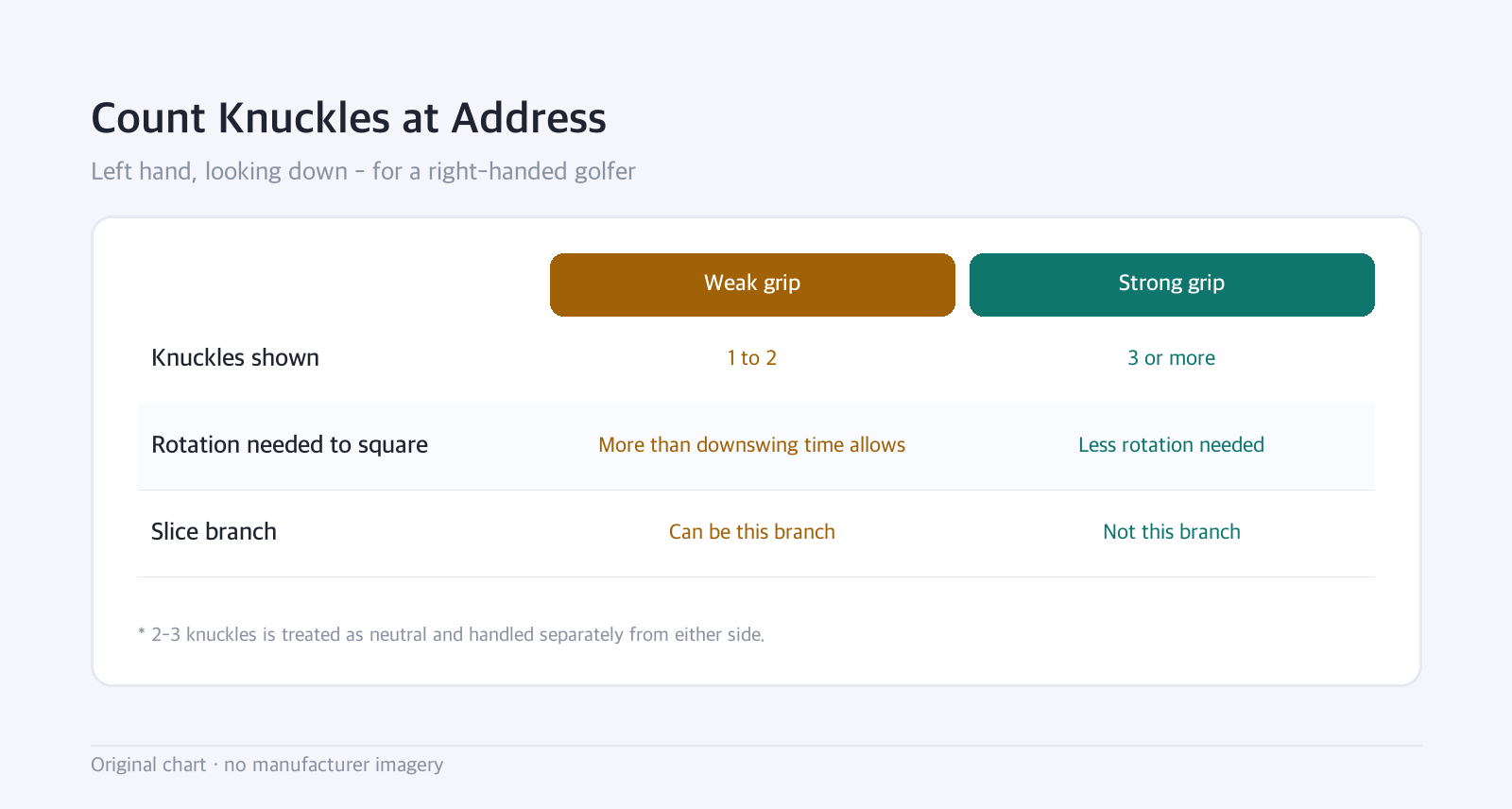
Look down at address. Count how many knuckles show on the back of the left hand.
- One to two — a weak grip. This can fall under the slice branch.
- Two to three — generally treated as neutral.
- Three or more — a strong grip. Here, grip isn't the cause of a slice.
This check doesn't require a driving range. One club at home is enough.
One thing worth flagging: the knuckle count is a diagnostic, not a prescription. Seeing one knuckle doesn't by itself confirm a slice. Check it alongside the next section.
3. Why a weak grip leaves the face open
The mechanics:
With a weak grip, squaring the face by impact requires far more forearm and wrist rotation.
But the downswing only has so much time available. More rotation is required while the time stays the same.
The usual outcome: impact arrives before the rotation finishes. The face meets the ball still open.
That's the definition covered separately: face right of path is a slice. A weak grip makes that condition easy to fall into — it's a starting point, not a certainty.
4. Signs that this is your branch
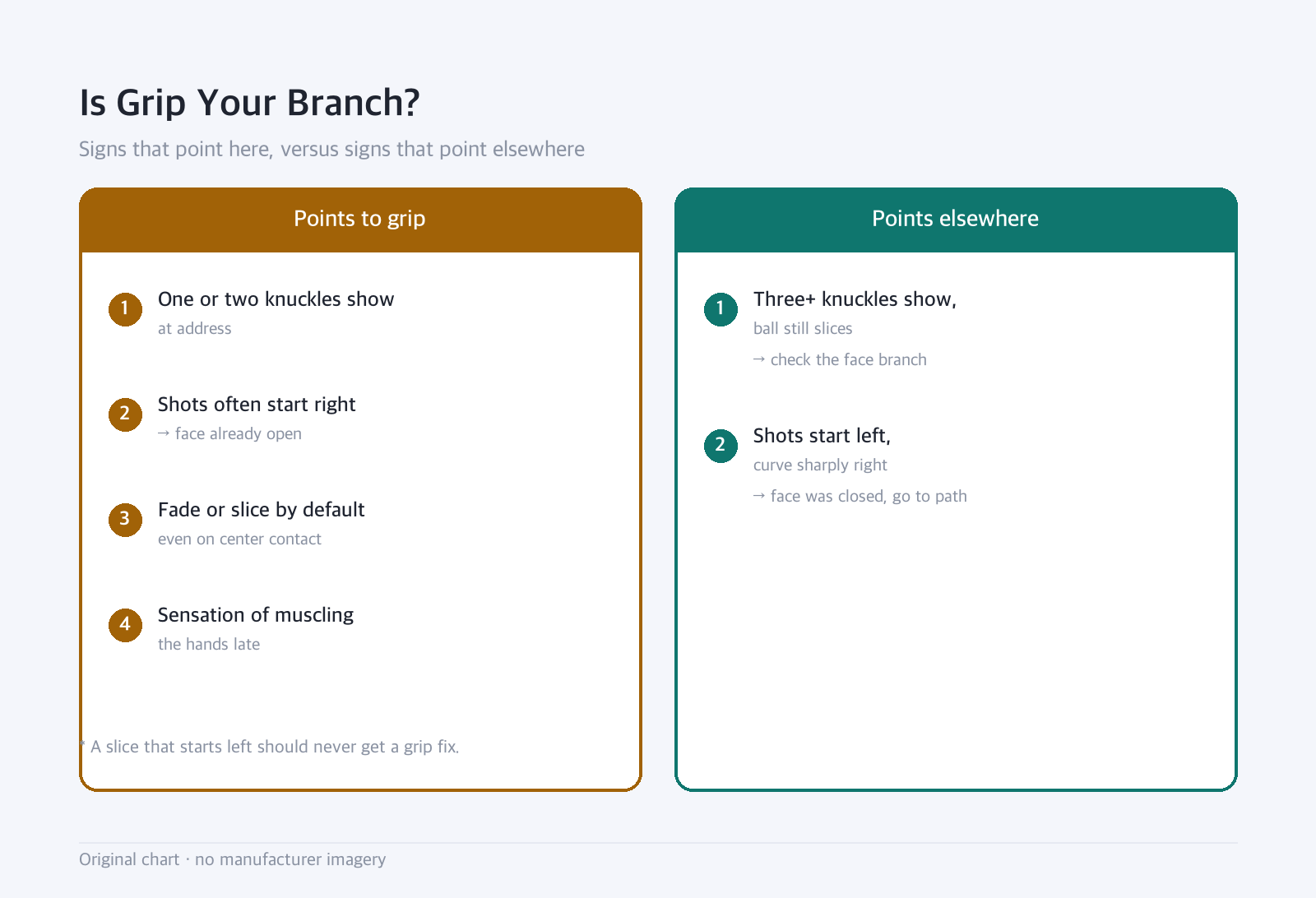
If grip is the cause, these tend to show up together:
- Only one or two knuckles show
- Shots often start right — meaning the face is already open
- Fade or slice is the default shape even on well-struck shots
- A sensation of muscling the hands and arms to rotate late
If the following apply instead, grip is probably not the branch:
- Three or more knuckles show, and the ball still slices
- Shots start left and curve sharply right — the face was closed; go to the path branch instead
The second point matters. A slice that starts left should not get a grip prescription.
5. Notes on making the change
Strengthening a grip is mechanically simple. Two things worth knowing first.
First, it feels wrong. Hand position is held in muscle memory, so a change reads as "incorrect" for a few days. That's normal.
Second, go too far and it turns into a hook. Read against the chart covered separately: once the face passes left of the path, the shot flips direction. The target is the point where the ball stops curving — not "as strong as possible."
So adjust gradually, not all at once. The goal is finding the point where the ball stops curving, not crossing over to the other side.
6. Where this branch stops applying
Worth being direct here. A slice that grip alone fixes is only a subset of cases.
Plenty of golfers slice with a neutral grip. In those cases, the cause is in one of the other three branches.
Grip is still worth checking first because the cost of checking is low — about a minute — and if it turns out to be the cause, the swing doesn't need to be touched at all.
Check whatever is cheapest to check, first. That's the ordering principle.
7. Who this is useful for
- Golfers whose shots start right — the face is already open, and grip can be the starting point.
- Golfers who want to self-check before a lesson — one club at home is enough.
- Golfers who'd rather not touch their swing — if this is the branch, the swing doesn't need to change.
- Beginners — a grip is far easier to set correctly before it hardens into habit.
This is less useful for:
- Golfers whose shots start left and curve sharply right — the face was closed; go to the path branch.
- Golfers who already show three or more knuckles — this branch doesn't apply.
8. What we could not confirm
- The correlation between knuckle count and actual face angle — hand size and grip thickness may shift this.
- The precise threshold for a neutral grip — instructors vary between two and three knuckles.
- How long adaptation takes after changing grip — this varies by individual, and we found no data.
- What share of slices trace to grip — no data on the distribution across the four branches turned up.
In one line
A weak grip doesn't open the face directly — it increases the amount of rotation needed to square it in time.
With the time fixed and the workload increased, the rotation often doesn't finish, and the face meets the ball open.
Checking it is just counting knuckles, and it takes a minute. Check what's cheap to check first. But if the grip is neutral and the slice is still there, the cause is in one of the other three branches.
This piece summarizes general instruction concepts and is not personalized coaching advice. Ball flight fixes depend on individual swing mechanics — a launch monitor session or certified instructor can confirm what applies to you.