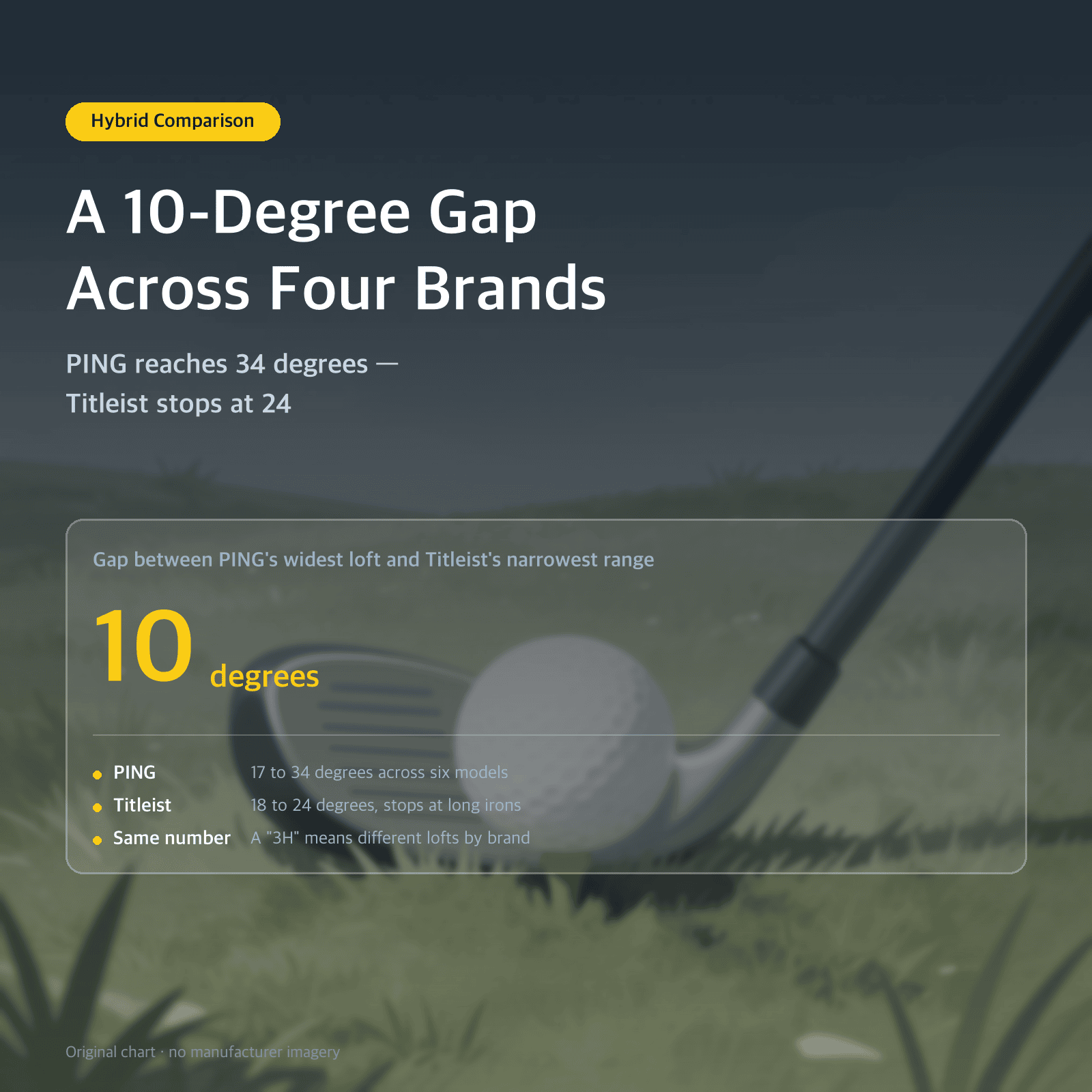
Hybrids look similar across brands — the expectation going in was that lofts would differ by a few degrees at most.
Lining up official spec sheets side by side, that wasn't the case. Titleist's range stops at 24 degrees, while PING's goes up to 34. A 10-degree gap.
Both use the word "hybrid," but where each brand draws the category's boundary is different.
1. What's being compared
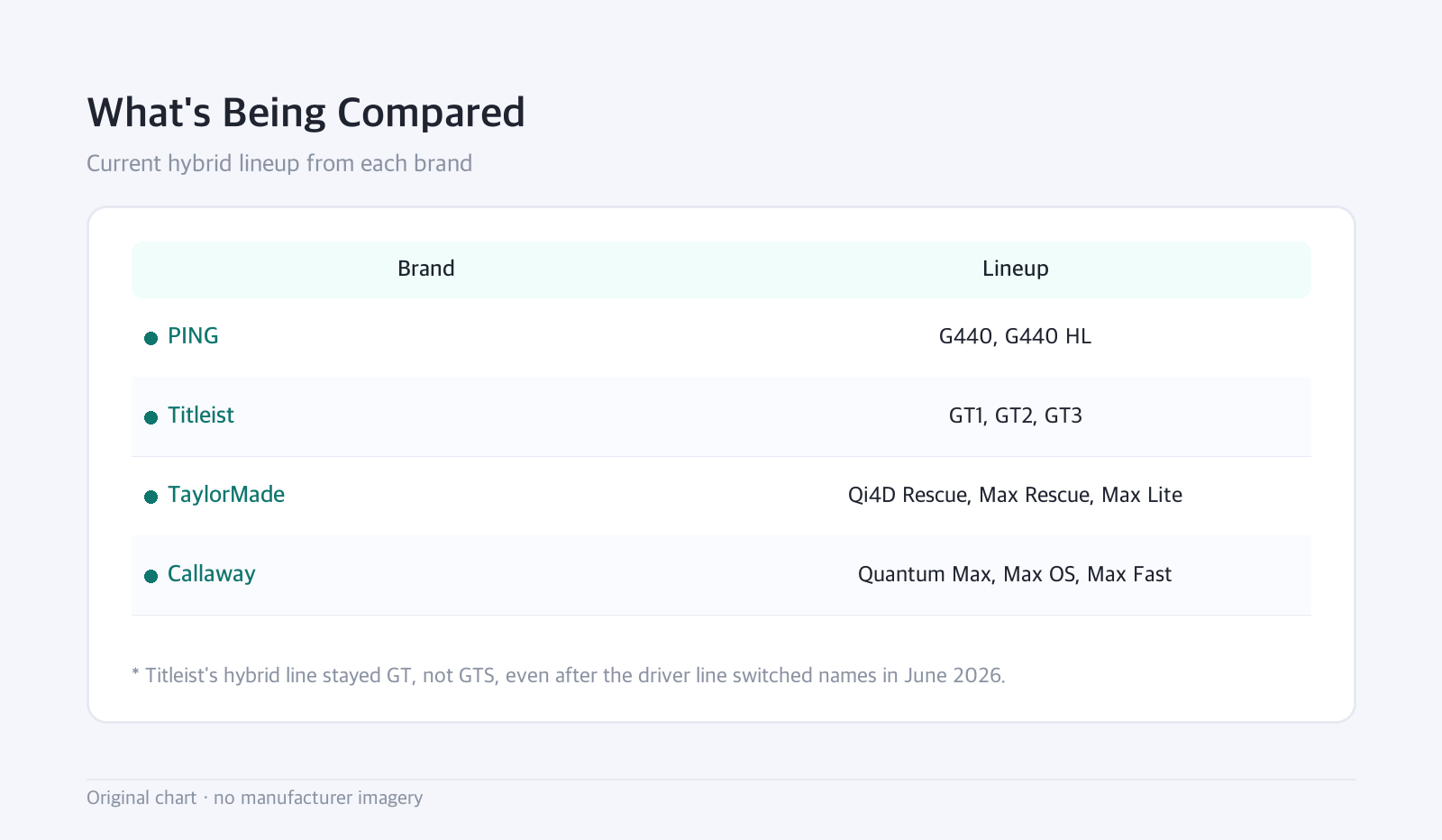
The current hybrid lineup from each brand:
- PING — G440, G440 HL
- Titleist — GT1, GT2, GT3
- TaylorMade — Qi4D Rescue, Qi4D Max Rescue, Qi4D Max Lite
- Callaway — Quantum Max, Quantum Max OS, Quantum Max Fast
Srixon's current hybrid lineup could not be confirmed and is excluded from this comparison.
One thing worth flagging first: Titleist's hybrid is the GT, not the GTS.
Titleist's driver line switched from GT to GTS in a full replacement in June 2026. The hybrid line did not — it remains GT1, GT2, GT3. No GTS hybrid has been announced. If you remember the driver name and go looking for a hybrid under it, you'll be looking for something that doesn't exist.
2. Loft range — where the gap is widest
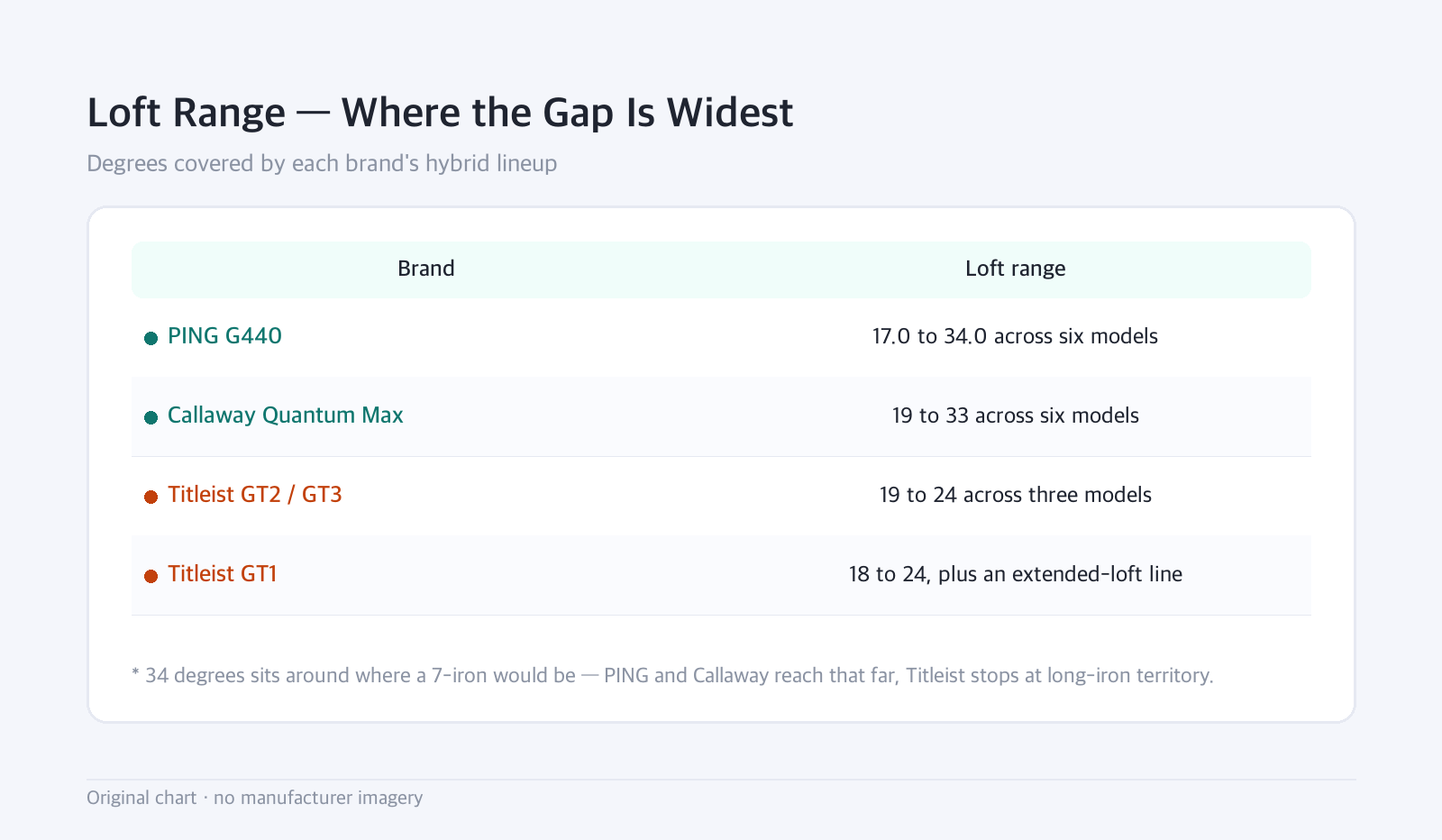
The range each brand covers with hybrids:
- PING G440 — 17.0 to 34.0 degrees across six models
- Callaway Quantum Max — 19 to 33 degrees across six models
- Titleist GT2 / GT3 — 19 to 24 degrees across three models
- Titleist GT1 — 18 to 24 degrees (plus a separate extended-loft line at 20, 23, 26, and 29 degrees)
PING and Callaway reach into the middle of a standard iron set — 34 degrees sits around where a 7-iron would be.
Titleist stops at 24 degrees, roughly the long-iron territory.
This isn't better or worse — it's a difference in how each brand defines the category. But the result is clear: if you want to replace your 6- or 7-iron with a hybrid, Titleist doesn't have that option.
3. Same number, different loft
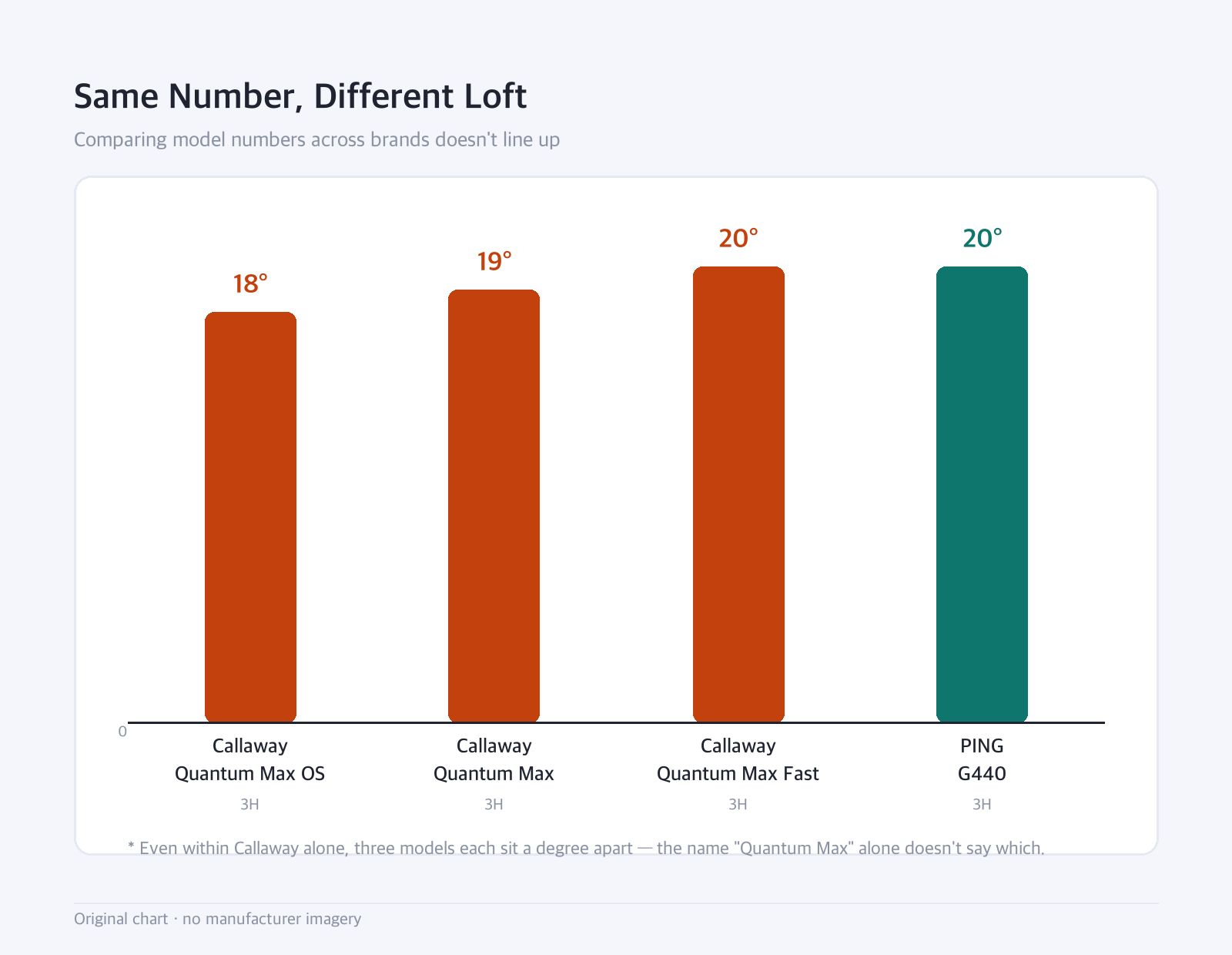
Comparing model numbers across brands doesn't line up. Take the 3-hybrid as an example:
- PING 3H — 20 degrees
- Callaway Quantum Max 3H — 19 degrees
Callaway goes a step further. Even within the same brand, standard loft varies by model.
- Quantum Max OS — 18 degrees
- Quantum Max — 19 degrees
- Quantum Max Fast — 20 degrees
Three models, each off by a degree from the next. "Quantum Max hybrid" alone doesn't tell you whether it's 18 or 20 degrees.
Comparing across brands means talking in loft, not model number.
4. Titleist's GT2 and GT3 share identical lofts
Within a single brand, there's something else to check. GT2 and GT3 both carry the same 19, 21, and 24 degree lofts. No difference at all.
A loft chart can't distinguish the two models. Whatever separates them, it isn't loft.
GT1 alone starts one degree lower at 18, and has a separate extended-loft line (20, 23, 26, 29 degrees) aimed at slower swing speeds. If you're looking for a Titleist hybrid above 24 degrees, GT1's extended line is the only path.
5. Adjustability also differs
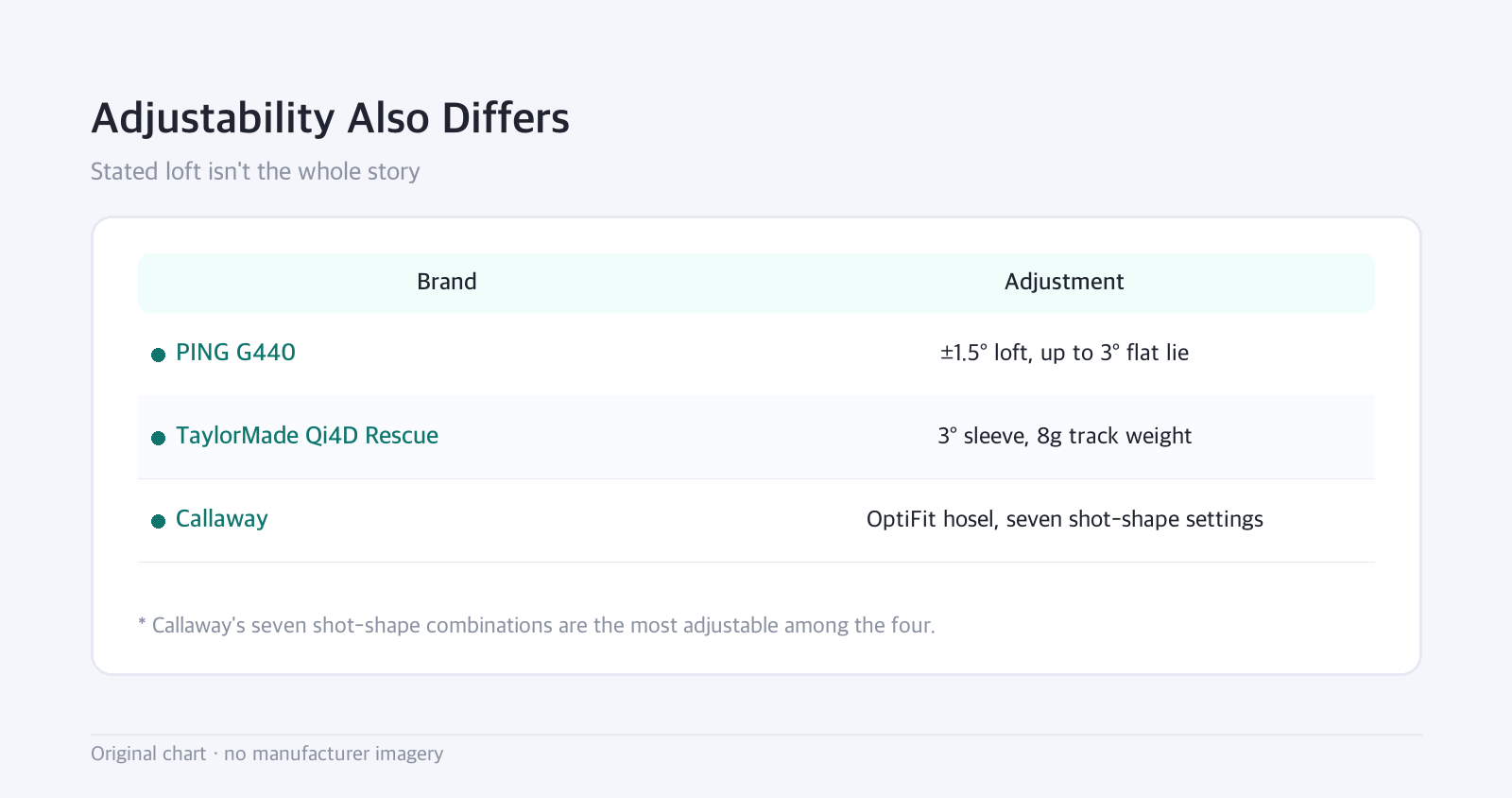
Stated loft isn't the whole story. Adjustment range extends how much of that spread is actually usable.
- PING G440 — ±1.5 degrees loft, up to 3 degrees flat lie
- TaylorMade Qi4D Rescue — 3-degree sleeve (±1.5 degrees from stated loft), 8-gram track weight
- Callaway — OptiFit hosel, 3-degree adjustment, seven shot-shape settings
PING's ±1.5 degrees and TaylorMade's 3-degree sleeve amount to the same swing — just labeled differently.
Callaway goes beyond loft and offers seven distinct shot-shape combinations, giving it the most adjustable combinations among the four.
6. Who this comparison is useful for
Judgment criteria inferred from confirmed specs.
- Golfers replacing a 6- or 7-iron — only PING (34 degrees) and Callaway (33 degrees) reach that range. Titleist stops at 24.
- Golfers filling the gap between a fairway wood and a long iron — all four brands cover that range (19–24 degrees). Loft range isn't a deciding factor here.
- Titleist driver owners — the hybrid line is GT, not GTS. A different name doesn't mean an older generation.
- Golfers who want fine adjustability — Callaway's seven shot-shape settings offer the most combinations.
This is less useful for:
- Golfers comparing brands by model number — the same "3H" designation means 19 degrees in one brand and 20 in another, and Callaway itself spreads 18/19/20 degrees across its own line.
- Golfers trying to distinguish GT2 from GT3 by loft — the two models share identical lofts.
7. What we could not confirm
- Srixon's current hybrid lineup — could not be confirmed and was excluded from this comparison.
- What separates GT1, GT2, and GT3 — lofts overlap, so the distinguishing factor could not be confirmed.
- The full loft range for the standard TaylorMade Qi4D Rescue — only the Max line's lofts (20, 23, 26 degrees) were confirmed.
- PING HL line lofts — only the 3H–7H configuration was confirmed.
- Length, lie angle, and swing weight — only confirmed for PING's official spec sheet.
In one line
Hybrids don't just differ by a few degrees of loft brand to brand — they differ in where each brand decides the category ends.
PING and Callaway reach into the middle of an iron set, while Titleist stops around the long irons. So the question isn't "which brand is better," but what gap you're actually trying to fill — settling that first narrows the field on its own.
Loft ranges and adjustment ranges in this piece come only from official manufacturer spec sheets and stated specifications. Where a value could not be confirmed, it was left blank.
This piece summarizes general instruction concepts and is not personalized coaching advice. Ball flight fixes depend on individual swing mechanics — a launch monitor session or certified instructor can confirm what applies to you.