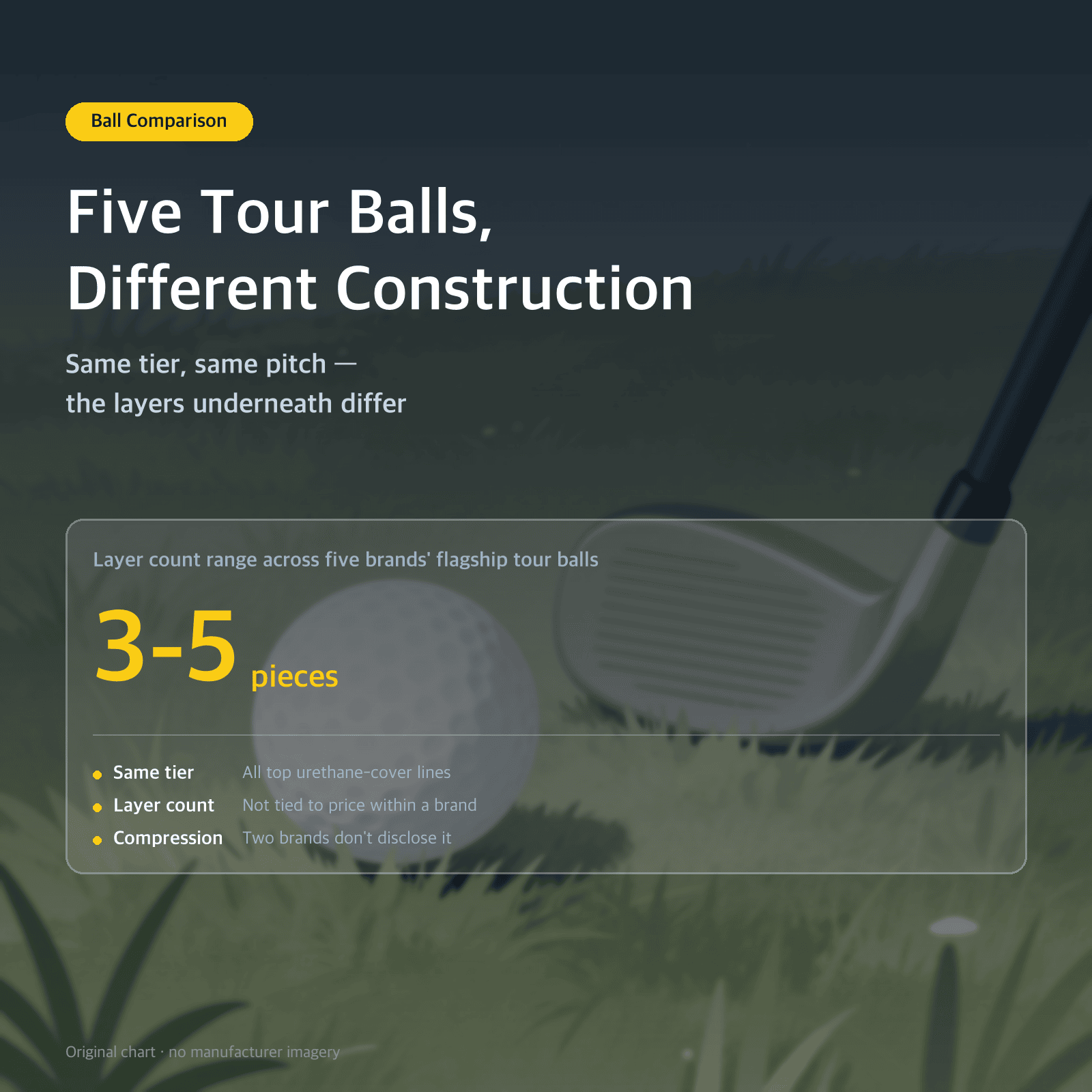
Tour balls sit at the top of each brand's lineup. The pitch is similar across brands: comparable pricing, "what the pros play."
Lining up the current models from five brands using official specs, the construction underneath turned out to differ more than expected — layer counts ranging from three to five, and street prices spread across a real gap.
Here is what's the same and what isn't.
1. What counts as the same tier
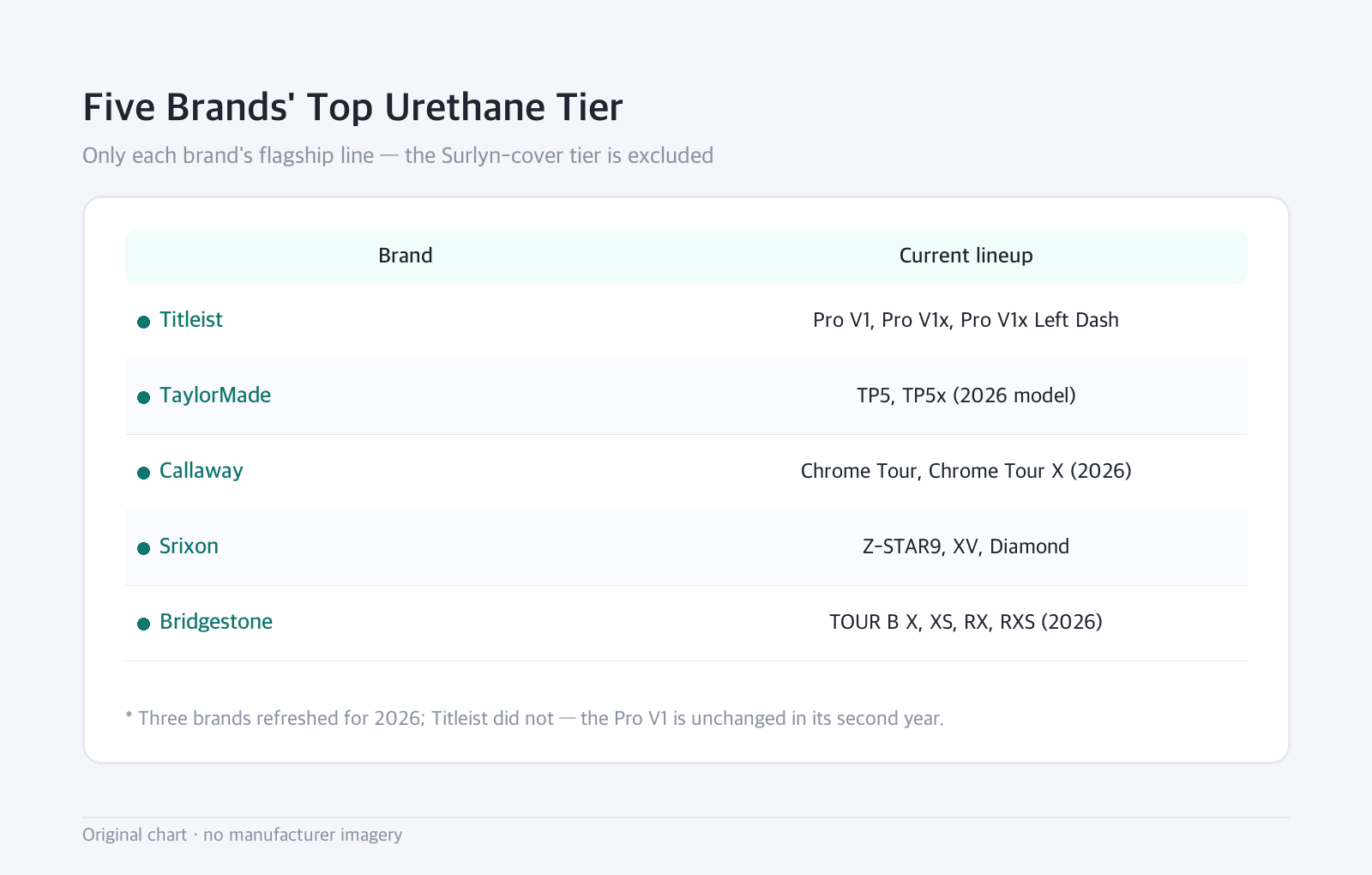
Only each brand's top urethane-cover line is included here. The tier below (Surlyn cover) is excluded.
- Titleist — Pro V1, Pro V1x, Pro V1x Left Dash
- TaylorMade — TP5, TP5x (2026 model)
- Callaway — Chrome Tour, Chrome Tour X (2026 model)
- Srixon — Z-STAR9, Z-STAR9 XV, Z-STAR9 Diamond
- Bridgestone — TOUR B X, XS, RX, RXS (2026 model)
One thing worth flagging first: some brands released a 2026 model, others didn't.
TaylorMade, Callaway, and Bridgestone all put out new 2026 models. Srixon's ninth generation remains current. Titlist did not refresh for 2026 — the 25th-anniversary model is in its second year unchanged. So calling it "the 2026 Pro V1" isn't accurate.
2. Layer count and pricing, side by side
| Model | Layers |
|---|---|
| Pro V1 | 3-piece, 388 dimples |
| Pro V1x | 4-piece, 348 dimples |
| TP5 / TP5x | 5-piece |
| Chrome Tour / Tour X | 4-piece |
| Z-STAR9 / XV | 3-piece / 4-piece |
| TOUR B X | 3-piece |
Only confirmed values are included.
Within the same tier, layer count runs from three to five.
3. More layers did not mean a higher price
This is the most striking part of the table.
TP5, the ball with the most layers (five), does not carry a premium over Pro V1, which has the fewest (three) among these lines. Layer count and price simply don't move together. What sets price is brand pricing strategy and distribution, not construction complexity.
Layer count isn't even a tier marker within a single brand. Titleist prices the 3-piece Pro V1 and the 4-piece Pro V1x the same. Srixon does the same with Z-STAR9 (3-piece) and XV (4-piece). If an extra layer signaled a step up in tier, the price would move with it — it doesn't.
4. Compression: some brands disclose it, some don't
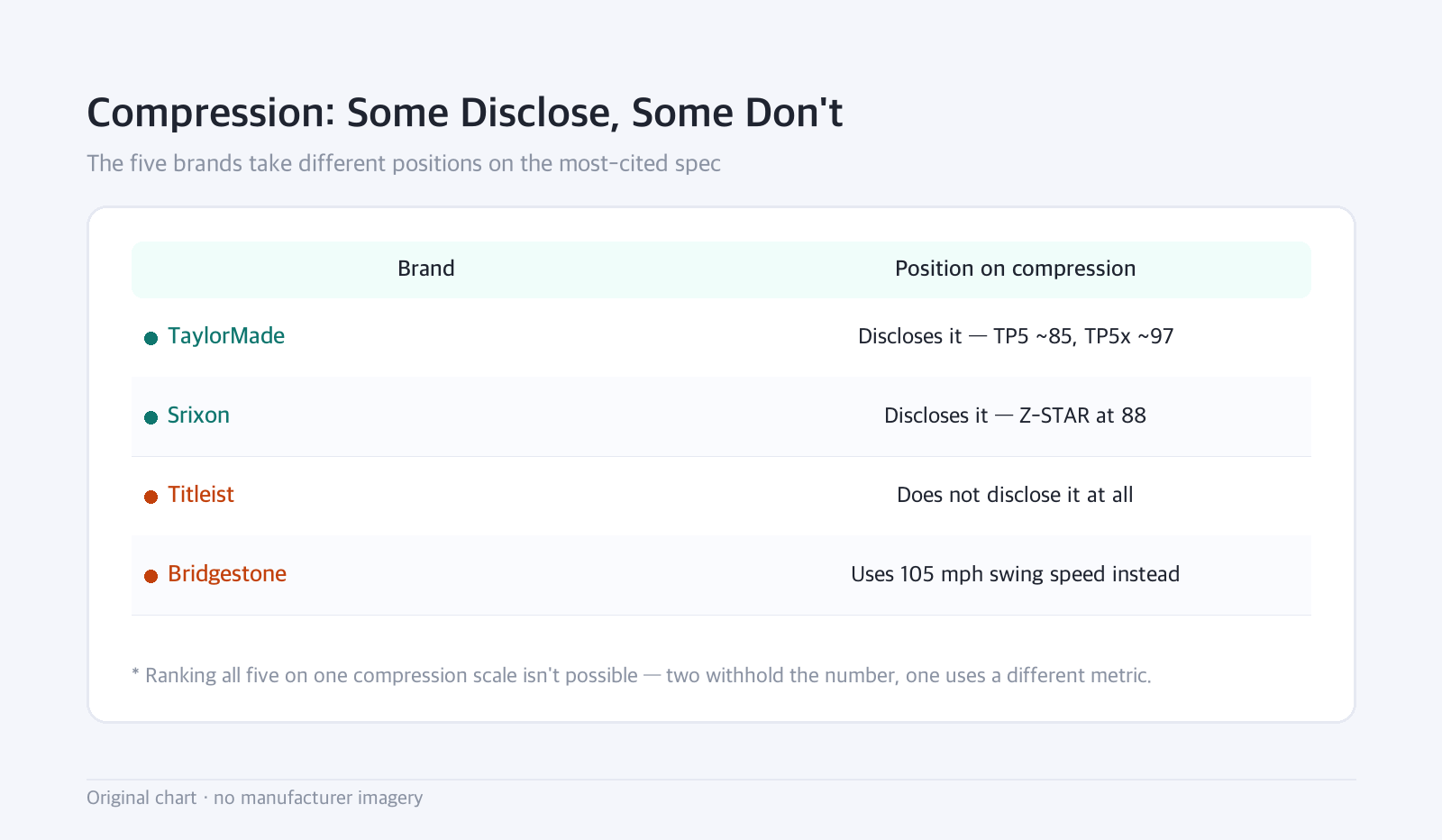
Compression is the most commonly cited selection criterion, and the five brands take different positions on it.
- TaylorMade — discloses it. TP5 around 85, TP5x around 97.
- Srixon — discloses it. Z-STAR at 88, stated to be the lowest in its own lineup.
- Titleist — does not disclose it. The brand's stated position is that it does not fit balls to swing speed via compression at all.
- Bridgestone — uses 105 mph swing speed as the dividing line between lines instead of compression. X/XS sit above that threshold, RX/RXS below it.
Ranking all five brands on a single compression scale isn't possible: two withhold the number, and one uses an entirely different metric.
5. What each brand changed for 2026
Looking at what the brands that did refresh actually touched, a pattern emerges. None of them touched layer count.
- TaylorMade — coating. A "micro-coating" process applies material in increments of one-millionth of a gram for a more even thickness, aimed at reducing dispersion in wind.
- Callaway — mantle material. A new "Tour Fast Mantle" with flexural modulus raised roughly 16% over the previous version, aimed at gaining ball speed without raising compression.
- Bridgestone — core and mantle. A material called "VeloSurge," reportedly narrowed down from 240 prototypes to four.
- Srixon — core formulation and cover. A "FastLayer DG Core 2.0" paired with a biomass-content ultra-thin urethane cover.
The impression here is not an era of adding layers, but one of refining the material and finish of the layers already in place.
6. Who this comparison is useful for
Judgment criteria inferred from confirmed differences.
- Golfers shopping on a budget — street prices vary considerably within the same tier. Compare against street price, not list price, to get the order right.
- Golfers with a measured driver swing speed — Bridgestone is the only brand that explicitly splits its line at a stated threshold (105 mph), which can cut the field in half.
- Golfers choosing between sibling models within one brand — layer count (3-piece vs. 4-piece) is where that brand actually draws the line.
- Golfers who practice heavily on indoor simulators — Titleist alone offers a separate spec built for indoor measurement setups.
This is less useful for:
- Golfers trying to rank balls by layer count — the same brand prices a 3-piece and a 4-piece identically.
- Golfers trying to rank all five brands by compression — two brands don't publish a number, so the table can't be completed.
7. What we could not confirm
Gaps left in this comparison:
- Dimple counts for Callaway, Srixon, TaylorMade, and Bridgestone — only Titleist's official dimple count was confirmed.
- Layer thickness and exact material composition — undisclosed across all brands.
- Layer count for Bridgestone TOUR B XS, RX, and RXS — only the X's 3-piece construction was confirmed via retail listing.
- Callaway Chrome Tour's standard retail price — the confirmed figure applies to a limited edition only.
- Layer count for Srixon Z-STAR9 Diamond — not confirmed.
- Measured distance and spin — omitted, since these vary by tester and conditions.
In one line
All five brands' tour balls compete for the same shelf space, but the construction underneath, the pricing, and even what each brand chooses to disclose all differ.
So "which tour ball is best" doesn't have a clean answer. Compare layer count within a single brand, compare price by street price rather than list price, and if a swing-speed threshold matters to you, start with the brand that actually states one.
Layer counts, dimple counts, and prices in this piece come only from official manufacturer specs and confirmed retail listings. Where a value could not be confirmed, it was left blank.
This piece summarizes general instruction concepts and is not personalized coaching advice. Ball flight fixes depend on individual swing mechanics — a launch monitor session or certified instructor can confirm what applies to you.