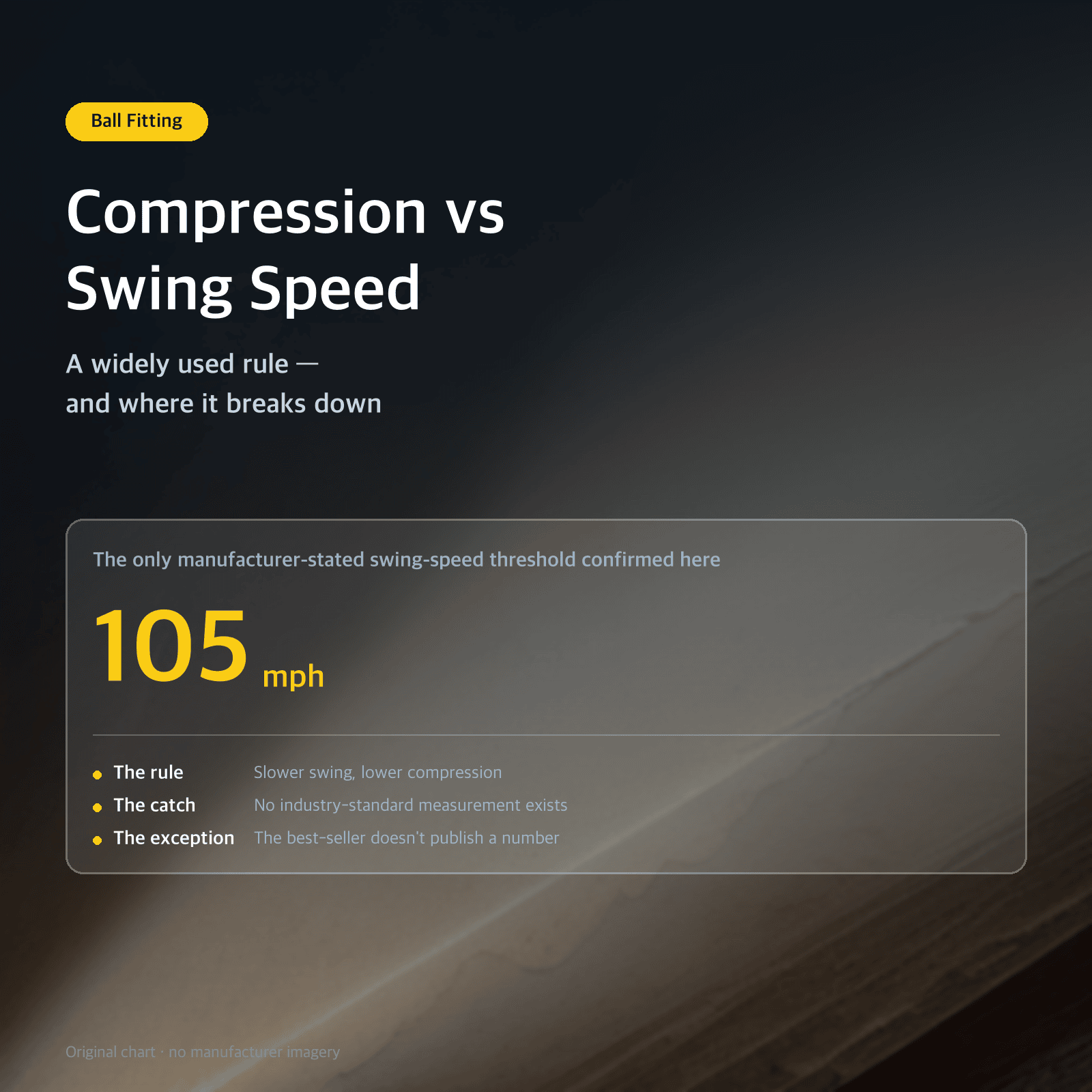
Compression is the most widely used criterion for choosing a golf ball. The line that comes with it, almost automatically, is "slower swing, lower compression."
We checked how well that rule actually holds up. The short version: there's a range where it works and a range where it doesn't — and, notably, manufacturers themselves disagree on it.
One side splits its lineup by swing speed. The other states publicly that it does not recommend balls by swing speed.
1. What compression actually measures
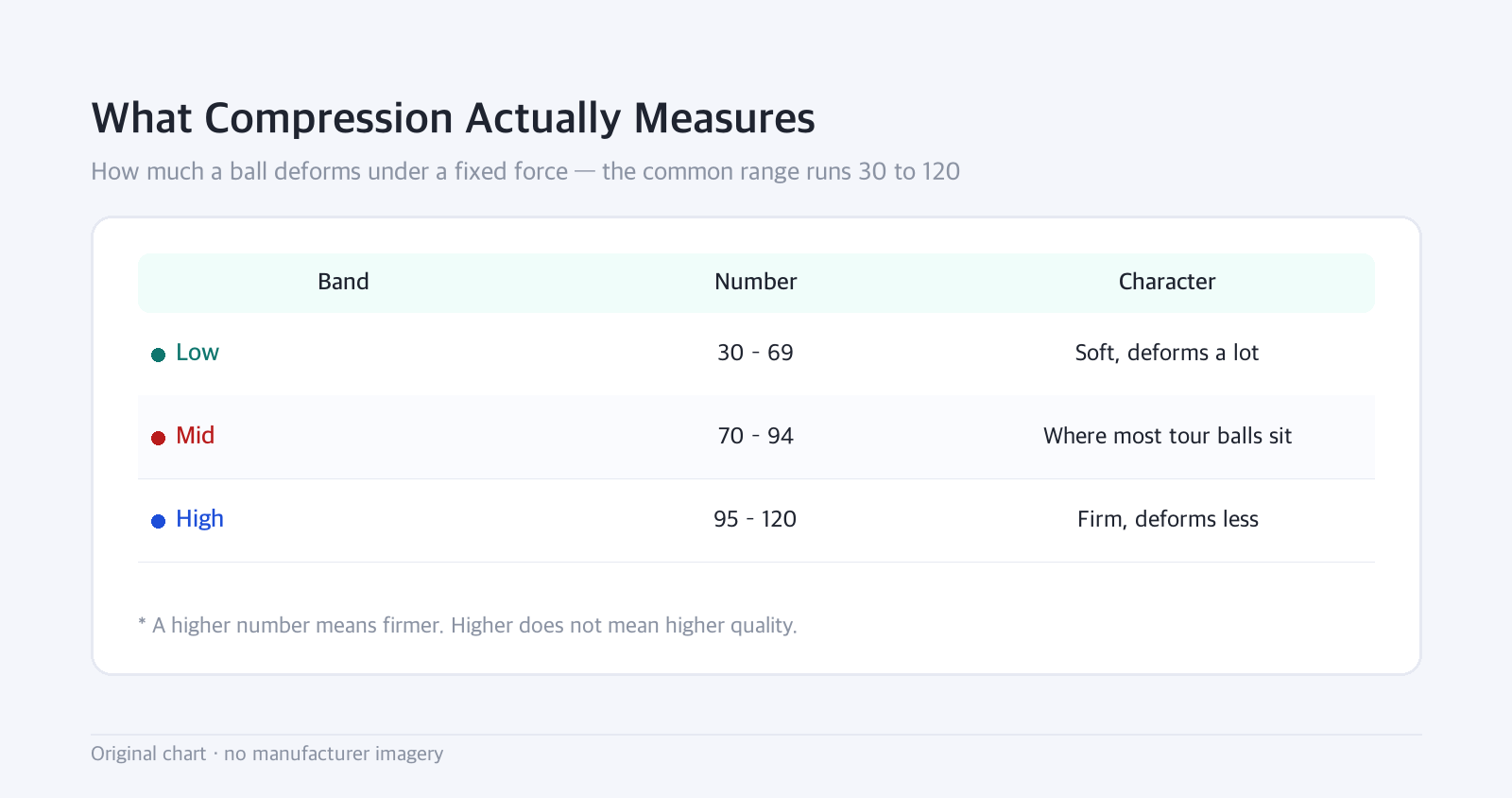
Compression is a number for how much a ball deforms under a fixed applied force. Deform less and the number is higher; deform more and the number is lower.
The commonly used range runs from 30 to 120. Thirty is the softest end, 120 the firmest. Today's tour balls mostly cluster between 80 and 100.
2. The widely used swing-speed bracket
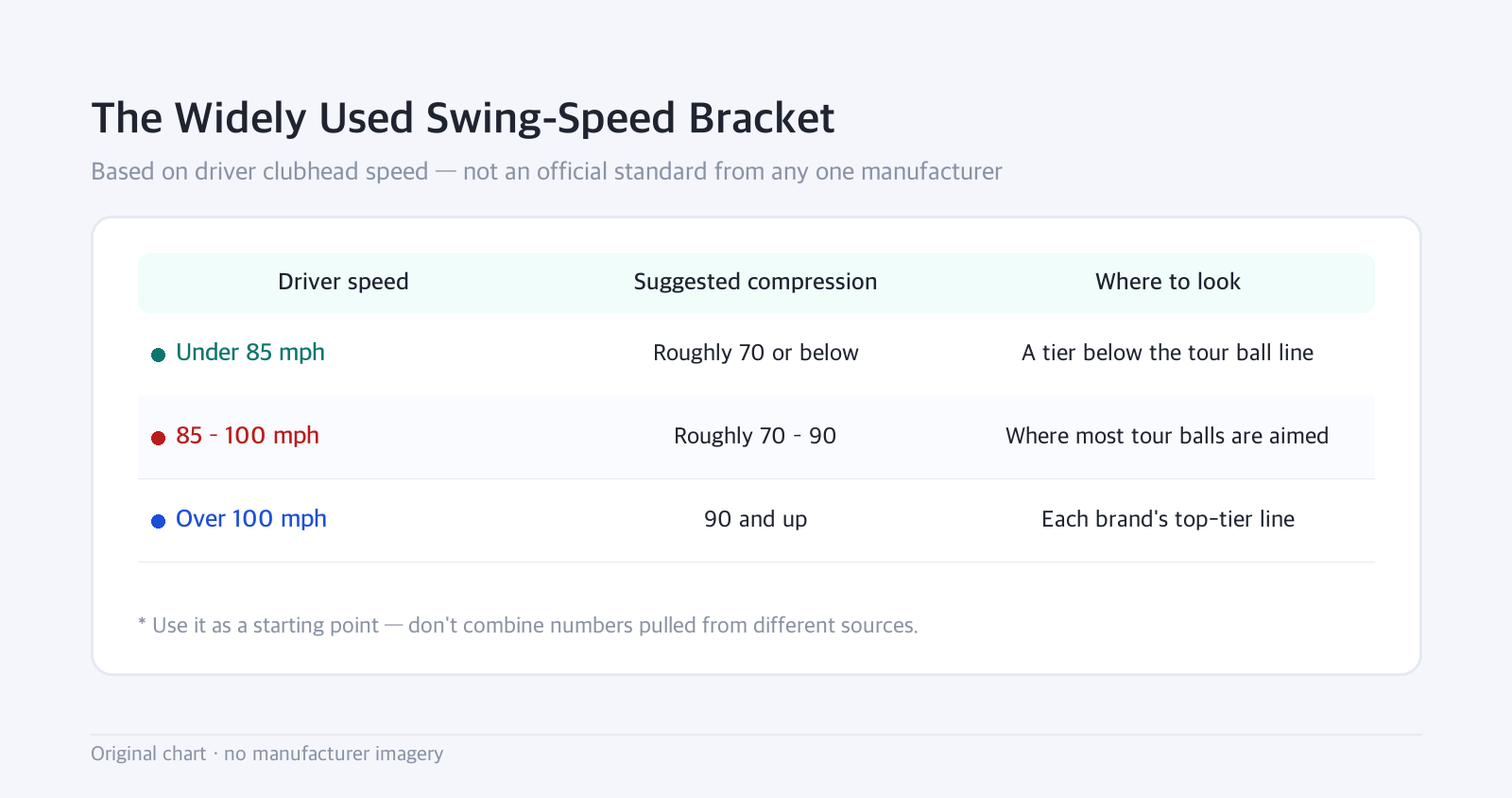
Start with the chart that's actually in circulation. Based on driver clubhead speed, it splits into three bands.
- Under 85 mph — lower compression, roughly 70 or below
- 85–100 mph — mid compression, roughly 70–90
- Over 100 mph — higher compression, 90 and up
The logic is simple: a ball has to be compressed enough to spring back the way it was designed to. Below a certain speed, a firm ball never gets compressed enough to do that.
This chart is a reasonable starting point. But two caveats attach to it, and they make up the rest of this piece.
3. Caveat one — the measuring stick isn't standardized
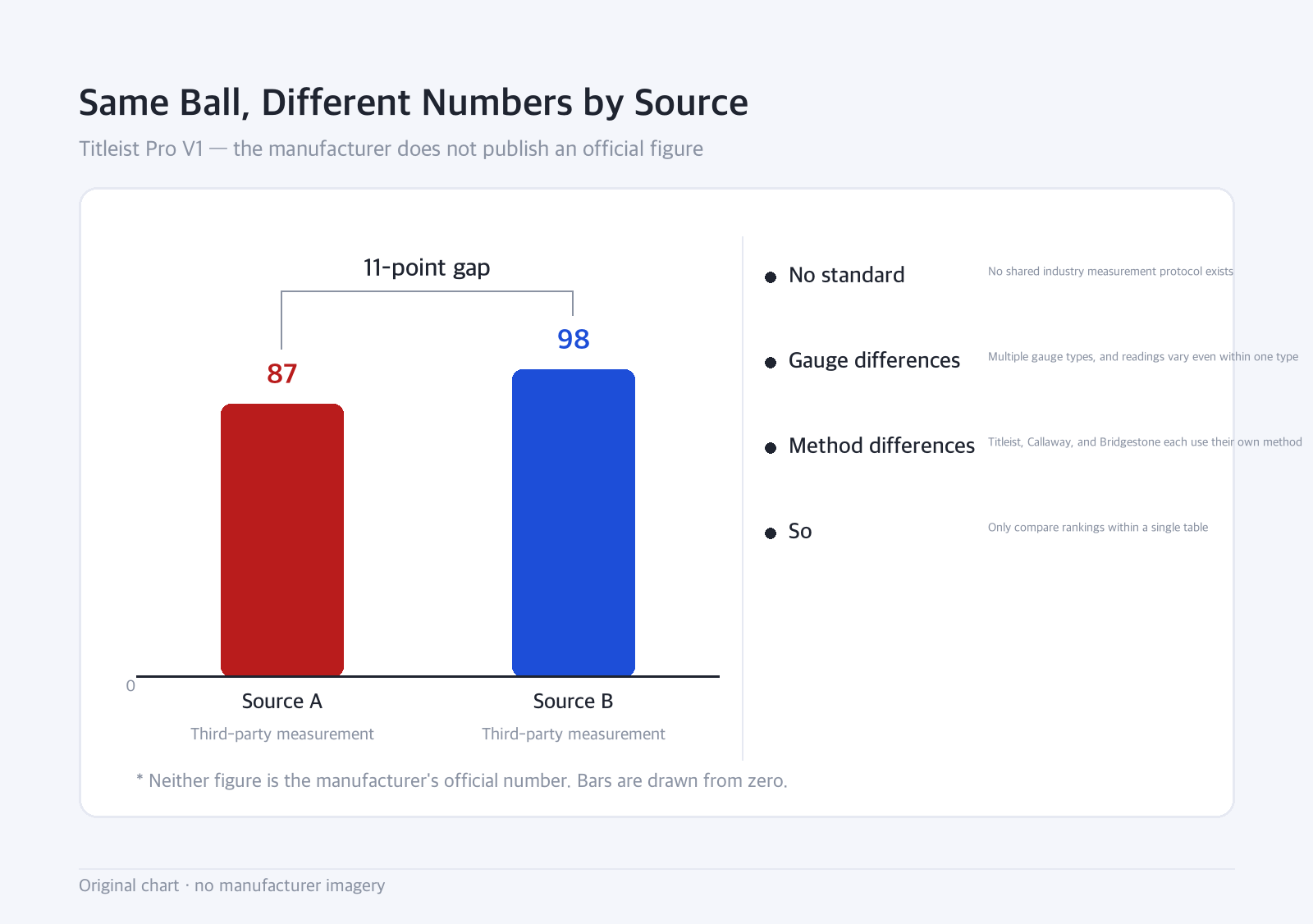
There is no industry-standard measurement protocol for golf ball compression.
- Gauges aren't all the same type.
- Even the same type of gauge produces slightly different readings machine to machine.
- Major manufacturers each use their own method.
So it's entirely possible for one brand's 90 to be another chart's 87. The Titleist Pro V1's compression is listed as 87 in one table and 98 in another. Neither is a typo — both figures circulate.
Compare that to a club's loft. Thirty degrees is 30 degrees no matter what measures it, so brands can be lined up and compared directly. Compression can't, because the measurement conditions themselves shape the value.
Here's how to use it anyway. If one source measured a set of balls with one piece of equipment, the ranking within that table is trustworthy. What you should avoid is placing Site A's number next to Site B's number. Don't throw the table out — just stay inside it.
4. Caveat two — the biggest seller won't give you a number
Titleist, the best-selling ball on the market, does not publicly disclose its compression figure.
Further, that manufacturer has stated publicly that it does not recommend balls by swing speed in ball fitting. Its stated reasoning: there's no meaningful difference in how much a tour pro and an amateur compress the ball.
Instead, the sequence it recommends is this:
- Start from the green and work backward — because the biggest performance gaps show up around the green.
- Fit the ball first, then wedges and irons, and driver last.
- Driver performance is treated as the least important factor in ball fitting.
The logic: amateurs miss greens far more often than pros, so it makes more sense to look first at what separates balls around the green.
5. But other manufacturers do use swing speed
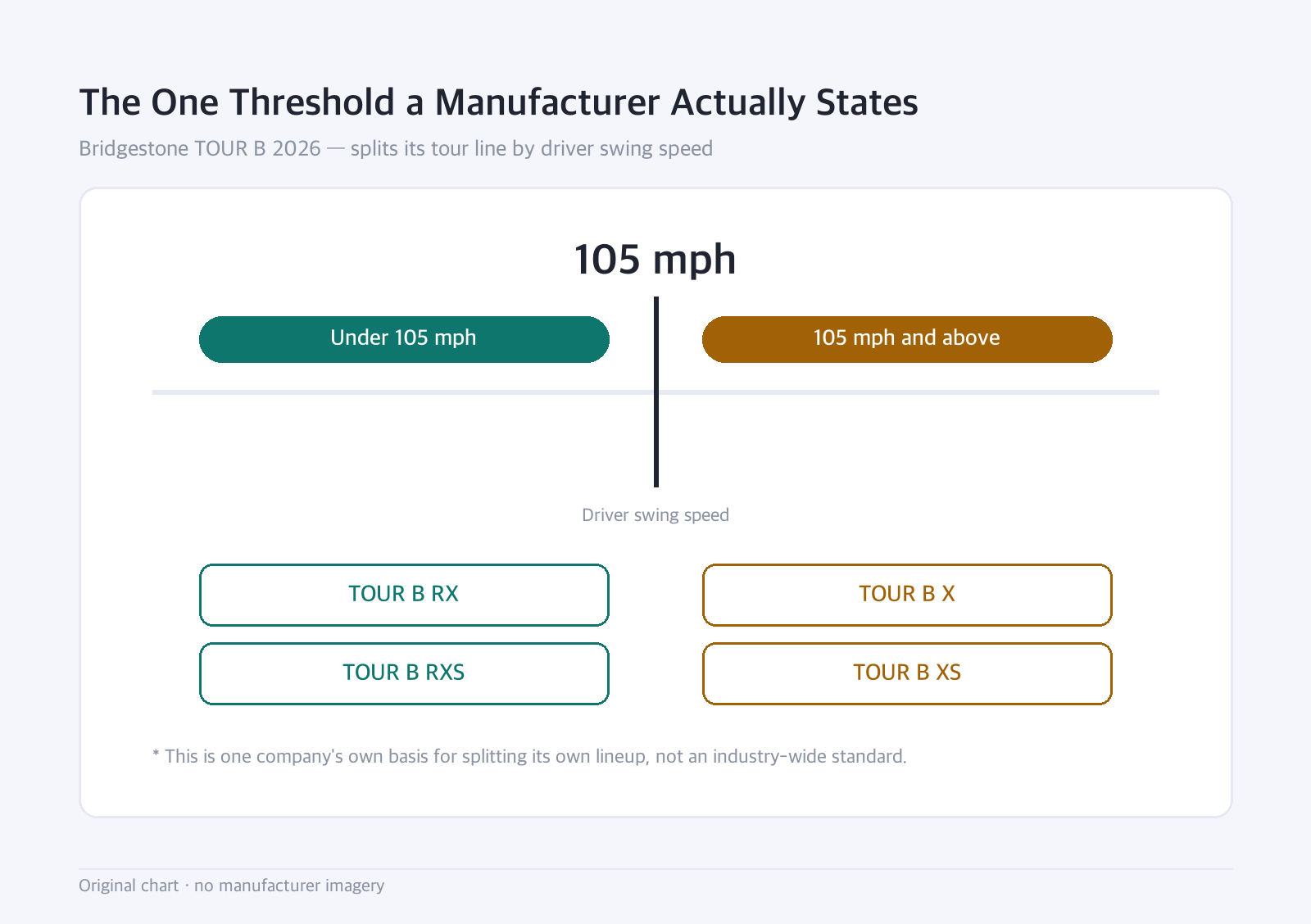
The opposite approach is just as clear. Bridgestone split its 2026 TOUR B four-model tour line at a 105 mph driver swing-speed threshold.
- 105 mph and above — TOUR B X and TOUR B XS
- Under 105 mph — TOUR B RX and TOUR B RXS
Same-name line, split into two branches by speed. This isn't a third party's inference — it's the manufacturer's own stated basis for splitting its own product.
Other brands do publish their own compression figures:
- Srixon's Z-STAR is listed at 88, described by Srixon as the softest in its own lineup.
- TaylorMade's TP5 is listed at roughly 85, described as the softest of its tour balls.
- Its companion model, TP5x, is listed at roughly 97.
All three numbers describe a position within that brand's own lineup. A published 88 isn't meant for comparison against a different brand — it means that ball is softer than its own stablemate.
6. So how do you actually choose
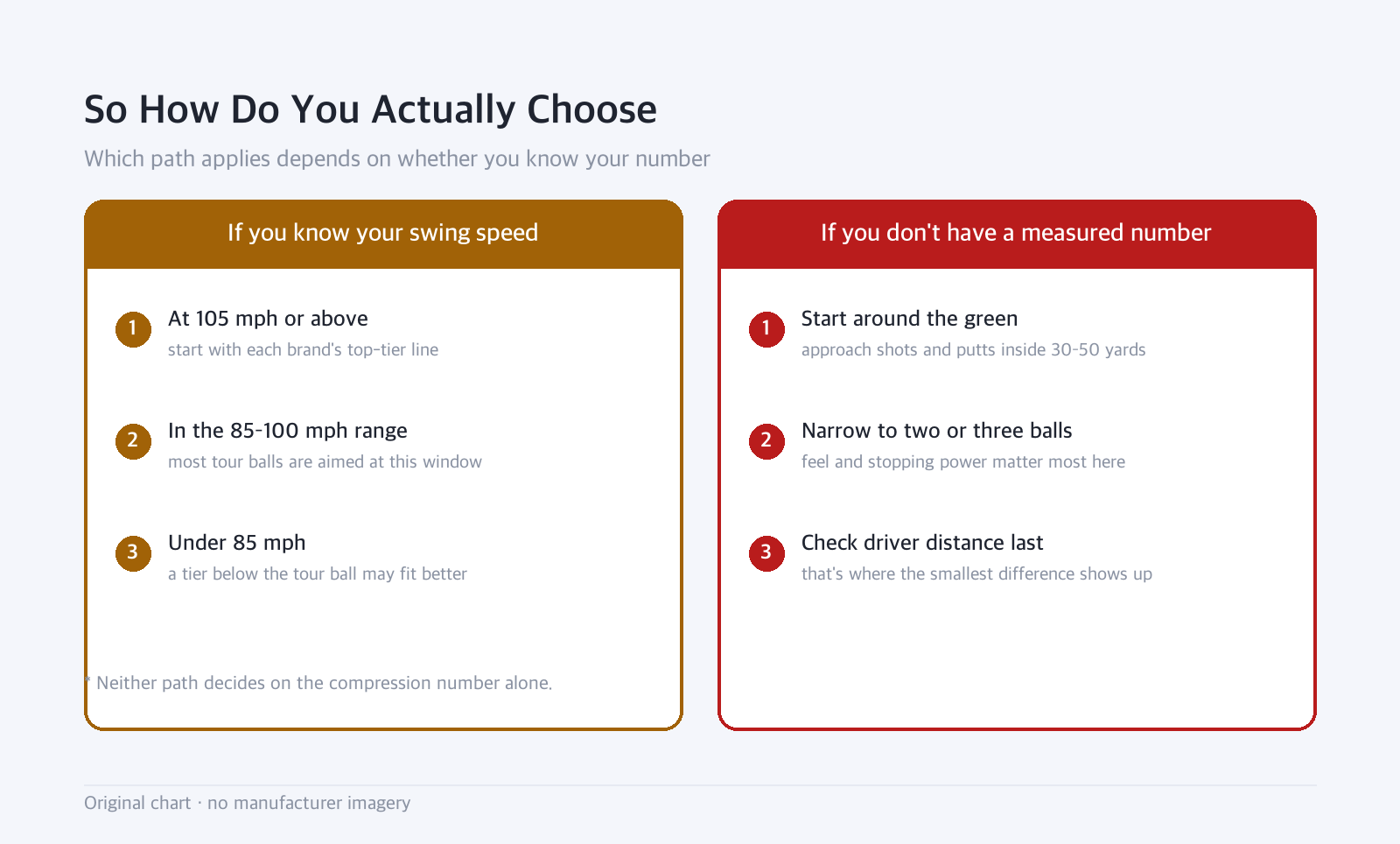
There are two paths. Which one applies depends on whether you know your number.
If you know your driver swing speed — from a simulator or a fitting session:
- At 105 mph or above, start with each brand's top-tier line. Bridgestone has literally designated that speed bracket with dedicated models.
- In the 85–100 mph range, most tour balls are aimed at exactly this window. Narrowing by around-the-green feel matters more here than compression.
- Under 85 mph, a tier below the tour ball may fit better than the tour ball itself.
If you don't have a measured number — true for most golfers:
- Follow the sequence Titleist itself recommends. Start around the green.
- Narrow to two or three balls based on feel and stopping power on 30–50 yard approaches and putts.
- Check driver distance last. That's where the smallest difference shows up.
Either path arrives at the same principle: compression alone doesn't decide it. Use the number to narrow candidates, and make the final call around the shorter clubs.
7. Who this is useful for
Useful for golfers with a measured swing speed — 105 mph is an actual threshold one manufacturer uses, so it can cut the field roughly in half.
Useful for golfers comparing two or three models within one brand — since the same company measured them the same way, the ranking within that set can be trusted.
Useful for golfers who feel weak around the green — Titleist's own recommended sequence starts exactly there. If you've been shopping by driver distance, it may be worth reversing the order.
Less useful for golfers trying to combine compression tables from different sites — the measurement methods differ, so that comparison doesn't hold.
Less useful for golfers trying to decide on compression alone — layer count, cover material, and dimple pattern are all items manufacturers do publish without the measurement-method problem.
8. What we could not confirm
- The measurement method details used by Titleist and Callaway — not disclosed by either company.
- Whether Callaway's Chrome Tour X published figure of 98 is its own number or a third-party measurement — left out of the list above since this couldn't be settled.
- The size of the variance between gauge types — confirmed that gauges differ, not by how many points.
- The origin of the swing-speed bracket chart — in wide circulation, but not traced to any single manufacturer's official standard. The only manufacturer-stated threshold confirmed here is the 105 mph split.
- How much compression actually affects real-world distance — figures citing a specific yardage loss circulate, but without disclosed test conditions, none are cited here.
In one line
Compression is not a number to discard — it's a number that works in specific places and not others.
It holds up when reading rank order within one table, and when choosing between sibling models from the same brand. It breaks down the moment you combine numbers from different sources across brands.
And if you don't have a measured swing speed, don't start with speed — start around the green. That's the order Titleist, the industry's biggest seller, recommends for its own products.
This piece summarizes general instruction concepts and is not personalized coaching advice. Ball flight fixes depend on individual swing mechanics — a launch monitor session or certified instructor can confirm what applies to you.