An earlier piece noted that a wedge naturally curves less. This piece is the explanation.
It's also, in a sense, the ball-flight law revisited from the club's side.
The conclusion up front: a wedge going straight isn't a sign of a good swing. It's loft.
1. First, a term to correct
The common term is sidespin — the idea that a sideways-rotating spin makes the ball curve.
Strictly speaking, that's inaccurate.
A ball doesn't rotate on a separate sideways axis. It spins around a single axis, and that axis is simply tilted. In the language used for the ball-flight law, this is the spin axis.
Stand that axis straight up and you get pure backspin — no curve. Tilt it, and the ball curves in that direction.
This distinction matters here, because it's a question of tilt, not of a separate rotation.
2. Higher loft means more backspin
This is the starting point.
A 60-degree wedge spins more than a 7-iron as a matter of physics. Not technique — the result of the angle.
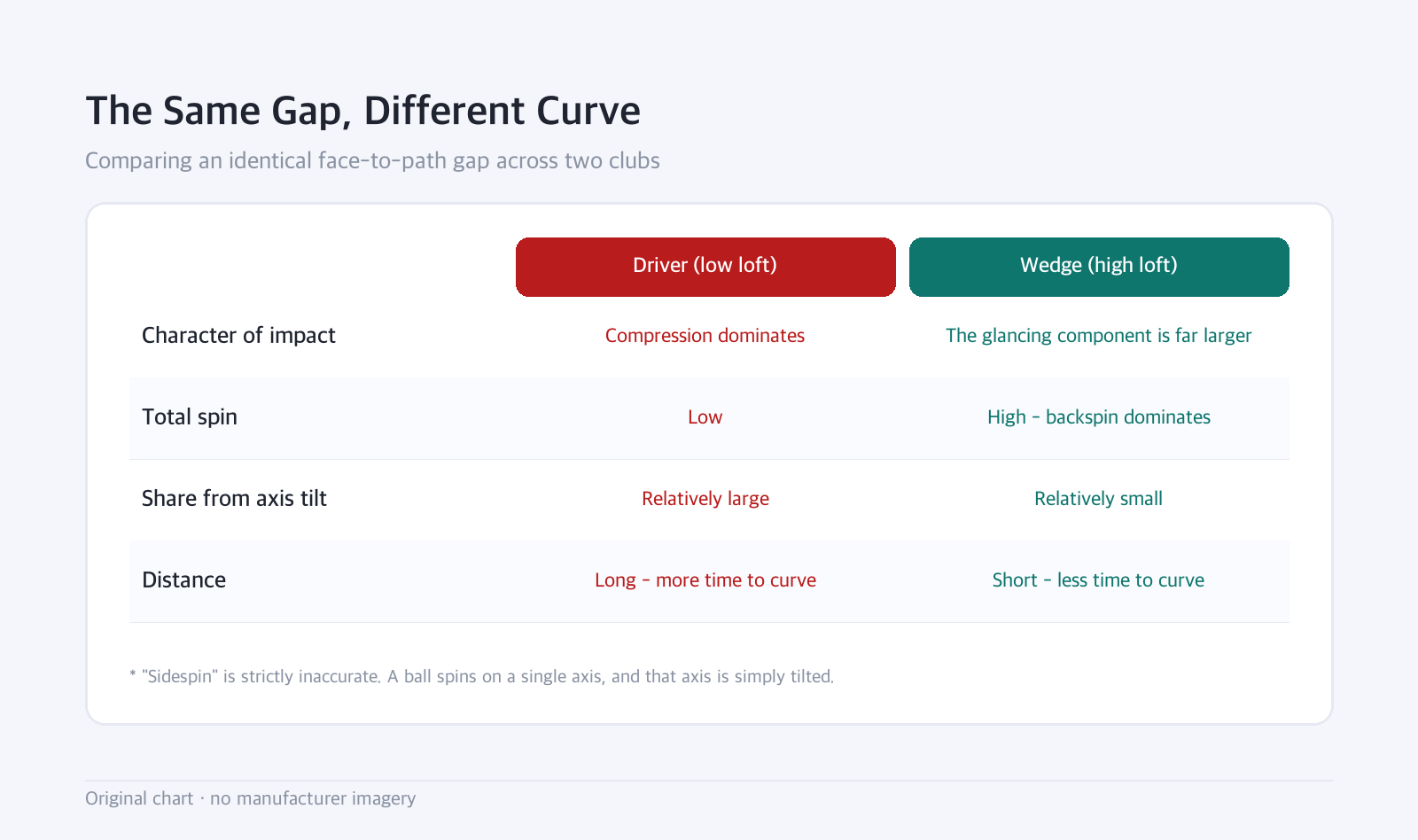
Higher loft means more of the impact force acts vertically. With the face laid back, the component that glances up the ball outweighs the component that compresses it forward.
Put another way: compression dominates the impact with a driver; the glancing, spin-generating component dominates with a wedge.
So a wedge produces a lot of spin.
3. Which means the same error shows up less
Now put the two together.
Say the gap between face angle and swing path is identical — 3 degrees with a driver, 3 degrees with a wedge.
That gap sets the tilt of the spin axis. So far, identical.
But the total amount of spin is different. A wedge carries an overwhelming amount of backspin. Within that larger total, the sideways-tilted share becomes proportionally smaller.
The same tilt shows up less when backspin dominates the total.
There's a second factor. The distance a wedge shot travels is shorter. If a rough estimate holds that 300 yards curves 12 yards, 100 yards curves far less than that. Less distance means less time to curve.
Both work in the same direction.
4. What this means on the course
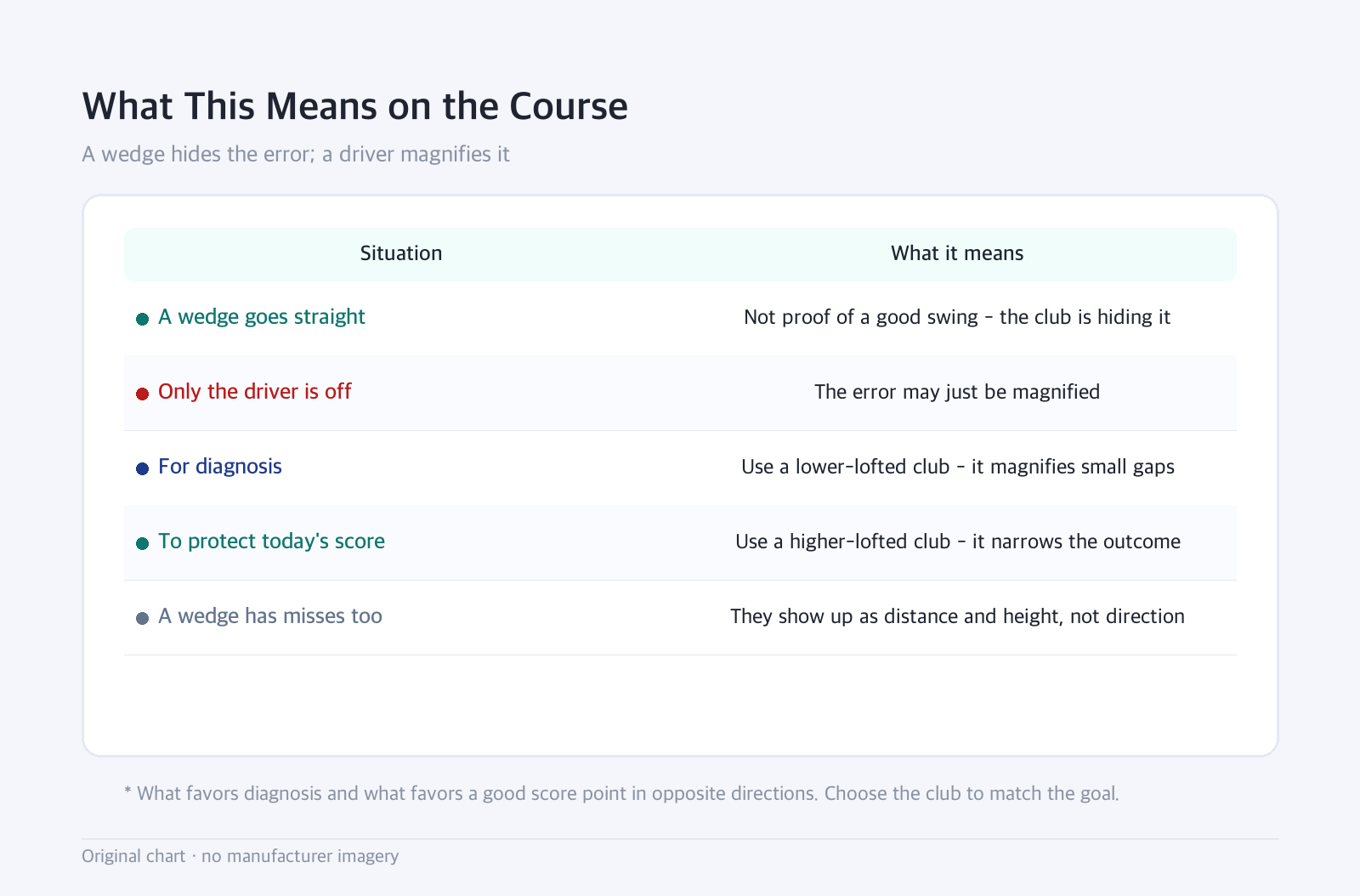
One — a wedge going straight doesn't mean the swing is good.
This is the illusion noted earlier. The same error is present; the wedge simply doesn't display it. The club is masking it.
Two — a driver, conversely, exaggerates it.
Lower loft means less backspin, and greater distance means more time to curve. The same 3 degrees that a wedge hides shows up large with a driver.
A large share of the "only my driver is off" feeling comes from here.
Three — diagnosis is easier with a lower-lofted club.
As noted earlier: to see a direction error, use a driver or a long iron. Magnifying a small gap is an advantage for diagnosis.
Four — but for managing a score, the logic flips.
Knowing an error exists that can't be fixed on the spot, a higher-lofted club narrows how far the result can go wrong. Reaching for a fairway wood or hybrid off the tee instead of a driver is an example of this.
5. But a wedge has its own misses
Curving less doesn't mean a wedge is free of misses. It just shows up differently.
With a wedge, the error appears:
- As distance — an off-center hit moves distance more than direction, straight from the gear-effect thread
- As height — a shifted low point produces a fat or thin shot, covered separately
- As a shank — as noted earlier, these cluster in wedges
Direction staying steady doesn't mean contact is clean. A wedge is graded on distance and height.
6. Who this is useful for
- Golfers whose wedge is fine but whose driver isn't — the club may just be showing it differently
- Golfers choosing a practice club — a lower loft is better for diagnosis
- Golfers who need to protect today's score — higher loft narrows the range of bad outcomes
- Golfers confused about spin terminology — it's spin-axis tilt, not sidespin
Less useful for:
- Golfers focused on distance — this piece is about curve
- Golfers focused on short-game accuracy — a wedge is graded on distance and height; a different piece fits better
7. What we could not confirm
- The actual difference in spin-axis tilt by club — the mechanism is explained, but we could not confirm figures
- The quantitative relationship between loft and total spin — this varies by club and ball
- The proportional relationship between distance and curve — beyond the 300-yard/12-yard rule of thumb, we could not confirm further data
Summary
Higher loft means backspin dominates, so the same degree of spin-axis tilt shows up less as curve.
Shorter distance compounds it. A wedge hides the error; a driver magnifies it.
A wedge going straight isn't proof of a good swing. It's graded on distance and height instead.
This piece summarizes general instruction concepts and is not personalized coaching advice. Ball flight fixes depend on individual swing mechanics — a launch monitor session or certified instructor can confirm what applies to you.