
A shank isn't evenly distributed.
It shows up most with wedges and short irons. Hitting one with a driver is relatively rare.
This piece covers why, and looks at how much club design can actually address it.
1. Four factors overlap
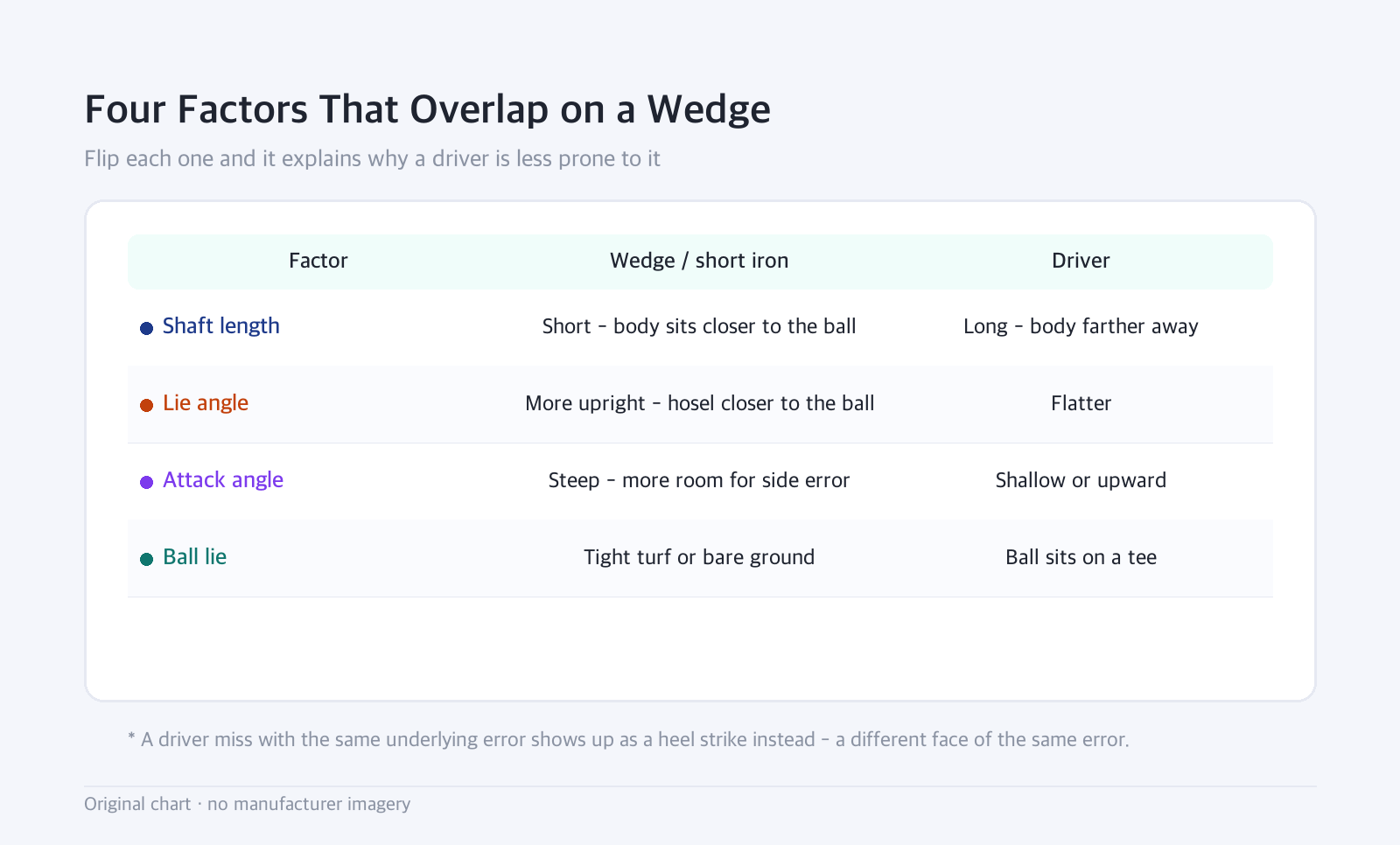
First, the shaft is short. A shorter shaft puts the body closer to the ball, which, as covered separately, reduces the room between body and hands.
Second, the lie angle is more upright. The club sits more vertically, putting the hosel closer to the ball.
Third, the attack angle is steep. Wedges and short irons come down from above at a steep angle. A steeper angle leaves more room for side-to-side error.
Fourth, the lie of the ball is tight. Wedges tend to come out in situations with short grass or bare ground, which demand precision with little margin.
All four point the same direction, which is why this miss concentrates on these clubs.
2. Why a driver is less prone to it
Flip each factor and the reason becomes clear.
The shaft is longer, so the body stands further from the ball. The lie angle is flatter. The attack angle is shallow or upward. And the ball sits on a tee.
There's one more factor: the driver head is large. A bigger face means more distance to the hosel.
To be clear, though: this doesn't mean a shank never happens with a driver. A heel strike, covered elsewhere, is the equivalent miss for that club, and it comes with slice spin from gear effect.
The same underlying error shows up with a different face depending on the club. A recurring point in this material.
3. What design can address
There's a lesser-known piece here.
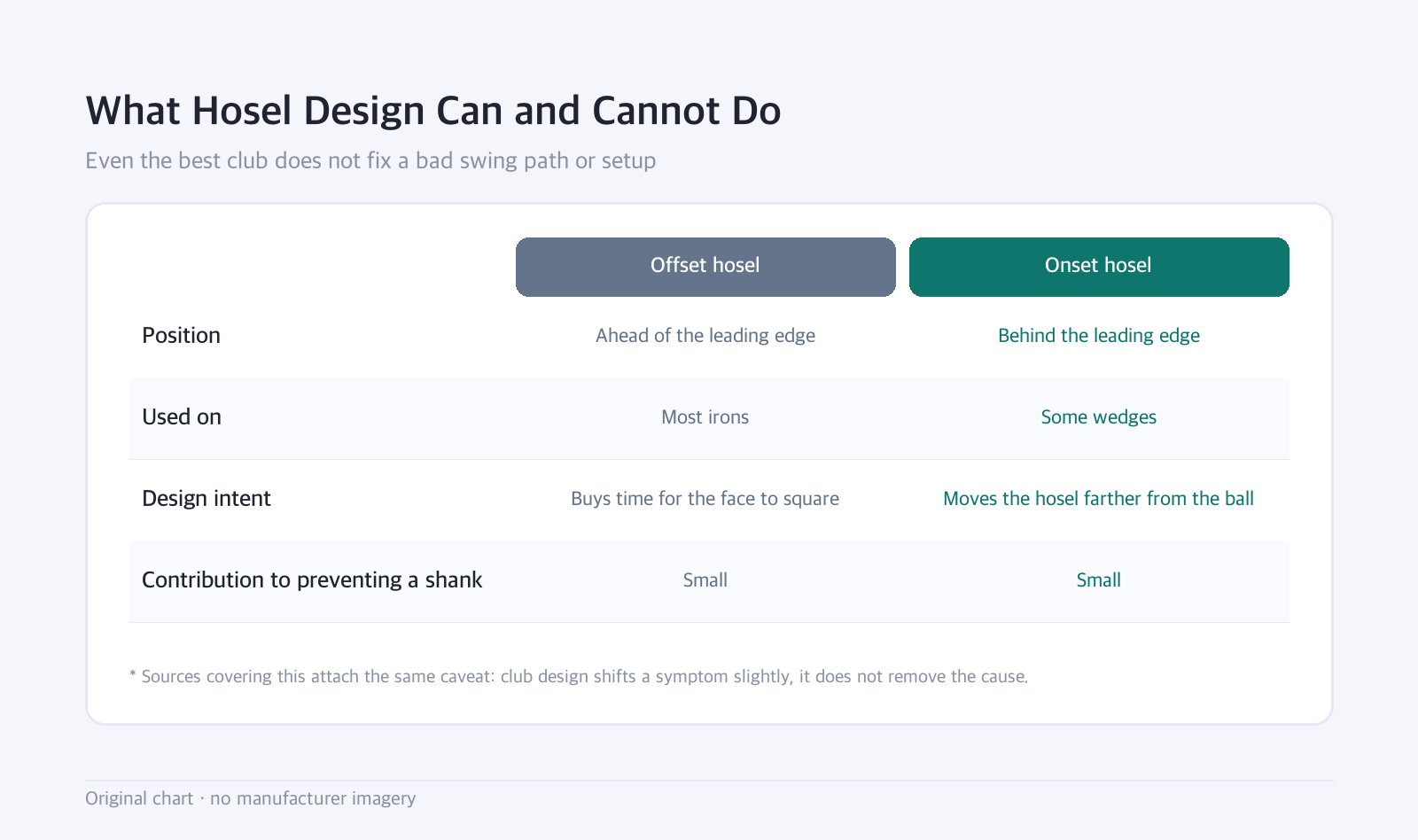
Most irons use an offset design. The hosel sits ahead of the leading edge, which sets the face back slightly. It's described as a design that buys time for the face to square up.
Some wedges use the opposite structure: an onset hosel, which places the hosel behind the leading edge.
The purpose is clear: to move the hosel farther from the ball and reduce the chance of a shank.
Clubs with a larger hosel or offset are also said to be somewhat more forgiving.
4. Keep expectations modest
This is the most important part of this piece.
Club design's contribution is small.
Sources covering this topic tend to attach the same caveat: even the best club doesn't fix a bad swing path or a bad setup.
Same structure as the adjustable-hosel piece covered elsewhere. Shifting a symptom slightly and removing the cause are different things.
There's still a place to use this information:
- Only wedges produce it, other clubs are fine → club geometry may be contributing. Worth checking whether the wedge has an onset design.
- Every club produces it → not a club issue. Go back to the swing-path and setup pieces.
- It started after switching to a new club → lie angle or length may have changed. Worth checking at a fitting.
The third case is the practical one. Check whether the timing of the club switch lines up with when the shank started.
5. And the situation adds up too
Beyond geometry, there's one more factor: the situation itself, when a wedge is in hand.
Wedges tend to get used near the green, where the result shows up immediately. The distance remaining is short, and a mistake shows up in the score right away.
From here on, this is not a confirmed fact but a circumstantial point, stated as such.
These are pressure situations that demand a precise shot. And as covered elsewhere, a lunge shows up more when intent is strong.
Geometry and situation point the same direction. This thread continues in a later piece.
6. Who this is useful for
- Golfers who only shank wedges — club geometry and lie may be contributing.
- Golfers whose shank started after a club change — worth checking whether the timing lines up.
- Golfers considering a fitting — lie angle and length are worth checking.
- Golfers whose driver is fine but whose irons aren't — the same error shows up differently by club.
This is less useful for:
- Golfers who shank every club — not a club issue.
- Golfers hoping equipment alone will solve it — the conclusion here is that the contribution is small.
7. What we could not confirm
- Shank frequency by club — we could only confirm that it's common with wedges and short irons.
- The actual effect size of an onset hosel — the design intent is clear, but we could not confirm verification data.
- The quantitative relationship between lie angle and shank frequency
- The correlation between hosel size and forgiveness — discussed, but no figures confirmed.
In one line
Short shaft, upright lie angle, steep attack angle, tight lie. All four point the same direction.
That's why it concentrates on wedges and short irons. It isn't absent from the driver — it just shows up as a heel strike, a different face of the same error.
Design can address part of it. An onset hosel is one example. But the contribution is small, and even the best club doesn't fix a bad swing path or setup.
This piece summarizes general instruction concepts and is not personalized coaching advice. Ball flight fixes depend on individual swing mechanics — a launch monitor session or certified instructor can confirm what applies to you.