
An earlier piece noted that lower loft magnifies error. This extends that thread to long irons.
That long irons are difficult is close to conventional wisdom in golf. But the reason isn't singular — four factors overlap.
1. Four factors pulling in the same direction
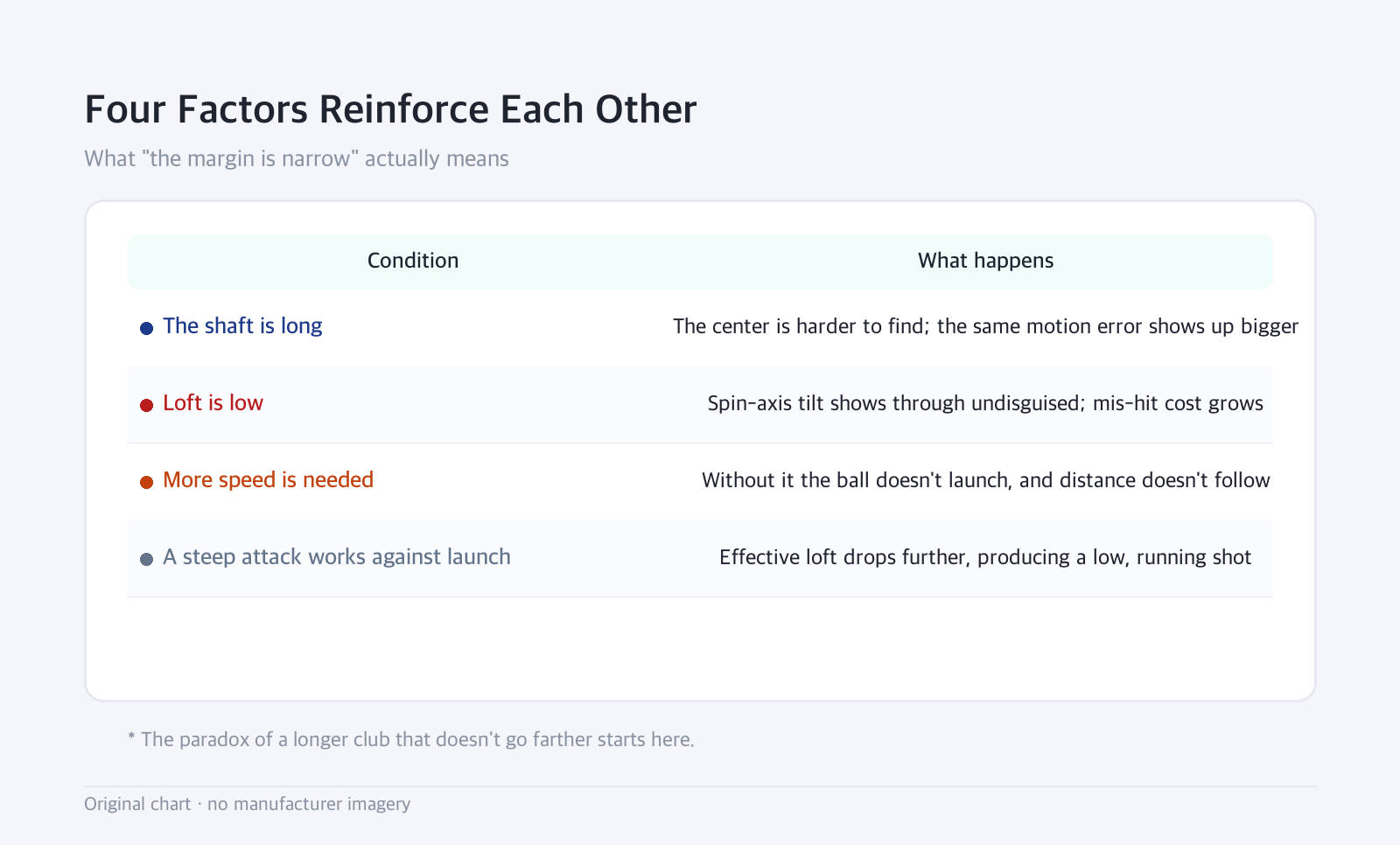
One — the shaft is long.
Length makes the head's center harder to find. The swing arc grows larger, and the distance from hands to head grows too. The same motion error shows up bigger at the head.
Two — loft is low.
As covered earlier: less backspin means the tilt of the spin axis shows through undisguised, and the cost of a mis-hit grows as well.
Three — it needs more clubhead speed.
Getting a good launch out of low loft requires speed. Without enough of it, the ball doesn't get airborne, and without launch, distance doesn't follow. The paradox of a longer club that doesn't go farther starts here.
Four — a steep angle of attack works against getting the ball up.
With loft already low, hitting down on it further reduces effective loft. The result is a low, running shot.
The four reinforce each other. That's the content behind "the margin is narrow."
2. Which is why hybrids took over that spot
For many golfers, the answer became replacing the 1- through 4-irons with hybrids.
The reason is that hybrids ease each of the four above.
- A larger head makes the center easier to find
- A rearward center of gravity makes getting the ball airborne easier
- The head moves through rough more cleanly
One more thing attaches here, from the earlier thread: a rearward center of gravity means a larger gear effect. Mis-hits tend toward a direction miss.
An iron's miss shows up as distance; a hybrid's miss shows up as direction. Swapping doesn't remove the miss — it changes its face. Consistent with the recurring pattern across this series.
3. Checking whether a long iron still suits you
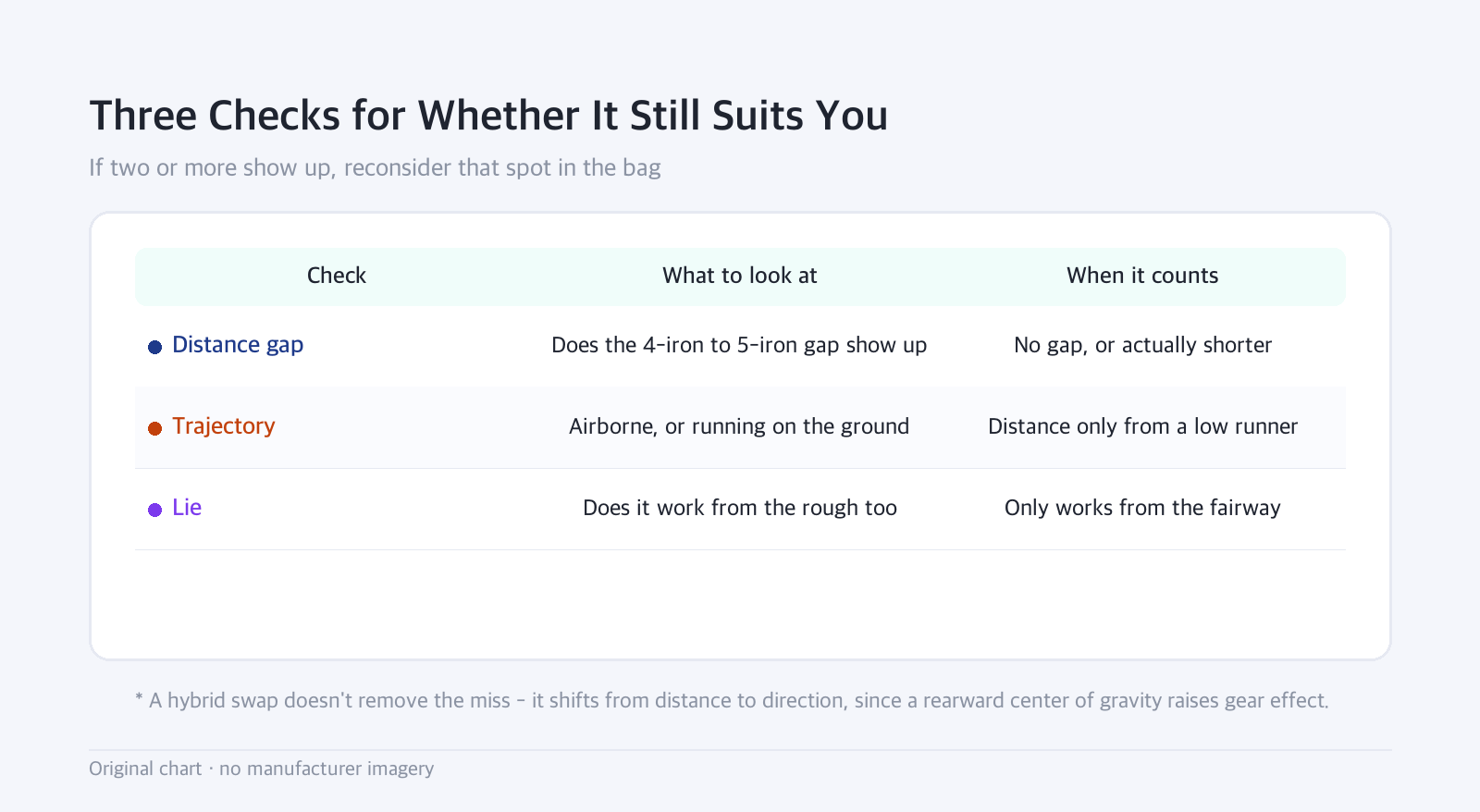
Here's a usable test.
Check the distance gap. Does the gap between a 4-iron and a 5-iron actually show up?
- A clear gap → the long iron is workable
- Barely any gap → launch isn't happening. A longer club with no added distance means the loft isn't being used
- Actually shorter → confirmed. Worth considering a swap
Check the trajectory too. A low, running shot that reaches distance by rolling is different from one that gets airborne and carries. Approaching a green needs the latter.
Check the lie as well. Working from the fairway but never from the rough means the club only functions in a narrow set of conditions.
If two or more of these show up, a hybrid or fairway wood may serve that gap better.
4. But a swap isn't always the answer
To be direct about it:
A hybrid's direction miss gets larger. As noted above. For a golfer who already hooks on tight holes, that can be a liability rather than a fix.
And higher trajectory is more exposed to wind. In conditions calling for a low, penetrating shot, a long iron has the advantage.
So, to lay it out:
- If getting the ball up is the problem, a hybrid is the better fit
- If direction is the problem, a swap may not be the answer
- If both are a problem, leaving that gap empty and redistributing distances among other clubs is also an option
That last option is actually common. Fourteen clubs is a ceiling, not an obligation. Carrying a club that can't be hit consistently can be worse than tightening the gaps between clubs that can.
5. Where this connects to the earlier threads
A principle repeated earlier in this series applies here too.
Moving a symptom is different from removing a cause.
Swapping a long iron for a hybrid doesn't remove the cause. The error is still there; the club just displays it less.
That said, this isn't a poor choice. Distinguishing first aid from a fix doesn't mean first aid shouldn't be used. It's better than carrying a club that currently can't be hit.
The goal is to distinguish, not to give up.
6. Who this is useful for
- Golfers struggling with long irons — there are four reasons, and they reinforce each other
- Golfers considering a hybrid swap — check the distance gap, trajectory, and lie
- Golfers who swapped and now miss left instead — the gear effect may have grown
- Golfers organizing their set — fourteen is a ceiling, not an obligation
Less useful for:
- Golfers with plenty of clubhead speed — one of the four factors doesn't apply
- Golfers who don't carry long irons — already settled
7. What we could not confirm
- The quantitative relationship between shaft length and center-contact rate — the mechanism is explained, but we could not confirm figures
- The actual improvement typically seen after a hybrid swap — we could not find supporting data
- The rate at which amateur golfers carry long irons
- A settled basis for the distance-gap threshold — this is practical judgment with no fixed figure
Summary
A long shaft, low loft, the speed it demands, and a steep angle of attack. Four factors overlapping narrow the margin.
Which is why, for many golfers, the answer became hybrids. But the miss doesn't disappear — it changes face, from distance to direction.
Check three things: distance gap, trajectory, lie. If two or more come up short, that spot in the bag is worth reconsidering.
This piece summarizes general instruction concepts and is not personalized coaching advice. Ball flight fixes depend on individual swing mechanics — a launch monitor session or certified instructor can confirm what applies to you.