
Look in a golf bag today and the irons sit in numerical order — 4 through pitching wedge, loft stepping up at a consistent interval, length shortening a little with each club.
This is called a set. It feels so obvious that nobody asks when it started.
But the concept is less than a hundred years old.
1. Wooden shafts made a matched set impossible
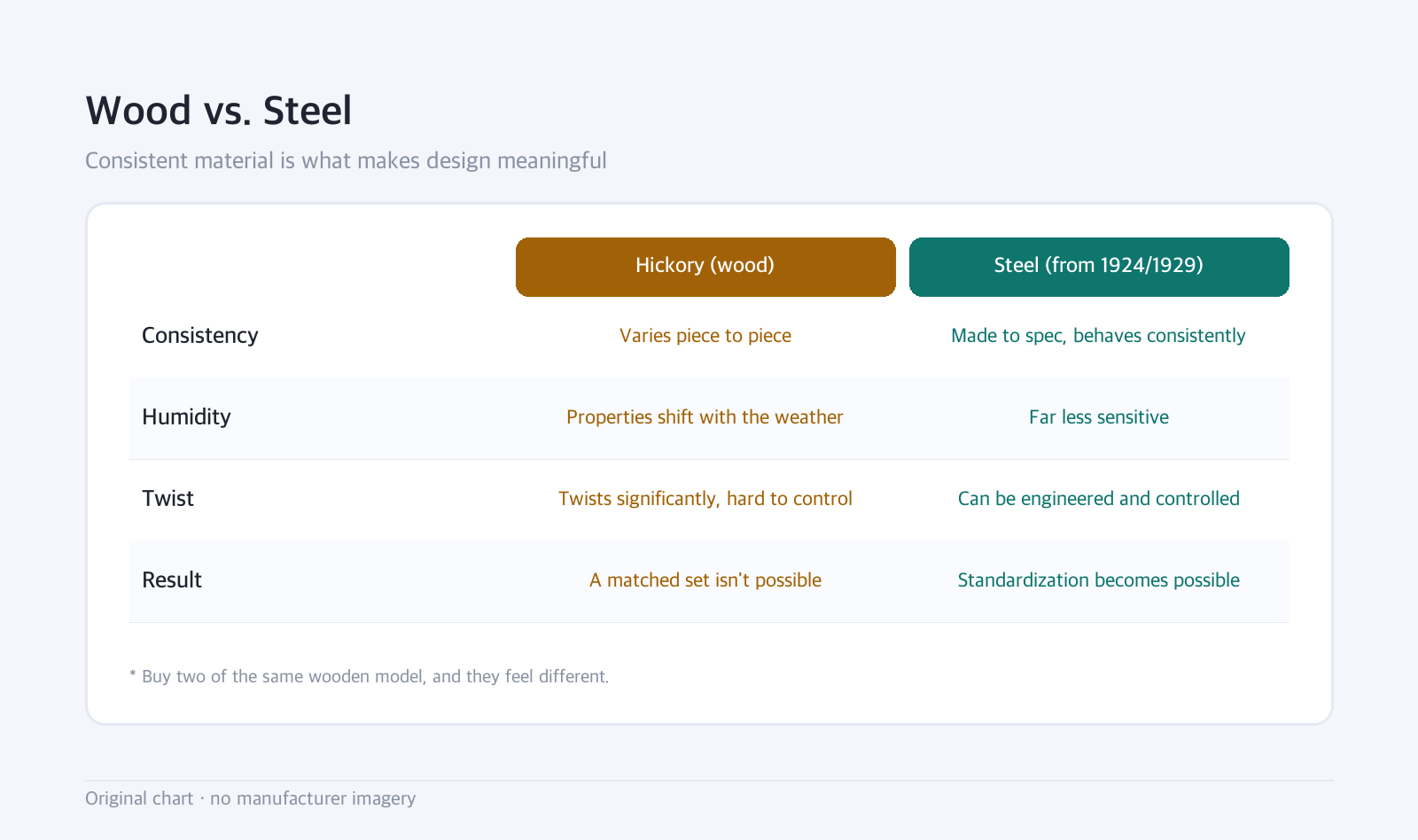
Before steel, shafts were hickory — wood.
Wood has properties you can't design around:
- It varies piece to piece. Even wood cut from the same tree differs in density, and so in flex.
- It reacts to humidity. Its properties shift with the weather.
- It twists significantly. Controlling how much the head rotates through the swing is difficult.
The result: buy two of the same model, and they feel different.
Under those conditions, the idea of matching several clubs to consistent properties doesn't even apply. A club was something chosen one at a time.
An early golf rulebook from 1744 included a provision that if a club broke during the downswing, the stroke still counted — a rule that tells you how fragile wooden shafts could be.
2. Steel made standardization possible
The USGA permitted the steel shaft in 1924, the R&A in 1929.
Made to spec, steel behaves consistently. It's far less sensitive to humidity, and twist can be engineered and controlled.
Crucially, the same specification could now be produced repeatedly.
That's where the set came from — spacing nine irons' worth of loft at even intervals, shortening length club to club, became a workable design exercise. Consistent material is what makes design meaningful.
The ability to compare shaft weight and torque today traces back to this same shift. Wood couldn't carry those specs meaningfully, since every piece was different.
3. And the club-count limit followed

Once clubs became easier to make, the number carried grew.
The 1935 U.S. Open field averaged 18 clubs, and some players carried 30 or more.
So the USGA and the R&A introduced a 14-club limit in 1938 and 1939 respectively.
The chain runs:
Material changed → standardization became possible → the matched set emerged → club count grew → count was capped.
One piece of technology, in effect, produced one rule.
4. This pattern recurs through golf's rule history
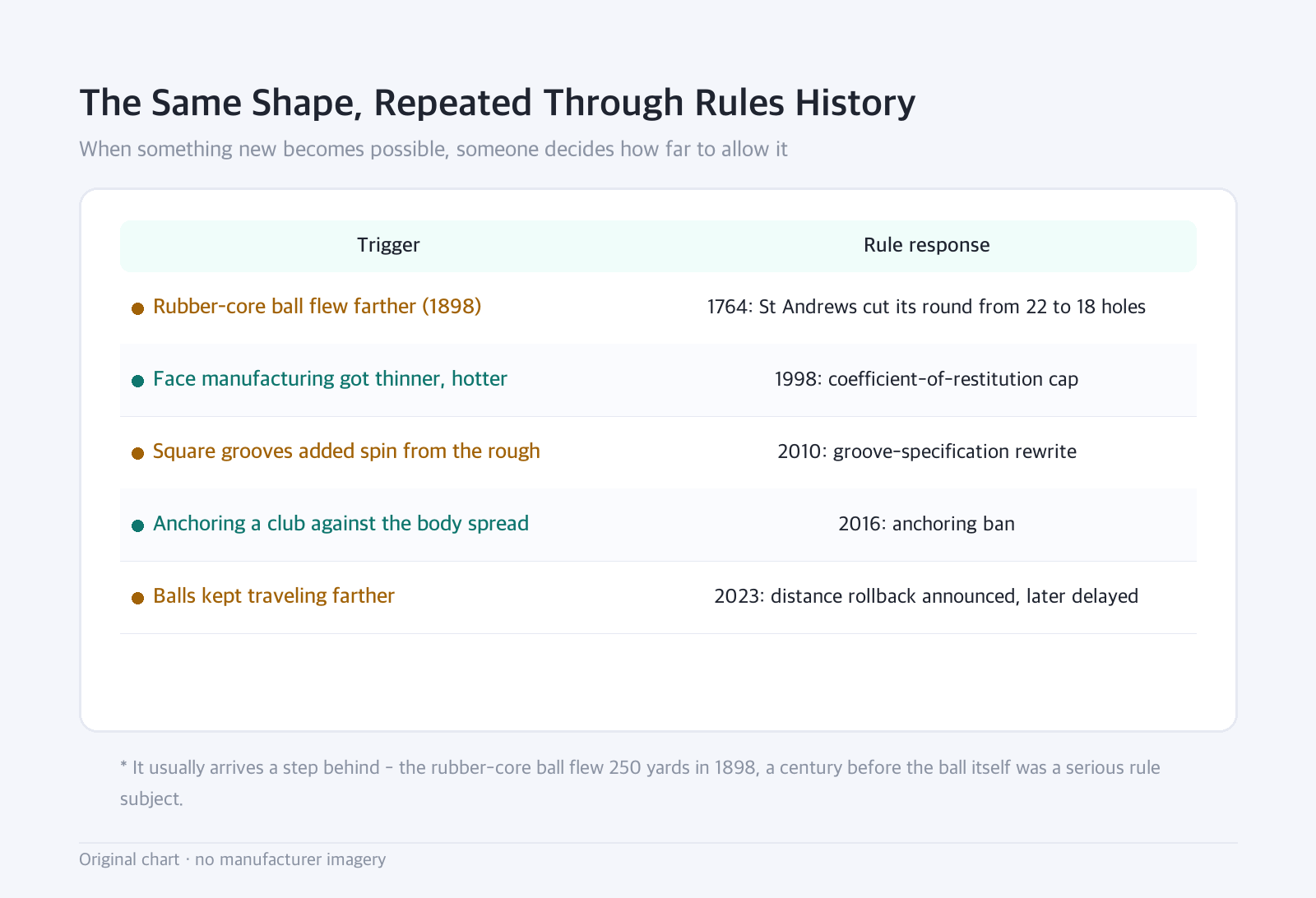
The same shape shows up repeatedly across golf's rules history:
- The ball started flying farther → in 1764, St Andrews cut its round from 22 holes to 18.
- Face manufacturing got thinner and hotter → the 1998 coefficient-of-restitution cap.
- Square grooves added spin even from the rough → the 2010 groove-specification rewrite.
- Anchoring a club against the body spread as a technique → the 2016 anchoring ban.
- Balls kept traveling farther → a 2023 distance rollback announcement, later delayed.
When something new becomes possible, someone has to decide how far to allow it. That's how golf's rules tend to get made.
And it usually arrives a step behind. The rubber-core ball in 1898 was already flying 250 yards, and it took roughly a century before the ball itself became a serious subject of rule change.
5. What turned up while checking the record
Working through this material, one thing kept recurring: some widely repeated stories turned out to have no supporting evidence.
- The claim that a 1910 putter ban stemmed from personal spite over an American win — no evidence found.
- The claim that the number 14 came from a compromise between two named golfers — no documentary evidence.
Both stories feature real people, plausible timing, and a story that sounds reasonable. Neither has a document behind it.
Rule text usually doesn't explain itself. It states "you may not carry more than 14" and stops there. A story tends to fill the space where the explanation is missing.
6. What stays and what disappears
Comparing that 1744 rulebook's thirteen articles against today's rules shows a pattern.
What disappeared — rules about where to place a tee, penalties for a broken club, whether a soldier's trench counted as a hazard. All of it concerned equipment and course conditions.
What survived — the farther ball plays first, a lost ball means returning to the spot of the previous stroke, a ball that stops after being struck is played as it lies. All of it concerned fairness in competition.
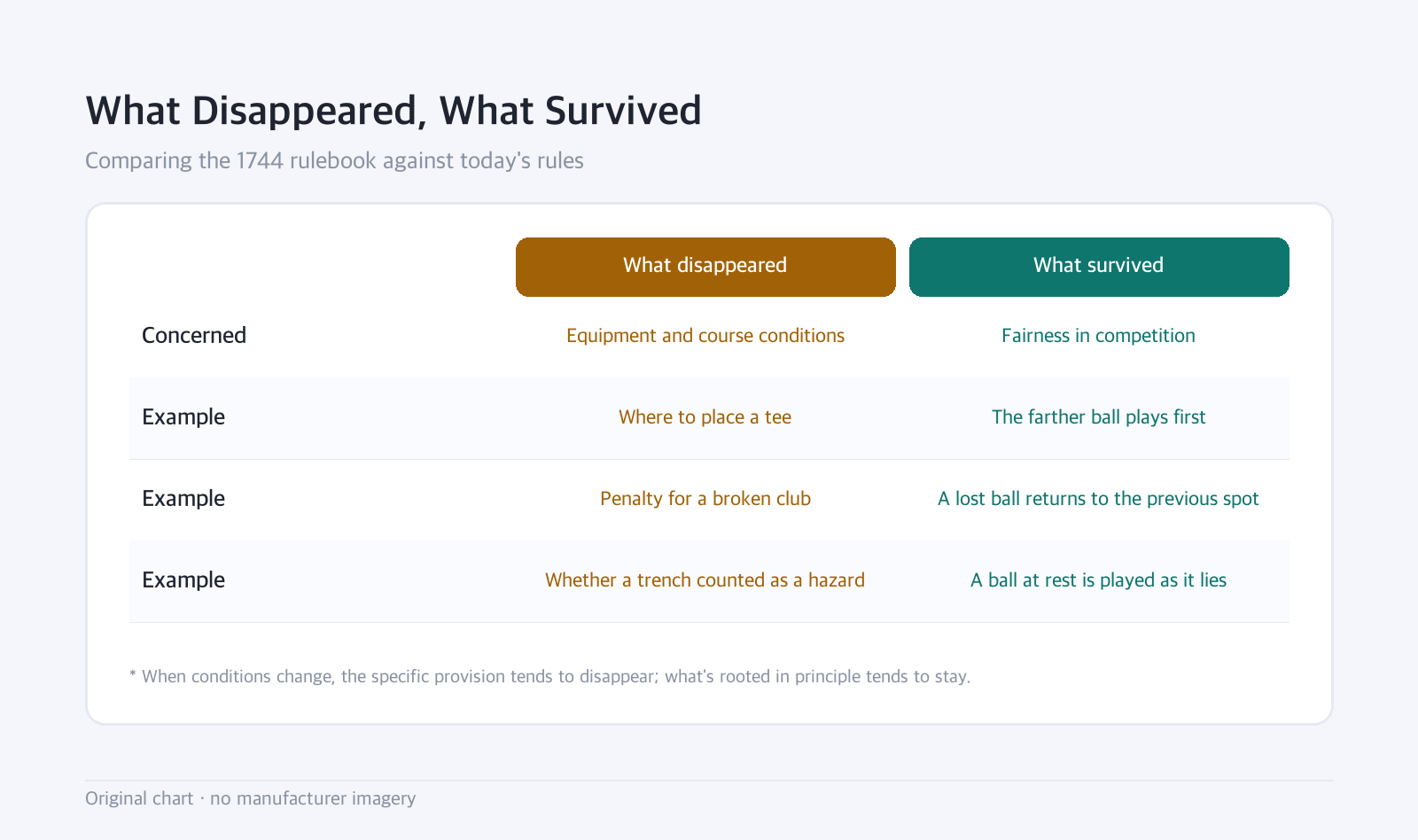
When conditions change, the specific provision tends to disappear. What's rooted in principle tends to stay.
Which side does the 14-club limit fall on? One of its three original grounds — the caddie's burden — no longer applies, because carts exist now. Yet the rule remains. The other two, being matters of principle, are likely why.
7. Who this is useful for
- Golfers building a matched set — the concept itself is a product of the steel-shaft era.
- Golfers following equipment rule changes — technology tends to arrive first, rules a step behind.
- Golfers who enjoy golf history — a well-constructed story and a confirmed fact aren't the same thing.
- Golfers curious why a rule looks the way it does — the provisions that survive tend to be about fairness.
Less useful for:
- Golfers needing an on-course ruling — this is about how rules get made, not how to apply one.
- Golfers shopping for clubs right now — equipment comparisons are covered separately.
8. What we could not confirm
- Exactly when the matched set became standard — only that it followed steel-shaft approval.
- When the nine-iron set composition settled in as standard.
- When the term "set" itself entered common use.
- The actual pace and rate of the shift from hickory to steel.
- How club composition changed after the 14-club limit took effect.
- Other unconfirmed details, noted individually in each related piece.
In one line
The matched set is a product of the steel shaft. Material had to be consistent before several clubs could be tuned to work together, and only then could design become meaningful.
Once clubs got easier to make, the count grew — and the club-count limit followed.
This same pattern — technology forcing a rule — recurs throughout golf history. A farther-flying ball changed the course or the ball itself; a hotter face brought a cap; deeper grooves brought a spec rewrite.
It typically arrived a step behind. And because rules rarely state their reasoning, stories filled the gap where an explanation was missing.
The dates and figures here come from confirmed sources; anything we could not confirm is marked as such.
This piece summarizes general instruction concepts and is not personalized coaching advice. Ball flight fixes depend on individual swing mechanics — a launch monitor session or certified instructor can confirm what applies to you.