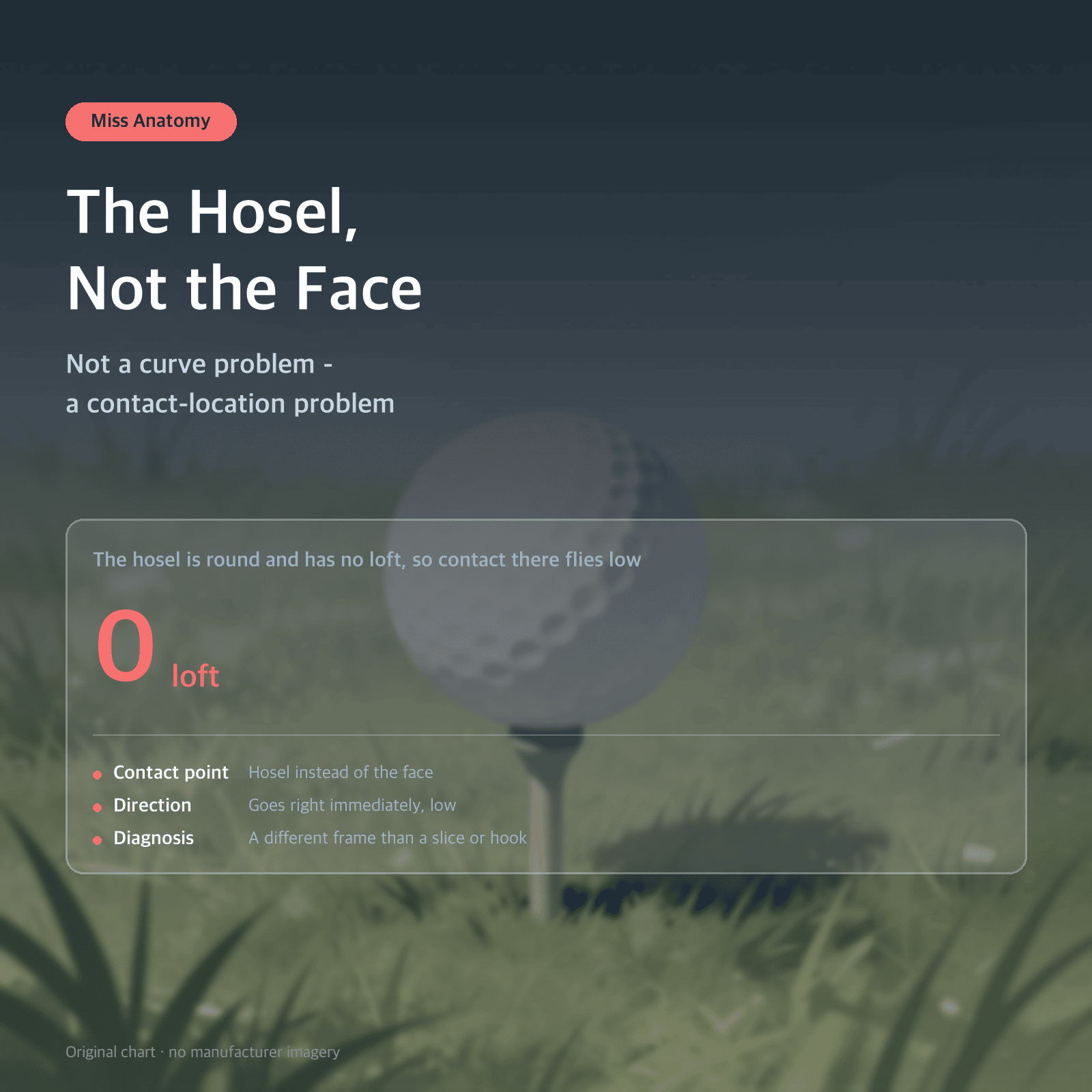
This piece moves to the miss with the most different character in this material: the shank.
A slice and a hook are both about a curving ball. In both cases, once the ball leaves the face, the question is how it spins. As covered separately, that comes down to the gap between clubface angle and swing path.
A shank is different. It's a ball that never left the face to begin with.
1. Where the ball actually makes contact
Stand a club up and look at it. Where the shaft meets the head, there's a rounded, protruding section. That's the hosel.
A shank is a ball that strikes the hosel instead of the face.
It has a nickname — the hosel rocket — common enough, and dramatic enough in its result, to have earned one.
2. Why it flies right
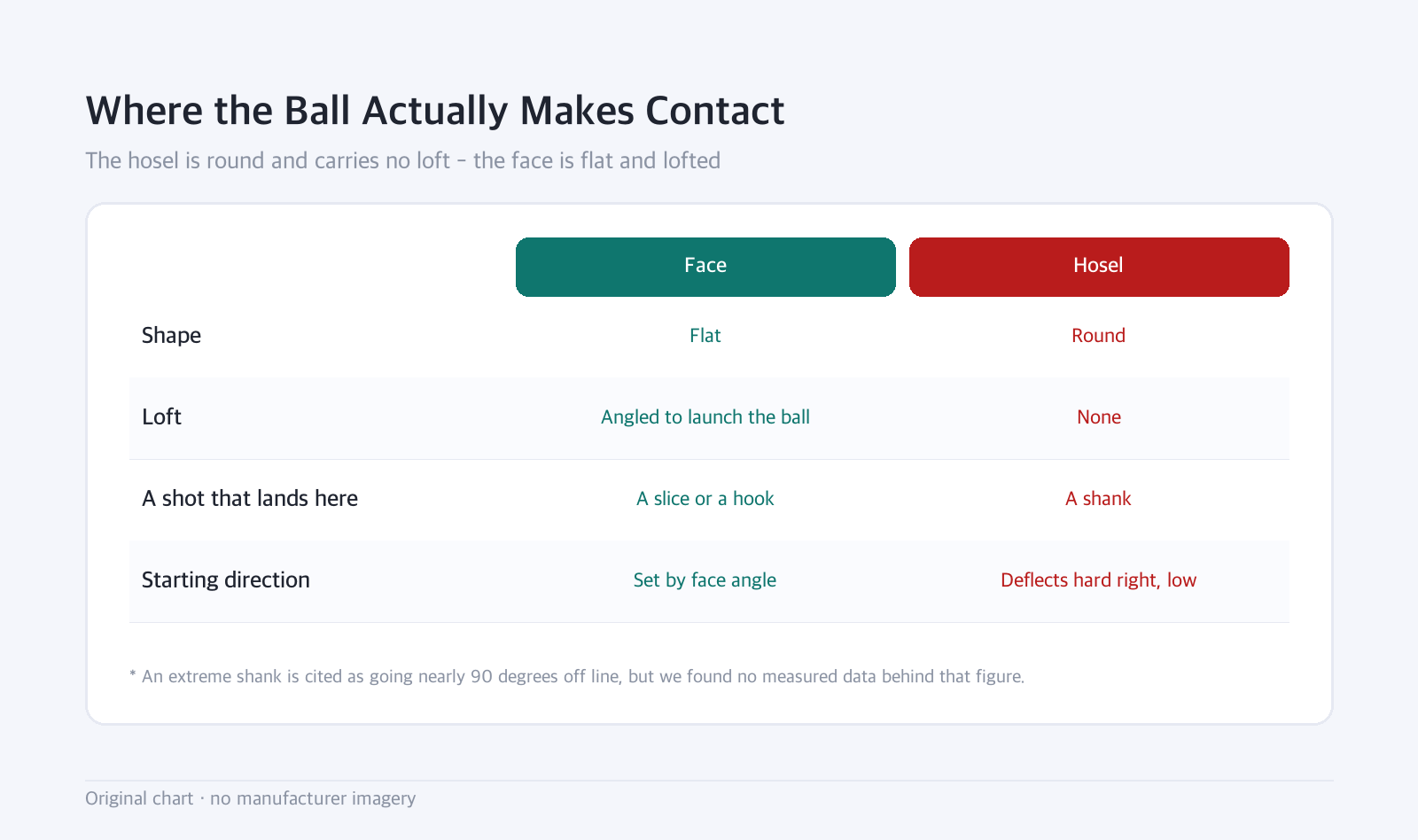
The hosel is round. Unlike the face, it isn't flat.
Think about what happens when a ball strikes a round surface: it deflects along the normal at the contact point. The hosel sits inboard of the face and juts forward, so for a right-handed golfer, that direction is right.
And the hosel has no loft. It doesn't lean back the way a face does. So the ball doesn't get up in the air.
The result:
- It goes right immediately — not a curve, but the starting direction itself
- It flies low, since there's no loft to launch it
- In severe cases it can go nearly 90 degrees off the target line
That last figure describes an extreme case. Most shanks are milder than that, but still more than enough to leave the fairway.
3. A slice and a shank are different balls
Both go right, which makes them easy to confuse. But they're entirely different misses.
A slice curves after leaving the face, from spin. As covered separately, it comes from the gap between face angle and swing path.
A shank has nothing to do with spin. It's a matter of contact location. No matter how well face and path line up, if the ball reaches the hosel, it's a shank.
The distinction is simple:
- Curves right along an arc → a slice
- Goes right almost in a straight line, low → a shank
- The sound is different — a shank is dull and short
The diagnostic frame used for a curving ball doesn't apply here. Reading starting direction and curve only makes sense for a ball that actually left the face.
4. And this miss carries a taboo
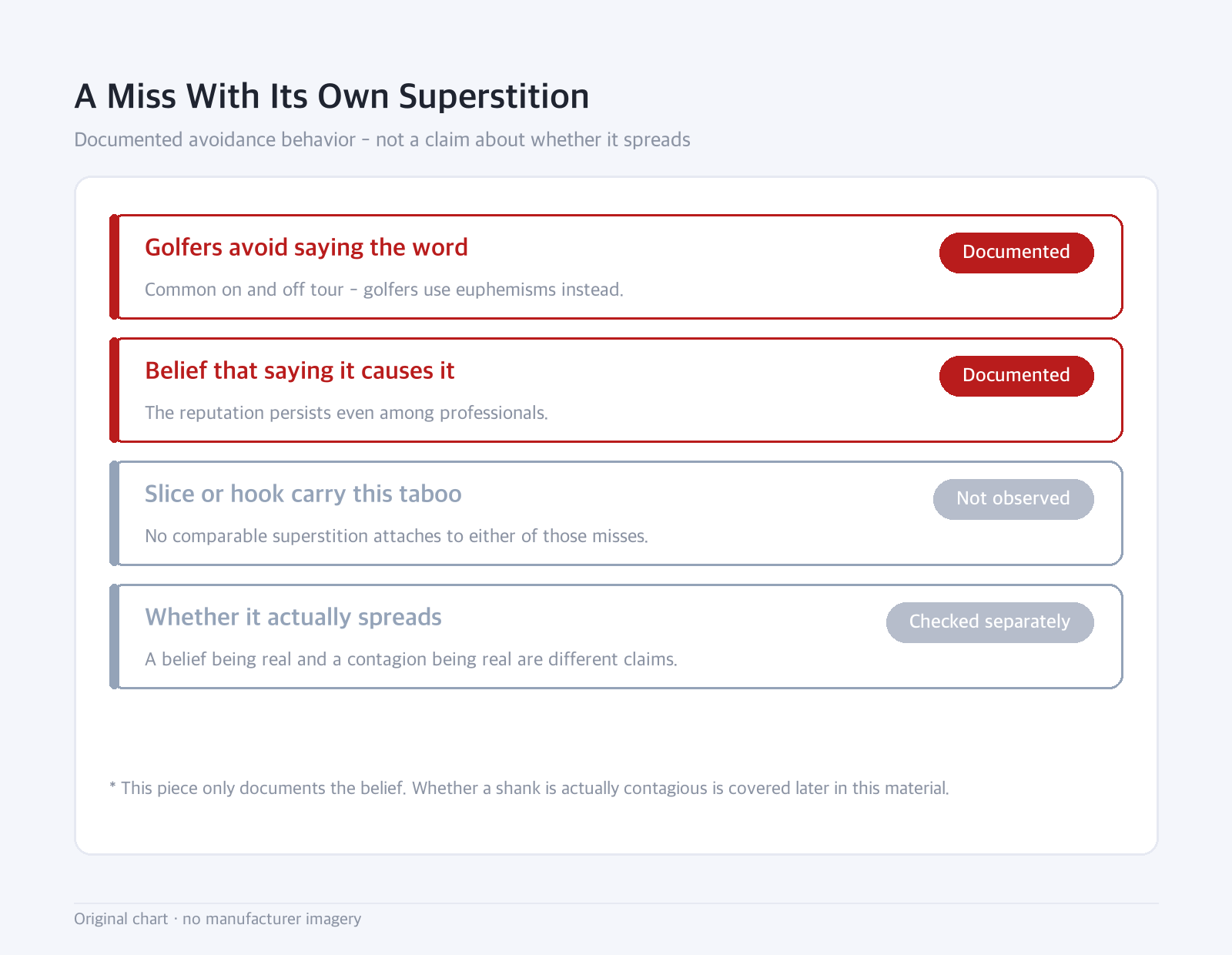
There's an unusual pattern in golf.
Many golfers avoid saying this word on the course. The belief is that saying it makes it happen again. Even among professionals, this reputation persists.
Golfers use euphemisms, or an entirely different name, rather than say the word.
No superstition of this kind attaches to a slice or a hook. It's unique to the shank.
Why that is, and whether it's actually contagious, is covered separately later in this material. One line in advance: a belief being real and a contagion being real are two different claims.
5. What's ahead
Five pieces remain in this material.
- Two opposite swing paths produce the same shank — the central point of this material.
- "Standing too close" is only one of several causes.
- Why wedges and short irons produce it disproportionately.
- The contagion story, and the psychology behind it.
- A checklist and wrap-up.
Same principle as before: diagnose first, split into branches, then apply criteria.
6. Who this is useful for
- Golfers who've hit a ball that shoots low and right — it may be a shank rather than a slice.
- Golfers who suddenly get a strange miss with a wedge — covered in the pieces ahead.
- Golfers whose slice correction never fixed the problem — it may be a different miss entirely.
- Golfers who've avoided saying the word — a later piece covers exactly that.
This is less useful for:
- Golfers working on a curving ball — that's covered separately.
- Golfers who've never hit a shank — though this miss tends to arrive without warning.
7. What we could not confirm
- The actual frequency of shanks — no statistics found for amateurs or professionals.
- The basis for the 90-degree figure — it's cited as an extreme case, but we found no measured data behind it.
- How contact location on the hosel affects direction — likely varies, but no data turned up.
- The origin of the taboo around the word
In one line
A shank isn't a spin problem — it's a contact-location problem.
The hosel is round and has no loft, so the ball shoots off immediately right, and low.
The diagnostic frame used for the earlier three pieces doesn't apply here, because that frame is for a ball that actually left the face. This material starts fresh.
This piece summarizes general instruction concepts and is not personalized coaching advice. Ball flight fixes depend on individual swing mechanics — a launch monitor session or certified instructor can confirm what applies to you.