
This is the central point of this material, and the most extreme case in the whole set.
A shank is a ball that strikes the hosel instead of the face, not a curve problem but a contact-location problem, as covered separately. A recurring point in the earlier pieces has been this: get the branch wrong, and the fix misses.
With a shank, the stakes are higher. Get the branch wrong here, and it doesn't just fail to help — it makes things worse.
That's because two opposite swing paths produce the same ball.
1. First — throwing the club outward
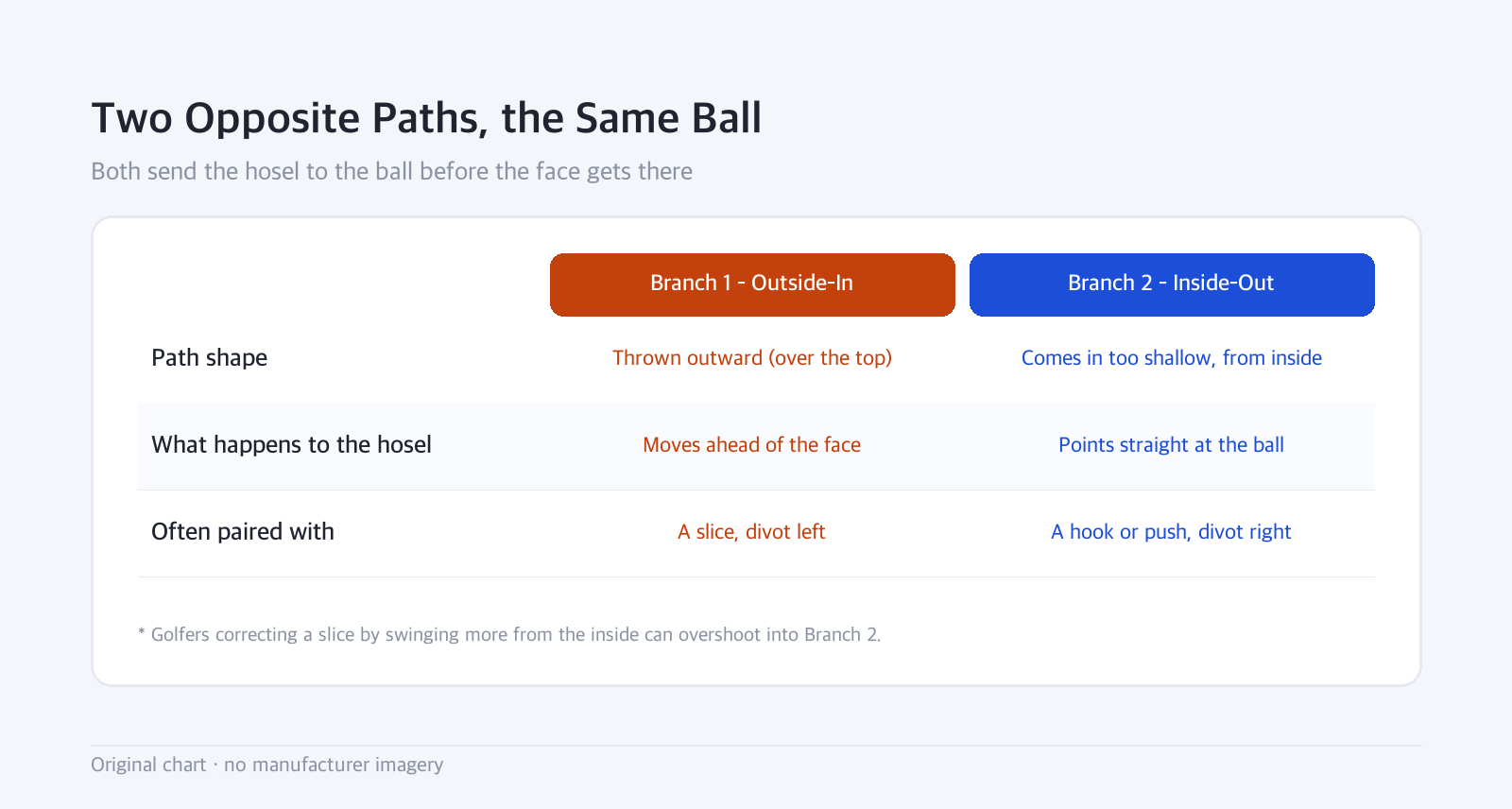
This is the out-to-in path, or "over the top," discussed elsewhere for its role in a slice.
Throw the club outward in the downswing and the head moves outside the target line. That pushes the hosel forward, toward the ball, ahead of the face.
The hosel arrives before the face does. Contact happens on the hosel instead.
A few things tend to show up alongside this pattern:
- A slice often appears in the same round
- The divot points left of the target line
- There's a felt sense of starting the downswing with the shoulders
Same root as the three branches of a slice covered earlier.
2. Second — coming in too shallow, from inside
This is the surprising side.
Here the path comes in too shallow, from an extreme inside-out angle — an exaggerated version of the inside-out swing.
Think about the angle at which the club approaches the ball on this path. Coming from inside, the hosel heads straight at the ball. It arrives before the face catches up.
An opposite path, and the same result.
What shows up alongside this branch runs opposite to the first:
- A hook or a push often appears alongside it
- The divot points right of the target line
- Golfers here have often been practicing "coming down from the inside"
That last point matters. Golfers trying to fix a slice by rotating the path inward sometimes end up here instead — the same over-correction pattern described elsewhere.
3. Which is why the fixes run opposite
This is where it gets dangerous.
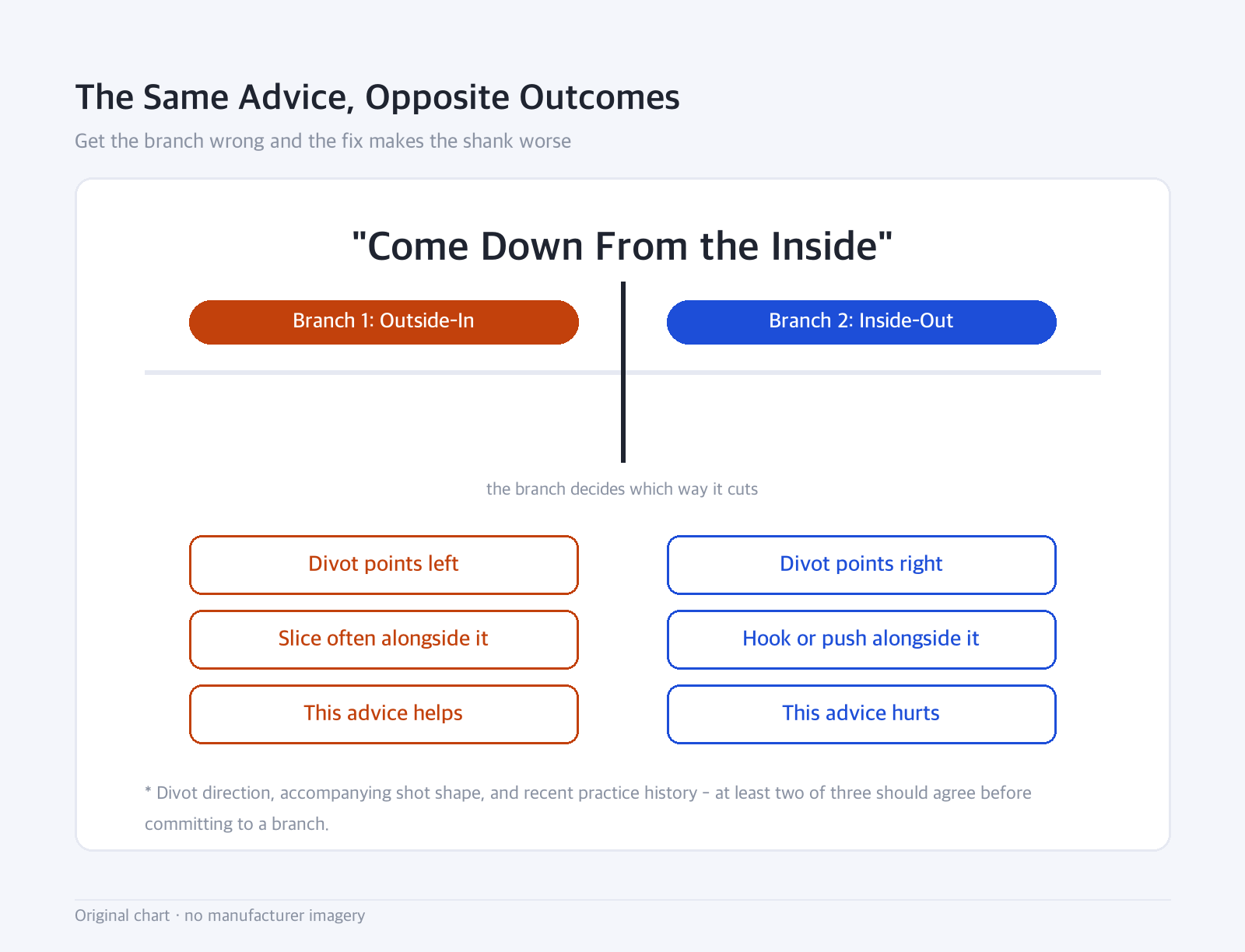
The most common advice for a shank is "come down from the inside." That's the right fix for the first branch.
But what happens if someone in the second branch gets that same advice?
They're already swinging from the inside, and now they turn it even further inward. The hosel points even more directly at the ball. Shanks increase.
The reverse happens too. Give the branch-two fix to a branch-one golfer, and the club swings even further outside.
The same ball can require opposite fixes. And getting the branch wrong makes the situation worse. This is where the "diagnose first" principle running through this series matters most.
4. So how do you tell them apart
Divot direction is the most practical clue.
As noted elsewhere, the divot is one of the few markers you can actually see. Hit an iron shot off turf and check which way it points.
- Divot left of target → the first branch. The club is coming from outside.
- Divot right of target → the second branch. The club is coming from too far inside.
The shot shape that comes with it is another clue.
- A slice shows up alongside it → the first branch.
- A hook or push shows up alongside it → the second branch.
Recent practice history matters too. If a golfer has recently drilled "swing from the inside," they may have crossed into the second branch.
If at least two of these three point the same direction, treat that as the branch.
5. When it's hard to check
Being direct about this: the divot test doesn't work on turf that doesn't take one, or on a mat.
And shanks aren't a frequent enough miss to make a sample easy to gather. Out of ten swings, only one or two might produce it.
For that reason, video review or a lesson pays off more here than for the other branches. The cost of getting this one wrong is high.
When the cost of a wrong call is high, it's worth spending more to check it. That's a caveat on the "cheapest first" principle stated elsewhere in this material.
6. Who this is useful for
- Golfers whose shank correction made things worse — the branch may have been the opposite one.
- Golfers who developed a shank while fixing a slice — they may have crossed into the second branch.
- Golfers who've never checked their divot — it's the most useful marker here.
- Golfers who've drilled "come from the inside" for a long time — worth checking.
This is less useful for:
- Golfers who only practice off a mat — divot-based diagnosis won't work; use the accompanying shot shape instead.
- Golfers whose cause is in the setup — the next piece covers that.
7. What we could not confirm
- The actual ratio between the two branches — no data found on which is more common.
- How closely divot direction correlates with the actual swing path — used as a marker, but its margin of error isn't confirmed.
- A threshold value for how extreme an inside-out path needs to be to cause this branch — we could only confirm the qualitative description "extreme."
In one line
Throwing the club outside causes a shank, and coming in extremely shallow from inside causes a shank too.
Opposite paths produce the same ball, and the fixes run opposite as well. That's why the most common piece of advice — "come down from the inside" — makes things worse for some golfers.
Divot direction, accompanying shot shape, and recent practice history. When at least two of the three point the same way, treat that as the branch.
This piece summarizes general instruction concepts and is not personalized coaching advice. Ball flight fixes depend on individual swing mechanics — a launch monitor session or certified instructor can confirm what applies to you.