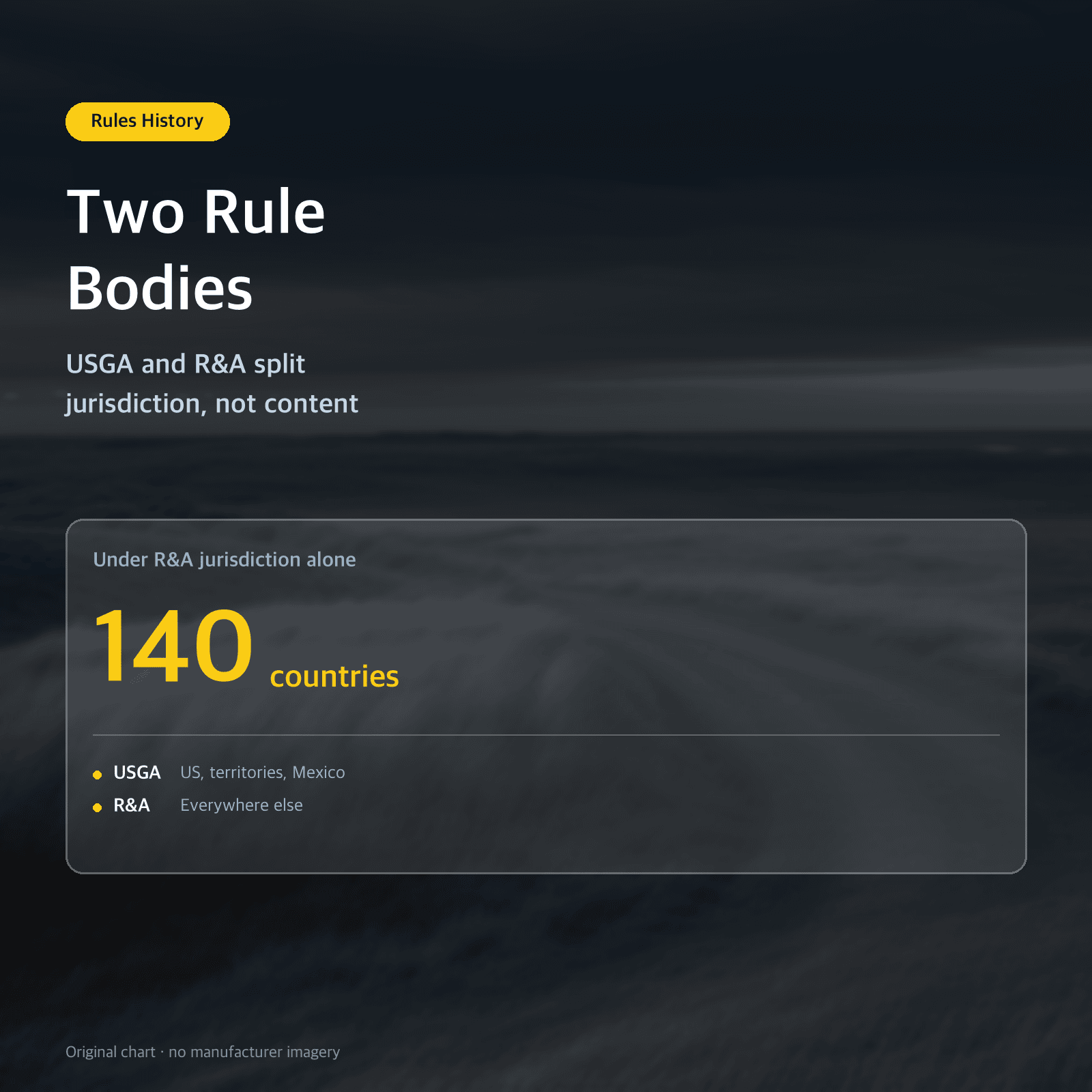
Search golf rules and the USGA and the R&A show up together so often it's easy to assume they're the same organization under two names.
They're separate bodies, and jurisdiction between them is split. The way it's split, though, isn't quite what you'd expect.
The USGA's territory is the United States, its territories, and Mexico — nothing more. The rest of the world falls under the R&A.
1. How jurisdiction is split
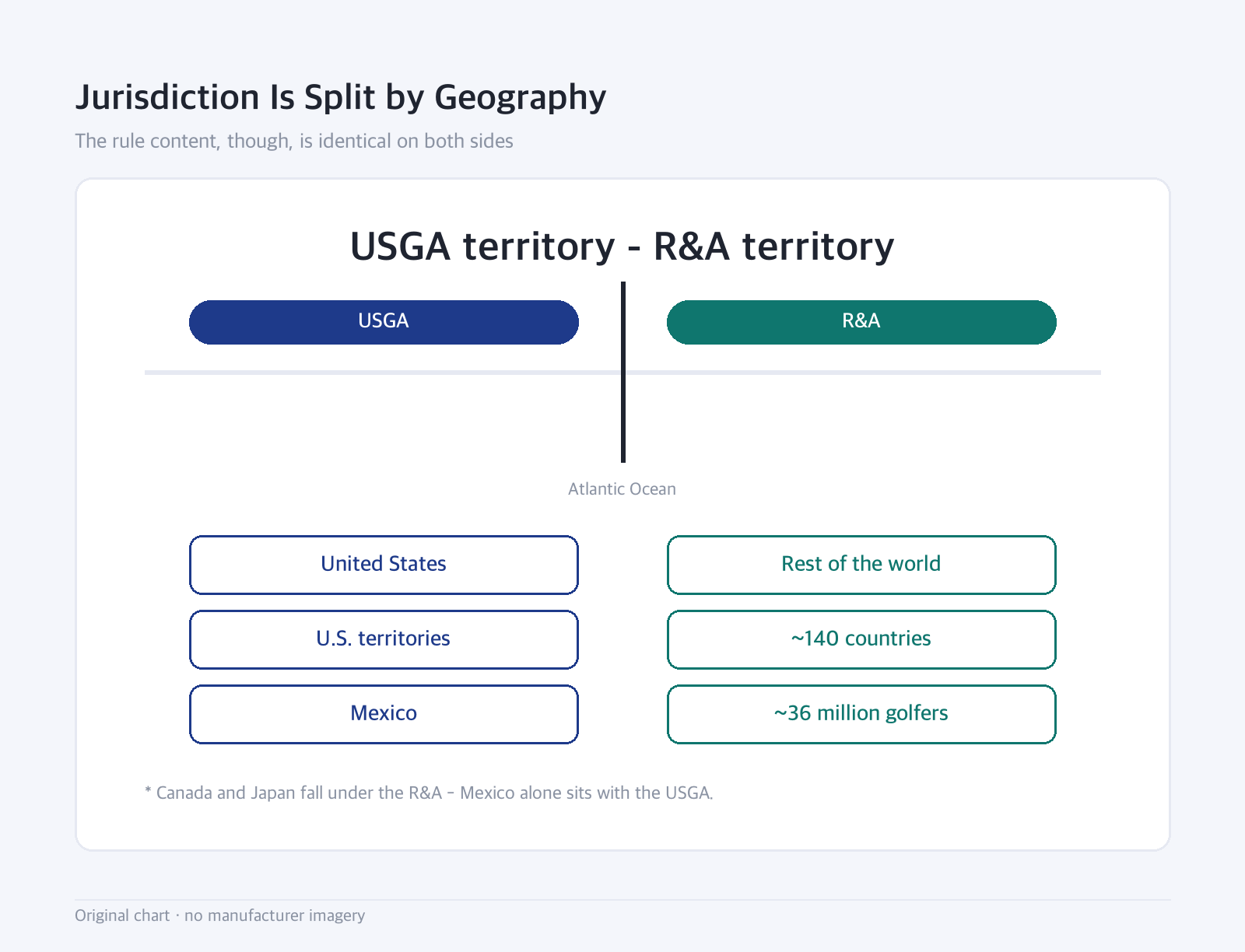
The official division:
- USGA — the United States, U.S. territories, and Mexico
- R&A (R&A Rules Ltd) — the rest of the world. Roughly 140 countries, an estimated 36 million golfers.
Canada falls under the R&A. So does Japan. Right next door to the U.S., but Mexico alone sits with the USGA.
The two bodies have separate jurisdictions but share a single code for the rules, amateur status, and equipment standards. Wherever you play, the rule content is the same.
In practice, this split has no effect on how a round is played — it's purely an administrative division of authority.
That wasn't always the case, though.
2. It started with the Leith articles
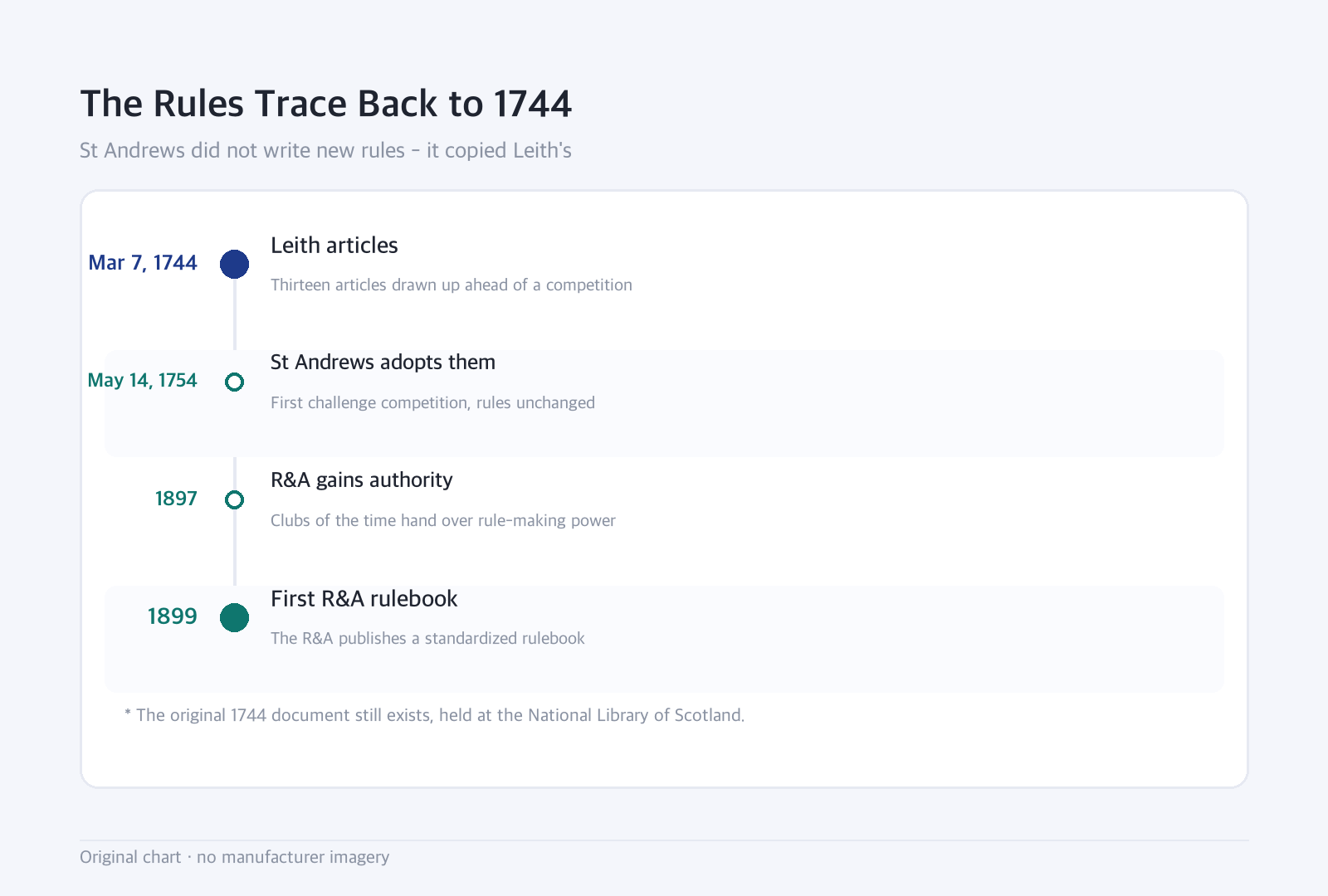
The oldest known written rules date to March 7, 1744 — thirteen articles drawn up by golfers in Leith, Edinburgh, ahead of a competition.
The document is titled "Articles & Laws in Playing at Golf," and it carries the signature of that year's winner, John Rattray, as captain.
The original still exists, held at the National Library of Scotland.
3. St Andrews simply copied it
On May 14, 1754, the first challenge competition was played at St Andrews — a date generally regarded as the starting point of the organization that later became the R&A.
Notably, St Andrews didn't write new rules. It adopted the Leith articles as they were.
Golf's most storied home course, in other words, began its rule-making life by copying someone else's document.
The R&A formally received rule-making authority much later, in 1897, when clubs of the time — mostly British — agreed to hand it over. It published its first standardized rulebook in 1899.
4. American golf started by adopting British rules, too
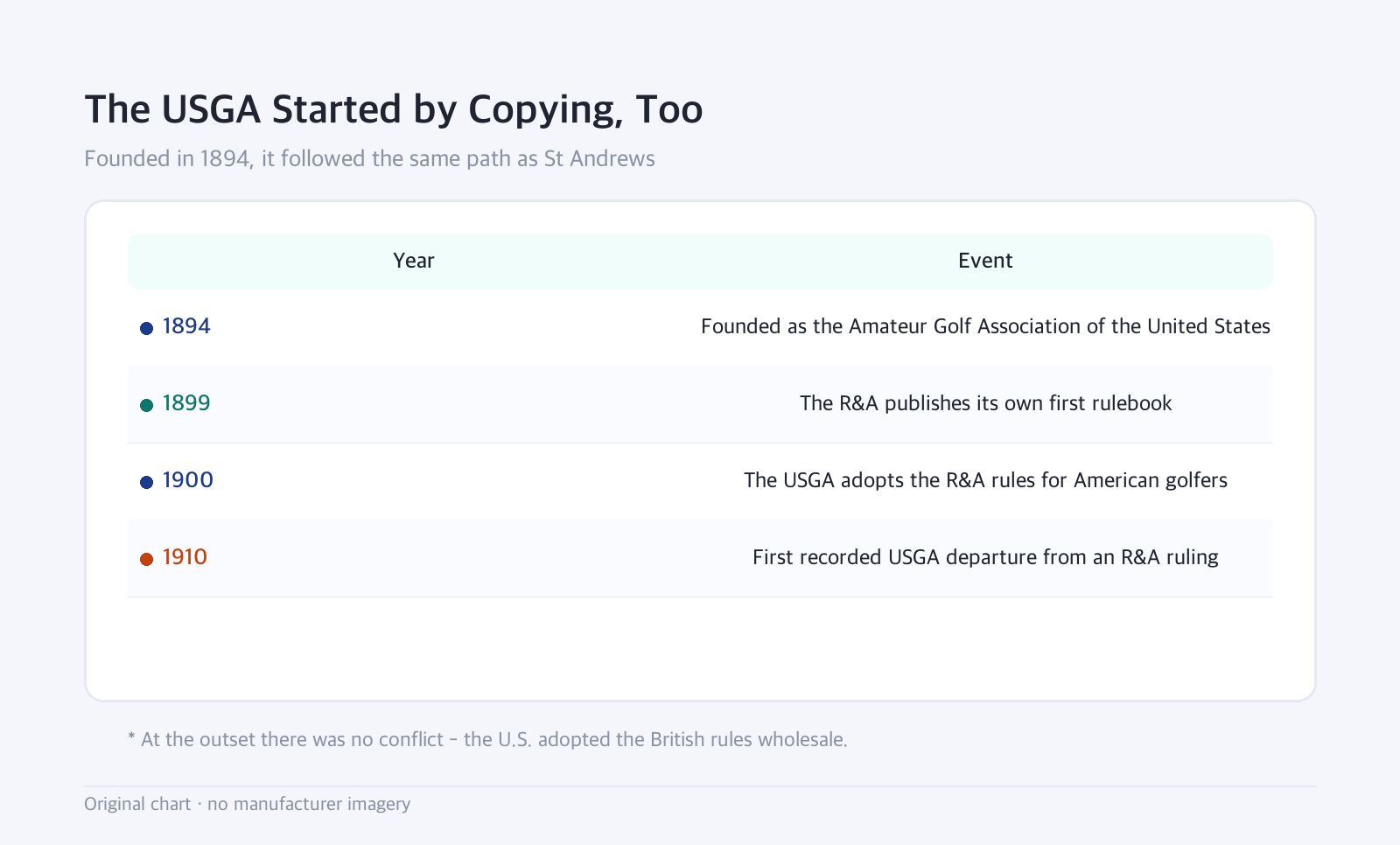
The USGA was founded on December 22, 1894, originally under the name "Amateur Golf Association of the United States," soon renamed.
It followed the same path as St Andrews had: it adopted the R&A's 1899 rules, publishing them for American golfers in 1900.
At the outset, then, there was no conflict — the U.S. simply adopted the British rules wholesale.
The conflict came later. A single putter caused the first split between the two bodies in 1910, and several more disagreements followed.
5. 1951, and twelve days of meetings
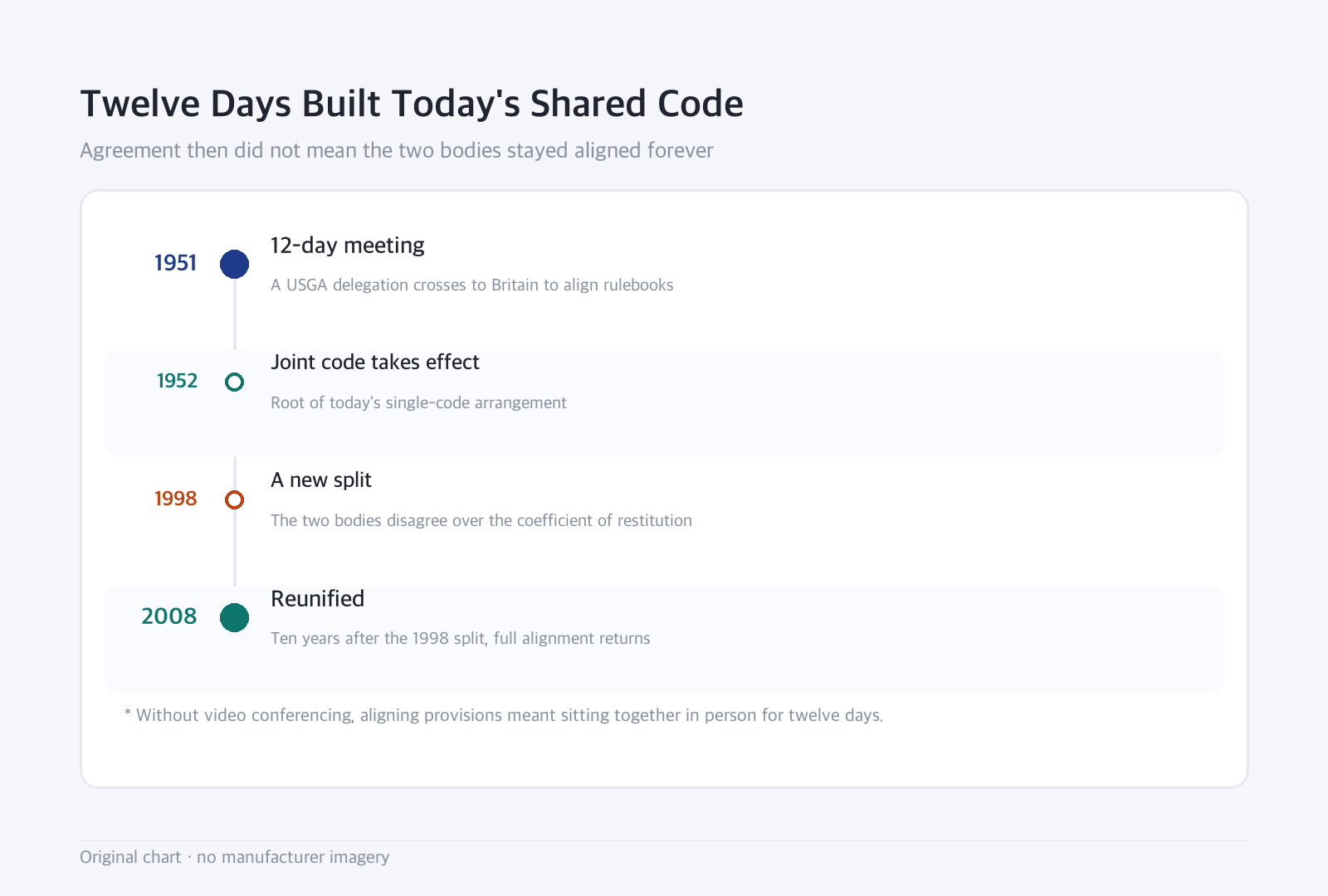
As the two rulebooks gradually diverged, the two bodies sat down together.
In 1951, a USGA delegation traveled to Britain, moving between London and St Andrews for twelve days of meetings, and reached agreement on a joint code. That code took effect in 1952.
Twelve days stands out. Without video conferencing, aligning provisions one by one meant sitting together in person, day after day, across the Atlantic.
That agreement is the root of today's single-code arrangement.
Agreement then didn't mean permanent alignment, though. In 1998, the two bodies split again over the coefficient of restitution on drivers, and it took ten years to reunify.
6. The most recent major overhaul was 2019
The two bodies began a rules modernization project in 2012 and put new rules into effect on January 1, 2019 — regarded as the biggest overhaul since 1984.
That overhaul also renumbered the entire rulebook. The anchoring ban, for example, was formerly Rule 14-1b and is now 10.1b — same content, different number.
That means older material needs a check on which numbering system it's using. Both systems still circulate online.
It's also worth separating what actually changed from what was only renumbered. Anchoring is a case of the latter: the number changed, but the ban itself has applied unchanged since 2016.
7. Who this is useful for
- Golfers looking up rules directly — jurisdictions are split, but since both bodies run on a shared code, the content is the same either way.
- Golfers reading older golf material — the rulebook was fully renumbered in 2019. 14-1b and 10.1b are one example of a single rule with two numbers.
- Golfers following rules disputes — the two bodies haven't always agreed. There have been several periods of divergence.
- Golfers curious about golf's origins — the oldest written rules, the 1744 thirteen articles, survive in original form at the National Library of Scotland.
Less useful for:
- Golfers needing an on-course ruling — the jurisdictional split has no bearing on how a ruling is made, since both bodies use the same code.
- Golfers checking tournament conditions — those are set separately from the rules of golf, event by event.
8. What we could not confirm
- Exactly how Mexico came to fall under USGA jurisdiction — only that it was settled by agreement.
- The specific process by which the R&A received rule-making authority in 1897 — which clubs, and how they agreed.
- What was actually discussed during the twelve days of meetings in 1951.
- The full text of the 1744 thirteen articles — only some provisions were confirmed.
- The current formal agreement document defining the jurisdictional split — we could not confirm the original text.
In one line
Golf has two rule-making bodies. The USGA covers the U.S., its territories, and Mexico; the R&A covers everywhere else.
Today, though, the two run a single code. The root of that system is the 1951 meeting, twelve days long. Before that, the same club could be ruled on differently on either side of the Atlantic.
The dates and organizational details here come only from each body's official material; anything we could not confirm is marked as such.
This piece summarizes general instruction concepts and is not personalized coaching advice. Ball flight fixes depend on individual swing mechanics — a launch monitor session or certified instructor can confirm what applies to you.