
In 1998, the USGA set a cap on driver coefficient of restitution (COR), and the R&A didn't follow. The same driver became legal in one place and illegal in another, depending on where it was played.
How long did that split last?
Full unification took ten years.
1. 2002 — a joint statement of principles
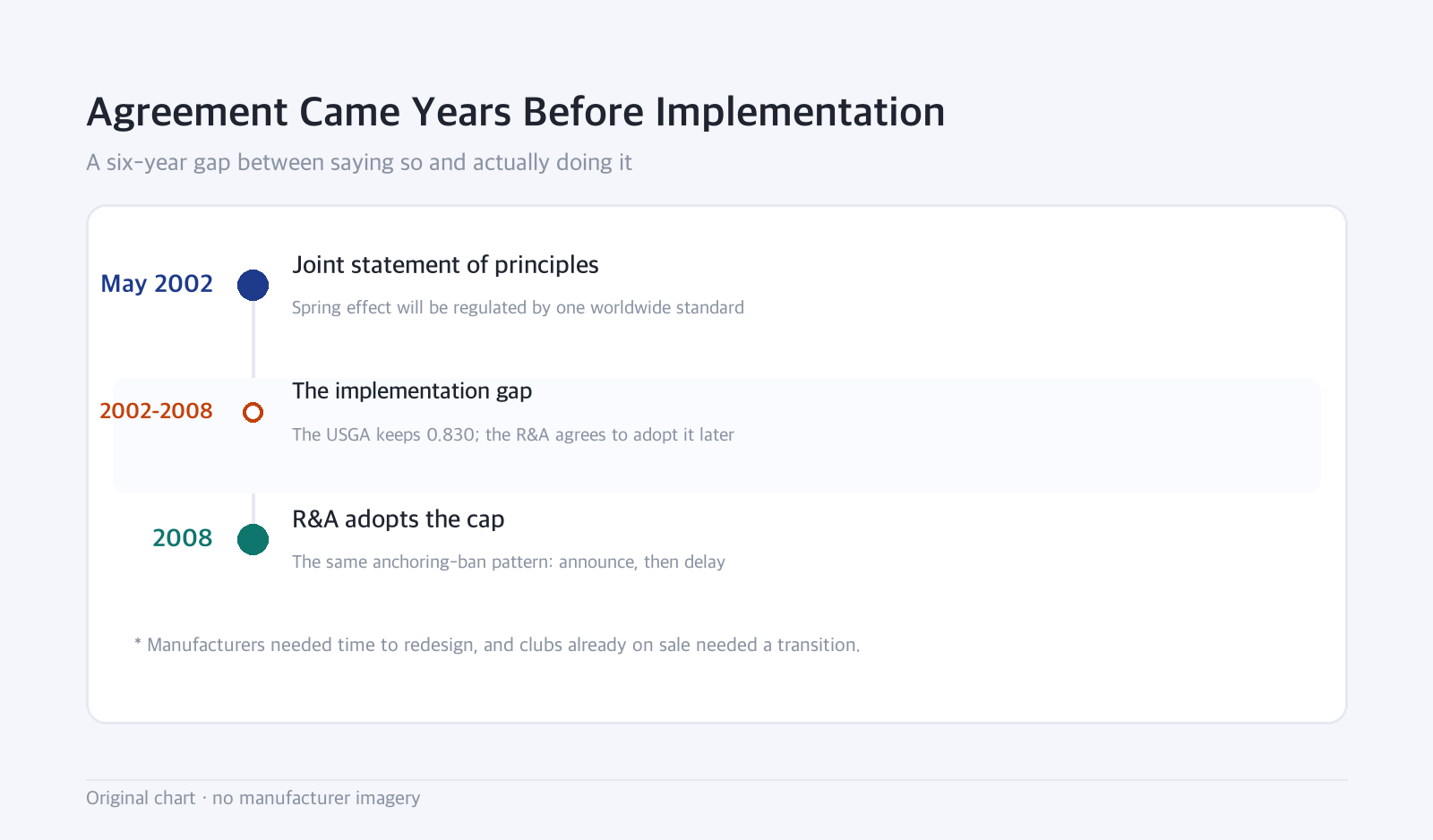
The first step came in May 2002, when the two bodies issued a "joint statement of principles."
The core of it: the spring effect of driving clubs would be regulated by the same standard worldwide.
The specifics were set as follows:
- the USGA would keep its existing 0.830 cap
- the R&A would adopt the same cap starting in 2008
What stands out here is another six-year gap — agreement came in 2002, but actual implementation waited until 2008.
2. Why the delay
This piece can't settle why the delay was necessary. But the structural reasons are worth noting.
Under R&A jurisdiction, there had been no cap up to that point. That means drivers exceeding 0.830 may have been legally on sale. Changing the rule immediately would have made those clubs unusable overnight.
Manufacturers also needed time to adjust — changing design and production lines takes time.
The same approach was used for the anchoring ban — announced in 2013, effective in 2016. The three-year gap was explained as time for golfers to adjust their stroke.
Rulemaking bodies routinely build in a delay between announcing a change and actually implementing it. It's how the field operates.
3. Meanwhile, the measurement method changed
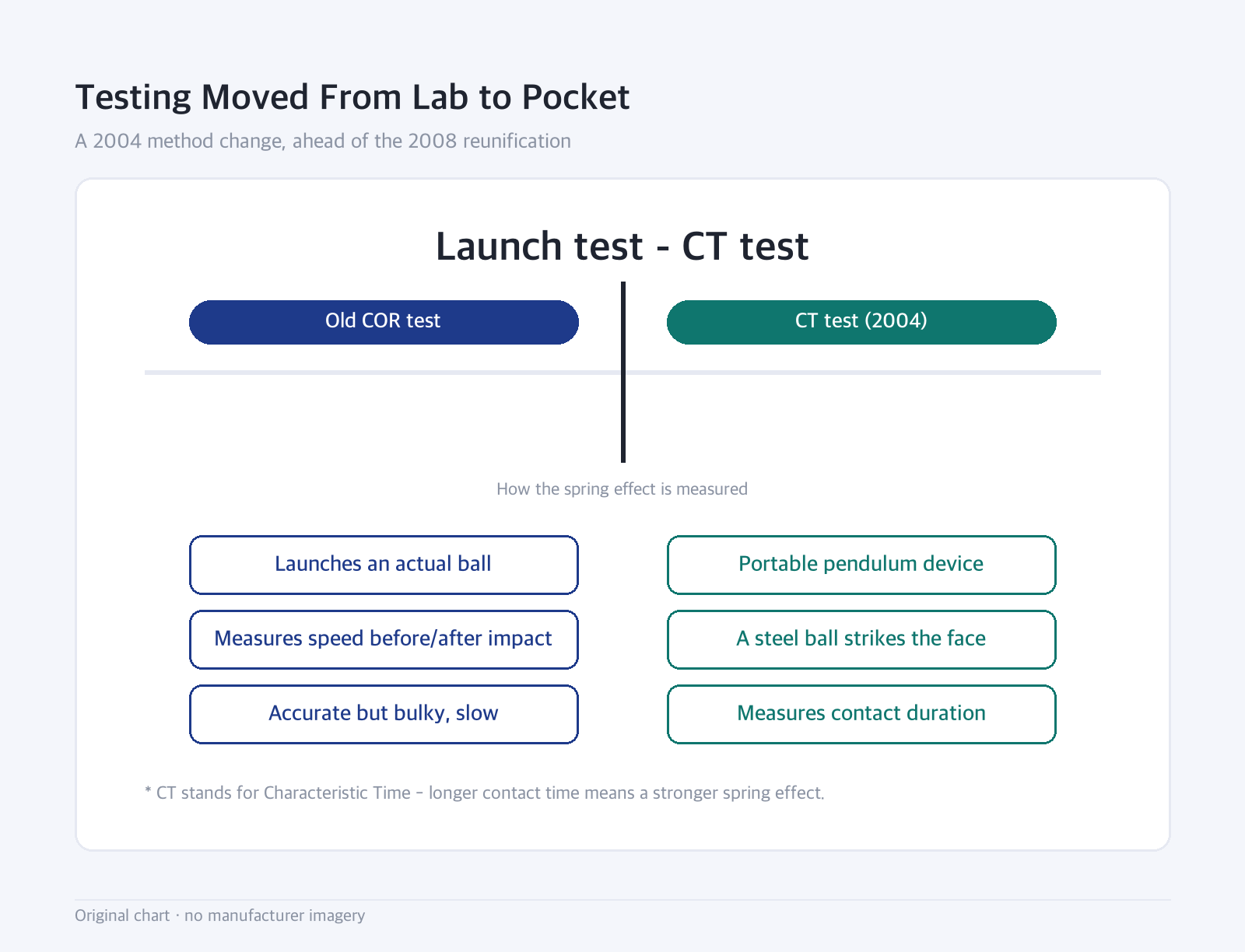
While waiting for unification, the USGA made a separate move: in 2004, it changed how testing worked.
The old COR test involved actually launching a ball and measuring speed before and after impact — accurate, but bulky and time-consuming.
The replacement was the CT test.
- it uses a small, portable pendulum device
- a steel ball strikes the face
- and the duration of contact is measured
The more the face flexes, the longer the ball stays in contact. Longer contact time means a stronger spring effect.
CT stands for Characteristic Time.
4. 239 microseconds
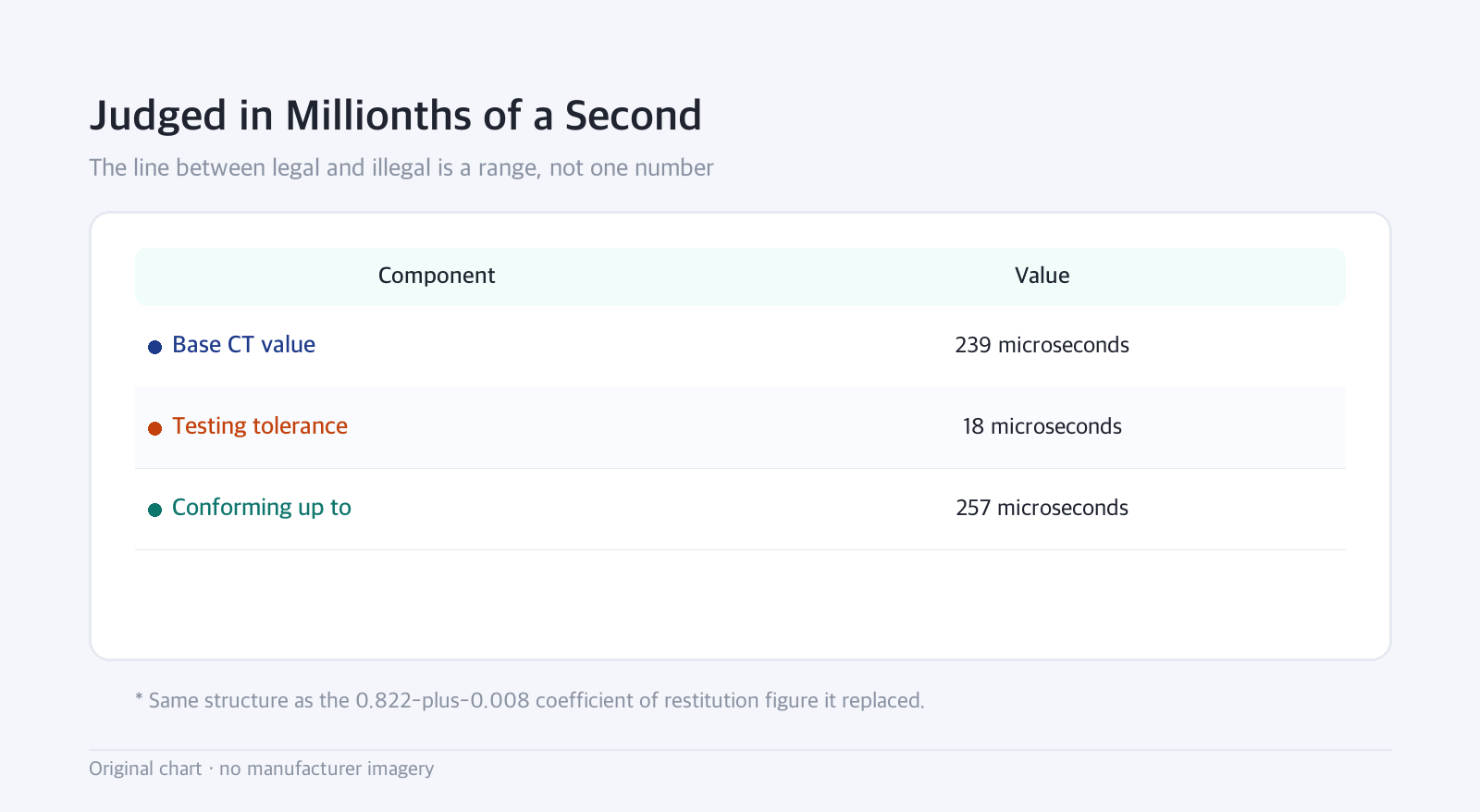
This is the CT test's cap.
- a base value of 239 microseconds — 0.000239 seconds
- a tolerance of 18 microseconds
- so anything up to 257 microseconds is conforming
Clubs are judged in millionths of a second. And as before, a tolerance is built in. It's the same structure as the 0.822-plus-0.008 arrangement used for coefficient of restitution.
Measurement always carries some error, and rules are written to account for it. The line between legal and illegal isn't a single clean number.
The portable nature of the device matters too — it means clubs can be tested right at the competition venue. No need to ship them to a lab, which allows more frequent testing.
There's another property worth noting. A face changes slightly with use. Repeated impacts can cause metal to fatigue microscopically, increasing the spring effect over time. A club that conformed when new isn't guaranteed to stay conforming.
5. Three splits, three resolutions
Lined up together, the three cases look like this:
- 1910, the Schenectady putter — R&A banned, USGA declined. When it was resolved isn't confirmed.
- 1924 and 1929, steel shafts — five years.
- 1998, coefficient of restitution — agreement in 2002, implementation in 2008. Ten years.
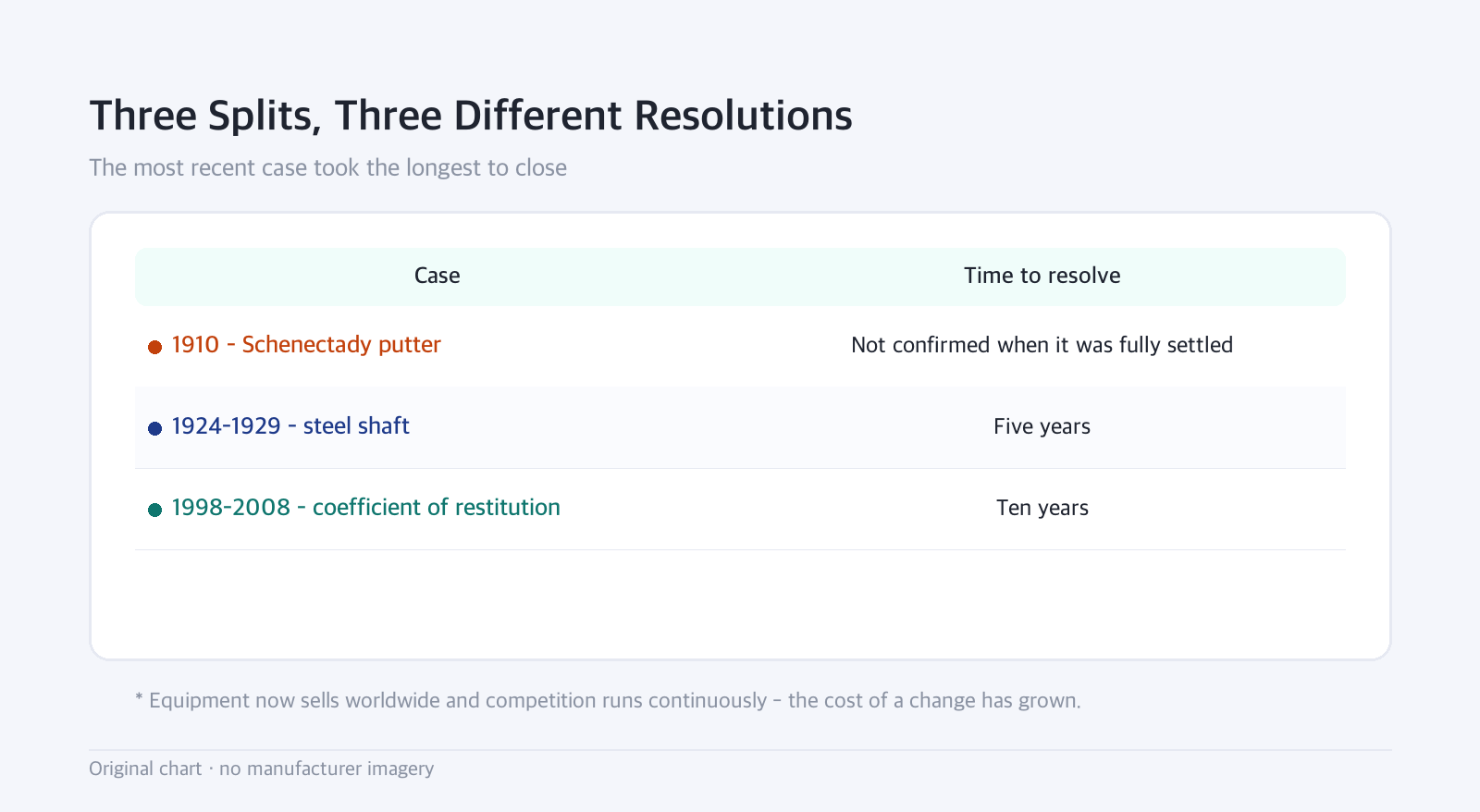
The most recent case took the longest.
That seems counterintuitive, but there's a plausible reason. Early on, rule changes affected a narrower range of players. Now equipment sells worldwide and international competition runs continuously. The cost of making a change has grown accordingly.
Today the two bodies operate under a single code. Jurisdictions remain separate, but the rules themselves match. Getting here took roughly a century.
6. Who this is useful for
Based on what could be confirmed:
- Golfers shopping for a driver — every product on the market today is built within the CT 257-microsecond cap. A "conforming driver with more rebound" isn't really a thing.
- Golfers following rule-change news — there's usually a gap of several years between announcement and implementation. Rules rarely take effect immediately.
- Golfers interested in the ball rollback — the same pattern is playing out: announced in 2023, implementation still pending.
- Golfers curious how equipment rules operate — a base value plus a tolerance is the standard structure.
This is less useful for:
- Golfers comparing club performance — the cap is uniform, so it won't distinguish products.
- Golfers who only need current rules — the two bodies' standards already match.
7. What we could not confirm
- The full text of the 2002 joint statement — only the summary was confirmed.
- Why the R&A set 2008 as its implementation date — we found no confirmed source.
- How the 239-microsecond value was derived — it appears to correspond to 0.830, but we could not confirm the calculation.
- When the 1910 Schenectady matter was fully settled.
- Actual enforcement cases since the CT test was introduced.
- When the R&A adopted the CT test.
In one line
The two bodies that split in 1998 agreed in 2002 and implemented in 2008. Full unification took ten years.
Along the way, the measurement method shifted from coefficient of restitution to a CT cap of 239 microseconds, and drivers today are judged in millionths of a second.
Of the three splits, the most recent took the longest — likely because the cost of changing the rules has grown.
The figures and dates here come only from confirmed sources, and anything unconfirmed is marked as such.
This piece summarizes general instruction concepts and is not personalized coaching advice. Ball flight fixes depend on individual swing mechanics — a launch monitor session or certified instructor can confirm what applies to you.