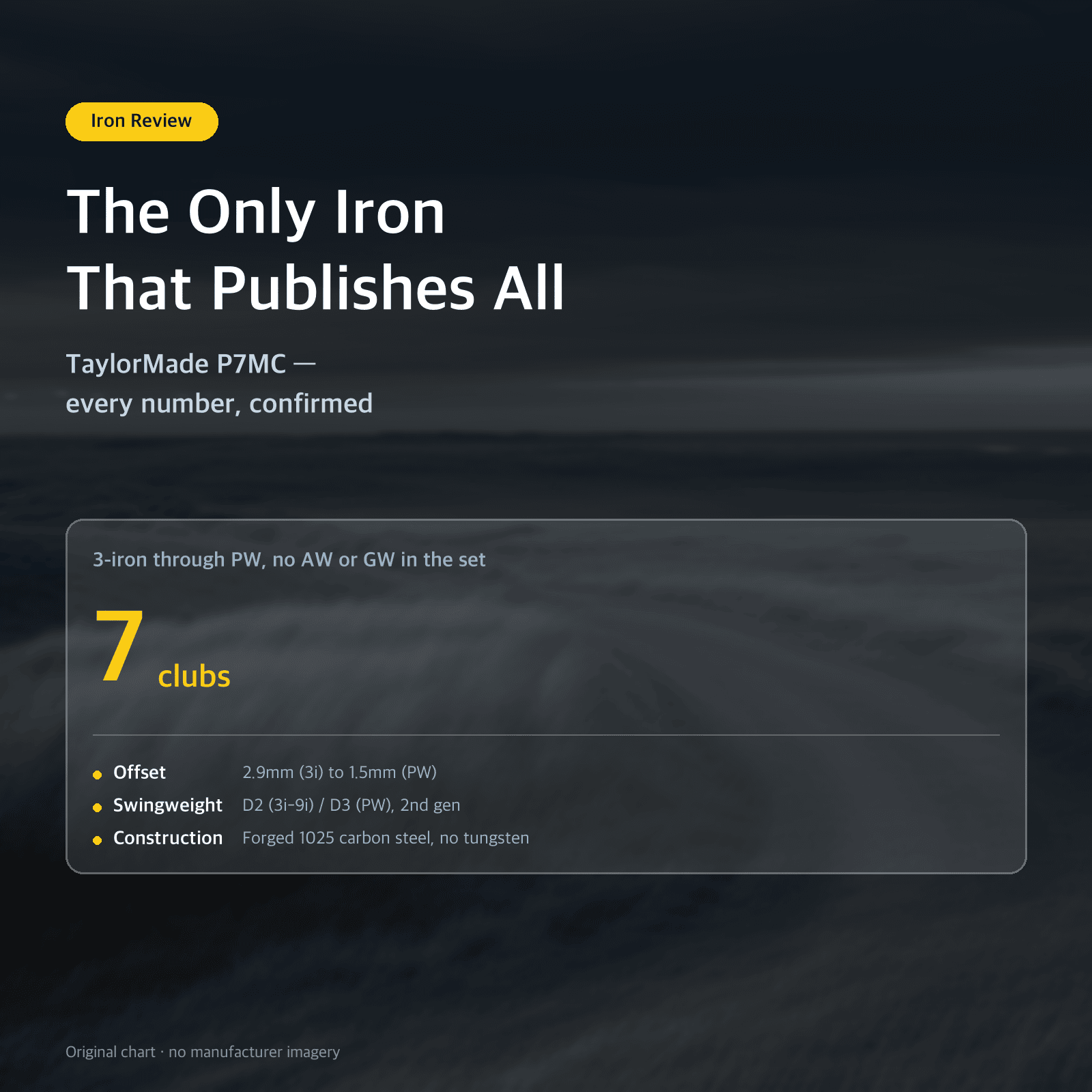
Look into the P-series irons and you eventually stop at the P7MC. It's a name that comes up often, but the specs are a mess — a 2020 article and a 2023 article get mixed together, and stock status varies by retailer. So this piece separates what's confirmed from what isn't. Numbers we couldn't confirm are left blank rather than filled in.
1. What generation is the current P7MC
There have been two generations of the P7MC.
- 1st generation — released September 2020
- 2nd generation — preorder December 2022, release January 2023 (current)
As of 2026, no 3rd generation has been released. Every P7MC currently on the market is the 2023 version.
Here's an interesting detail: loft, lie, length, and offset are identical between the two generations. The only spec that changed is swingweight. The 1st generation ran D3 for 3-iron through 9-iron and D4 for the PW; the 2nd generation runs D2 and D3, respectively. That's why P7MC spec tables online often contradict each other — it's not that the loft changed, it's that generations are being mixed.
One more thing worth flagging: P7MC doesn't appear in TaylorMade's current U.S. iron lineup. Both generations' product pages are marked out of stock, with the P7CB occupying that spot instead. No formal discontinuation has been announced, but by U.S. standards it's fair to treat it as outside the current lineup, even where it's still listed for sale elsewhere.
2. Official spec sheet
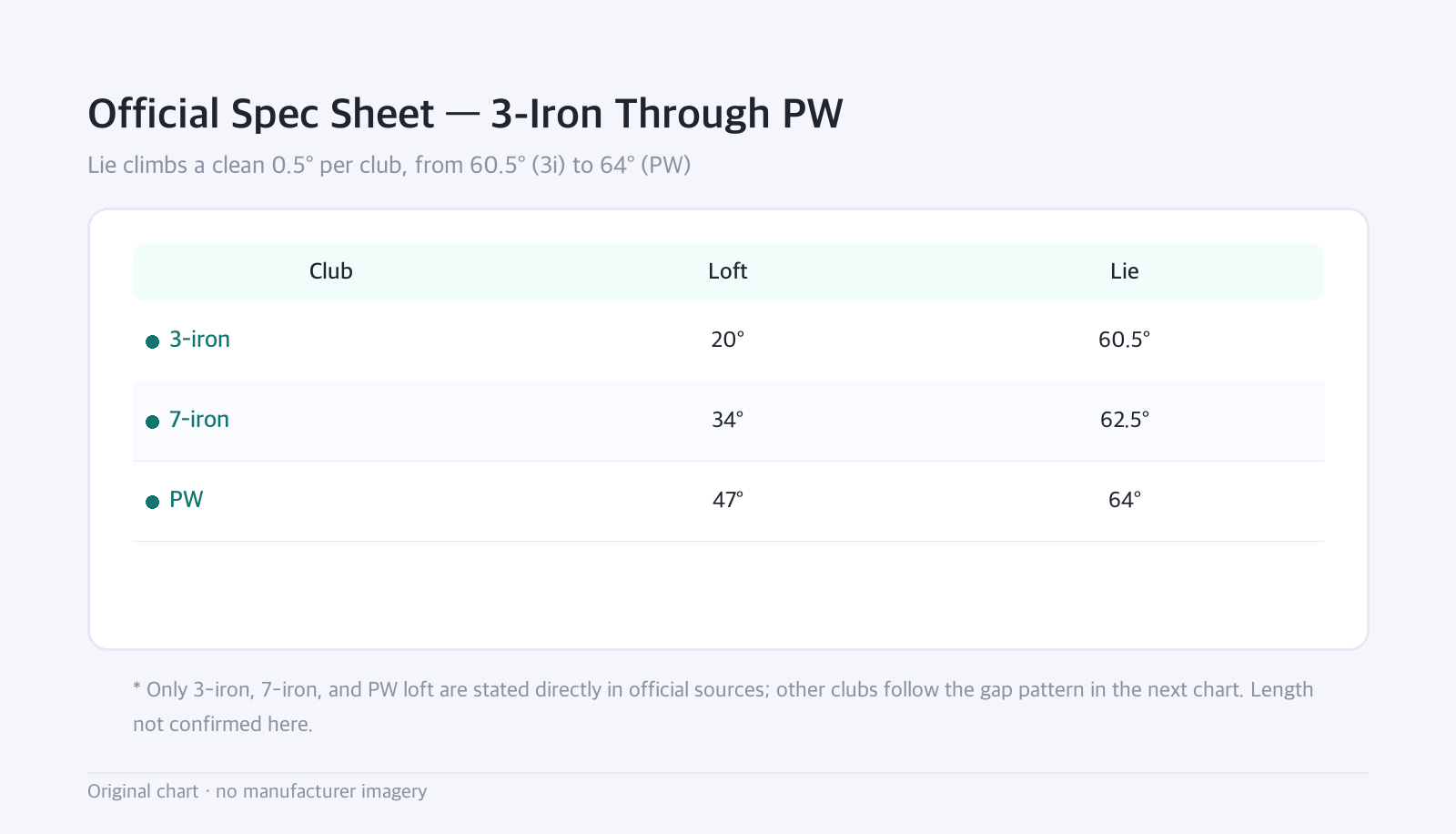
The set runs 3-iron through PW — seven clubs. There's no AW or GW option.
Lie angle climbs a clean 0.5° per club, from 60.5° at the 3-iron to 64° at the PW. Length drops 0.5 inch per club, except for the step from 9-iron to PW, which drops only 0.25 inch. This part is identical across all three P-series models.
3. Loft spacing — 3° gaps widening to 4°
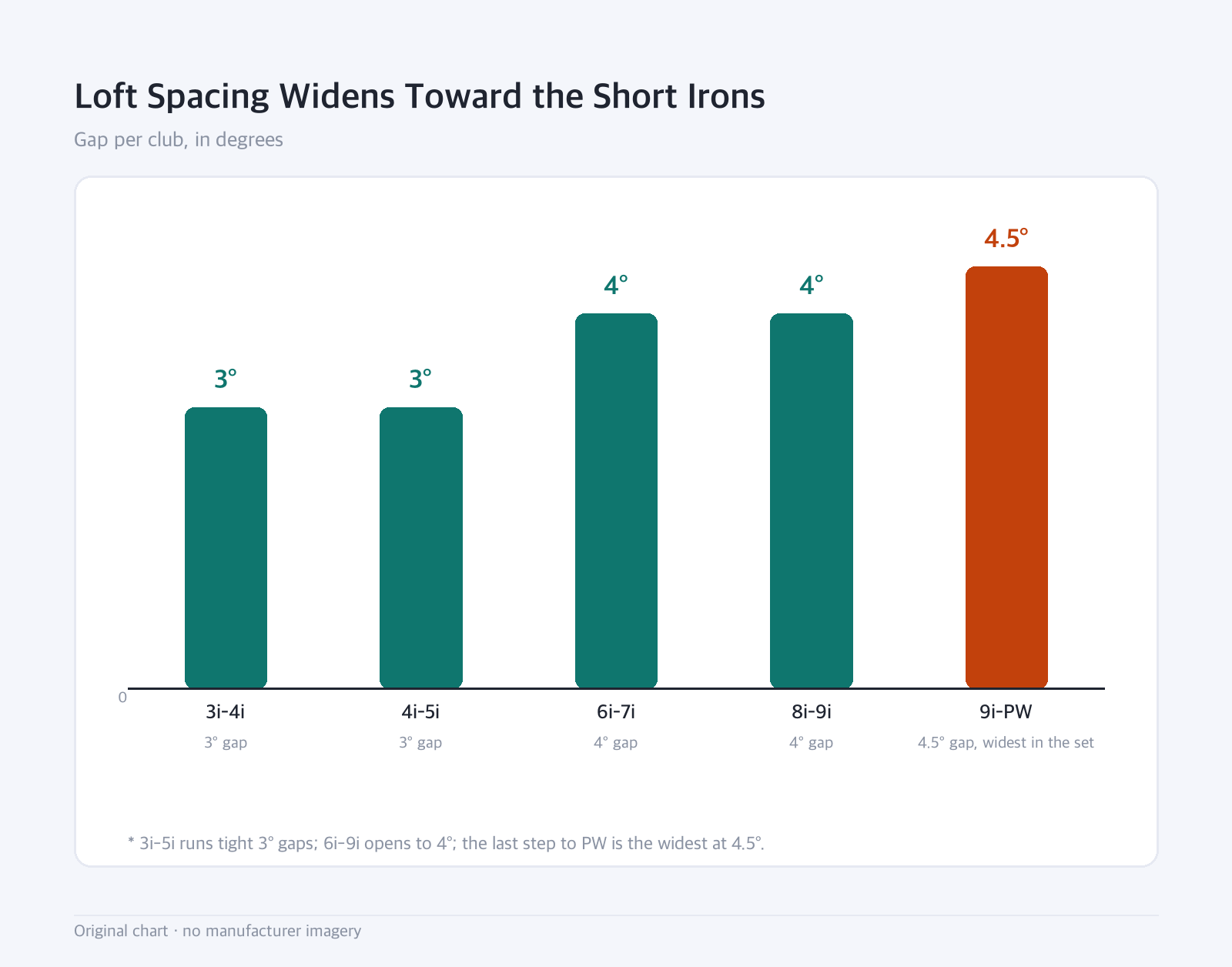
The loft spacing tells you something about intent.
- 3-iron through 5-iron: 3° gaps
- 6-iron through 9-iron: 4° gaps
- 9-iron to PW: 4.5°
The long-iron end is tighter, the short-iron end wider. As loft gets stronger, the same angular difference produces a smaller distance gap, so widening the gaps toward the bottom of the set isn't an unusual choice.
The number worth watching in real use is the last one. A 47° PW means it's worth planning ahead whether the gap down to the sand wedge gets covered with two wedges or three. Compared to the strong-lofted irons that are common now, a 47° PW actually makes wedge-gapping easier.
4. Offset — the one model that publishes the numbers
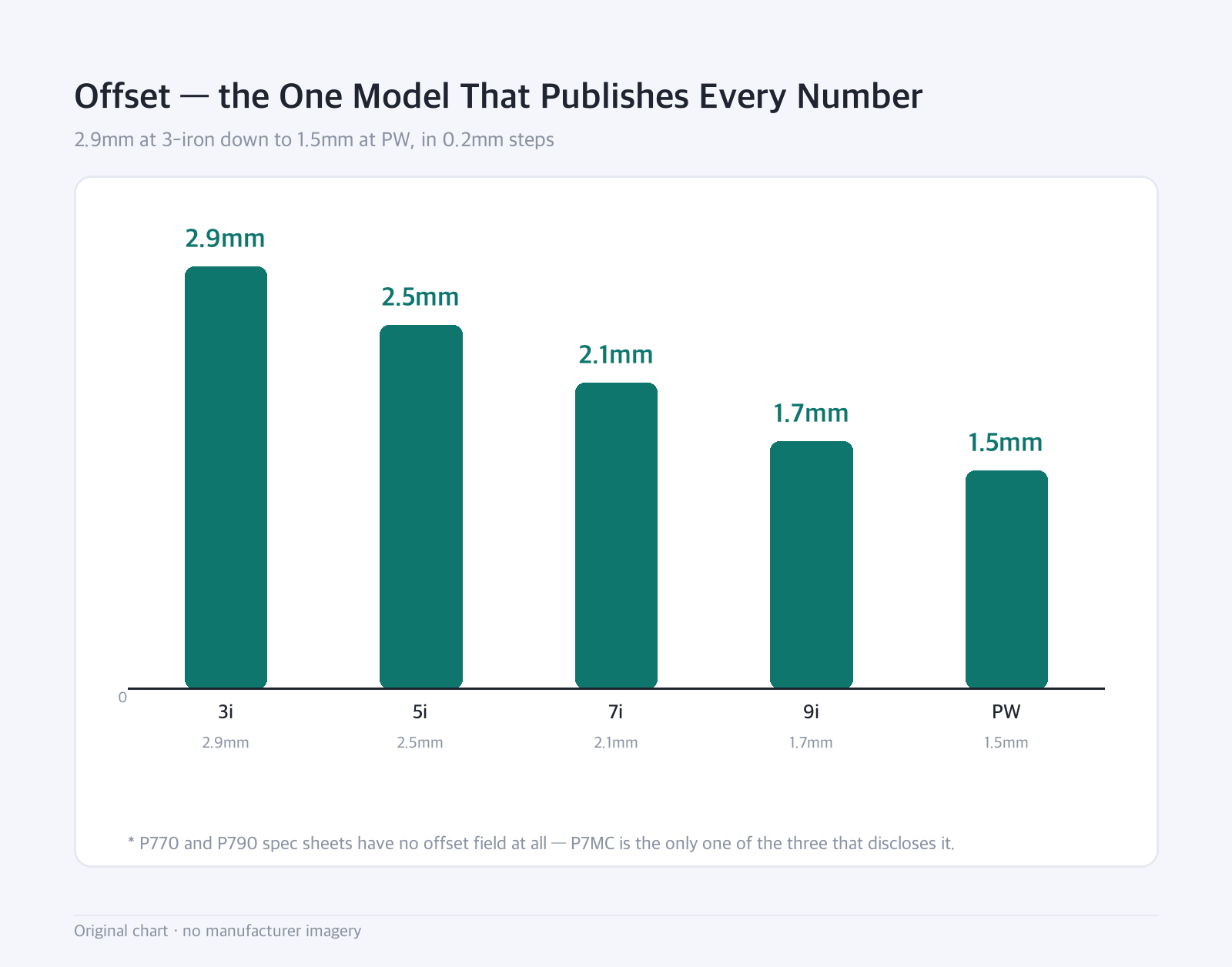
This is the part worth dwelling on most.
P7MC publishes offset for every club on its official spec sheet, running from 2.9mm at the 3-iron down to 1.5mm at the PW, in 0.2mm steps. By contrast, the P770 and P790 spec sheets have no offset field at all — the same is true for bounce and blade length.
This matters because the P770/P790 offset figures circulating online are mostly either outdated-generation values or unsourced. A 2017-era P770 offset table is still copy-pasted across multiple sites as if it were current. Once someone's numbers get dropped into a blank field, it stops being information and starts being a misconception.
A smaller offset means the leading edge sits closer to the shaft line at address. That trades away some of the forgiveness that comes with a "helping hand" look, in exchange for easier face manipulation. Going from 2.9mm to 1.5mm is on the small end for irons generally.
5. Construction — nothing added inside
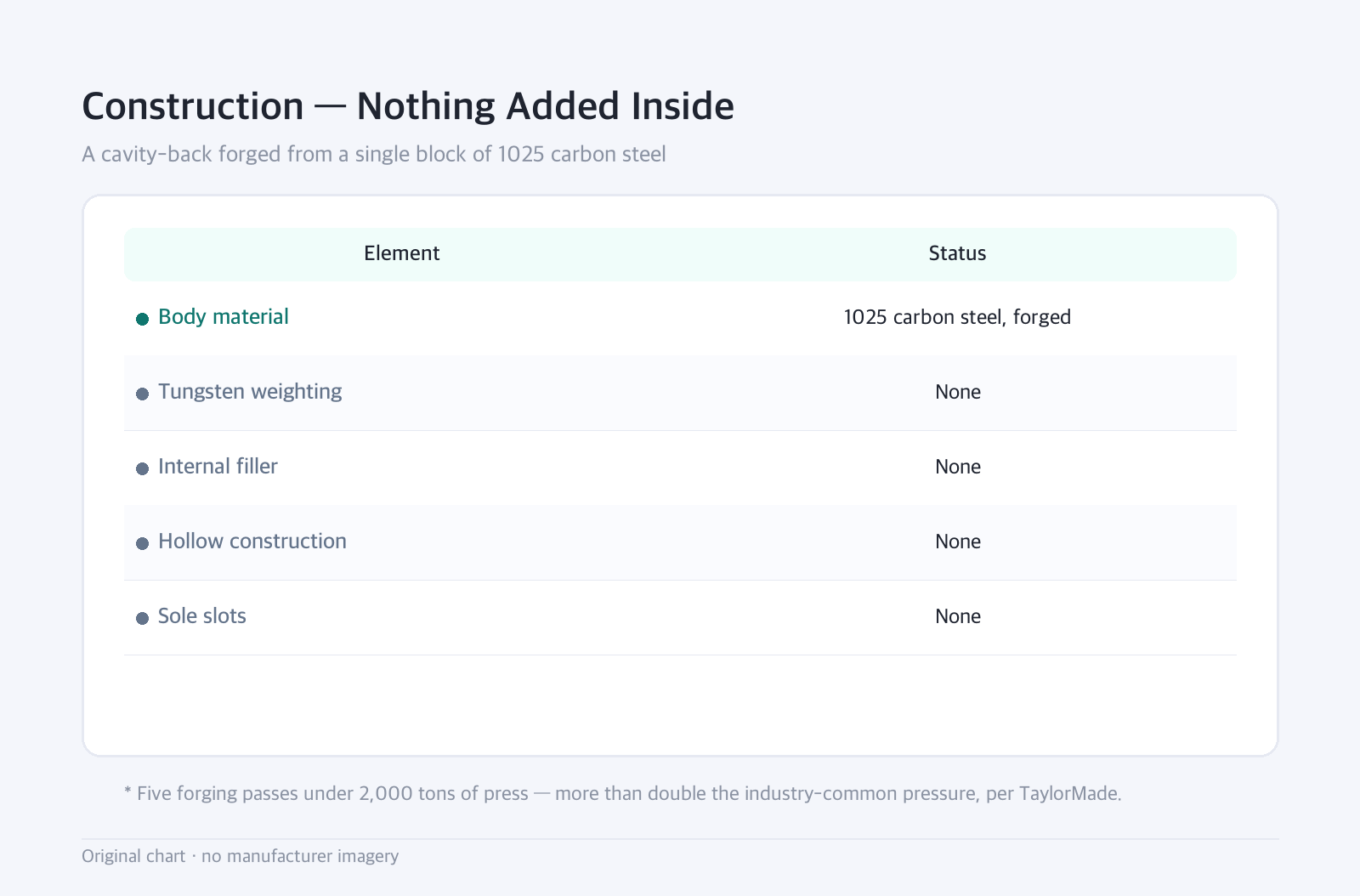
The P7MC's construction fits in one sentence: a cavity-back forged from a single block of 1025 carbon steel.
TaylorMade describes the process as five forging passes under 2,000 tons of press — more than double the pressure commonly used in the industry, which the company says produces a tighter metal grain structure. The face is finish-milled by machine, and satin is the only finish offered.
What's absent matters as much as what's there:
- No tungsten weighting
- No internal filler
- No hollow construction
- No sole slots
There's no mechanism at all for pushing weight to the perimeter. Forgiveness is structurally limited as a result. In exchange, feedback from off-center contact transmits directly to the hands — which is the reason to choose this club.
6. Shaft, price, and who it's for
Stock shaft is KBS Tour steel (S 120g / X 130g), with a Golf Pride Z Grip 360 grip at 52g. A graphite option is also available separately.
Pricing is given as of the time it was checked. The 2023 launch price was $1,299 for a seven-club steel set. Prices vary by market and configuration, so it's worth confirming again right before buying.
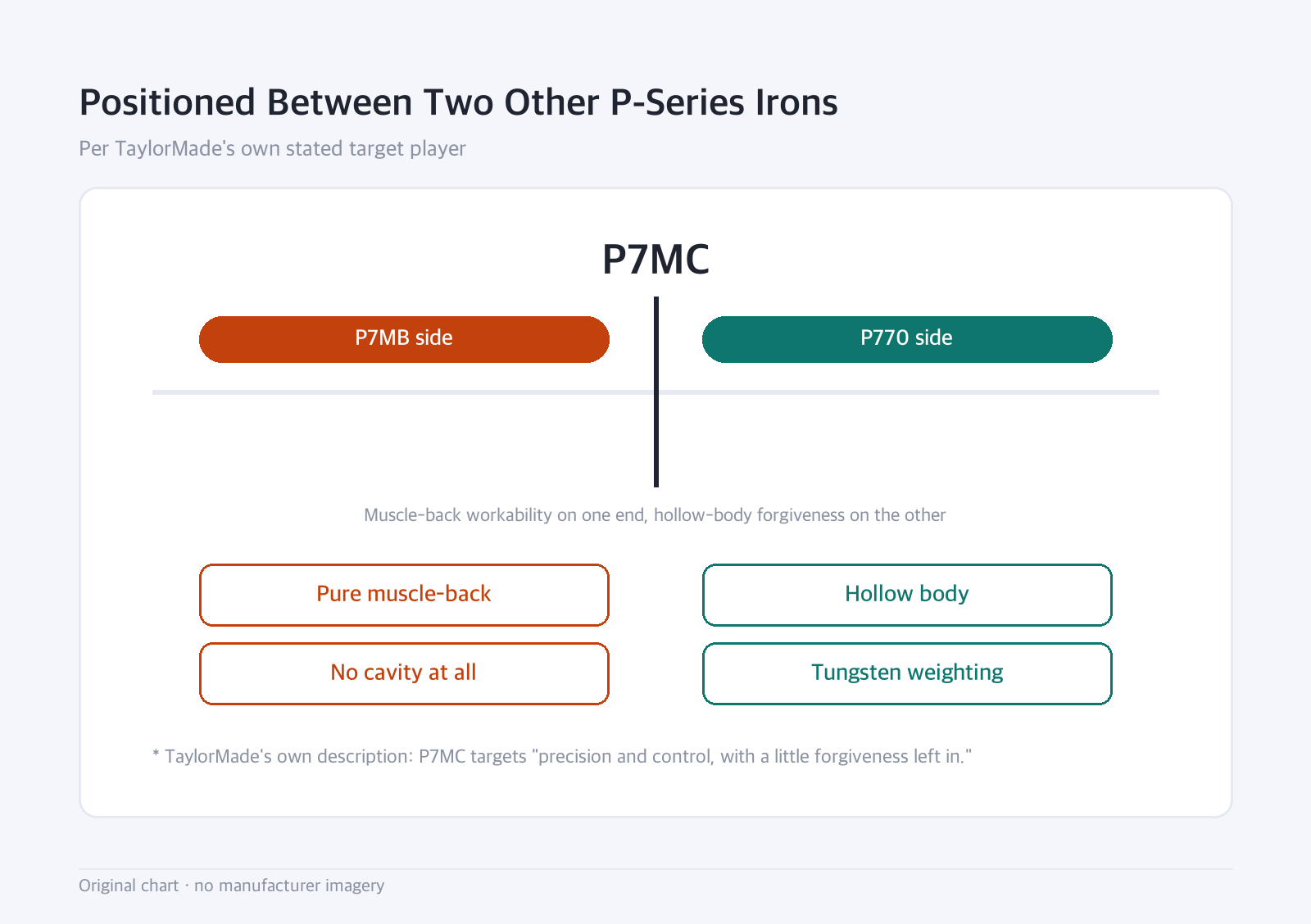
TaylorMade's stated target player is someone who wants "precision and control, with a little forgiveness left in." That places it between the pure muscle-back P7MB and the hollow-body P770.
7. Who this iron is for
Judgment calls based on confirmed specs.
- Low-handicap players who prioritize feel and workability — no tungsten, filler, hollow body, or sole slots means there's no mechanism for shifting weight. If you want contact quality to transmit directly to your hands, this is the spot
- Golfers who like to open and close the face — offset runs small, from 2.9mm at the 3-iron to 1.5mm at the PW. A leading edge closer to the shaft line gives more room to manipulate the face
- Golfers who want a simple wedge setup — at 47°, the PW leaves a smaller gap to the wedges than today's stronger-lofted irons
It may be less suited for:
- Golfers who can't tolerate distance loss on mishits — there's structurally no mechanism to shift weight, so forgiveness is limited
- Golfers who want a full AW/GW set from the same brand — the set only runs 3-iron through PW, seven clubs; wedges need to come from elsewhere
8. What we could not confirm
Honestly listed. Neither the manufacturer nor major retailers publish numbers for these:
- Bounce angle per club
- Blade length (mm)
- Sole width and topline thickness measurements
Only descriptive language — "narrow sole," "tight leading edge" — is available. If these numbers matter to you, the only option is checking the physical club in person.
In one line
P7MC skips every weight-shifting mechanism, but in exchange, it's the one model that publishes all its own numbers.
It's not a club you buy for forgiveness — you're trading forgiveness for workability. Whether that trade is worth it comes down to whether you can live with the distance loss the last time you mishit one.
Every chart in this piece was built directly from official manufacturer spec sheets. What we couldn't confirm is left blank.
This piece summarizes general instruction concepts and is not personalized coaching advice. Ball flight fixes depend on individual swing mechanics — a launch monitor session or certified instructor can confirm what applies to you.