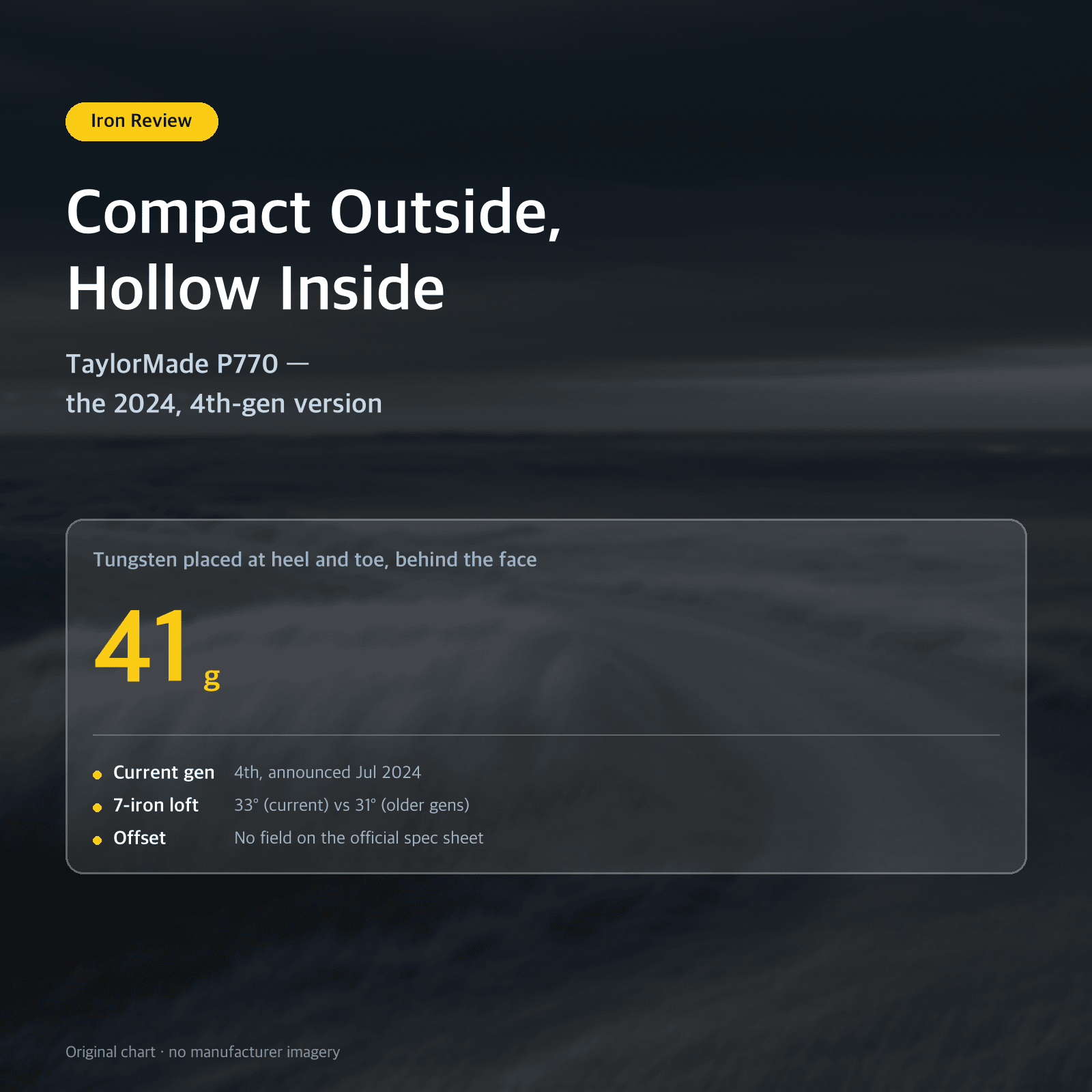
P770 is a tricky club to describe. At address, the small head and thin topline read as a pure player's iron. Look inside, though, and it's hollow with tungsten weighting. The shape belongs to the P7MC side; the construction belongs to the P790 side.
There's also a trap when you search for specs: the current P770 and the P770 spec tables floating around online are often different generations. That's worth addressing first.
1. The current P770 is the 2024 version
Here's the generational history:
- 1st generation — 2017
- 2nd generation — 2020
- 3rd generation — 2022
- 4th generation — announced July 2024, released September 2024 (current)
A Battle Worn finish was added in August 2025, but that's a finish variant, not a new head. As of 2026, the current generation is the 2024 version.
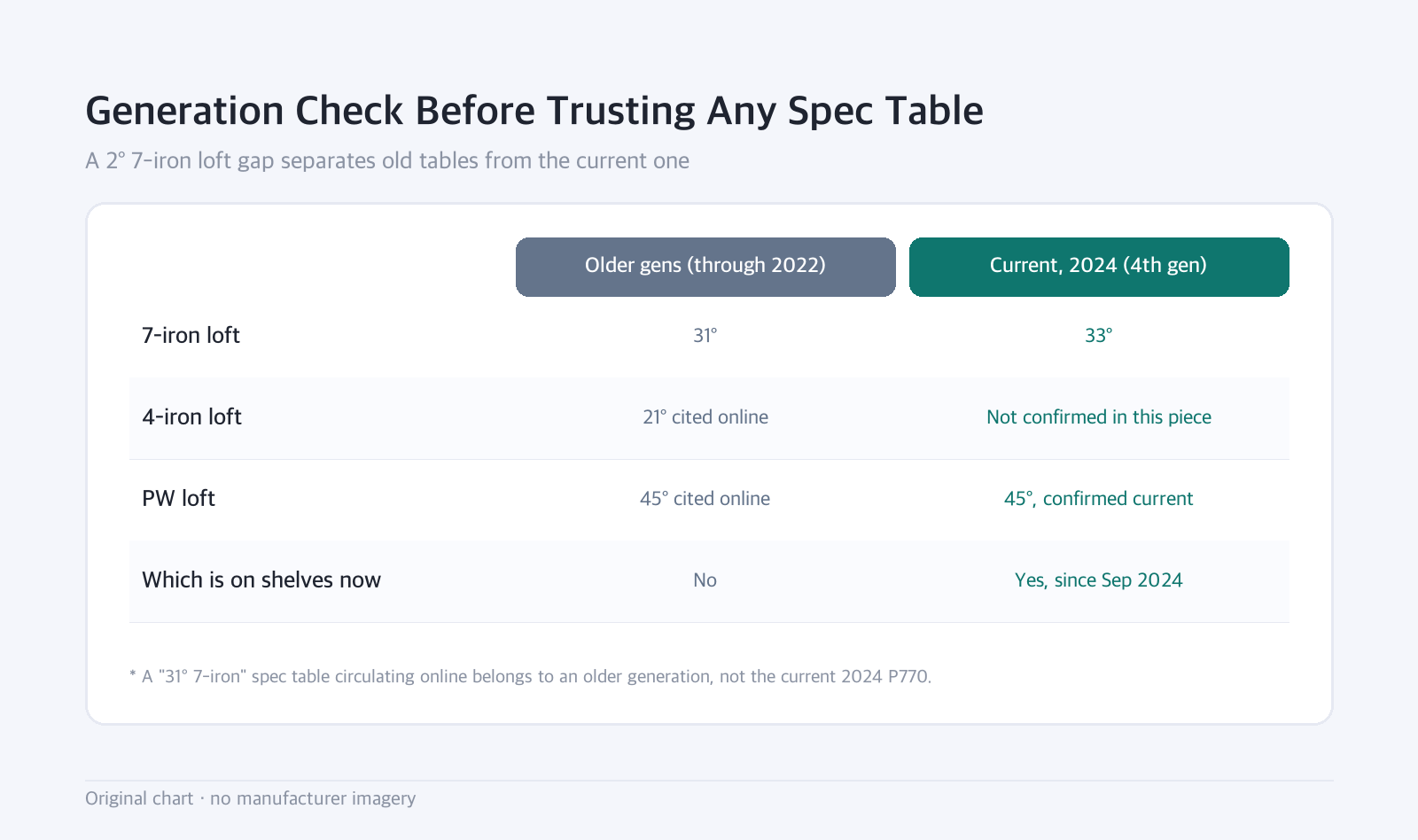
The problem shows up here: if you've seen a P770 spec table listing "31° 7-iron, 21° 4-iron, 45° PW," that's an older generation. The current 2024 version's 7-iron is 33°. A 2-degree difference is not negligible in distance terms, and it can throw off an entire gapping calculation.
Confirm the generation before you trust the spec sheet.
2. Official spec sheet
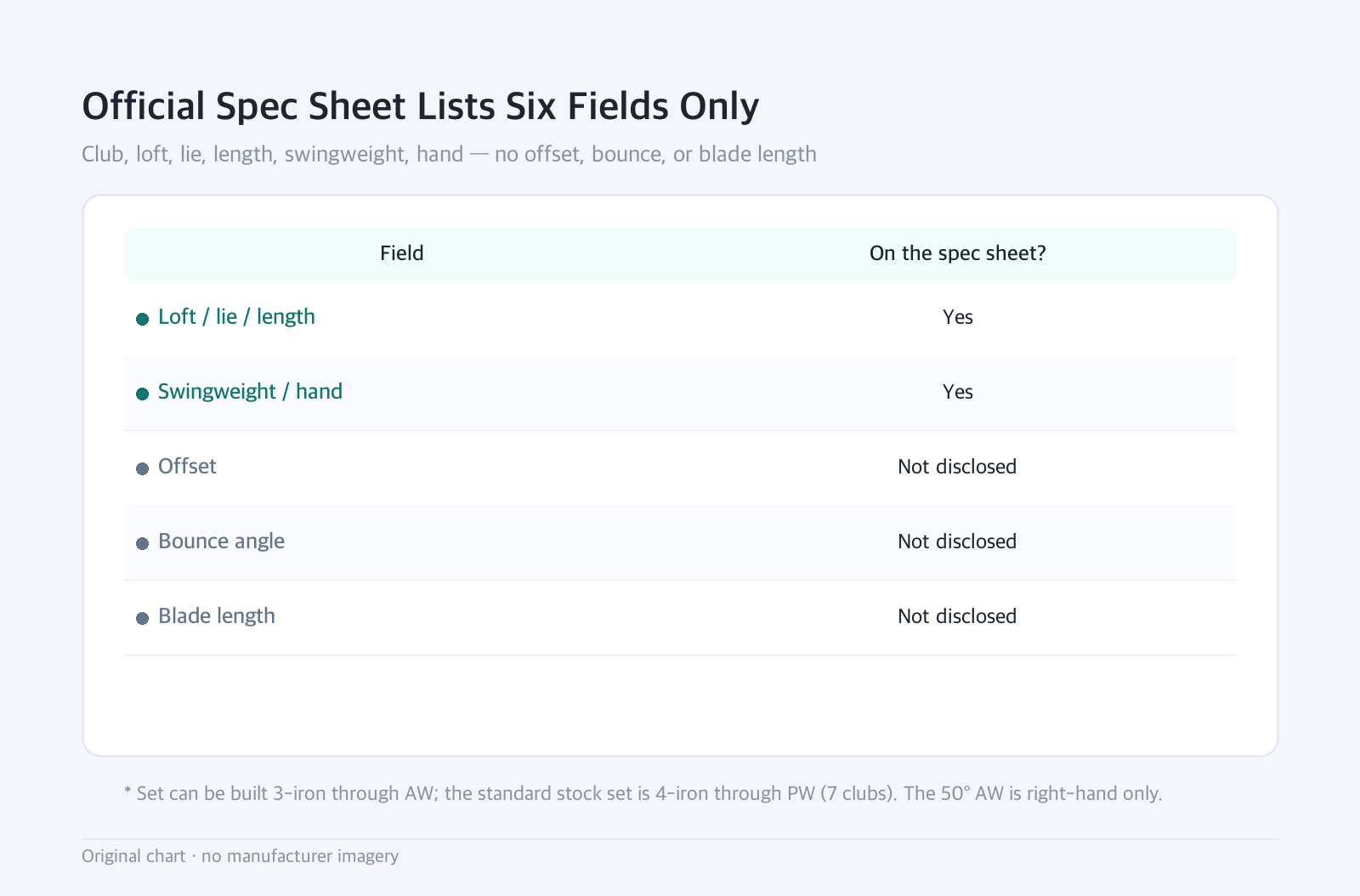
The set can be built from 3-iron through AW; the standard stock set typically runs 4-iron through PW, seven clubs. The 50° AW is right-hand only.
You'll notice the offset row is entirely marked "not disclosed." That's not an error. TaylorMade's official spec sheet lists only six fields: club, loft, lie, length, swingweight, and hand. Offset, bounce, and blade length aren't included at all.
So this piece leaves those blank too. If you've seen P770 offset numbers elsewhere, they're most likely from the 1st generation, 2017.
3. Loft spacing
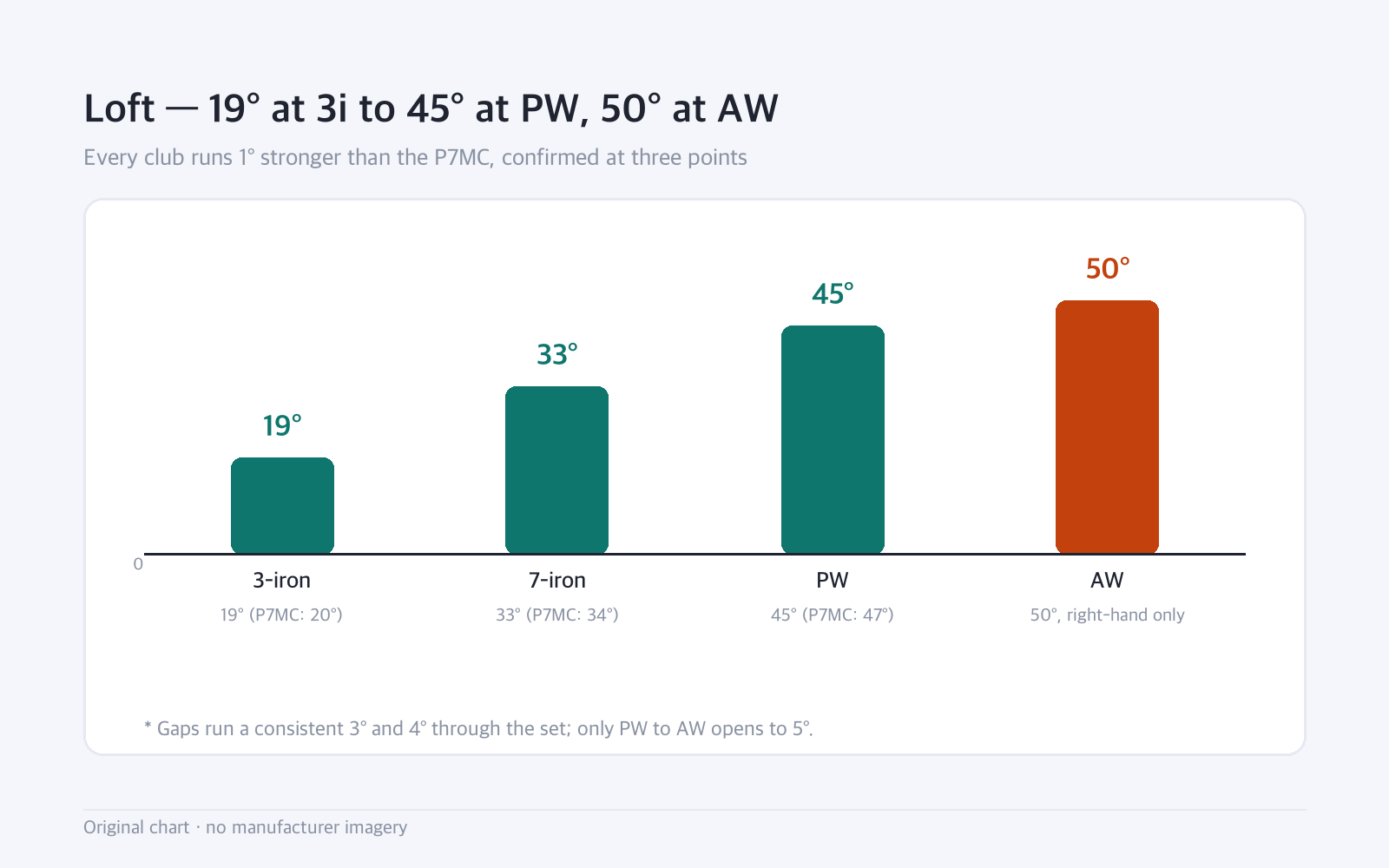
Starting at 19° for the 3-iron and running to 45° for the PW, the gaps run a consistent 3° and 4°. Only the step from PW to AW opens up to 5°.
Lined up next to the P7MC, every club runs exactly 1° stronger: 20° vs. 19° at the 3-iron, 34° vs. 33° at the 7-iron, 47° vs. 45° at the PW. A single degree is hard to feel on its own, but it's worth knowing that it holds consistently across the entire set.
4. Construction — what's packed inside a compact shell
P770's core idea is a forged hollow body. The outside stays small while the freed-up weight gets used elsewhere.
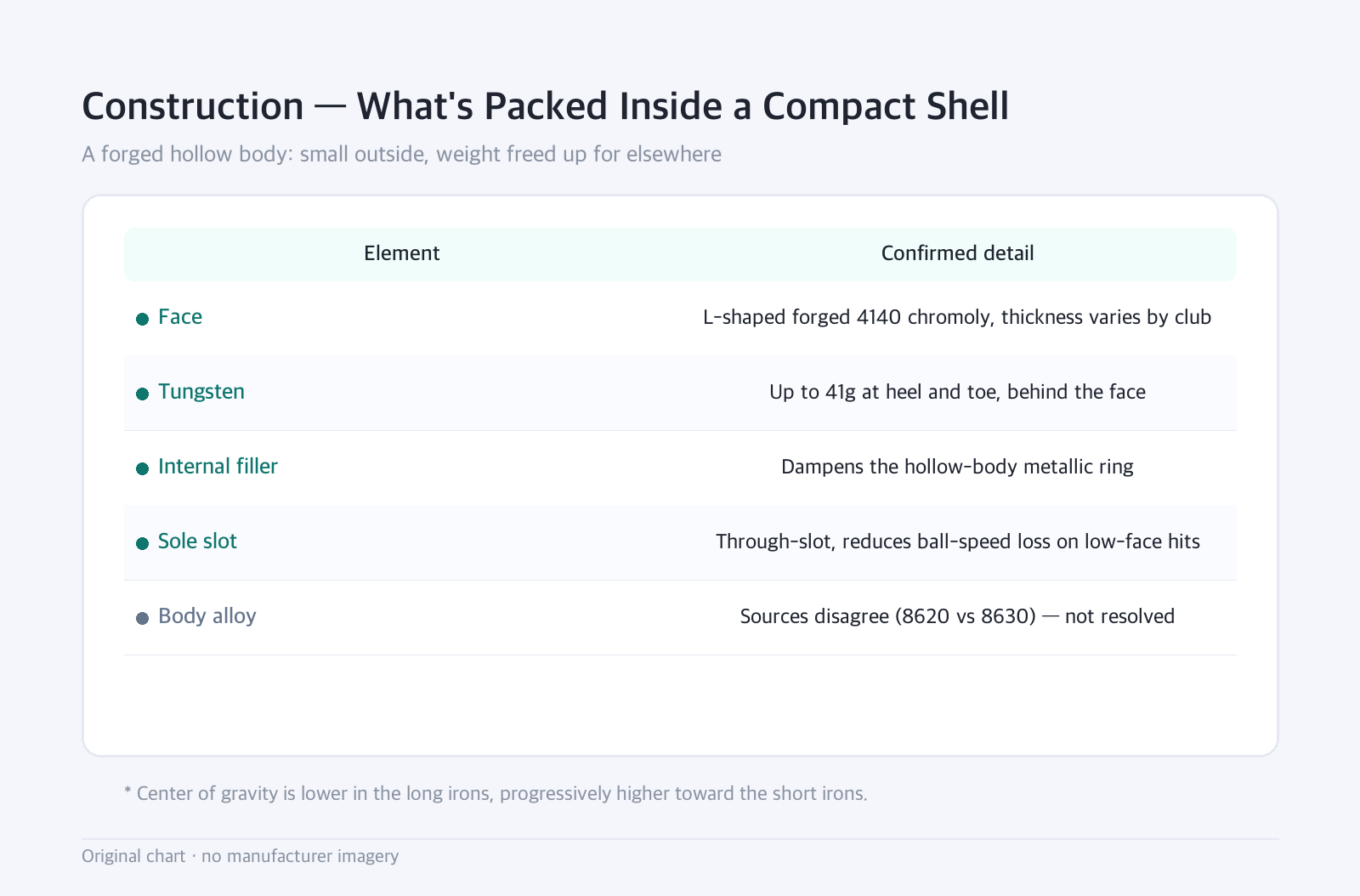
Confirmed specs:
- Face — L-shaped forged 4140 chromoly steel, with thickness varying club to club
- Tungsten — up to 41g placed at the heel and toe behind the face
- Internal filler — dampens the metallic ring typical of hollow construction
- Center of gravity — lower in the long irons, progressively higher toward the short irons
- Sole slot — a through-slot designed to reduce ball-speed loss on low-face contact
- Long-iron leading edge — lowered on the 3- through 7-irons to improve turf interaction
Sources disagree on the body alloy, split between 8620 and 8630. Japanese official catalogs and overseas reviews list 8620; some regional official pages list 8630. Since this wasn't resolved, it's described here only as a "soft-iron alloy."
The varying center of gravity by club plays out in practice like this: the long irons launch easily with a lower center of gravity, while the short irons hold spin without launching excessively due to a higher one. A set with the same character throughout tends to leave the long irons launching too low or the short irons launching too high — one or the other.
5. How it compares to the P790
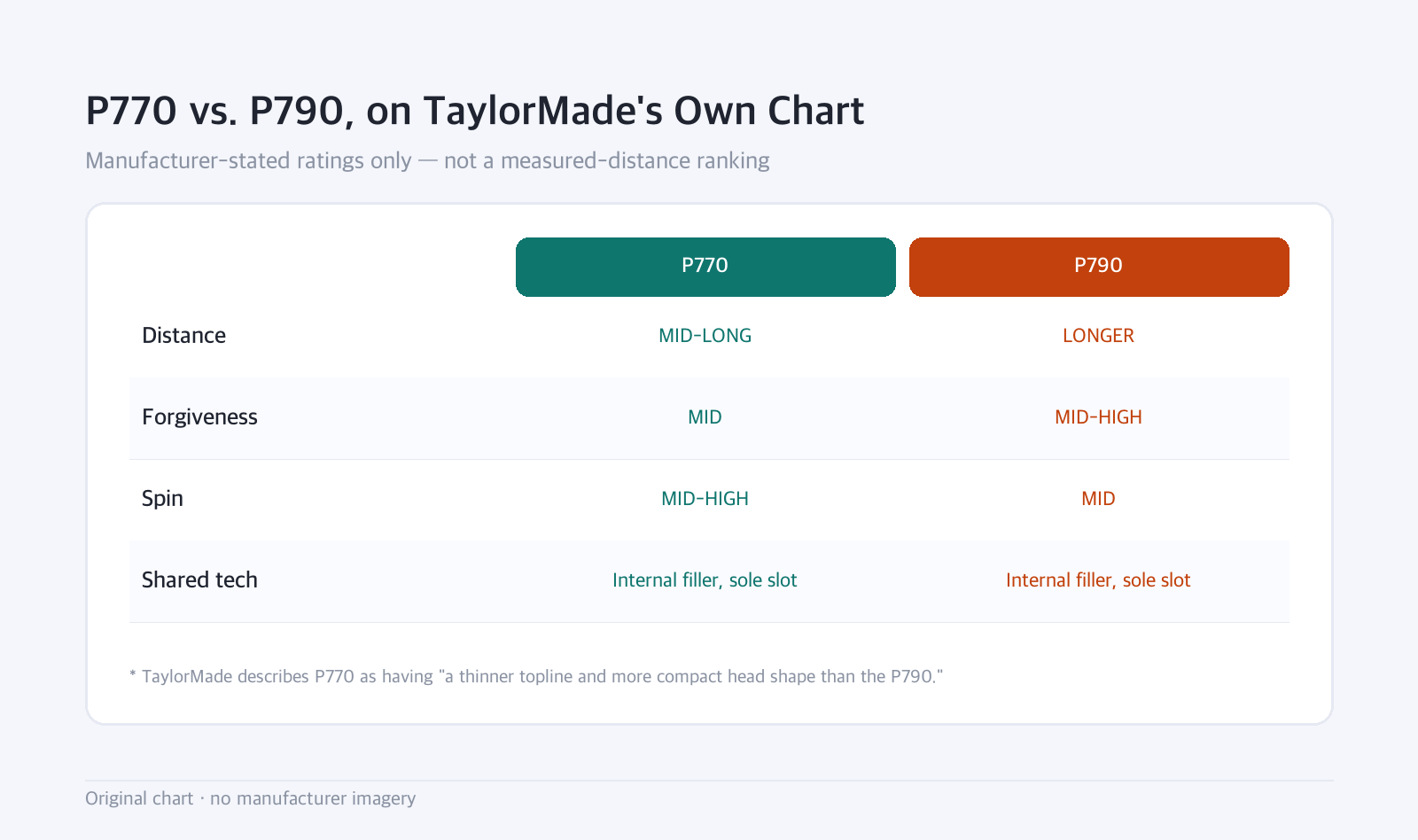
This section sticks to what the manufacturer states directly.
TaylorMade describes the P770 as having "a thinner topline and a more compact head shape than the P790." At launch, the positioning was that the two models occupy opposite ends of the player's-distance category — sharing internal filler and sole slot technology, while differing in silhouette.
On the official comparison chart: P770 rates distance MID-LONG, forgiveness MID, spin MID-HIGH; P790 rates distance LONGER, forgiveness MID-HIGH, spin MID.
6. Shaft, price, and target player
Stock shafts are True Temper Dynamic Gold MID 115 (R300/S300/X100) and Nippon Modus3 Tour 120 Luxury Black (S/X). Grip is Golf Pride Z-Grip Plus 2.
U.S. pricing is $1,399.99 for a seven-club set. The Battle Worn finish runs $1,499.99. Pricing varies by market and configuration and is best confirmed directly before purchase.
The stated target player, per outside reviews, generally lands in the single-digit-to-low-double-digit handicap range — someone not quite ready for a true blade, but for whom the P790 feels too bulky.
7. Who this iron is for
Judgment calls based on confirmed specs.
- Golfers who want a small head but worry about mishit distance loss — a hollow body plus up to 41g of tungsten keeps the look compact while building in forgiveness
- Golfers who want long irons that launch easily and short irons that hold spin — the center of gravity is positioned differently by club (lower in the long irons, higher in the short irons)
- Golfers torn between the feel of the P7MC and the bulk of the P790 — the manufacturer's own spectrum (distance MID-LONG, forgiveness MID) places this squarely in between
It may be less suited for:
- Golfers who want offset numbers for precise fitting — the official spec sheet has no offset field at all
- Golfers relying on whatever spec table they find online — 7-iron loft varies by up to 2° between generations, so confirming the current generation (2024, 7-iron at 33°) comes first
8. What we could not confirm
- Offset — no field on the official spec sheet
- Bounce angle per club — only a general note of "progressive through the set"
- Blade length — one review site cited 77mm, but as a measured observation rather than an official per-club spec, it wasn't adopted here
- Face thickness (mm) — only described as "variable thickness"
- Body alloy — sources disagree between 8620 and 8630
In one line
P770 doesn't give up the look to gain forgiveness.
If you want a small head but the fear of mishit distance loss is holding you back, this is a reasonable answer. Just confirm the generation before buying — the 7-iron should read 33° if it's the current 2024 version.
Every chart in this piece was built directly from official manufacturer spec sheets. What we couldn't confirm is left blank.
This piece summarizes general instruction concepts and is not personalized coaching advice. Ball flight fixes depend on individual swing mechanics — a launch monitor session or certified instructor can confirm what applies to you.