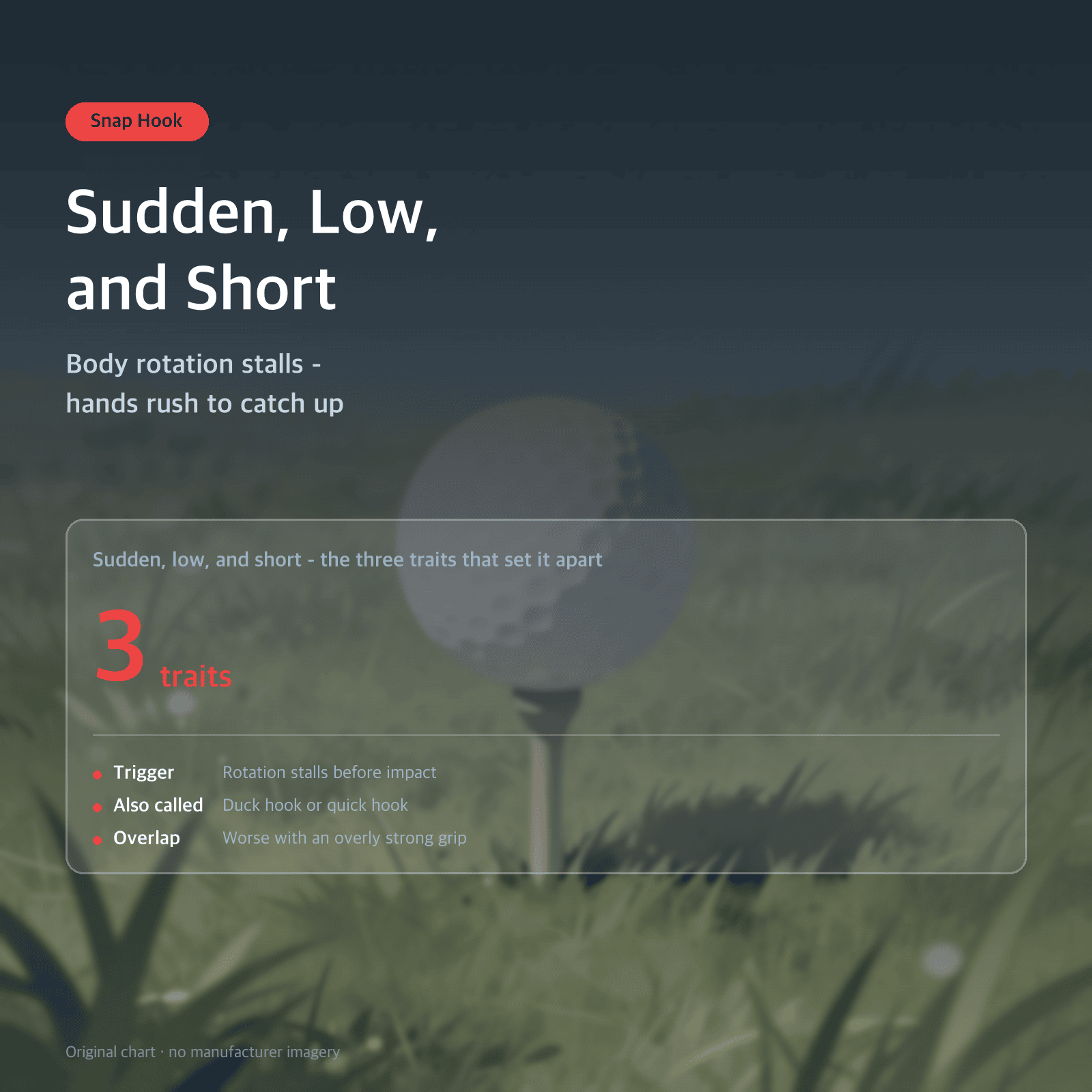
There's one variety of hook with a different character. The snap hook.
Also called a duck hook or quick hook — a shot that curves sharply from right to left while barely getting off the ground.
Worth covering separately, because it doesn't fit the framework used for the other hooks.
1. What's different about it
The hooks covered elsewhere tend to be fairly consistent. A strong grip or an over-rotated path curves the ball by roughly the same amount each time, which makes it manageable by adjusting aim.
The snap hook isn't like that.
- It appears suddenly. Ten good swings, then one goes sideways.
- It doesn't get off the ground. It launches low and breaks left from there.
- It's short. Low and sharply bending, it doesn't travel far.
A regular hook was already shown to reduce loft and launch low (covered separately). A snap hook is that taken to an extreme — the face closes so abruptly that loft drops sharply.
2. When the body stops, the hands take over
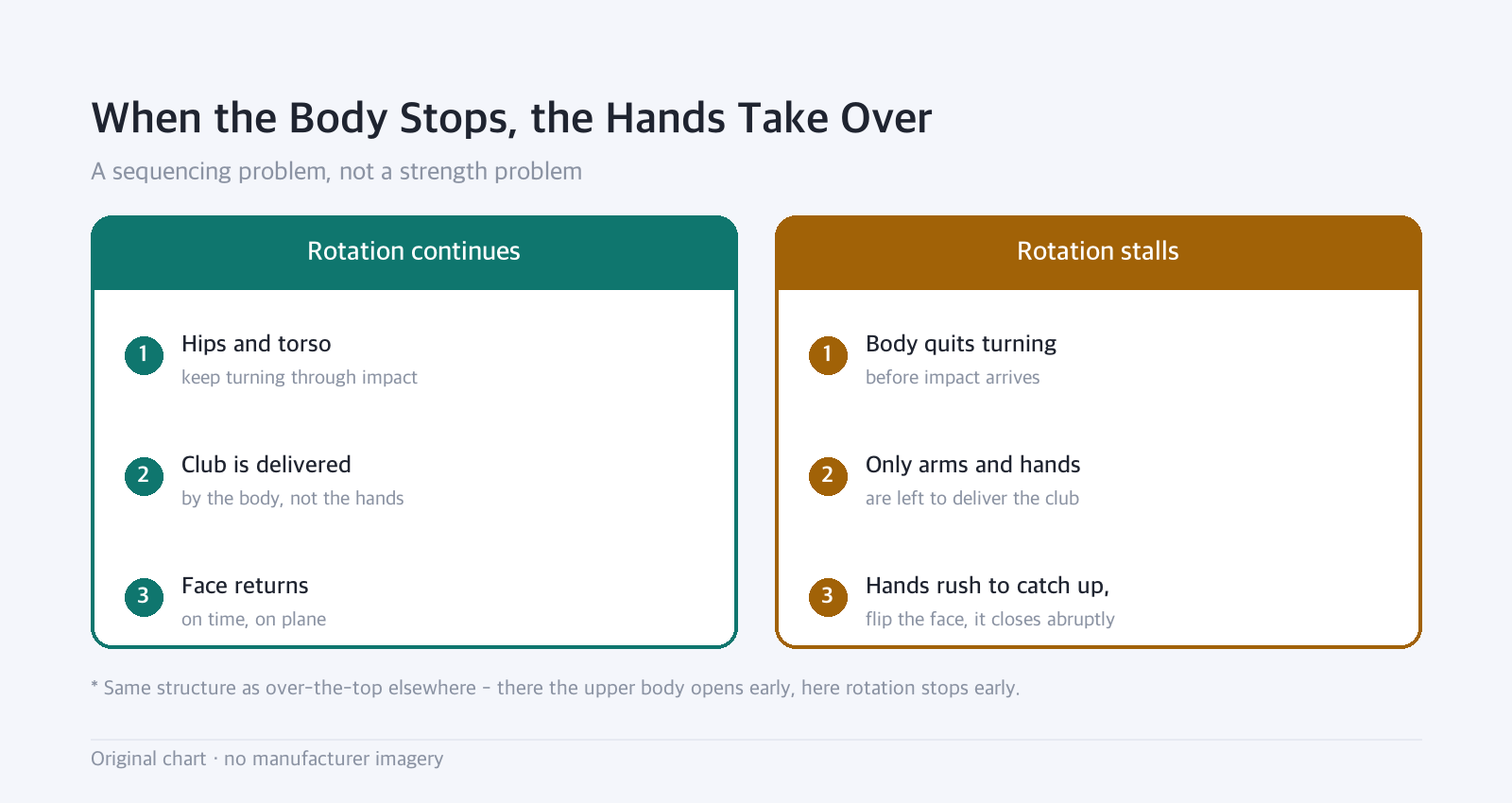
Here's the mechanism most commonly cited.
The lower body and torso rotation stall right before impact during the downswing.
The backswing was fine. But as the club comes down, the body's rotation stops before impact. The large muscles quit working.
That leaves only the arms and hands to deliver the club. Needing speed, the hands rush to catch up and flip the clubhead over.
The face closes abruptly. A shot that could have been a draw becomes one that dives left.
Worth noting: this is explained as a sequencing problem, not a strength problem. It's the same structure as over-the-top, covered elsewhere — there, the upper body opens early; here, rotation stops early.
3. That's why it appears suddenly
This mechanism explains the character of the snap hook.
The hands' action depends on timing. The outcome hinges on how fast the hands catch up after the body stalls.
But timing is hard to repeat. It happens on some swings and not others.
That produces this pattern:
- Mostly fine, but occasionally a big miss left.
- More frequent when swinging harder.
- Reportedly more common at high-pressure moments.
That last point is sometimes attributed to psychology. But within what we could confirm, we found no supporting evidence, so we're keeping this at "it's said to happen this way."
4. When a strong grip is layered in
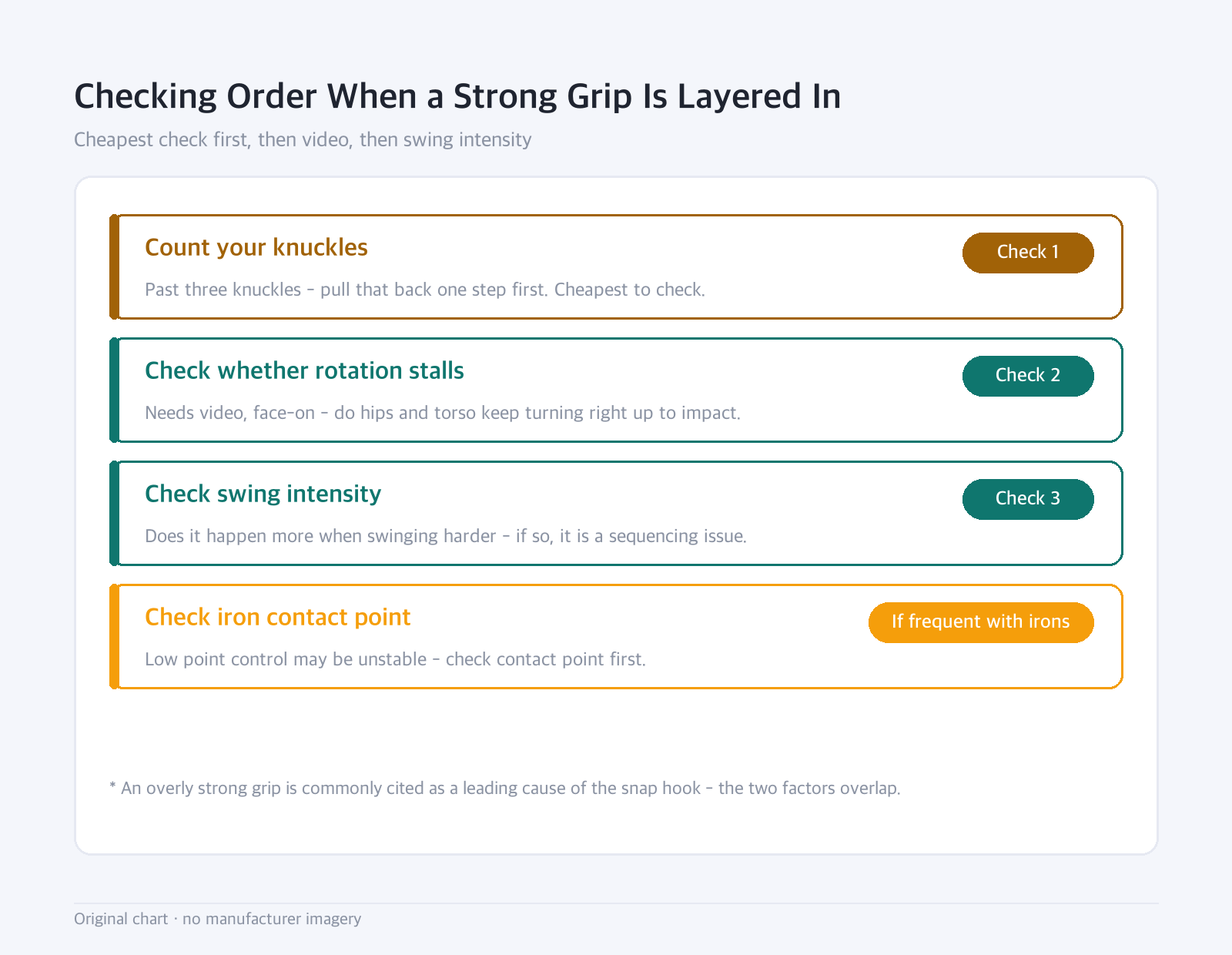
As covered earlier, an overly strong grip is commonly cited as a leading cause of the snap hook.
The reason is overlap. A strong grip pre-sets the hands into a position where they roll over easily. Add a stalled body forcing the hands to rush, and both factors push in the same direction.
That gives a checking order.
First, count your knuckles. Past three, pull back one step here first. Cheapest to check.
Second, check whether rotation stalls. This needs video — shot from face-on, checking whether the hips and torso keep turning right up to impact.
Third, check whether it happens more when swinging harder. If so, it's a sequencing issue. Whether it disappears when you ease off swing intensity is the tell.
5. Being straightforward about this branch
The same point made about early extension elsewhere applies here.
This piece won't hand you a fix either.
A rotation that stalls is a body-movement issue. Sometimes it's habit, sometimes it's limited mobility. And as noted elsewhere, pushing hard on body issues without guidance tends to end in injury.
Instead, here are actionable checkpoints.
- If you're past three knuckles, start by pulling that back. Some cases resolve with this alone.
- If it disappears when you ease off intensity, it's a sequencing issue. Managing swing intensity works as an immediate measure.
- If it persists even at lower intensity, video review or instruction is the efficient path.
- If it shows up often with irons too, check contact point first, as covered elsewhere — low point control may be unstable.
6. Separating a quick fix from an actual correction
Same point made in the closing piece on aim adjustments elsewhere.
If you need to get through a round, easing off swing intensity genuinely works. Since the snap hook tends to show up more on harder swings, pulling the driver or shortening the swing is a valid choice.
But that's not a correction. The underlying cause is still there.
Using a quick fix is fine. The problem is mistaking it for a correction.
7. Who this is useful for
- Golfers who occasionally hit a sharp shot left — a different category from a consistent hook.
- Golfers who miss left specifically when swinging hard — may be a sequencing issue.
- Golfers whose driver suddenly dives left — loft has dropped sharply.
- Golfers who switched to a stronger grip and started seeing this shot — could be an overlap of both causes.
This is less useful for:
- Golfers with a consistent leftward curve — the earlier two pieces fit better.
- Golfers looking for an immediate fix — this piece doesn't provide one.
8. What we could not confirm
- A statistical link between stalled rotation and the snap hook — the mechanism is explained, but we could not confirm numbers.
- The basis for the claim that it appears more at high-pressure moments — widely repeated, unconfirmed.
- What share of cases trace back to limited mobility.
- A frequency comparison between the snap hook and a regular hook.
In one line
When body rotation stalls right before impact, only the arms and hands are left to deliver the club.
The hands rush to catch up, flip the clubhead, and the face closes abruptly. With loft sharply reduced, the result is a shot that dives low and short.
And hand timing is hard to repeat, which is why it appears suddenly. Check the grip first, then rotation — and this branch, too, is not one to push through alone.
This piece summarizes general instruction concepts and is not personalized coaching advice. Ball flight fixes depend on individual swing mechanics — a launch monitor session or certified instructor can confirm what applies to you.