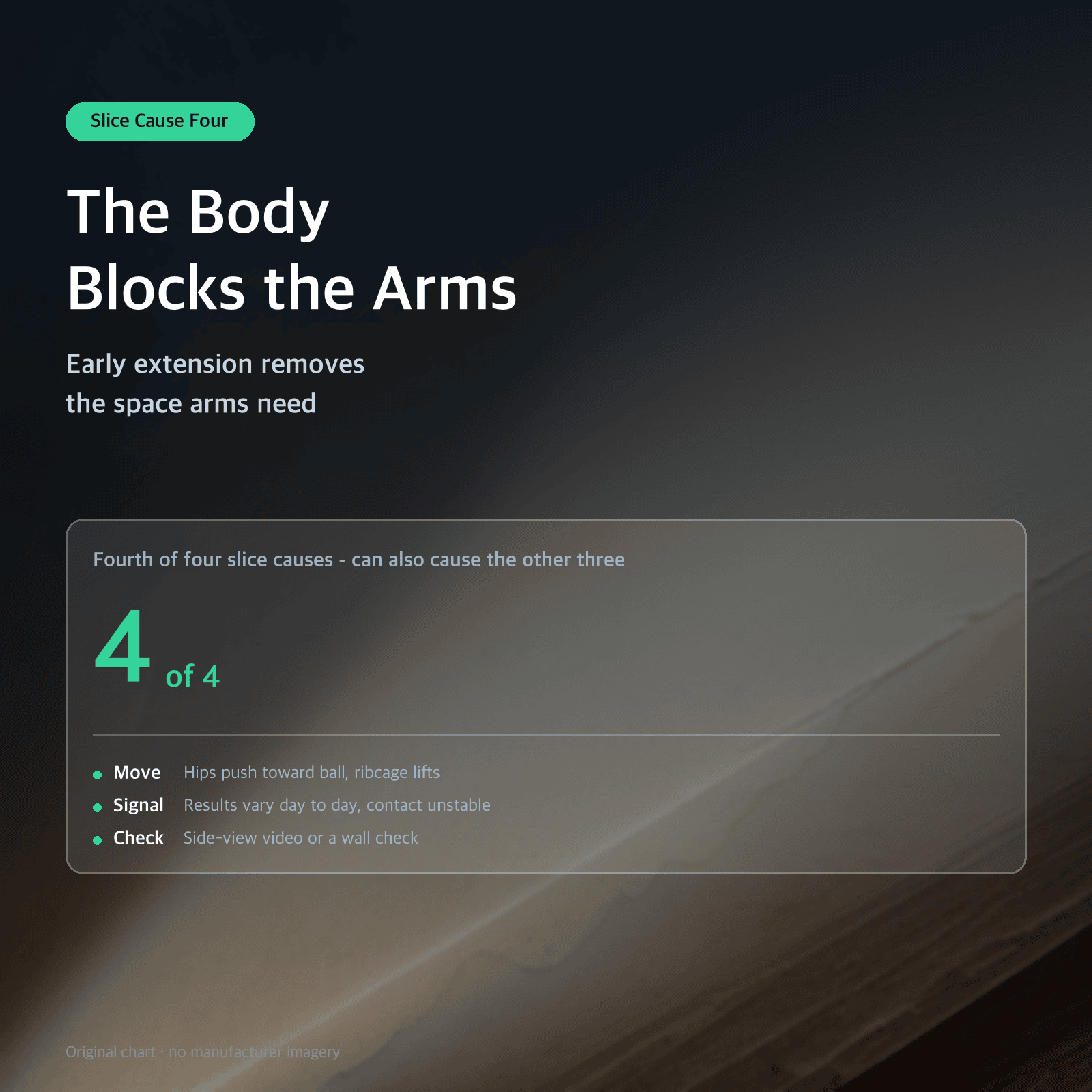
The fourth branch is the body.
The first three were about the hands and the club. This one is different: the body blocks the arms' path.
There's a reason this branch comes last. It can also cause the other three.
For readers new to this series: a slice happens when the clubface is right of the swing path at impact, for a right-handed golfer. The same slice can trace to four distinct causes; this piece covers the fourth.
1. What early extension is
A move in the downswing where the hips push toward the ball and the rib cage lifts.
At address, the upper body is bent forward over the ball. Early extension is that forward-bend angle straightening out before impact. "Extension" is the straightening; "early" is that it arrives too soon.
TPI, a golf training organization, considers this the most common swing fault among amateurs.
TPI publishes its own figure: 67 percent of the 90,000-plus golfers it has screened show early extension, against fewer than 1 percent of the tour professionals in its sample. That number comes from TPI itself and is not peer-reviewed — TPI does not publish the study design behind it — so treat it as an organisation's own reporting rather than an independent finding.
2. Why this leads to a slice
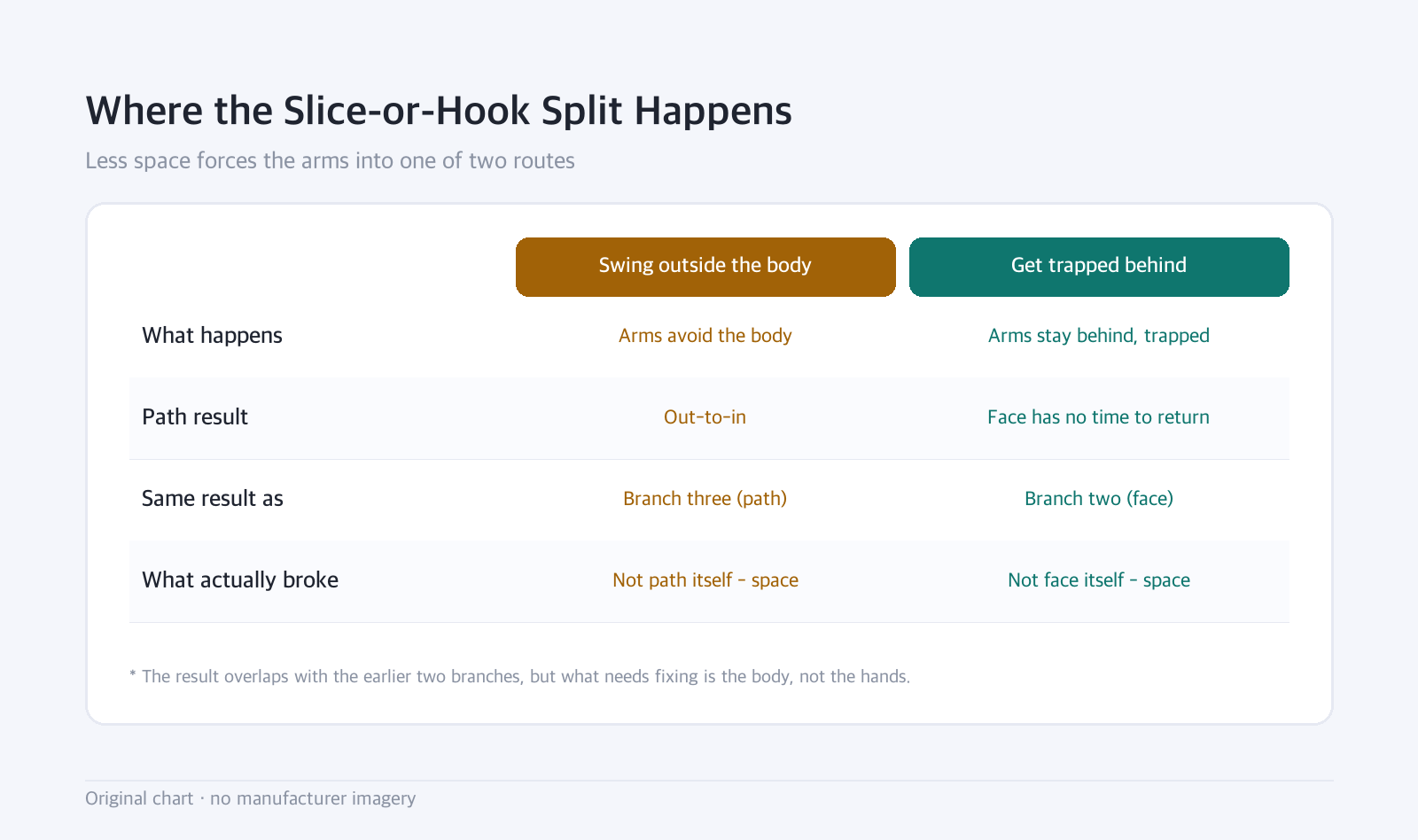
This is the core of the piece.
When the hips push toward the ball, the space for the arms to swing through shrinks. The body has moved into the spot the arms were meant to occupy.
From there, the arms do one of two things.
One — swing outside the body to avoid it. This becomes an out-to-in path — the same result as branch three.
Two — get trapped and stay behind. The face runs out of time to return — the same result as branch two.
The result overlaps with the previous two branches, but what needs fixing is entirely different. That's what makes this branch tricky.
3. Which is why the earlier fixes don't work
A golfer whose real cause is the body, given hand-and-arm fixes, gets this:
"Swing more from the inside" — the body is still blocking the route in; there's no room to come inside.
"Rotate the face more" — with the arms trapped, only the wrists end up doing the work, and results swing between good days and bad.
"Strengthen the grip" — some days a hook, some days a slice. The cause hasn't changed, so the result stays unstable.
The common thread is "it works some days and not others." That pattern is worth treating as a reason to suspect this branch.
4. Signs that this is your branch
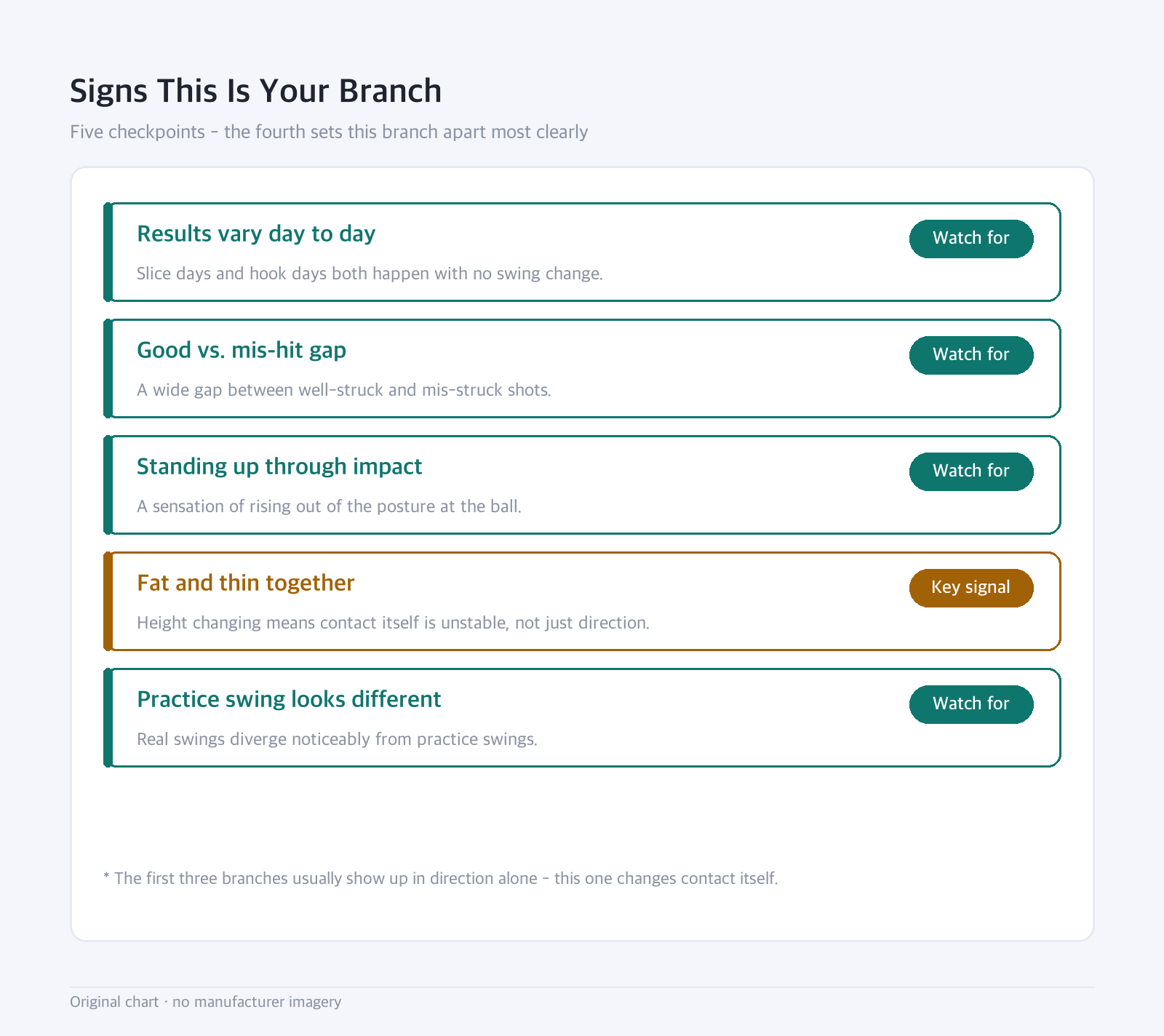
- Results vary widely day to day — slice days and hook days both happen.
- A wide gap between well-struck and mis-struck shots.
- A sensation of standing up through impact.
- Fat and thin iron shots showing up together — height changing means contact is unstable too.
- Practice swings look noticeably different from real swings.
The fourth is the sign that sets this branch apart most clearly. Early extension changes body height, so contact itself becomes unstable, not just direction. The first three branches usually show up in direction alone.
5. How to check
A side-view video works best here. Film from a line parallel to the target line, off to the side of the body.
Draw an imaginary line behind the hips at address, and watch whether the hips move forward of that line during the downswing.
If video isn't available, a wall check is commonly used. Set the hips lightly against a wall through the backswing, then watch whether they come off the wall on the downswing.
This is a check, not a fix. Because this branch concerns body movement, the cause is sometimes flexibility or mobility. In that case, swing cues alone don't move the needle.
6. What to do with this branch
Being direct here: this piece doesn't provide a fix.
Two reasons.
First, the cause varies. A habitual pattern and a mobility limitation need different approaches. That's hard to split apart in writing.
Second, this branch involves the body, and pushing it wrong can lead toward injury. That's different from the other three branches.
Here's an actionable standard instead.
- If contact is unstable, suspect this branch first — it comes before direction work.
- If the previous three fixes worked some days and not others, the cause may sit here.
- If this is the branch, a lesson or a movement screen tends to be more efficient than working alone. This is the one branch out of four where that's true.
7. Who this is useful for
- Golfers whose shot shape changes day to day — the cause may be in the body.
- Golfers hitting fat and thin shots together — a sign that height is unstable.
- Golfers for whom several fixes each worked briefly — the branch may have been lower down.
- Golfers weighing whether to take a lesson — this branch benefits from one more than the others.
This is less useful for:
- Golfers with a consistent shot shape — this branch is less likely.
- Golfers wanting a fix to use right away — this piece doesn't provide one.
8. What we could not confirm
- Independent verification of the 67 percent figure — the number is TPI's own published screening result, not an independently peer-reviewed study.
- The statistical correlation between early extension and slicing — the mechanism is explained, but we could not confirm figures.
- What share of cases trace to a mobility limitation — no data turned up.
- The accuracy of the wall check — widely used, but we could not confirm verification data.
In one line
Early extension doesn't damage face or path directly. It removes the space the arms need.
From there, the arms either swing outside the body or get trapped behind it. The result overlaps with the previous two branches, but what needs fixing is different.
So the tell here isn't direction — it's consistency. If results vary day to day and contact itself wavers, check this branch first. And it's the only one of the four branches this piece doesn't recommend fixing alone.
This piece summarizes general instruction concepts and is not personalized coaching advice. Ball flight fixes depend on individual swing mechanics — a launch monitor session or certified instructor can confirm what applies to you.