Closing out this material with a sequence and a summary.
One thing about this sequence works differently from the ones used elsewhere in this series.
When a wrong guess costs more, spend more to check it.
The earlier sequences in this series ran on "cheapest first." Here, that principle gets a qualifier: cheapest first, but hold the highest-stakes step back until last.
1. Why the principle changes here
The reason traces back to the piece on the two opposite swing paths.
A shank's swing-path branches run in opposite directions, and guessing wrong makes things worse.
With a slice, guessing the wrong branch just means it doesn't get fixed. The cost is time. With a shank, guessing the wrong swing-path branch makes it worse.
So the order is built accordingly. Clear out everything that's self-checkable and reversible first, and only touch swing path once the evidence has piled up.
2. Five steps
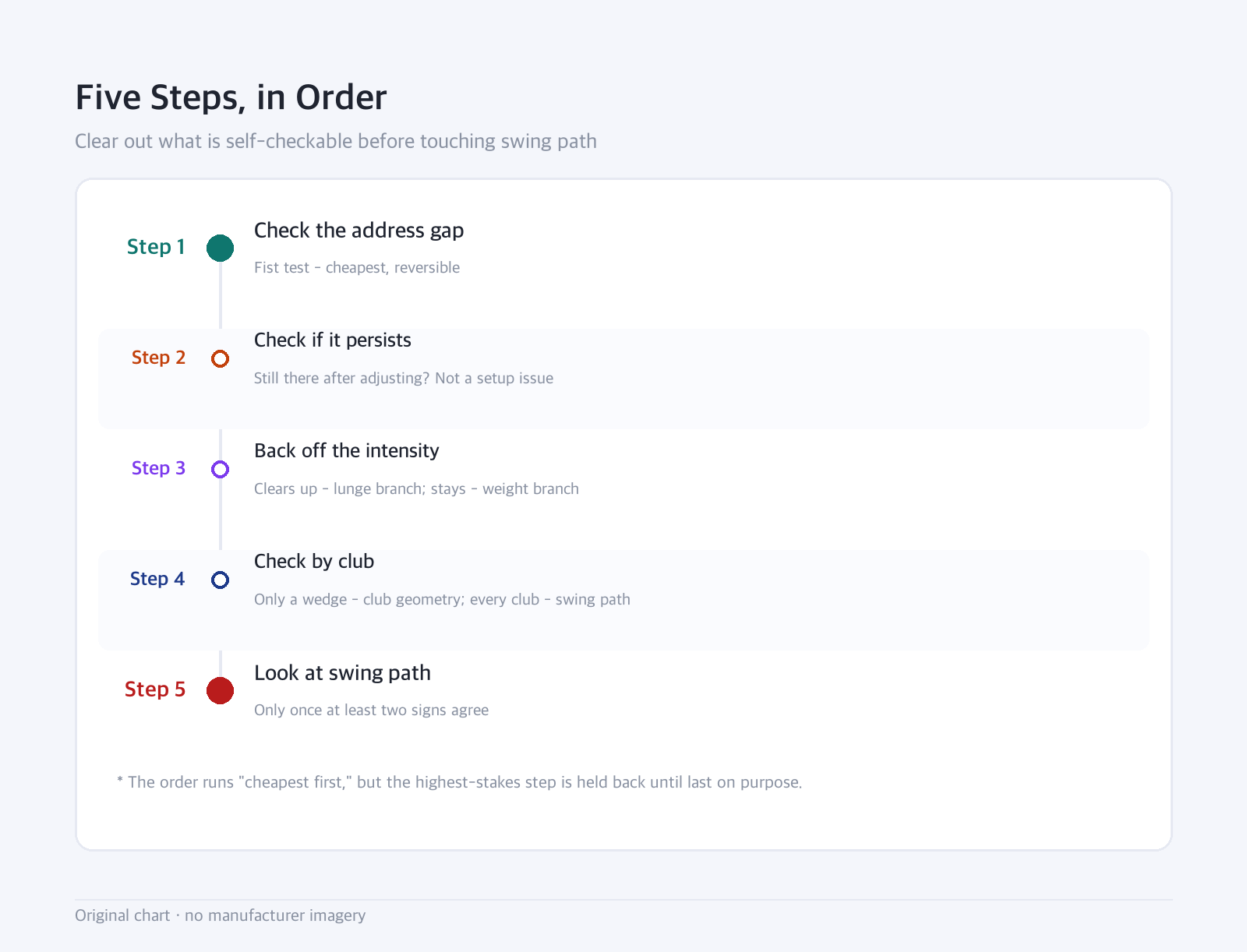
Step 0 — confirm it's actually a shank. A ball curving right along an arc is a slice. A shank goes right almost in a straight line, low, from the start. The sound is different too. If it sorts as a slice here, go to the slice material instead.
Step 1 — check the address gap. The room between the end of the grip and the body. If a fist doesn't fit, try adjusting it. Cheapest, and reversible.
Step 2 — check whether it persists after adjusting. If it does, it's not setup — it's movement during the swing.
Step 3 — back off the intensity. If it disappears, that points to the lunging branch; if it stays, the weight-forward branch.
Step 4 — check by club. Only with a wedge means club geometry and lie are contributing. Every club means swing path.
Step 5 — only now, look at swing path. Divot direction, accompanying shot shape, recent practice history. Only set the branch when at least two of the three agree.
3. As a table
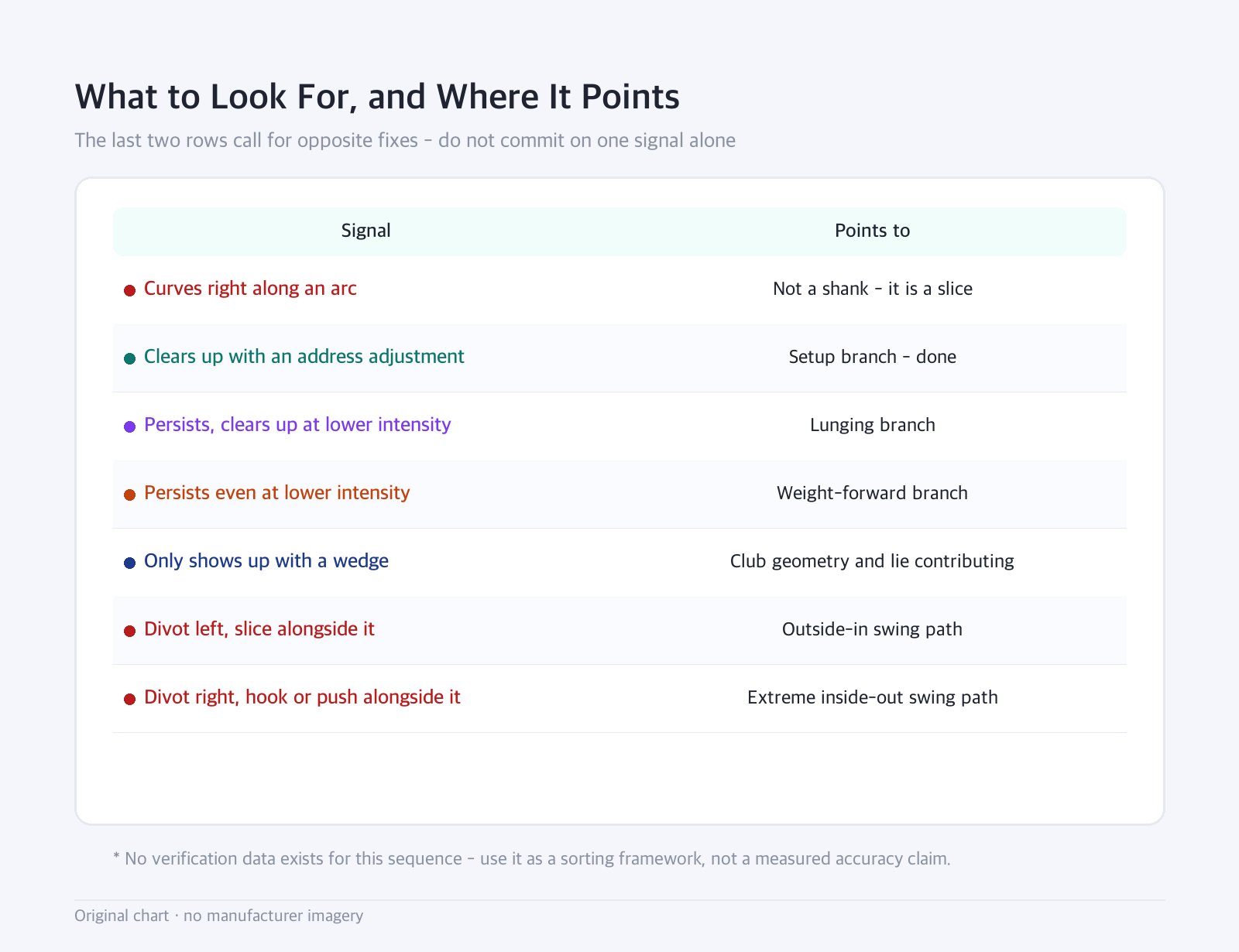
What to look for, and where it points.
- Curves right along an arc → not a shank. It's a slice.
- Clears up with an address adjustment → the setup branch. Done.
- Persists after adjustment, clears up when intensity drops → the lunging branch.
- Persists even at lower intensity → the weight-forward branch.
- Only shows up with a wedge → club geometry and lie are contributing.
- Divot left + slice alongside it → the outside-in path.
- Divot right + hook or push alongside it → the shallow inside-out path.
The last two rows call for opposite fixes. So when only one piece of evidence points that way, don't commit to a branch yet.
4. What this material established
First, a shank is a contact-location problem, not a spin problem. The hosel is round and has no loft, so the ball shoots off immediately right and low. The diagnostic frame from the earlier three pieces doesn't apply here.
Second, two opposite swing paths produce the same result. Throwing the club outside causes it, and coming in extremely shallow from inside causes it too. That's why the most common piece of advice, "come down from the inside," makes things worse for some golfers.
Third, "standing too close" is one cause among several. What they share is that the hands end up a few inches outside their address position at impact; the paths that get them there differ.
Fourth, there's a reason it clusters on wedges and short irons. Short shaft, upright lie angle, steep attack angle, tight lie. It isn't absent from the driver — it shows up as a heel strike, a different face of the same error.
Fifth, the belief that it's contagious is real, and contagion itself isn't confirmed. Runs of shanks are explained by persistence of conditions.
5. The fourth time this pattern showed up in this axis
One thing repeated again in this piece.
"Widely believed" and "true" are different.
This axis has run into that four times now: the Schenectady putter grudge story, the Bobby Jones / Tony Torrance compromise story, the "90 percent of golfers slice" figure, and now the contagion claim. Only Hogan's quote, covered separately, actually held up.
One out of four. And every time, there was no way to know which until we checked.
So we kept checking. The point was never to debunk for its own sake — it was to draw the line between what's confirmed and what isn't.
6. Who this is useful for
- Golfers trying to isolate the cause of a shank — five steps sorts it into a branch.
- Golfers who tried a correction and got worse — the swing-path branch may have been guessed backward.
- Golfers who want this material in one piece — sections 3 and 4 are that summary.
- Golfers deciding what to check at the range — start at step 1 and work down.
This is less useful for:
- Golfers who've never hit a shank — though this miss tends to arrive without warning.
- Golfers trying to fix it today — this is a miss that's hard to sort out mid-round.
7. What we could not confirm
- The actual distribution across the five causes — no data on which is most common.
- The accuracy of this sequence — no verification data exists. Use it as a sorting framework.
- The relationship between shank frequency and handicap
- A verified cause for runs of shanks occurring in sequence
In one line
The earlier pieces in this series ran on "cheapest first." This one carries a qualifier: when a wrong guess costs more, spend more to check it.
Clear setup, intensity, and club first, and only touch swing path once at least two pieces of evidence agree. Two opposite branches wear the same face — that's why.
The next look at this material covers how a miss changes by club, and on-course first aid, as a separate piece.
This piece summarizes general instruction concepts and is not personalized coaching advice. Ball flight fixes depend on individual swing mechanics — a launch monitor session or certified instructor can confirm what applies to you.