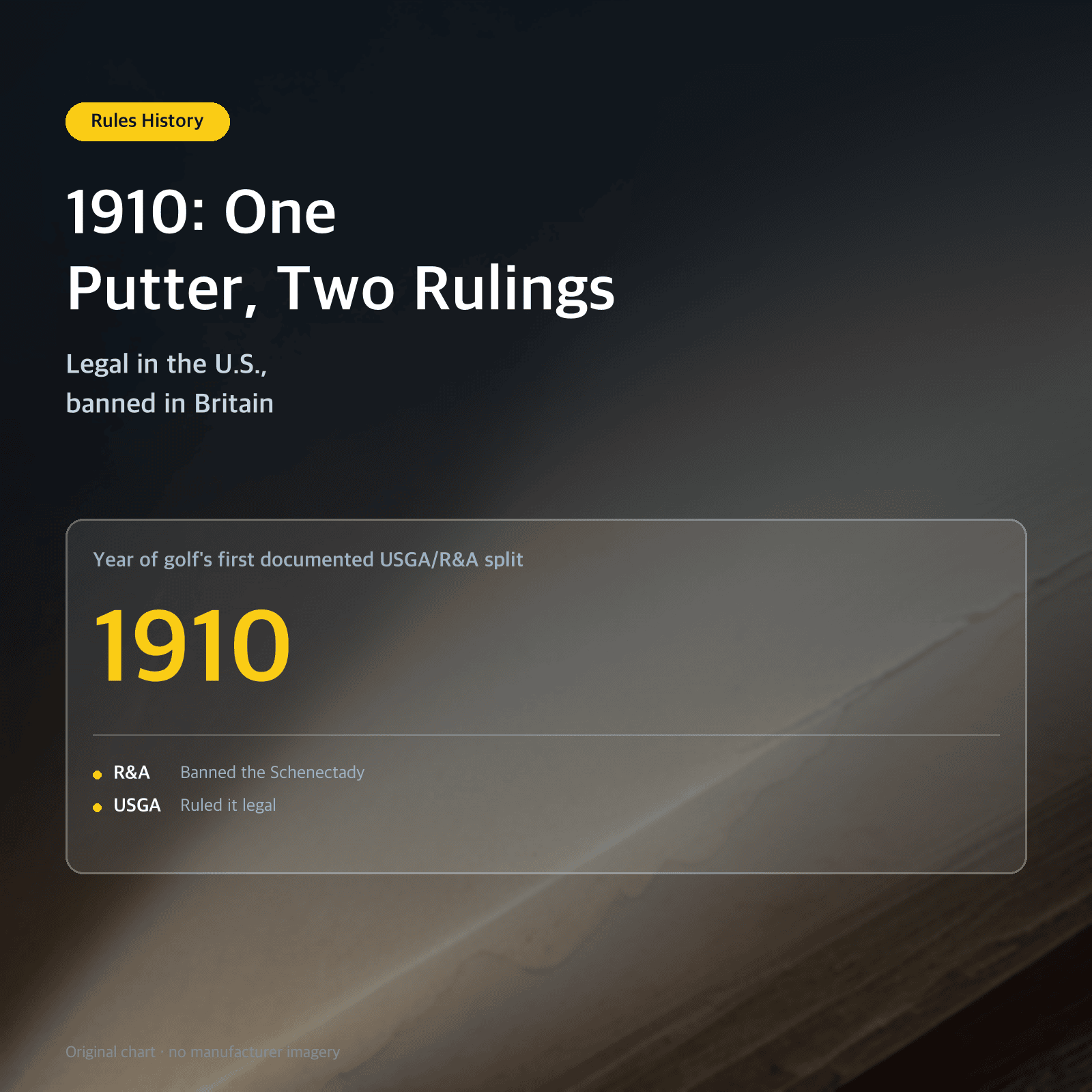
Today the USGA and the R&A run the same rulebook, splitting jurisdiction but not content.
In 1910, that wasn't true. One body banned a putter; the other kept allowing it. The same club became legal or illegal depending on which side of the Atlantic you were on.
The putter in question was the Schenectady.
1. A putter named after a small New York city
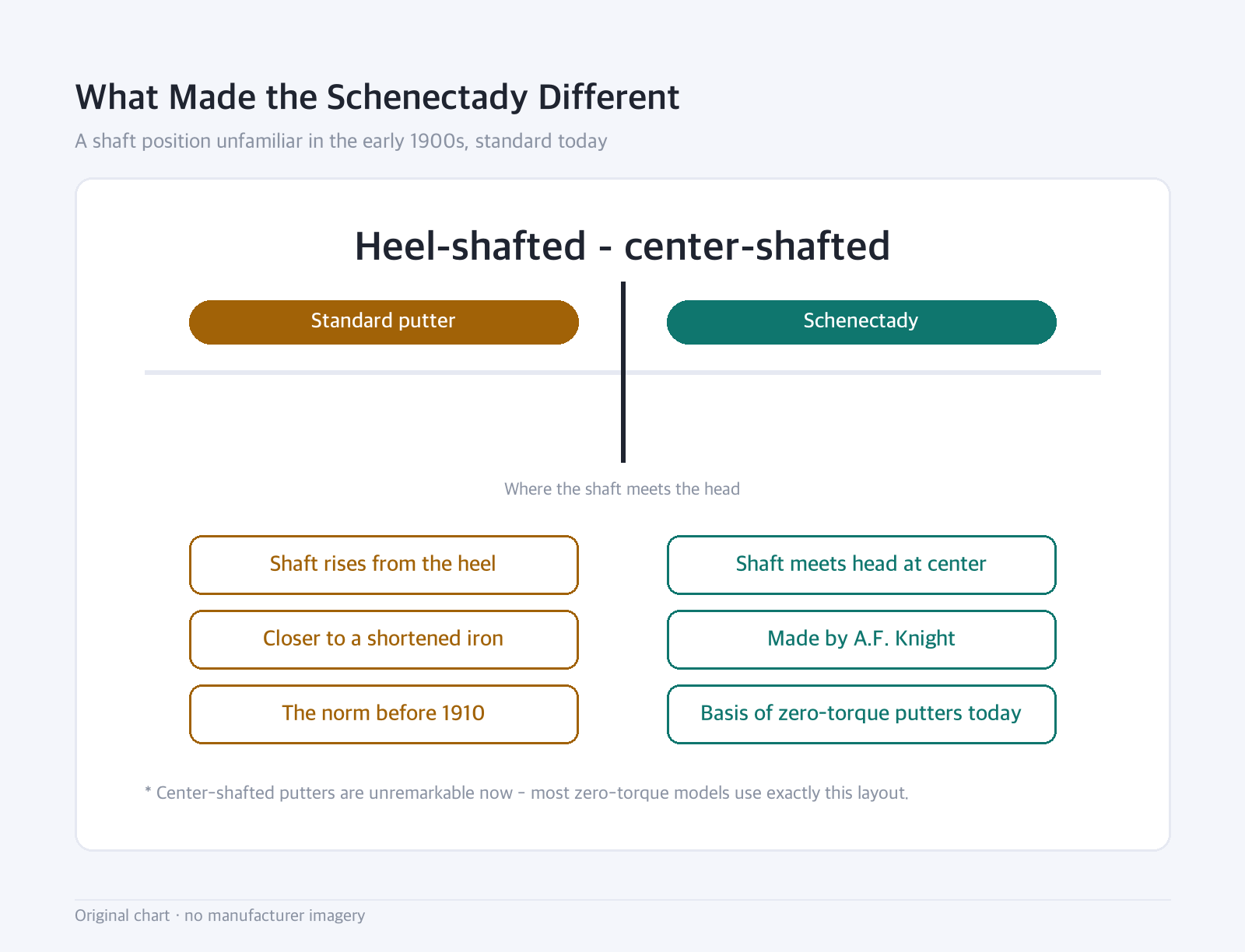
Schenectady is a city in upstate New York. The putter was named after it because its maker, A.F. Knight, lived there.
What set it apart from other putters of the day was where the shaft met the head. A standard putter's shaft rose from the heel end. This one's shaft met the head at the center.
By today's standard, that's completely unremarkable. Center-shafted putters are common now — most Odyssey and TaylorMade zero-torque models use exactly that layout.
In the early 1900s, though, it was unfamiliar. Putters of the era were closer to a shortened iron, with the shaft rising naturally from one end. Mounting the shaft at the dead center of the head was a genuinely new idea.
2. An American won a British championship with it
In 1904, Walter Travis won the British Amateur Championship — the first American to do so.
The putter he used was the Schenectady.
The British Amateur was, at the time, a matter of British golfing pride. An American took it, using an unfamiliar putter made in the U.S.
That detail later became the seed of a story: the claim that the ban was retaliation for the loss. We checked that claim on its own terms elsewhere, and found no supporting evidence for it — a separate piece looks at the case in detail.
3. 1910: the R&A bans it
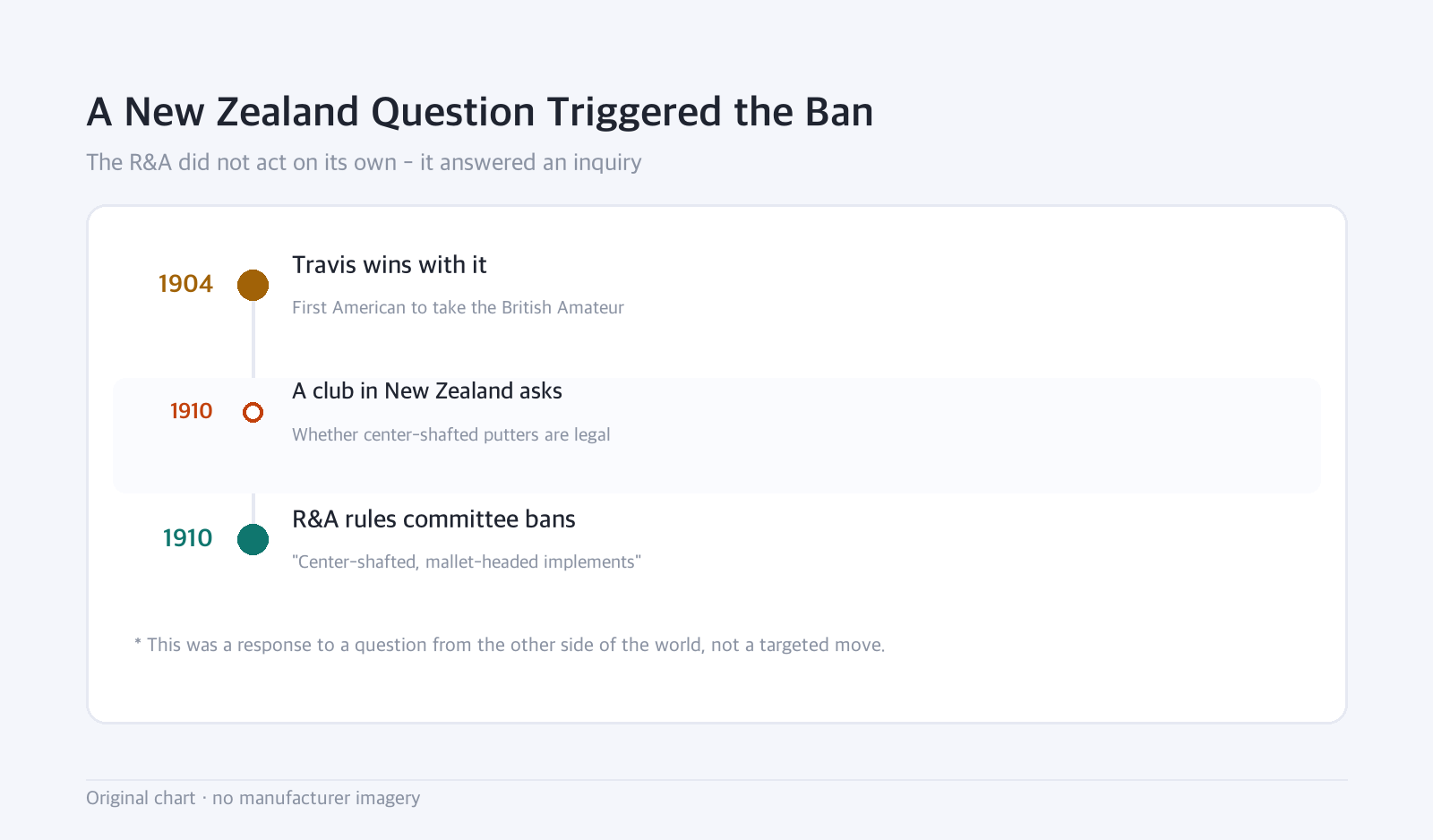
In 1910, the R&A's rules committee made a ruling prohibiting "center-shafted, mallet-headed implements" going forward.
One detail is worth noting: this wasn't a ruling the R&A initiated on its own. It came in response to an inquiry from a golf club in New Zealand.
In other words, this wasn't Britain lying in wait for a chance to target an American product — it was an answer to a question that arrived from the other side of the world.
4. But the USGA didn't follow
This is the core of the story.
Up to that point, the USGA had been following R&A rulings. Its 1900 rulebook was simply an adoption of the R&A's 1899 rules.
This time was different.
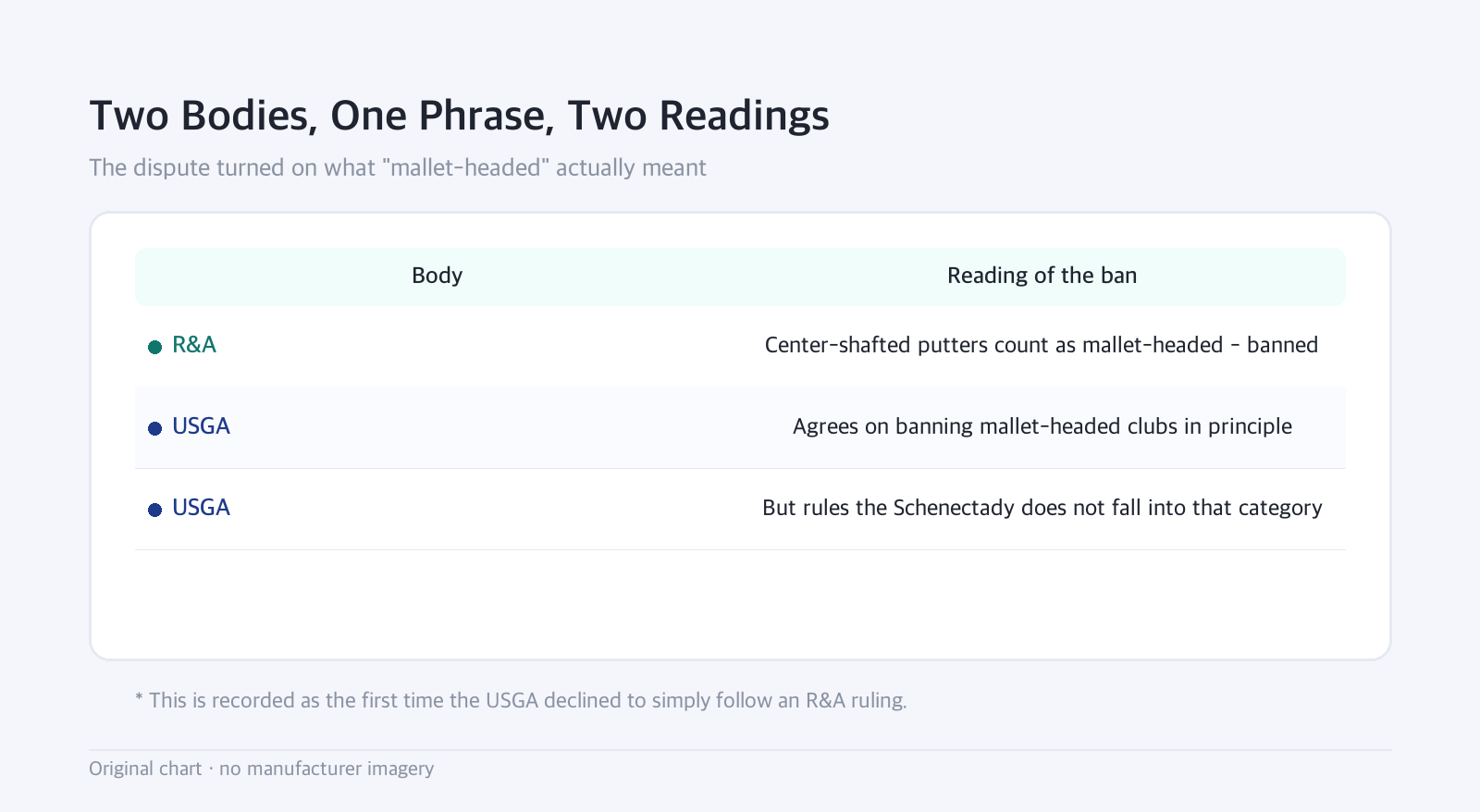
- The USGA agreed with banning mallet-headed clubs in principle
- But it ruled that the Schenectady, and center-shafted putters generally, didn't fall into that category
Two bodies read the same phrase differently — the dispute turned on what "mallet-headed" actually meant.
This is recorded as the first time the USGA declined to simply follow an R&A ruling.
The result was straightforward: the same putter was now unusable in Britain and usable in the U.S.
5. It happened again more than once after that
1910 wasn't the last time.
- The steel shaft — the USGA legalized it in 1924; the R&A followed in 1929. A five-year gap.
- The coefficient of restitution — the USGA introduced a cap in 1998; the R&A initially declined to follow. Full alignment took a decade.
All three cases share a structure: the American side tended to move first or allow more, while the British side reached a different conclusion. The direction wasn't always the same, though — with the Schenectady, the R&A restricted and the USGA allowed; with the coefficient of restitution, it was the USGA that restricted while the R&A held off.
6. Where things stand now
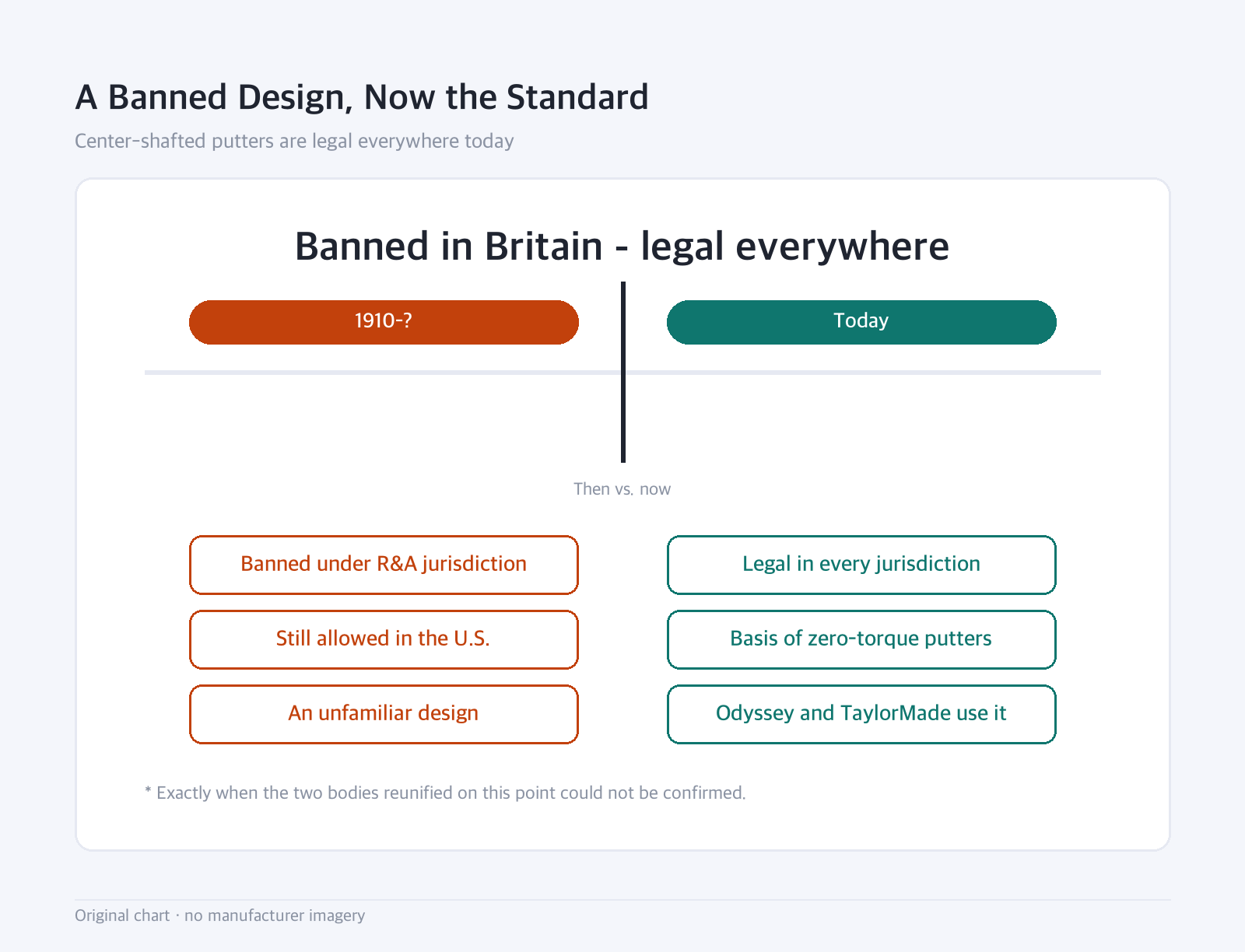
Center-shafted putters are legal everywhere today. In fact, the zero-torque putters getting attention recently are mostly built on a center-shafted structure.
A design once banned now underpins current technology.
Exactly when the two bodies reunified on this point isn't something this piece can pin down. What is confirmed: the two bodies met for twelve days in 1951 and agreed on a joint code, effective from 1952. The Schenectady question was likely resolved by then at the latest.
7. Who this is useful for
- Golfers using or considering a center-shafted putter — it's legal everywhere today. This piece is about a period when it wasn't.
- Golfers interested in zero-torque putters — the structure traces back to a design banned a century ago.
- Golfers who treat a rules body's ruling as final — this is a case where two bodies read the same wording differently.
- Golfers curious about equipment history — an early example of a recurring pattern: ban, then eventual legalization.
Less useful for:
- Golfers who just need the current rule — center-shafted putters carry no restriction today.
- Golfers comparing putter performance — this is rules history, not a performance comparison.
8. What we could not confirm
- The full text of the 1910 R&A ruling — we could confirm the phrase "center-shafted, mallet-headed implements," not the complete document.
- Which New Zealand club made the original inquiry — the club's name is unconfirmed.
- When the R&A eventually lifted the ban — the exact date is unconfirmed.
- How the ban was actually enforced in Britain during the period it was in effect.
- Whether A.F. Knight held a patent on the design.
- What discussions, if any, passed between the two bodies over this issue at the time.
In one line
In 1910, the R&A banned the center-shafted putter, but the USGA ruled that it didn't fall under what they meant by "mallet-headed" — and declined to follow.
Two bodies read the same wording differently, and the same putter ended up illegal on one side of the Atlantic and legal on the other. It's the first documented split between golf's two governing bodies.
The design banned then is now the basic structure behind the zero-torque putter.
The dates and rulings here come from confirmed sources; anything we could not confirm is marked as such.
This piece summarizes general instruction concepts and is not personalized coaching advice. Ball flight fixes depend on individual swing mechanics — a launch monitor session or certified instructor can confirm what applies to you.