
The earlier material in this series was organized by type of miss — slice, hook, shank. This piece organizes by club instead.
There's a reason for the switch. The same pattern kept surfacing across those pieces: it shows up one way with a driver and another way with irons. This piece pulls those threads together.
1. Three things that already came up
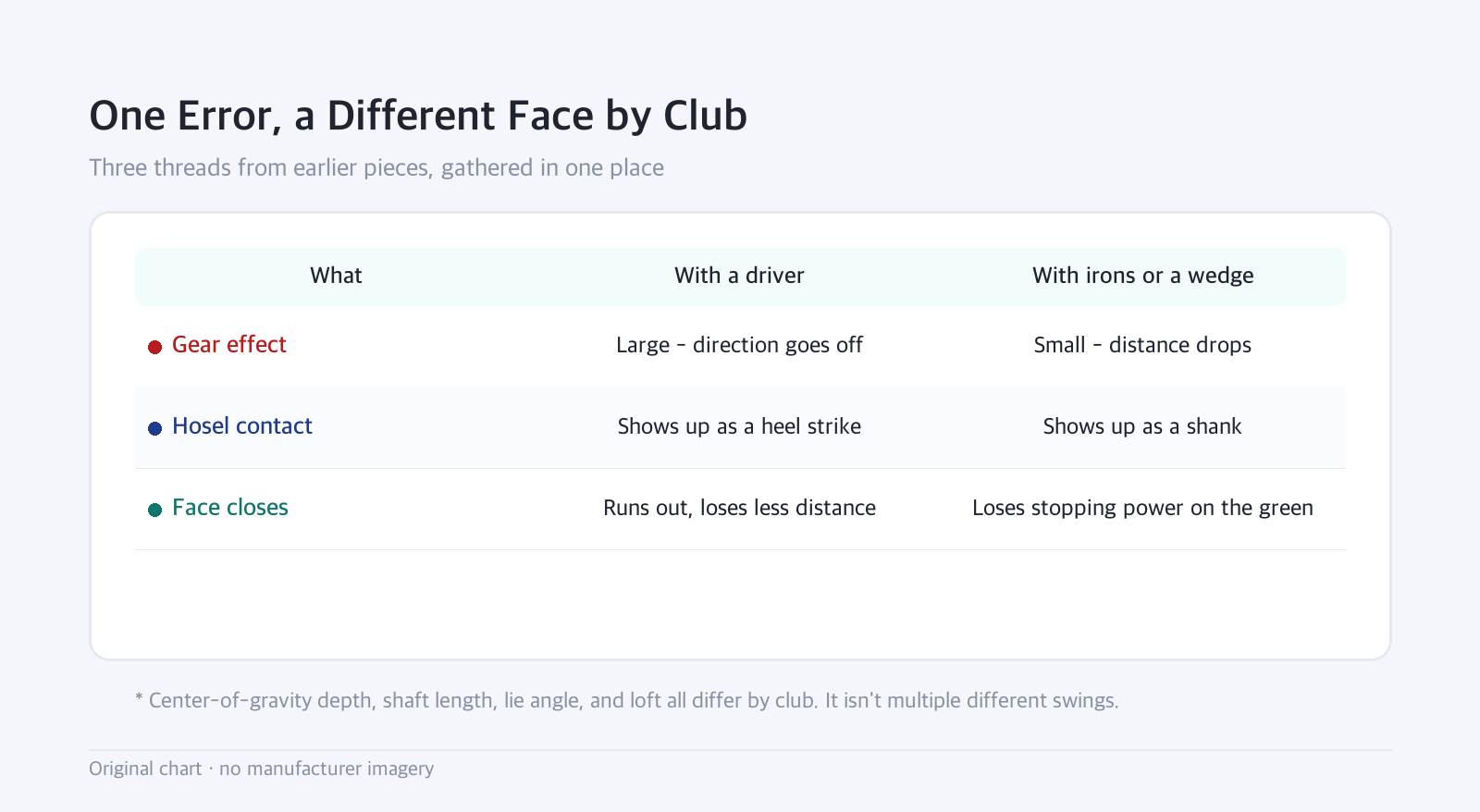
First, gear effect. When contact is off-center, the head twists at impact and imparts opposite spin to the ball. The size of that effect differs by club — a driver's center of gravity sits farther from the face, so the effect is large; an iron's sits closer, so it's small.
The outcomes split accordingly: mis-hit a driver and direction goes off; mis-hit an iron and distance drops.
Second, shanks cluster. They concentrate in wedges and short irons — short shaft, upright lie angle, steep angle of attack, tight lie. Four conditions stacking together.
A driver isn't immune to the same underlying error. It just shows up under a different name: a heel strike.
Third, hooks and loft. A closing face reduces effective loft. But the cost of that isn't the same across clubs. A driver loses less distance, while an iron loses the stopping power it needs on the green.
2. So it collapses into one sentence
Stack the three together and this is what falls out:
The swing error is one thing, but the club turns it into a different face each time.
The same degree of mis-hit sends a driver right and shortens an iron. The same degree of a closing face lets a driver run out and sails an iron over the green.
Judge the swing by the look of the miss, and the club fools you. That's what this piece is about.
3. Three traps this creates on the course
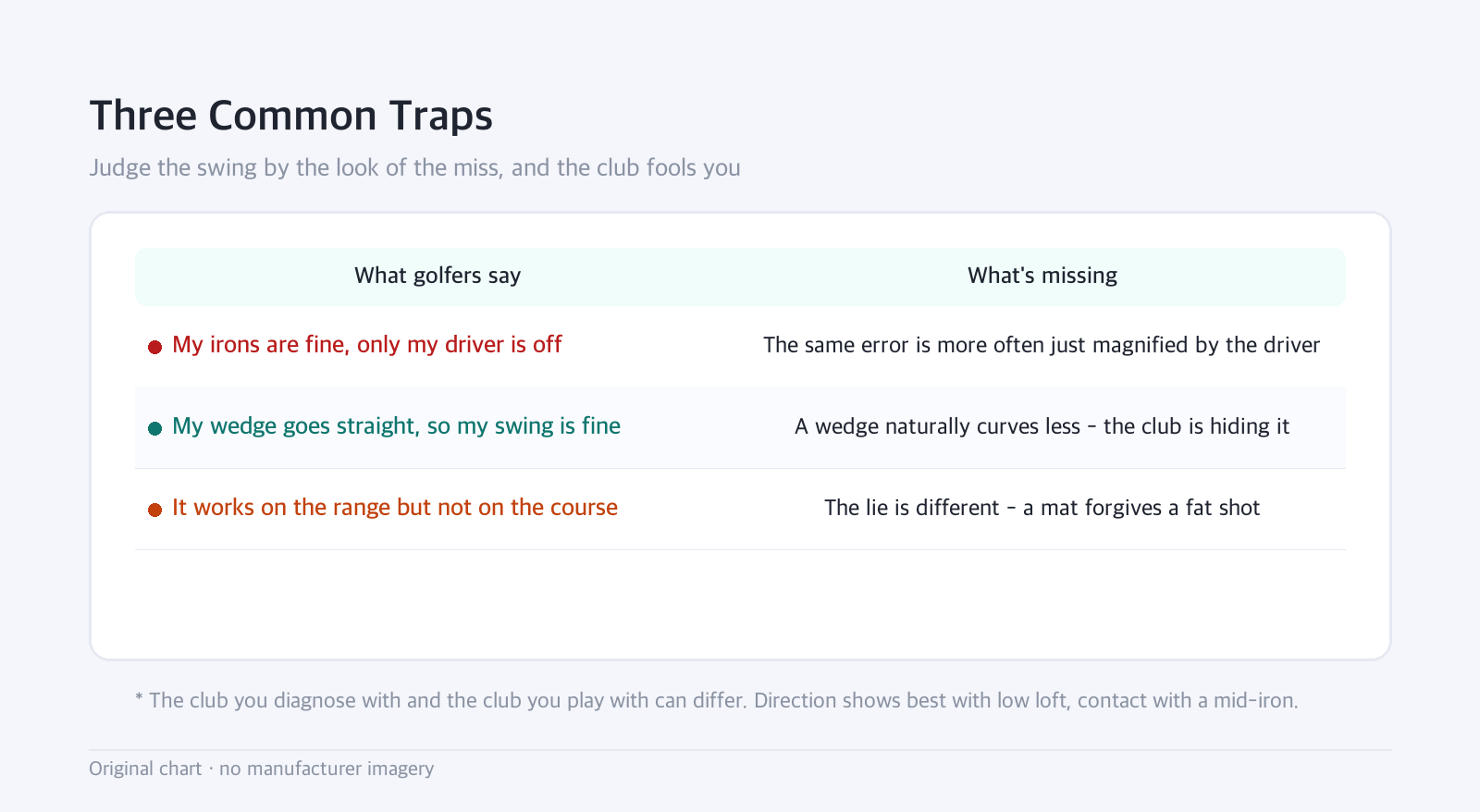
Three are common.
One — "my irons are fine, only my driver is off."
This can mean two different things: a genuinely different driver swing, or the same error that only shows up with the driver.
The second is more common. A driver is long, fast, and low-lofted, so it magnifies the error and puts it on display.
Two — "my wedge goes straight, so my swing must be fine."
This is risky. A wedge naturally curves less — the reason is covered separately. The error isn't gone; the club is hiding it.
Three — "it works on the range but not on the course."
The lie is different. A mat forgives a fat shot; turf doesn't. That distinction is covered in the piece on low point.
4. So which club should you use to diagnose
A practical question. The answer depends on the goal.
To see a direction error, use a driver or a long iron. Low loft lets the tilt of the spin axis show through undisguised. Small differences show up large.
To see a contact error, use a mid-iron. It takes turf, so a divot confirms it, and it isn't as extreme as a driver.
To confirm a swing has actually improved, check it across several clubs. Improvement with one club doesn't guarantee it elsewhere.
The club you diagnose with and the club you play with can differ. Confirming a fix only with a wedge and expecting the driver to follow is a mismatch.
5. What follows
One piece looks at why a wedge curves less. It comes down to physics.
One piece looks at why long irons are hard to hit.
One piece looks at low point — a fat shot and a topped shot sit on a different axis from the misses covered so far in this series.
One piece looks at on-course first aid — sorting what actually works from what only feels like it works.
One piece closes out this thirty-piece material.
6. Who this is useful for
- Golfers whose results differ wildly by club — it may not mean multiple different swings
- Golfers who feel "only my driver is off" — the error may just be magnified there
- Golfers choosing which club to practice with — the right choice depends on the goal
- Readers of the earlier pieces in this series — scattered club-specific notes come together here
Less useful for:
- Golfers who play only one club — there's nothing to compare against
- Readers new to this series — this piece is a synthesis and assumes the earlier ground
7. What we could not confirm
- The actual ratio by which error is magnified per club — the mechanism is explained, but we could not confirm figures
- Research on choosing a diagnostic club — this is practical judgment, and we could not find supporting sources
- The measured difference between mat and turf results — widely discussed, but we could not confirm measurement data
Summary
The swing error is one thing, but the club turns it into a different face. A driver magnifies it; a wedge hides it. Judge the swing by the look of the miss, and the club fools you.
"Only my driver is off" and "my wedge goes straight so I'm fine" are the same illusion, seen from opposite ends.
This piece summarizes general instruction concepts and is not personalized coaching advice. Ball flight fixes depend on individual swing mechanics — a launch monitor session or certified instructor can confirm what applies to you.