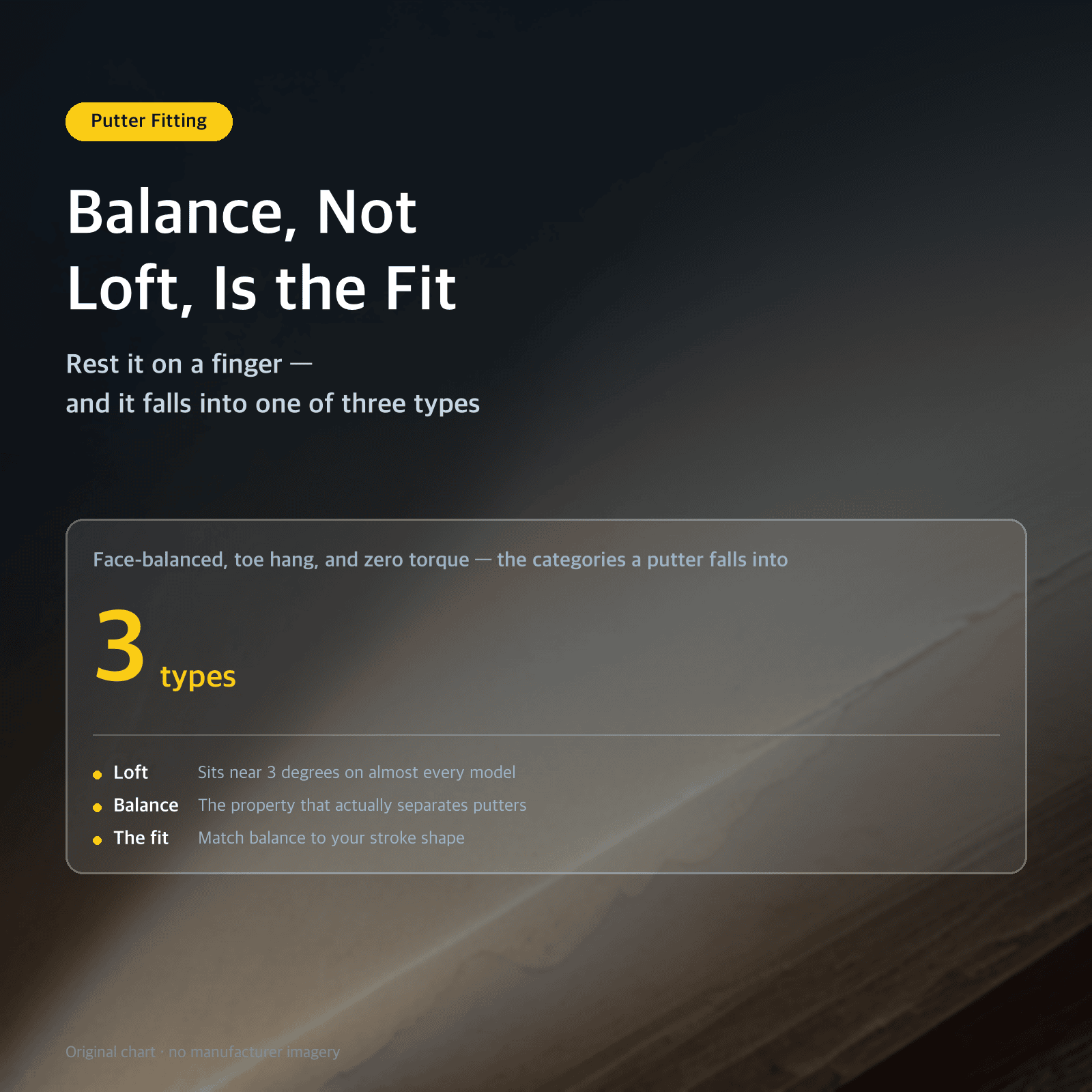
Irons get fit by loft. So do wedges and hybrids — angle is the baseline.
Putters are different. Loft sits around 3 degrees across almost every model, and length clusters between 33 and 35 inches. The variable that actually separates putters is balance.
How the head settles when you rest the shaft across a finger tells you the putter's character.
1. Balanced on a finger, three things happen
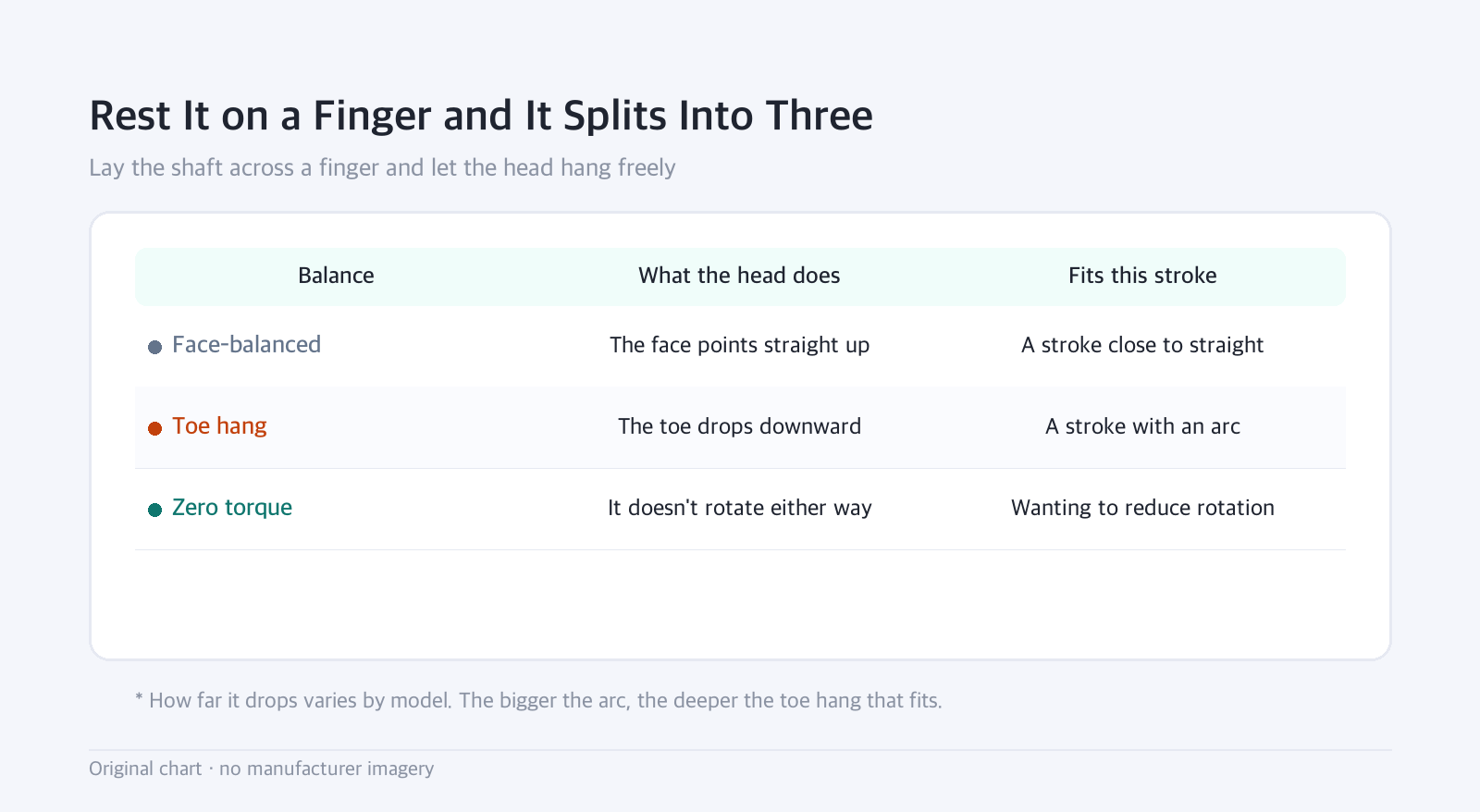
Rest the shaft across a finger and let the head hang freely. One of three things happens.
- Face-balanced — the face points straight up at the sky. It doesn't rotate either way; it stops level.
- Toe hang — the toe (the far end of the head) drops downward. How far it drops varies by model.
- Zero torque (no-torque) — the head doesn't try to rotate in either direction. On some models the toe even lifts slightly upward instead.
This difference comes from how far the center of gravity sits off the shaft axis, and in which direction. The further off-axis it sits, the more gravity pulls the head to rotate.
So this isn't a matter of taste — it's a physical property created by structure. Even the same brand and the same head shape can land in a different balance category if the hosel differs. It's a difference you can't see from the outside.
2. There are two kinds of putting strokes
Understanding why balance matters starts with the stroke itself.
Putting strokes split broadly into two types.
Straight-back-straight-through — the putter moves straight along the target line on the way back and straight through on the way forward. The face barely opens or closes.
Arc stroke — driven by rotation around the shoulders, the putter swings inside the line on the backstroke and returns inside again on the forward stroke. Along the way, the face naturally opens and closes.
Neither type is objectively correct. What matters is that which balance suits you depends on which stroke you have.
3. The matching principle
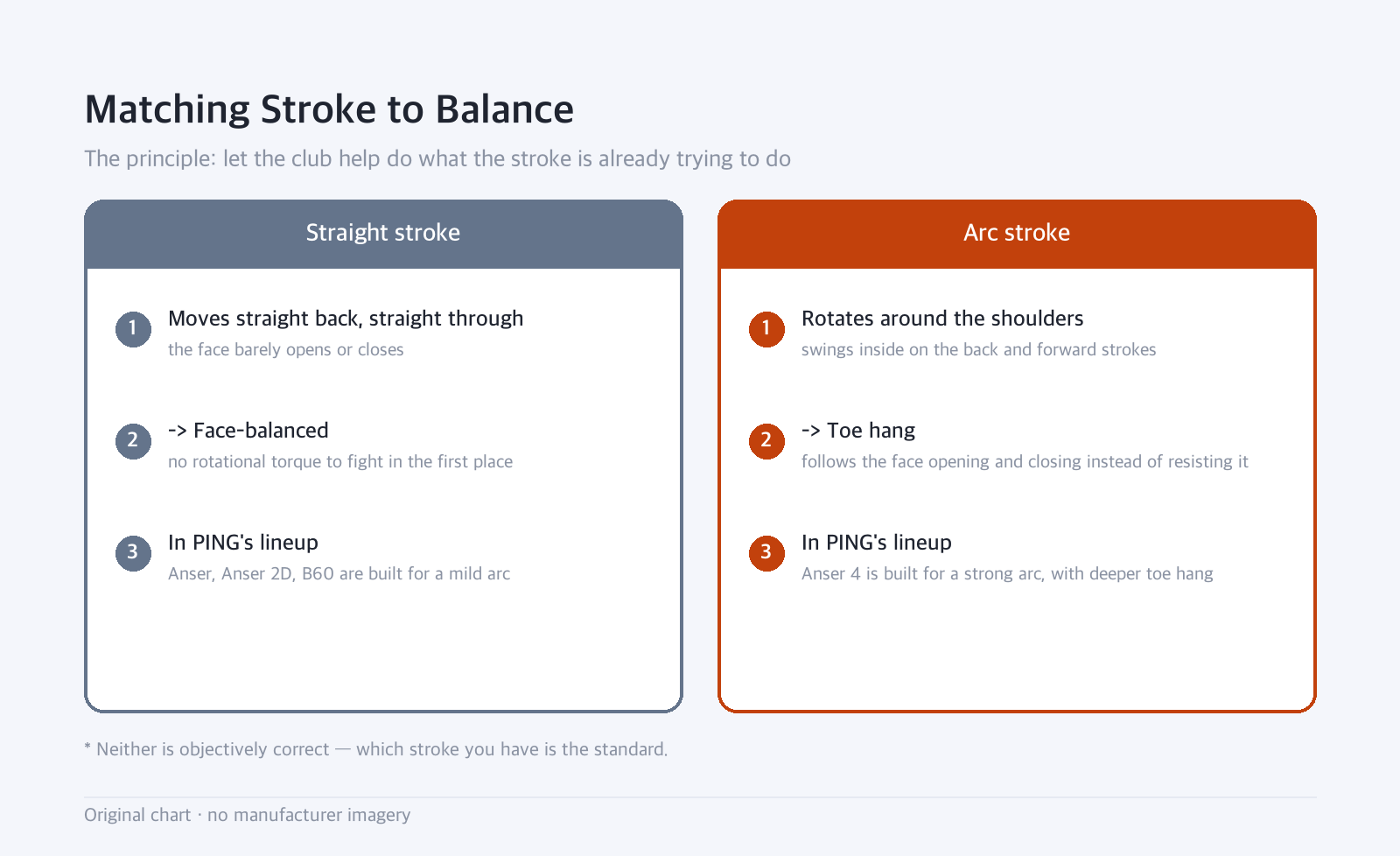
The principle is simple: let the club help do what the stroke is already trying to do.
Straight stroke → face-balanced
If the stroke doesn't open and close the face, but the head keeps trying to rotate anyway, your hands have to fight that rotation. A face-balanced head has no rotational torque to fight in the first place.
Arc stroke → toe hang
An arc stroke naturally opens and closes the face. A putter with toe hang follows that motion instead of resisting it. The larger the arc, the deeper the toe hang that fits.
PING builds this directly into its lineup structure. Within the Scottsdale line, the Anser, Anser 2D, and B60 are built for a mild arc, while the Anser 4 is built for a strong arc. The Anser 4 uses an H4 flow neck, giving it deeper toe hang than the Anser's plumber's neck.
4. Zero torque is a third answer
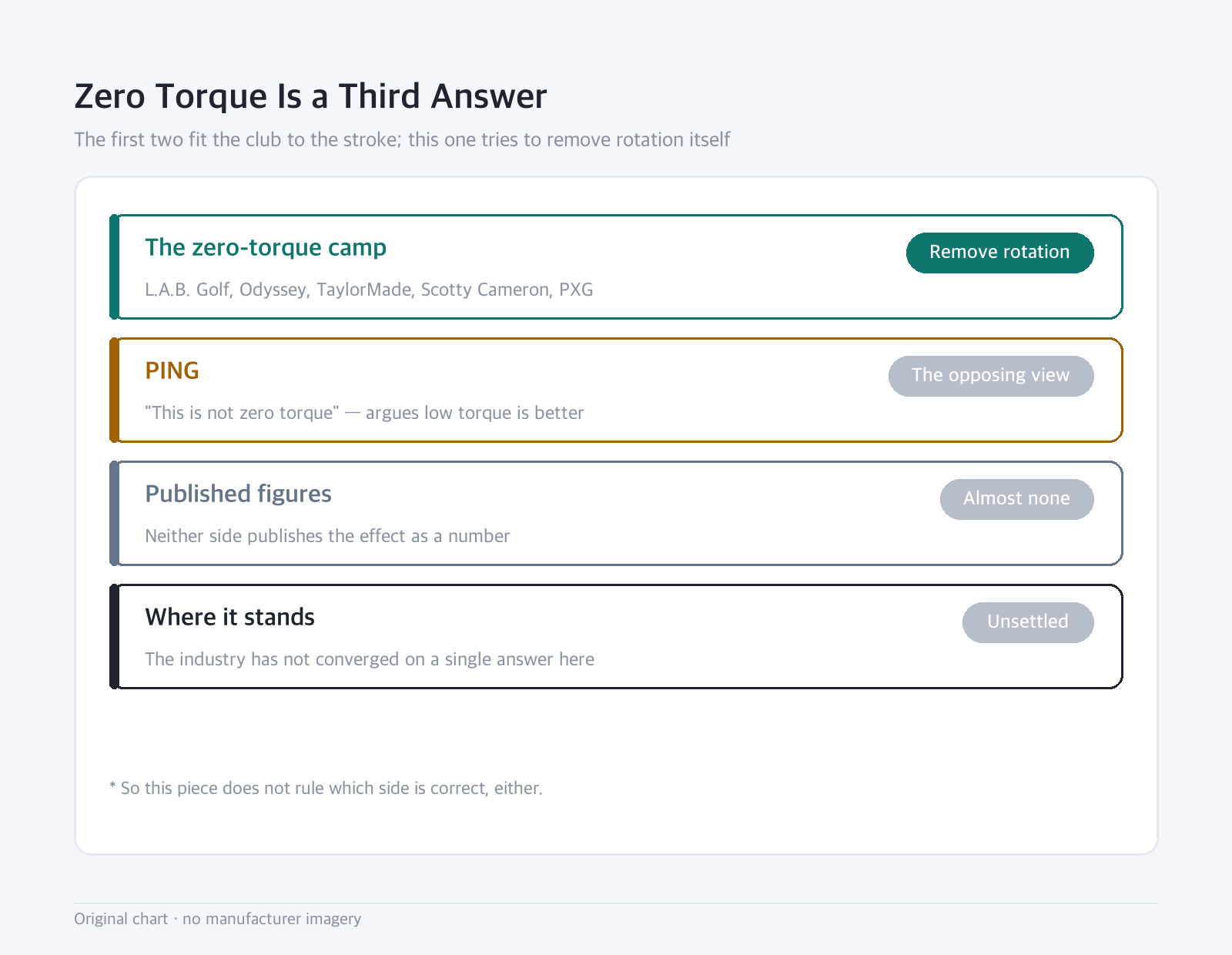
The first two approaches fit the club to the stroke. Zero torque takes a different route — it tries to remove rotation itself.
By placing the center of gravity directly over the shaft axis, gravity has no direction to rotate the head toward. Manufacturers describe this as keeping the face square through the whole stroke.
There's one thing worth being honest about here: not every brand agrees with this direction.
PING doesn't sell a zero-torque model. It offers only low-torque models, and explicitly states that its Scottsdale TR putters are "not zero torque" and that this alternative approach is "better," using an onset shaft design instead.
In other words, this is a field where the industry hasn't converged on a single answer.
5. How to find yours
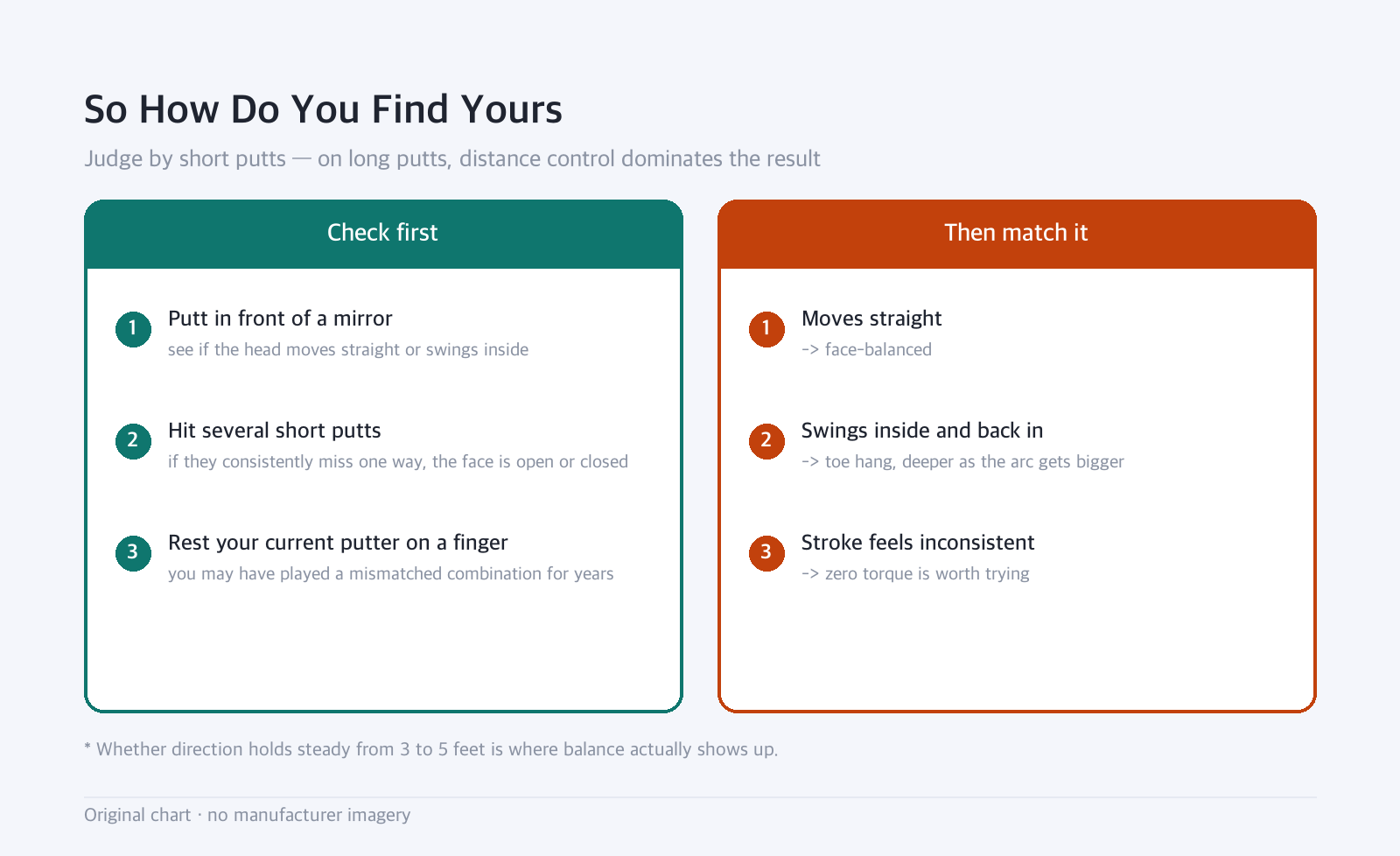
First, check your stroke.
Standing in front of a mirror or a window and putting normally usually shows whether the head moves straight along the target line or swings inside and back in.
There's a simpler test too. Hit several short putts on a practice green and watch which direction they miss. If they consistently miss one way, the face is likely open or closed relative to that direction.
Then match the balance.
- Moves straight → face-balanced
- Swings inside and back in → toe hang, deeper as the arc gets bigger
- Stroke feels inconsistent → zero torque is worth trying
Check the balance of the putter you're using now. Just rest it on a finger. If you've been playing a mismatched combination for a long time, fixing only that can change a lot.
But judge by short putts. On long putts, distance control dominates the result and masks directional issues. Whether direction holds steady from 3 to 5 feet is where balance actually shows up.
6. Who this is useful for
A judgment framework drawn from confirmed facts.
- Golfers who have been choosing putters by loft or length — those values barely differ between models. Balance is where the real difference sits.
- Golfers who consistently miss short putts to one side — balance may be mismatched with the stroke.
- Golfers with a big arc stroke — look toward models with deeper toe hang. In PING's lineup, that's the Anser 4.
- Golfers curious about zero torque — treat it as a third option, and be aware that not every brand agrees with this direction.
This may not fit:
- Golfers expecting balance alone to fix their putting — distance control and green reading are separate problems.
- Golfers mid-change on their stroke — a club fit to your current stroke may not suit the stroke you're changing into.
- Golfers testing with long putts — distance control dominates the result and masks balance differences.
7. What we could not confirm
- Toe-hang angle in degrees — brands describe "deep" or "shallow" but we could not confirm a brand that publishes the figure in degrees.
- How much balance affects putting success rate — the direction is explained, but we found no published numerical data.
- Center-of-gravity location for individual models — not disclosed.
- The distribution of stroke types among golfers — we could not confirm how common each type is.
- The data behind PING's claim that low torque is "better" — the claim itself is confirmed, but the supporting data is not.
In one line
Putters are a club you fit by balance, not angle. Rest one on a finger and it falls into one of three categories — what matters is whether that category matches your stroke.
Straight stroke means face-balanced, arc stroke means toe hang, and wanting to reduce rotation altogether means zero torque. And which of the three is "correct" is still an open question within the industry.
The lineup structure and design explanations here come only from what each manufacturer has stated officially. Anything we could not confirm has been left blank.
This piece summarizes general instruction concepts and is not personalized coaching advice. Ball flight fixes depend on individual swing mechanics — a launch monitor session or certified instructor can confirm what applies to you.