
Two warnings recur in the slice-correction pieces:
A grip that goes too strong produces a hook. A path rotated too far also produces a hook.
This piece addresses that warning directly. This is the point where fixing a slice crosses over into the opposite miss.
And it's the common source of the amateur hook.
1. The hook usually shows up later
There's a sequence often described in teaching circles.
It starts as a slice — over the top and an open face, the causes covered separately.
As skill develops, the hook appears. The player learns to rotate the face, shifts the path from out-to-in to in-to-out, and strengthens the grip. Then it goes too far.
This isn't a confirmed statistic — it's a common observation within teaching circles, and we're labeling it as such.
But mechanically, it makes sense. Every slice fix pushes in the same direction — toward closing the gap that produces a leftward miss. Push past zero, and you're on the other side.
2. What exactly overshoots
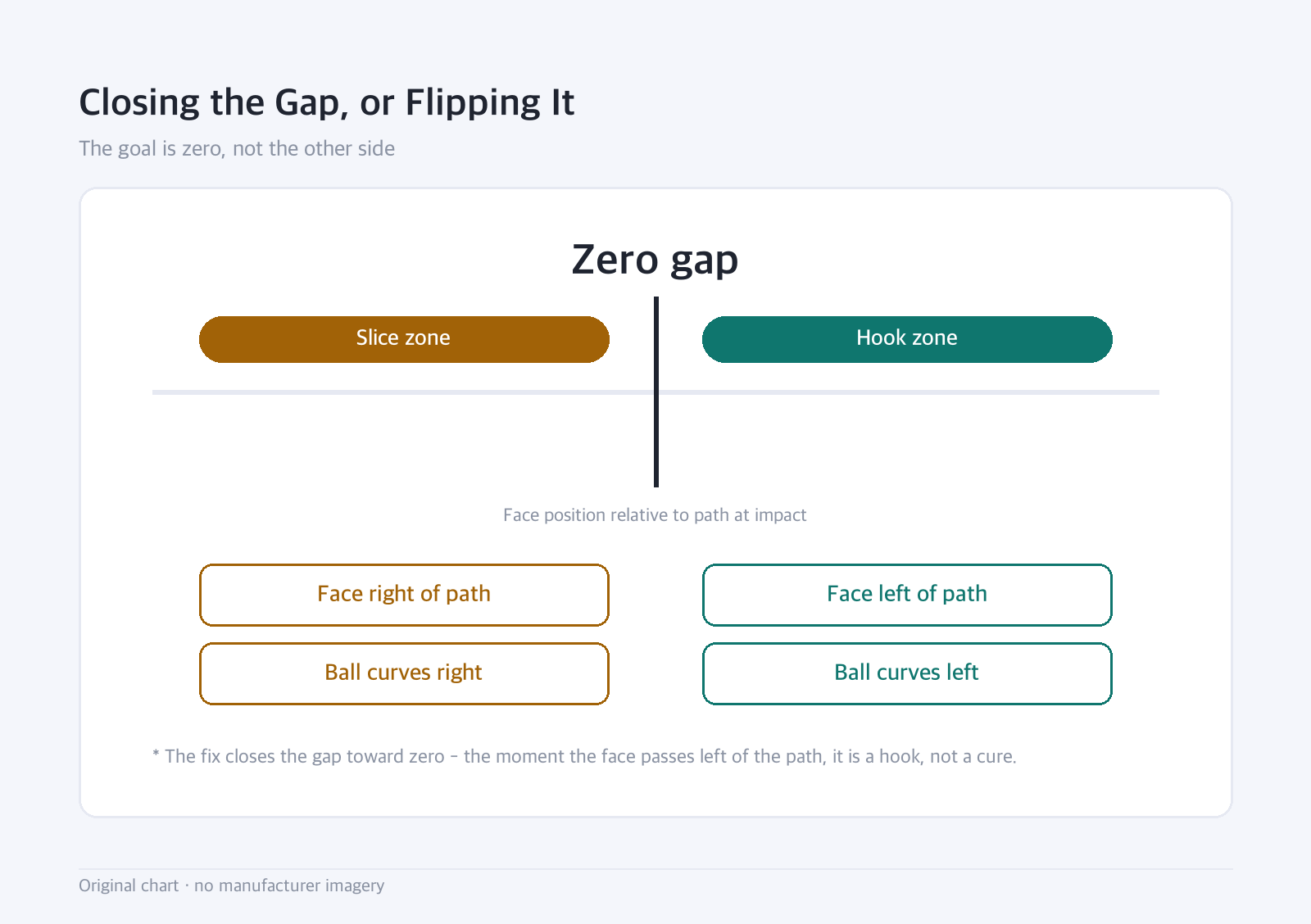
Using the definitions established earlier, this is clear.
A slice happens when the face is right of the path. The fix is to close that gap.
But the goal is closing the gap to zero — not flipping it. The moment the face passes left of the path, it's a hook.
The earlier grip discussion noted that "too strong a grip produces a hook." Here's a closer look at why.
3. What a strong grip creates
A strong grip reduces how much work is needed to square the face, as covered earlier.
But it has a flip side. It pre-sets the hands into a position from which they roll over more easily through impact.
Teaching circles commonly identify an overly strong grip as a leading cause of the snap hook. The setup itself already positions the hands to over-rotate through impact.
There's a practical check here.
If you're past three knuckles, worth checking. As covered separately, one to two knuckles is a weak grip, two to three is roughly neutral. If you're past three and seeing a left miss, this is the first place to look.
4. But it's not always the grip
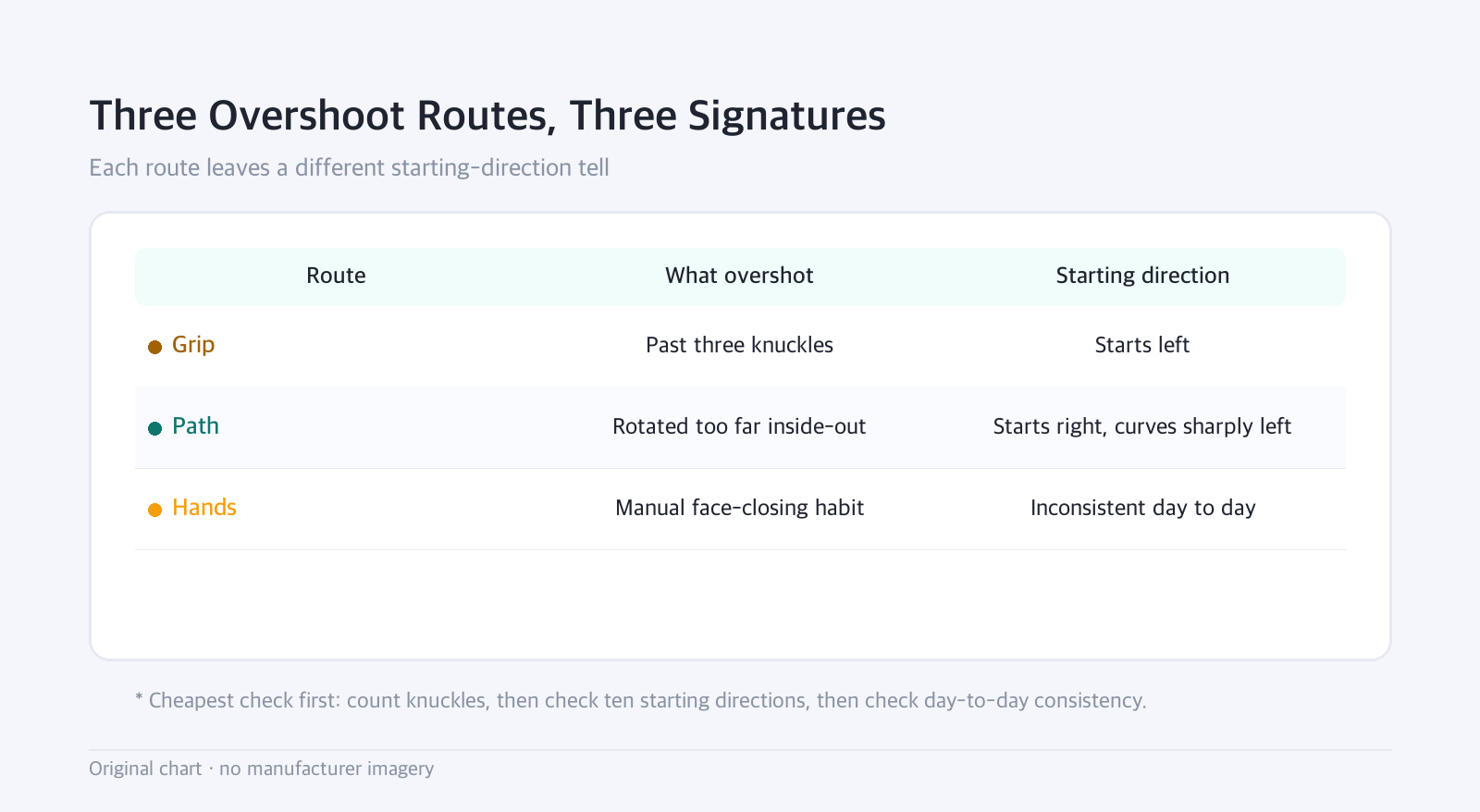
There are three routes by which a slice fix overshoots.
One — the grip went too strong. Three-plus knuckles. Easiest to check.
Two — the path was rotated too far. Repeating "swing more from the inside" eventually pushes the path far to the right. In this case, the ball starts right and curves sharply left — the push hook from the earlier framework.
Three — a habit of manually rotating the face developed. Practicing the feel of closing the face can harden into an in-swing habit. Results vary day to day here, because hand timing is hard to repeat consistently.
Each has a different signature.
- Starts left → grip or face.
- Starts right, curves sharply left → path went too far.
- Inconsistent day to day → possibly hand-driven.
5. The order for walking it back
The same principle applies as before: cheapest check first, and in small steps.
First, count your knuckles. If you're past three, pull back one step. Don't make a large change at once.
Second, check ten starting directions. If most start right, the path went too far.
Third, if results vary day to day, check whether you're manufacturing it with your hands. In this case, resetting the grip alone won't fix it.
One more thing: walking it back can send you right back into a slice. So this becomes a process of small adjustments, searching for the point where the ball stops curving.
The goal isn't which direction it curves — it's finding the point where it doesn't.
6. Worth saying up front
Crossing from a slice into a hook isn't, by itself, a bad sign.
It means you've become able to release the face. Teaching circles do hold a view that a hook is a better miss than a slice — the reasoning being that at minimum, release is happening. Others disagree.
Either way, as covered separately, a hook comes with a wider range of predictability as a tradeoff.
Which is better isn't something to settle here. Instead: overshooting is a common part of learning control, and the task now is walking back exactly as far as you went.
7. Who this is useful for
- Golfers who fixed a slice and started missing left — this is that story.
- Golfers whose shot shape got unstable after strengthening their grip — try pulling back one step.
- Golfers who start right and curve sharply left — the path went too far.
- Golfers whose results vary day to day — you may be manufacturing it by hand.
This is less useful for:
- Golfers still dealing with a slice — see the slice pieces first.
- Golfers who hooked the ball from the start — this piece covers overshoot specifically; a separate piece fits better.
8. What we could not confirm
- The rate at which slicers cross into hooking — a common observation in teaching circles, not a confirmed statistic.
- The basis for the three-knuckle threshold — a common teaching benchmark that may vary by hand size.
- A statistical correlation between strong grip and snap hook — commonly cited as a leading cause, but we could not confirm numbers.
- The typical time needed to walk it back.
In one line
Every slice fix pushes in the same direction — toward closing the face-path gap. Push too far, and you're on the other side.
The goal is closing the gap to zero, not flipping it. Stop where the curve disappears — going further isn't better.
There are three overshoot routes, and each has a different signature. Starting left points to grip and face, starting right points to path, and day-to-day inconsistency points to the hands.
This piece summarizes general instruction concepts and is not personalized coaching advice. Ball flight fixes depend on individual swing mechanics — a launch monitor session or certified instructor can confirm what applies to you.