PING is one of the larger club brands active today. It sits behind a wide range of equipment covered separately, from hybrids to putters.
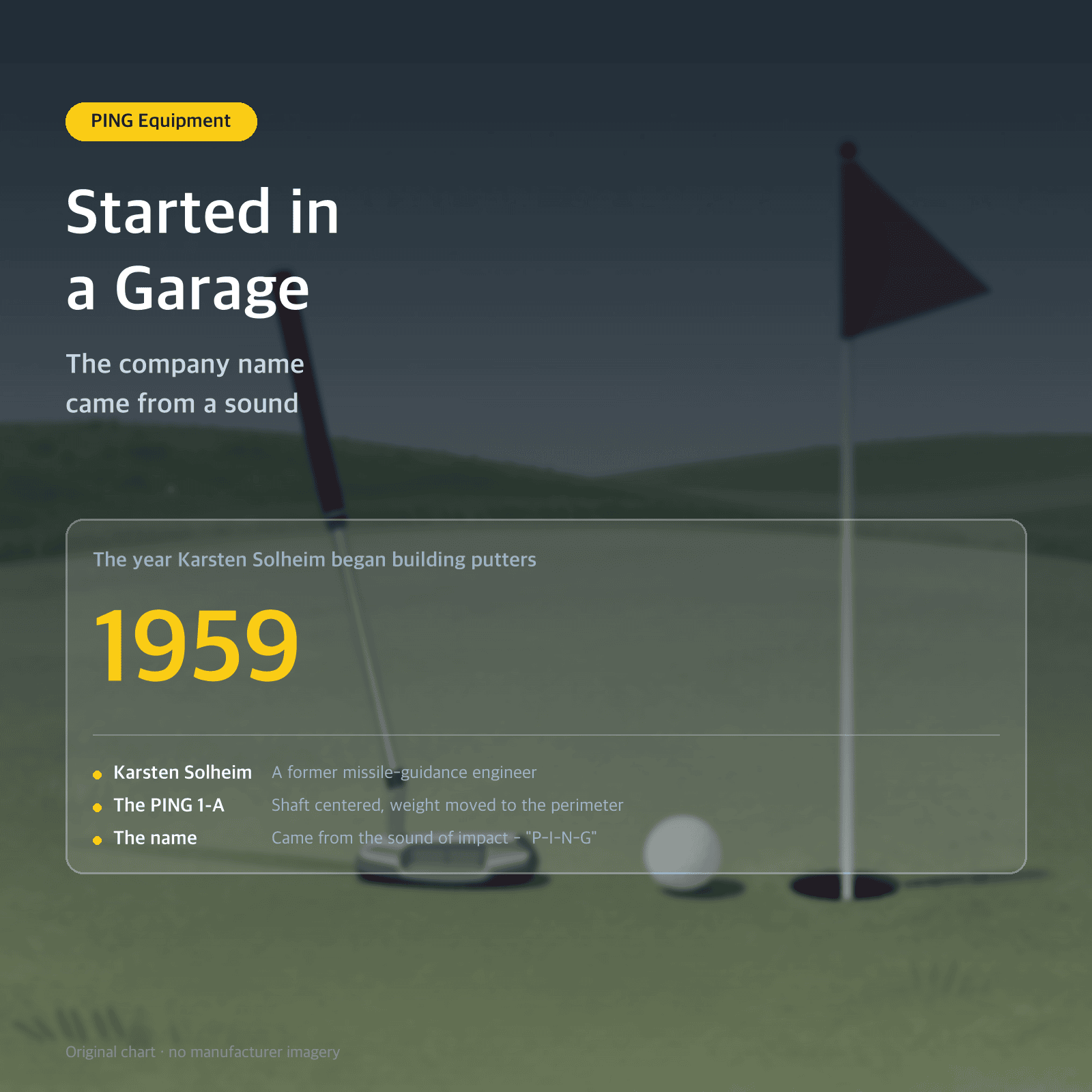
It started in a garage. And the company name came from a sound.
1. An engineer who worked on missile guidance systems
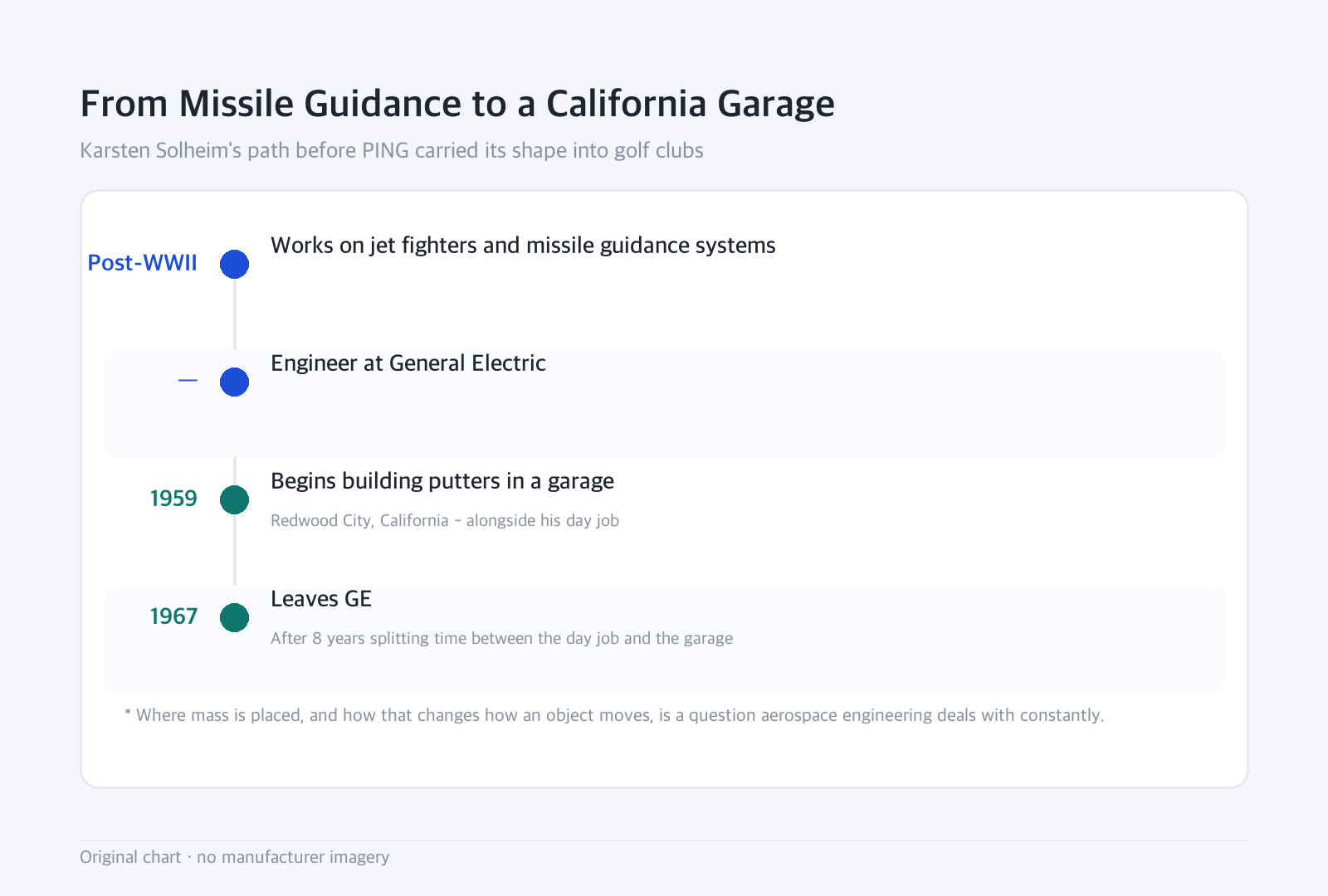
The founder was Karsten Solheim. Born in Norway, he worked after World War II on jet fighters and missile guidance systems.
He later worked as an engineer at General Electric.
None of this has anything to do with golf on its face. But that background fed directly into club design later. Where mass is placed, and how that changes how an object moves, is a question aerospace engineering deals with constantly.
2. 1959 — building putters in a garage
In 1959, in a garage in Redwood City, California, he began building putters. It was work done alongside a day job.
The first result was the PING 1-A. It differed from putters of the time in two ways:
- The shaft was attached to the center of the blade, not the heel
- Weight was moved to the perimeter of the head
The second point is the core idea. The reasoning: put the weight around the perimeter, and the head twists less even on an off-center hit.
That principle is standard now — most irons and putters covered separately use some version of it. In 1959, it was a new idea.
He left GE in 1967, after eight years of splitting time between the day job and the garage.
That same year, 1967, was also when the Anser putter received its design patent. It appears he left the job after the product that would carry the company already existed. That story is covered separately.
3. The name came from a sound
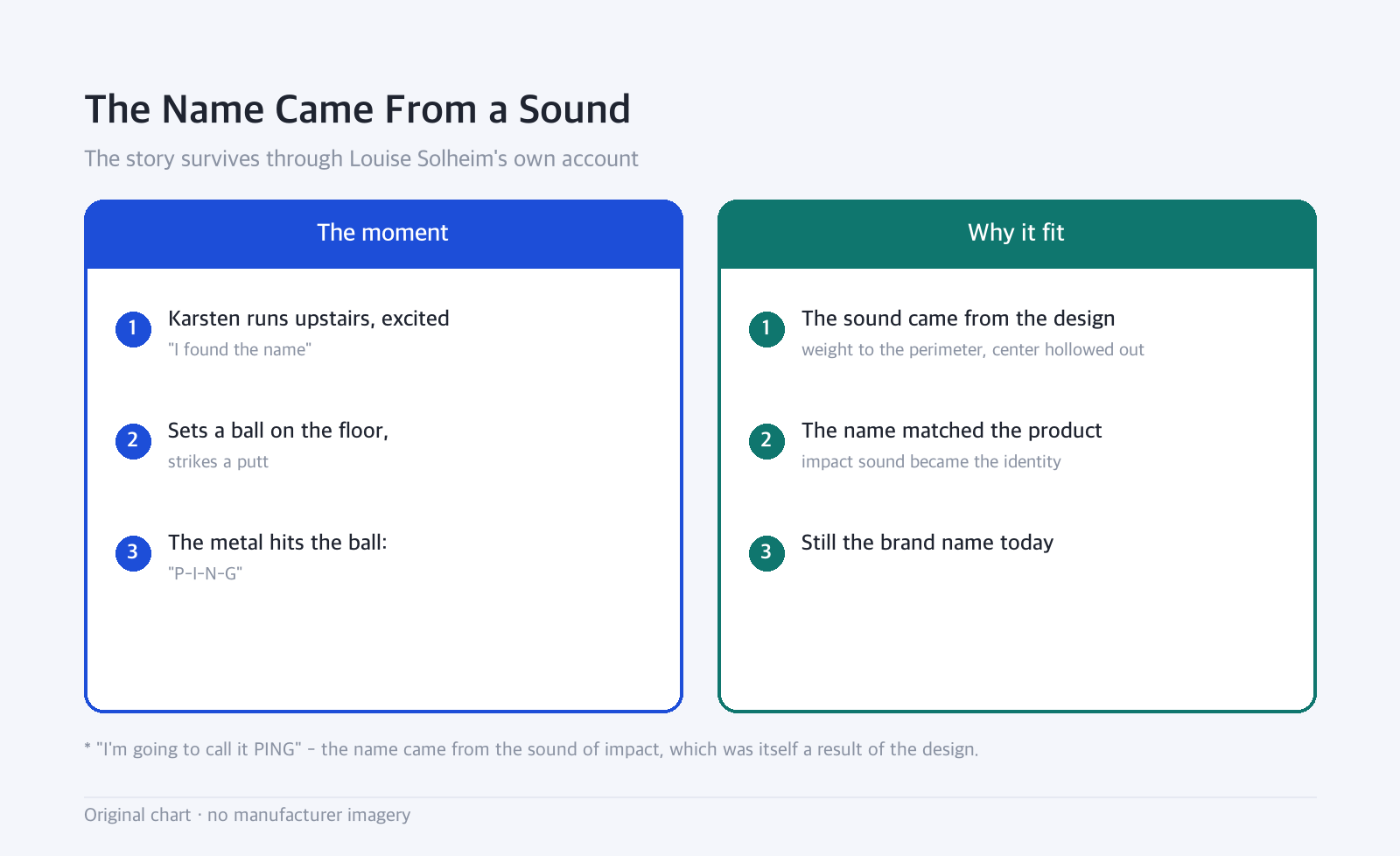
The story behind the company name comes from his wife, Louise Solheim, in her own recollection.
Karsten came running up the stairs, excited. He said he'd "found the name."
He set a ball on the floor and struck a putt. The moment the metal hit the ball, it made a sound: "P-I-N-G."
"I'm going to call it PING."
The brand name came from the sound of impact — and that sound was itself a result of the design. Move weight to the perimeter and hollow out the center, and the sound changes.
4. Sound is still a design consideration
Sound and feel at impact remain an important design target in putters today, and current models covered separately make the point clearly:
- Scotty Cameron — cites the natural damping of the material as a reason for using carbon-steel inserts
- PING — uses PEBAX, an elastomer, in the face to soften the feel
- PXG — fills hollow heads with polymer to control acoustic ring
Three companies solving the same problem differently. Sound and feel aren't captured by a performance number, yet they sit at the center of the design.
The company name happened to occupy that space from the start.
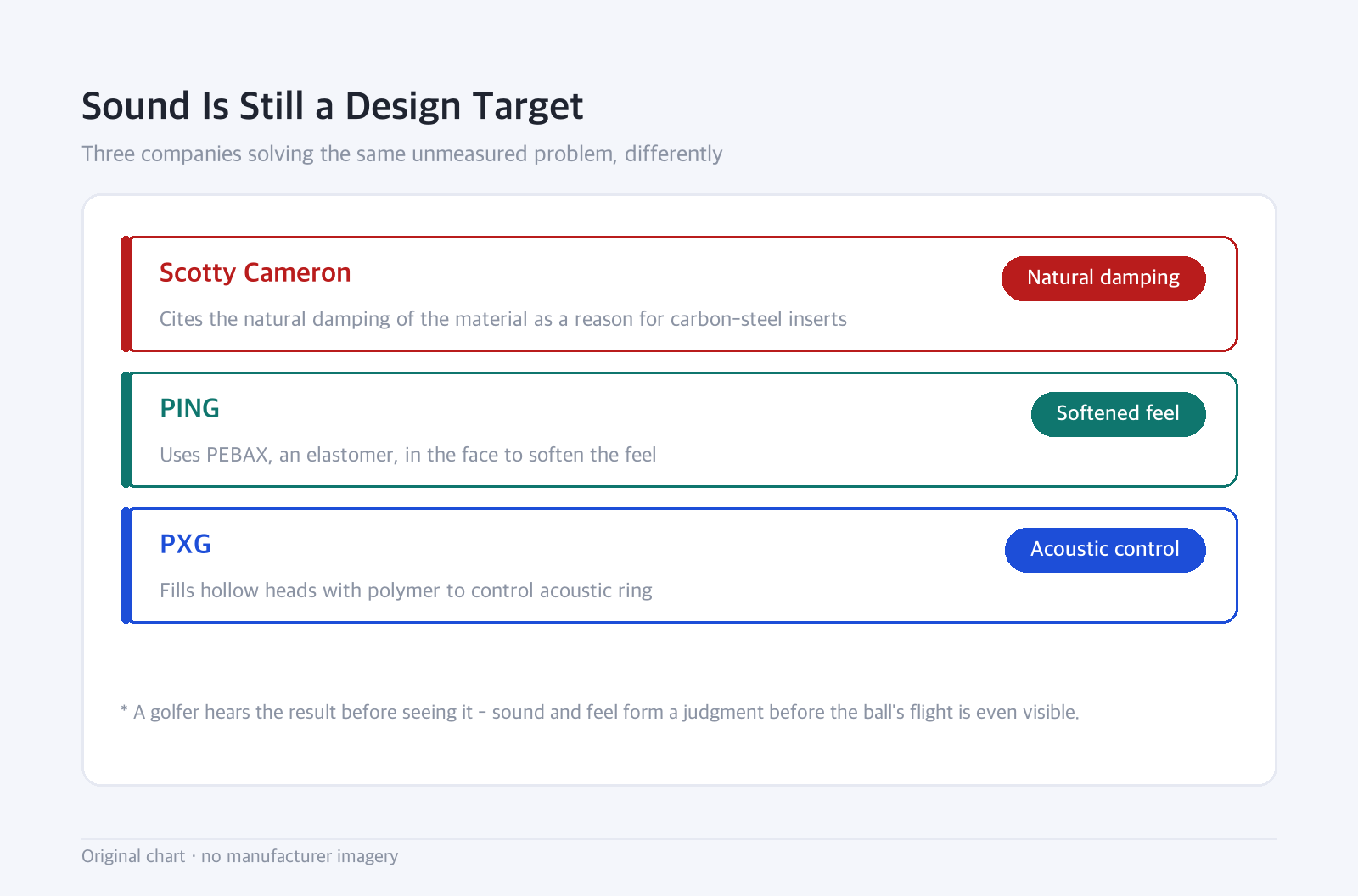
Sound matters because a golfer hears the result before seeing it. The sound at impact and the feel in the hands form a judgment of "that was struck well" before the ball's flight is even visible.
That is why something unmeasured sits at the center of the design.
5. What "started in a garage" is worth
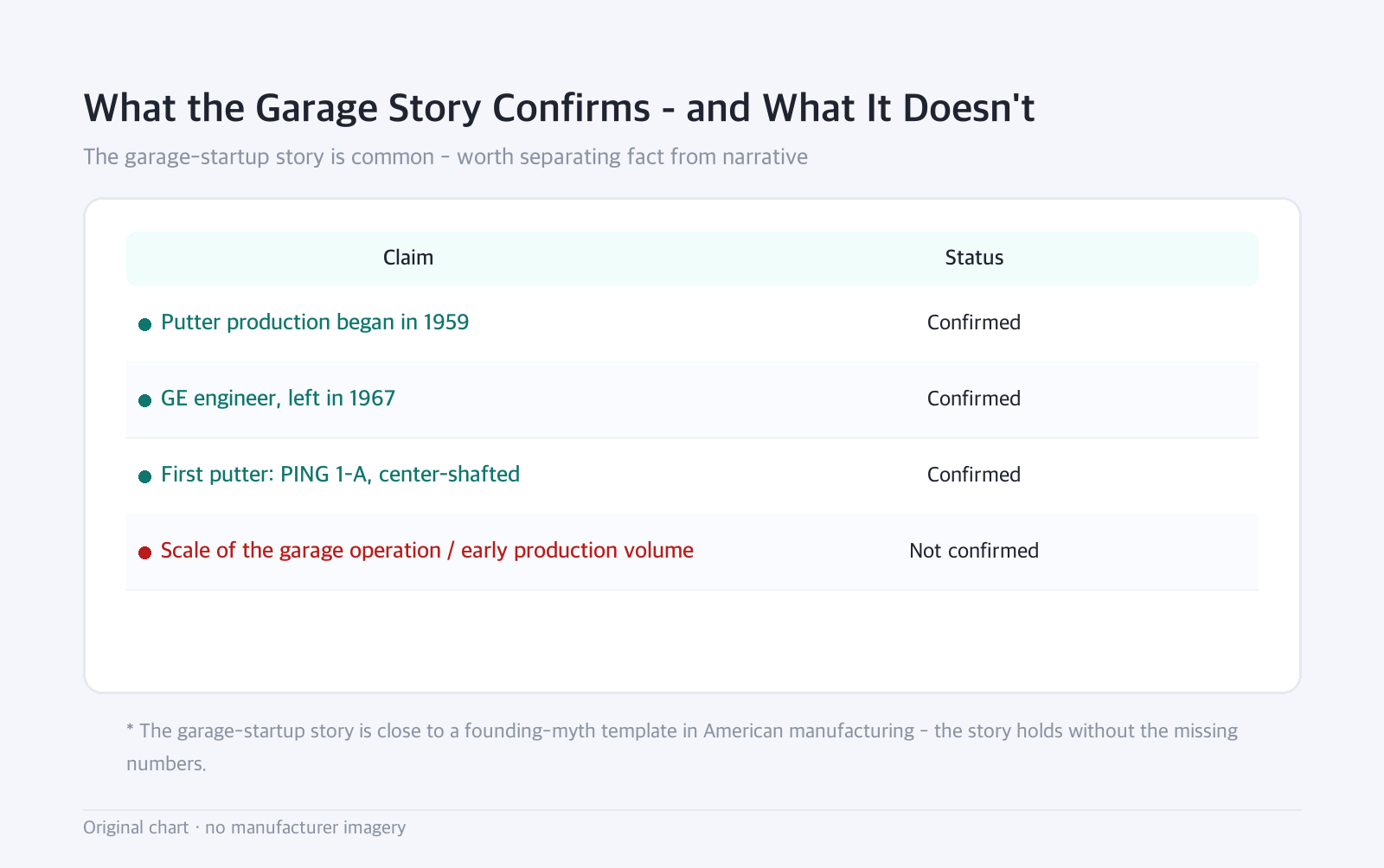
One thing worth flagging: the garage-startup story is common. In American manufacturing and technology in particular, it's close to a founding-myth template.
That's a reason to separate confirmed fact from narrative when reading a story like this.
What is confirmed:
- Putter production began in 1959
- He was a GE engineer and left in 1967
- The first putter was the PING 1-A, with a center-shafted design
- The perimeter-weighting approach was used
What could not be confirmed is more specific — the scale of the garage operation, or early production volume. The story holds without those numbers, but it's worth marking what is and isn't confirmed.
6. Who this is useful for
Based on what could be confirmed:
- Golfers who play PING clubs — this company's foundational design, perimeter weighting, began in 1959.
- Golfers interested in club design — an example of aerospace thinking carried into golf.
- Golfers who care about putter sound at impact — the brand name itself came from that sound.
- Golfers interested in equipment history — how a now-standard design started and when.
This is less useful for:
- Golfers currently shopping for a club — this is history, not a product comparison.
- Anyone drawn to founding myths generally — this piece sticks to confirmed facts only.
7. What we could not confirm
- Early production volume and how putters were sold — we could not confirm how many were made in the garage or how they reached buyers.
- The exact release date and specifications of the PING 1-A.
- The specific nature of the missile-guidance work.
- What happened during the eight years between 1959 and 1967 — we could not confirm the details.
- Exactly when the PING name was settled on — the anecdote survives, but not a firm date.
- Whether there was an early patent.
In one line
PING is a company started in 1959, in a garage, by an engineer who had worked on missile guidance systems.
The idea behind the first putter — "weight around the perimeter means the head twists less even off-center" — became the design most clubs use today.
And the company name came from the sound of a ball being struck.
The years and events here are drawn from confirmed sources; anything we could not confirm is marked as such.
This piece summarizes general instruction concepts and is not personalized coaching advice. Ball flight fixes depend on individual swing mechanics — a launch monitor session or certified instructor can confirm what applies to you.