A line has repeated throughout this series.
First aid and a real fix are different things.
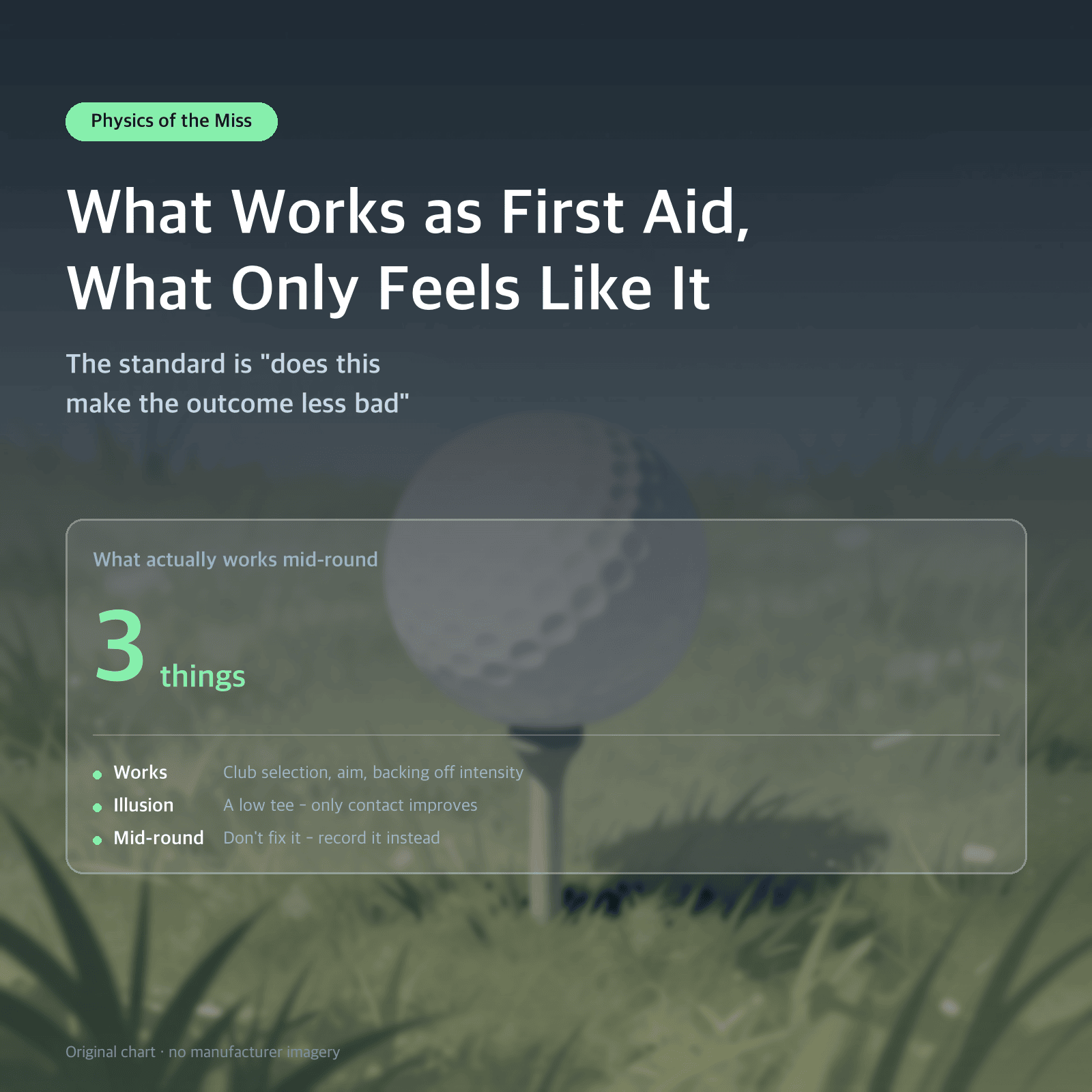
But every time, that ended with "that's not a fix." This piece goes the other way. What, then, actually works as first aid?
Mid-round, there's no time to find a cause. Getting through the day is the goal.
1. The standard for first aid is one thing
First, a standard for judging.
"Does this make the outcome of this shot, right now, less bad?"
Not "does the swing get better." That's not something available today.
By this standard, first-aid moves split into two kinds:
- Things that actually make the outcome less bad — use these
- Things that leave the outcome unchanged but feel better — don't use these
The second kind is the problem, and it's common.
2. What actually works — club and aim
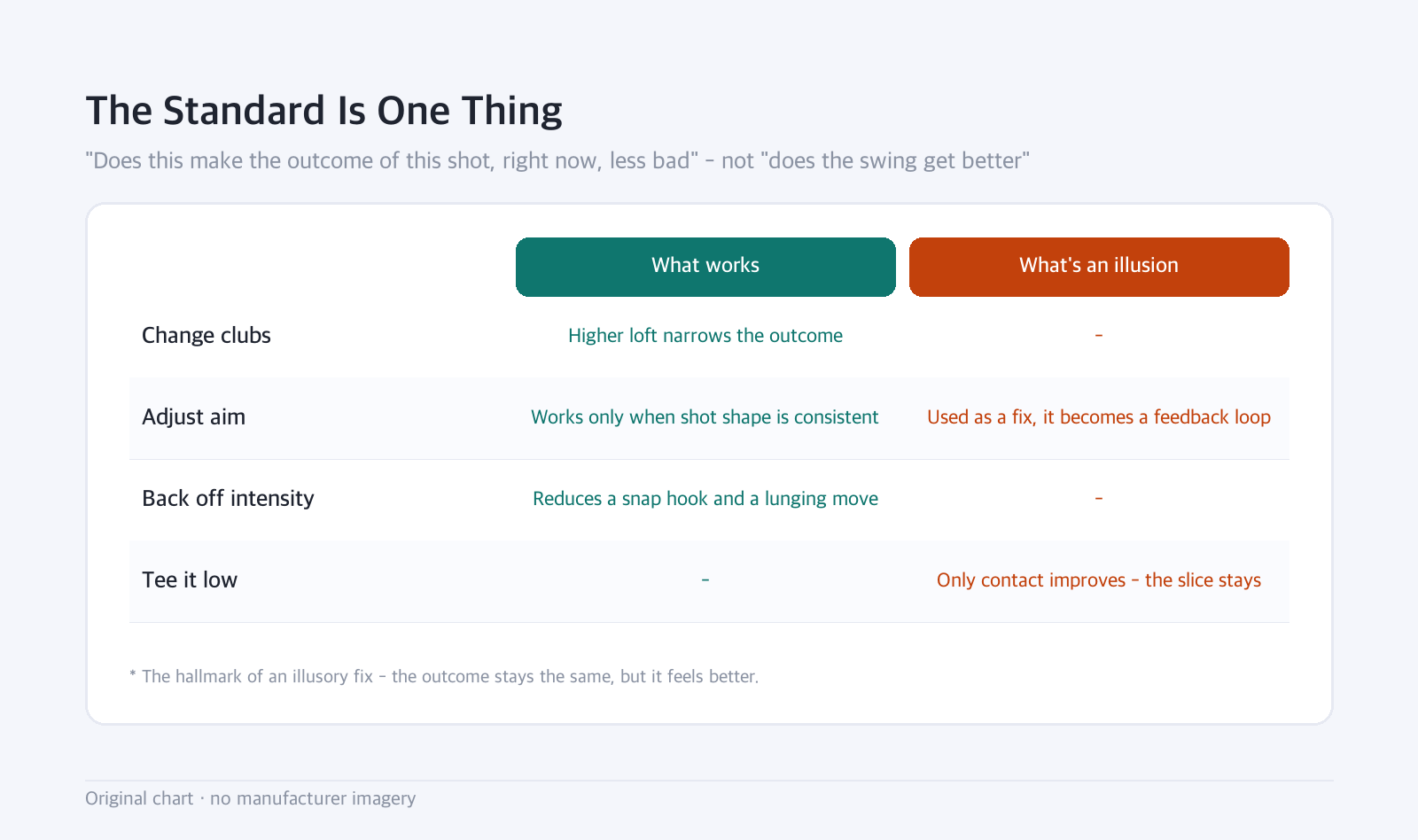
Changing clubs is the most reliable.
Straight from the physics covered earlier in this series: higher loft hides the error. A fairway wood or hybrid instead of a driver, two shorter clubs instead of a long iron. Distance drops, but the spread of the outcome narrows.
If a shank shows up, there's the option of running an 8- or 9-iron instead of a wedge for the rest of the day. As covered earlier, conditions differ by club.
Adjusting aim also works, with a caveat.
An earlier piece noted that aiming left creates a feedback loop. That's when it's used as a fix. Using it for one day is different.
It only works when the shot shape is consistent. If it curves differently every time, aim can't manage it.
Backing off intensity genuinely helps too. A snap hook and a lunging move both tend to show up more when swinging hard.
3. What only feels like it works — the tee-height example
Here's a specific case worth walking through. Tee height.
The common advice is: tee it high if you slice, low if you hook. The usual benchmark cited is having about half the ball above the crown.
Reality runs the other way.
A player who slices usually tees it low instinctively. A steep downswing needs a low tee to make clean contact.
So what happens? Contact improves. Whiffs and thin strikes drop off. But the slice stays exactly the same, because the relationship between path and face hasn't changed at all.
The outcome is unchanged, but it feels better. That's the textbook case of first aid that's actually an illusion.
And there's something worse. Teeing it low reinforces the steep swing. It works in the direction of entrenching the cause, not removing it.
4. So what should you actually do with tee height
To sum up:
- If a slice is the issue, try teeing it higher. The advice has a reason — a low tee encourages a steep swing
- Results may get worse at first. The contact won't feel familiar. This belongs more to practice than to first aid
- If protecting today's score is the goal, changing clubs is more reliable than changing tee height
Separate what belongs to first aid from what belongs to practice. Tee height sits closer to the latter.
5. What not to do mid-round
Last, a list of what to avoid.
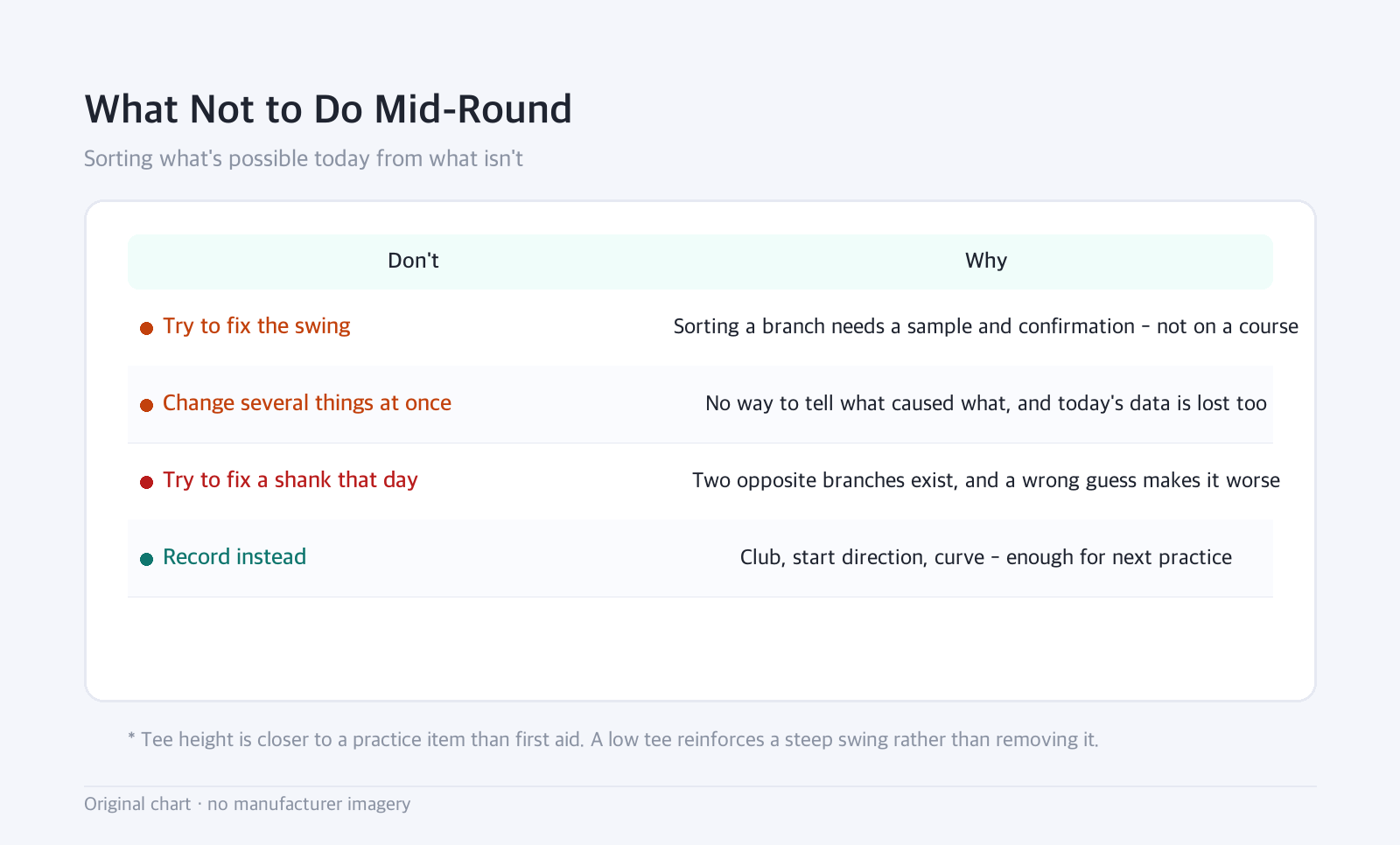
One — don't try to fix the swing.
Sorting a branch, as this series has shown, needs a sample size and confirmation. A course has neither. Guess wrong and the rest of the round goes with it.
Two — don't change several things at once.
Adjust grip on one hole and aim on the next, and there's no way to tell which change did what. You lose today's data along with the round.
Three — especially don't try to fix a shank that day.
As covered earlier, two opposite branches exist, and guessing wrong makes it worse.
Four — record instead.
Which club, which starting direction, which way it curved. Three data points are enough. Not fixing it today in exchange for material for the next practice session is the practical trade.
6. Who this is useful for
- Golfers who've fallen apart mid-round — sorting what's fixable today from what isn't
- Golfers who've experimented with tee height — contact and shot shape are different things
- Golfers who want to use first aid without guilt — it's fine to use, as long as it's labeled correctly
- Golfers planning practice — a round can double as a data-gathering session
Less useful for:
- Golfers currently working to find a cause — earlier pieces in this series cover that
- Golfers who only ever play the range — this piece is about the course
7. What we could not confirm
- The quantitative relationship between tee height and shot shape — the advice is consistent, but we could not confirm figures
- The basis for the "half the ball above the crown" benchmark — this is a common convention
- The actual stroke savings from a club-selection fix — we could not find supporting data
- The success rate of mid-round fix attempts
Summary
The standard for first aid is "does this make the outcome of this shot, right now, less bad."
By that standard, what works is changing clubs, adjusting aim, backing off intensity. All three physically narrow the spread of the outcome.
Tee height leans toward illusion. Tee it low and contact improves while the slice stays. Worse, it reinforces the steep swing.
And don't try to fix anything mid-round. Record instead — club, starting direction, curve. Three data points are enough.
This piece summarizes general instruction concepts and is not personalized coaching advice. Ball flight fixes depend on individual swing mechanics — a launch monitor session or certified instructor can confirm what applies to you.