
Everything covered in this series so far has been about direction — slice, hook, shank. Left-right misses.
This piece is different. It's about up and down.
A fat shot and a thin shot. These two are covered together because misses that look like exact opposites come from the same cause.
1. What low point is
A swing traces an arc with the clubhead. The point where that arc reaches its lowest is called the low point.
This gives the core principle for irons.
Low point needs to fall behind the ball — on the target side.
In sequence: ball first, turf second. The divot should form on the target side of where the ball sat.
This can sound counterintuitive. It seems like you'd need to scoop from underneath to get the ball airborne, but an iron strikes the ball on the way down, then takes the turf after. Loft does the work of getting it up.
2. Off in one direction or the other, and you get two different misses
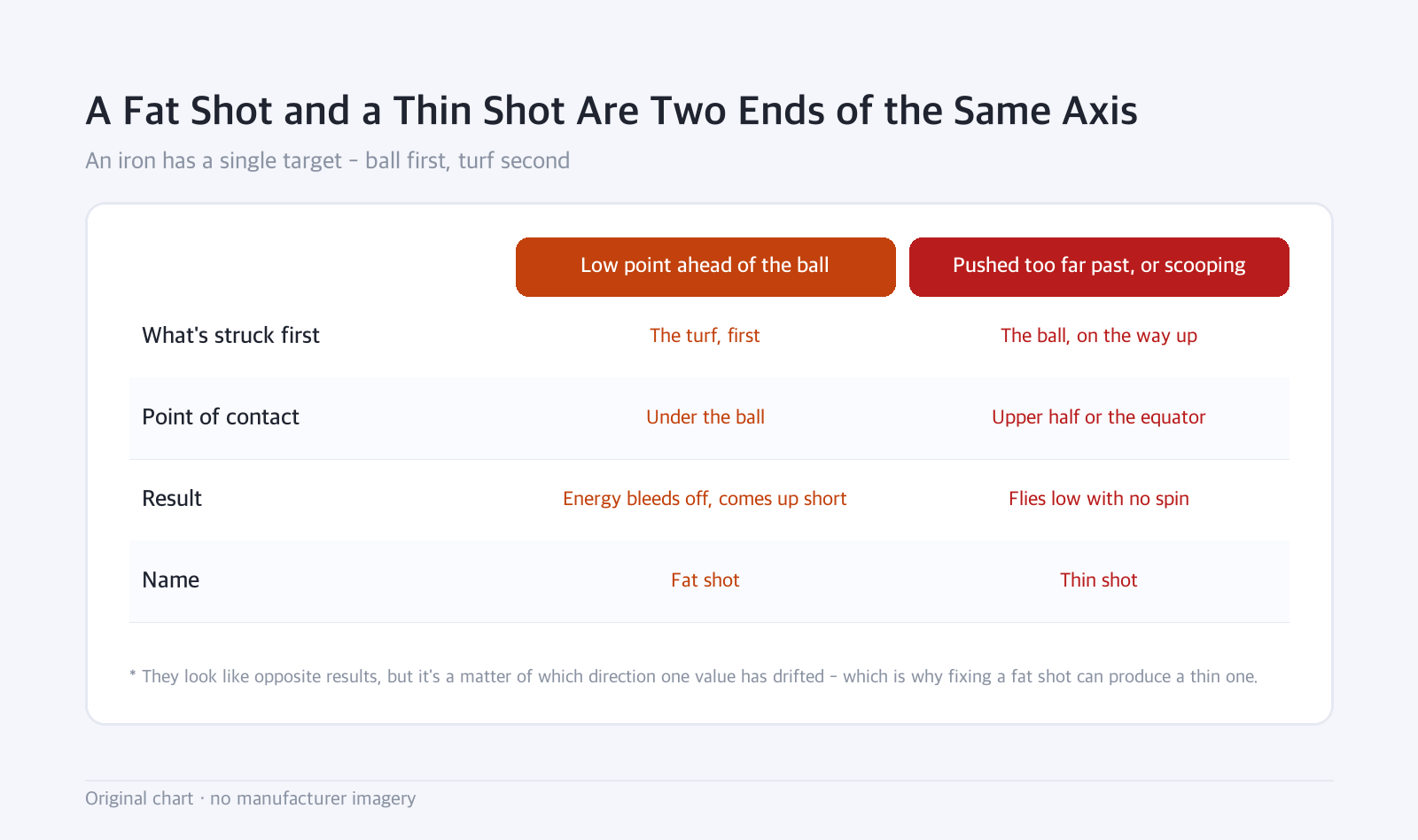
Low point ahead of the ball — a fat shot.
The club strikes the turf first. Energy bleeds off there and the ball comes up short. Sometimes it doesn't get airborne at all.
Low point pushed too far past, or an attempt to scoop it up — a thin shot.
The club is already rising when it meets the ball. Contact lands on the upper half or around the equator of the ball. It flies low with no spin.
Here's the core of this piece. A fat shot and a thin shot look like opposite results, but they're two ends of the same axis. It's a matter of which direction a single value has drifted.
Which is why this happens: trying to fix a fat shot produces a thin one. The same structure as the over-correction seen earlier in this series.
3. What sets low point
These are commonly cited factors in instruction. They're closer to conventional explanation than confirmed fact, so they're flagged as such here.
- Wrist mechanics — how the wrists release through impact
- Weight shift — which foot carries weight through the swing
- Rotation — whether the body keeps turning or stops
- Release timing — when the club is let go
All of these share something. They're all about "where the body is."
And this is where it connects to earlier pieces in this series. Rotation stopping came up with the snap hook; weight moving forward came up with the shank.
The same root shows up as different misses. The pattern that has repeated through this series.
4. How to check it
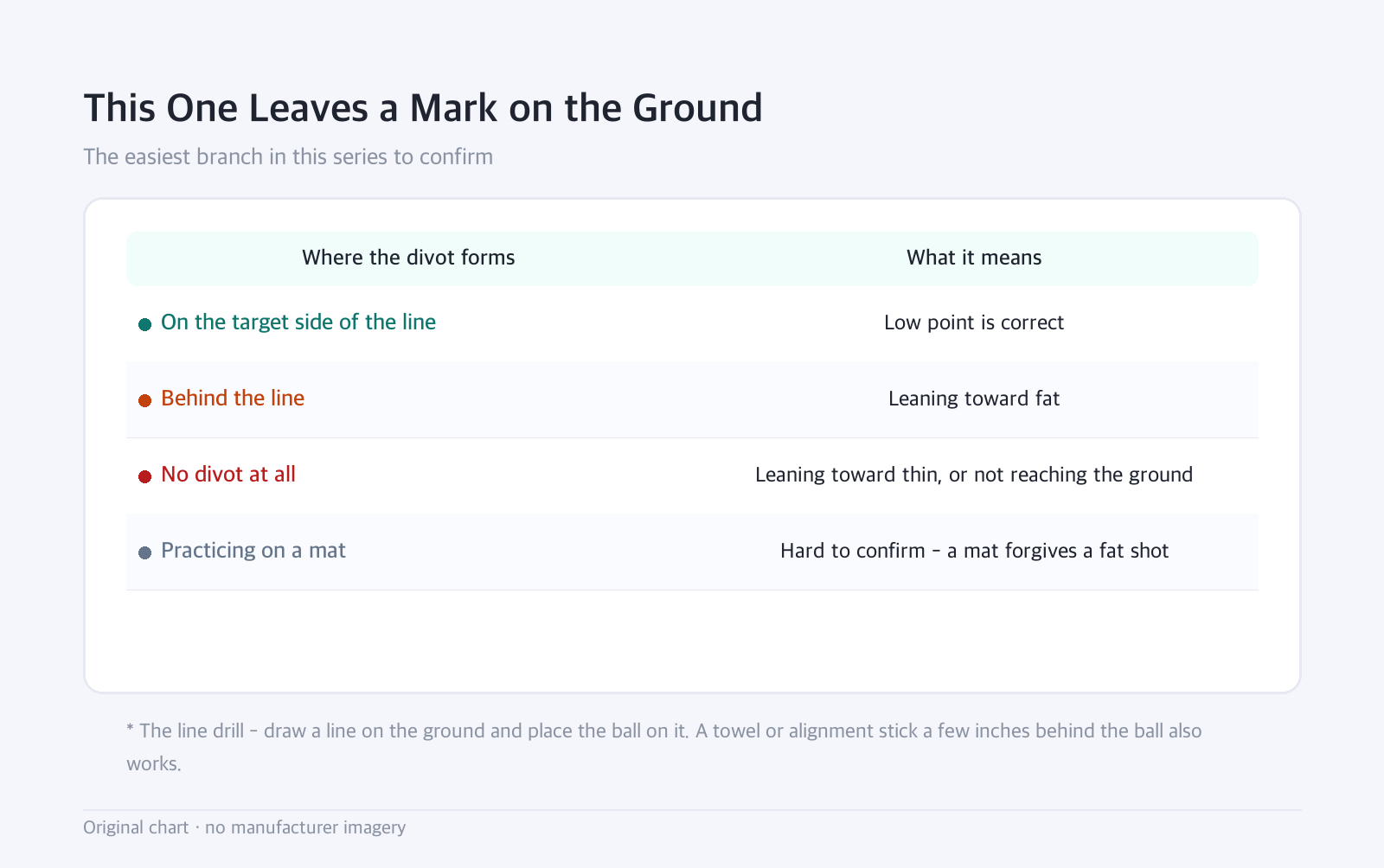
This branch is easier to confirm than most, because it leaves a mark on the ground.
The line drill is the most widely used method. Draw a line on the ground, or use spray paint, and place the ball on it. Then check which side of the line the divot forms on.
- Forms on the target side of the line → low point is correct
- Forms behind the line → leaning toward fat
- No divot at all → leaning toward thin, or low point isn't reaching the ground
Placing a towel or an alignment stick a few inches behind the ball is another common method. A fat shot hits that first.
An earlier thread applies here. This is hard to check on a mat. A mat forgives a fat shot — the club skids and the result comes out reasonably fine anyway.
A large part of "it works on the range but not on the course" comes from here.
5. What to actually do about it
This branch differs from the others covered so far in one respect: the practice method is relatively clear.
Direction misses needed the branch sorted before a fix made sense. Low point has a single target. Ball first, turf second.
- Draw a line and repeat. Confirmation is immediate
- Practice on turf when you can. A mat can't show this
- Make small adjustments when correcting a fat shot. Overshoot and you get a thin one
The same caveat from earlier pieces applies. If the cause sits in a physical constraint, instruction alone won't move it. Weight shift and rotation tied to limited mobility are examples.
If a drill isn't producing improvement, that's the point to stop pushing on your own.
6. Who this is useful for
- Golfers who alternate between fat and thin shots — two ends of the same axis
- Golfers whose range results don't carry to the course — the mat may be hiding this
- Golfers whose iron distances are inconsistent — it may be contact, not direction
- Golfers who've never checked their divot — the easiest item in this series to confirm
Less useful for:
- Golfers focused on direction — earlier pieces in this series cover that
- Golfers focused only on the driver — a teed ball is a different situation
7. What we could not confirm
- The relative weight of the factors that set low point — the commonly cited list is given, but not a verified ranking
- The measured difference between mat and turf results — widely discussed, but we could not confirm measurement data
- The effect size of the line drill — widely used, but we could not confirm validating data
- A settled benchmark for correct divot position
Summary
A fat shot and a thin shot look like opposites, but they're two ends of the same axis — which direction low point has drifted.
An iron has a single target: ball first, turf second.
And this item is the easiest to confirm in this series. Draw a line and see which side the divot lands on. A mat, though, won't show it.
This piece summarizes general instruction concepts and is not personalized coaching advice. Ball flight fixes depend on individual swing mechanics — a launch monitor session or certified instructor can confirm what applies to you.