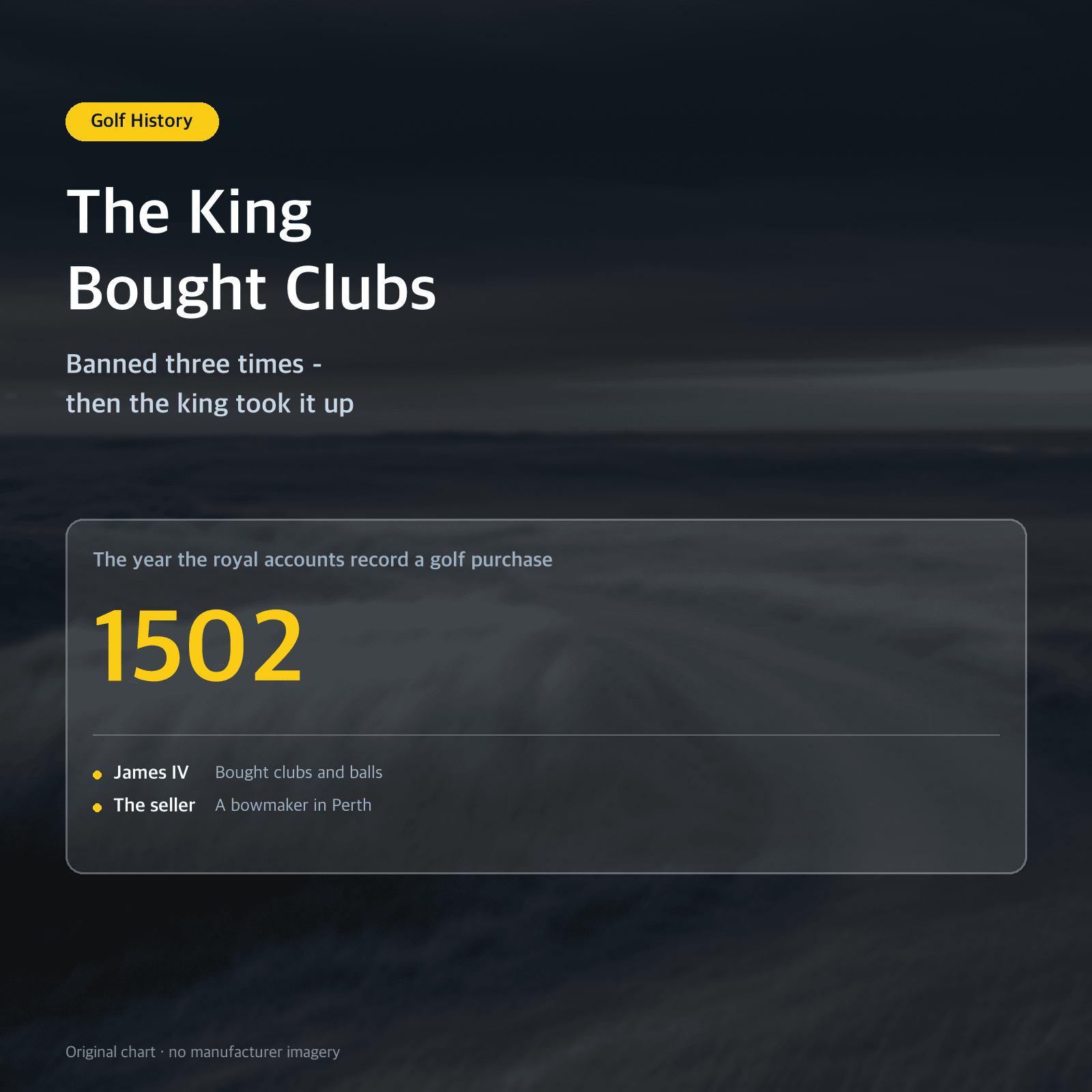
A separate piece covers how the Scottish Parliament banned golf in 1457, citing neglected archery practice — a matter of national defense.
Whether that law worked can be seen in the records that followed.
The same ban was issued twice more. And in the end, the king bought golf clubs.
1. 1471, 1491 — banned again
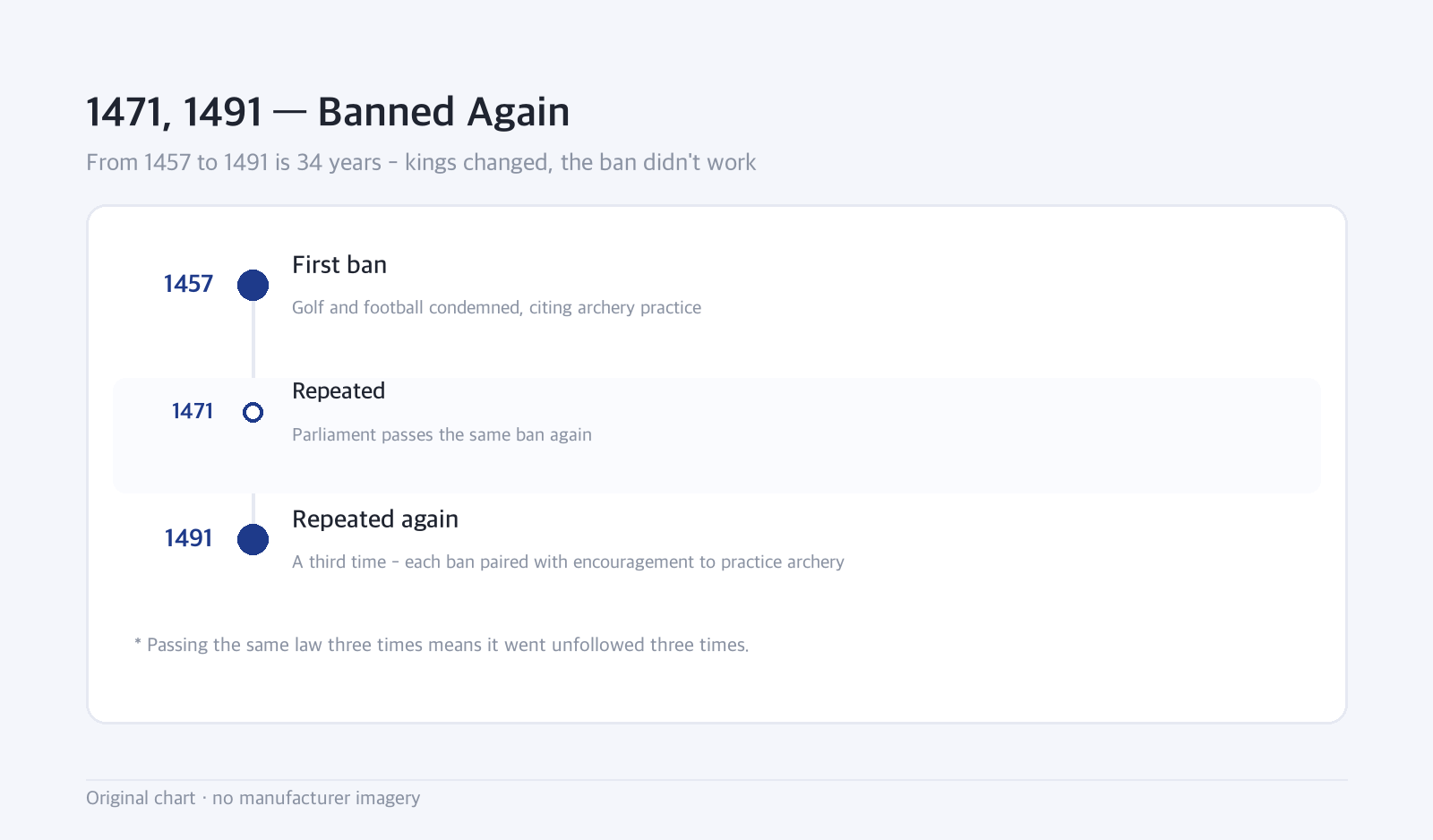
Parliament repeated the same ban in both 1471 and 1491.
If a single ban had settled the matter, there would have been no reason to legislate it again. Passing the same law three times means it went unfollowed three times.
From 1457 to 1491 is 34 years. Kings and parliaments changed in that span, but the situation didn't. People kept playing golf.
It's also a case study in how hard it is to legislate a pastime out of existence.
One more detail stands out: all three bans came paired with a clause encouraging archery. It wasn't only a ban — an alternative was offered alongside it. That still didn't work.
2. And in 1502, the royal accounts
The ending to this story is unexpected.
James IV gave up on the ban and took up golf himself.
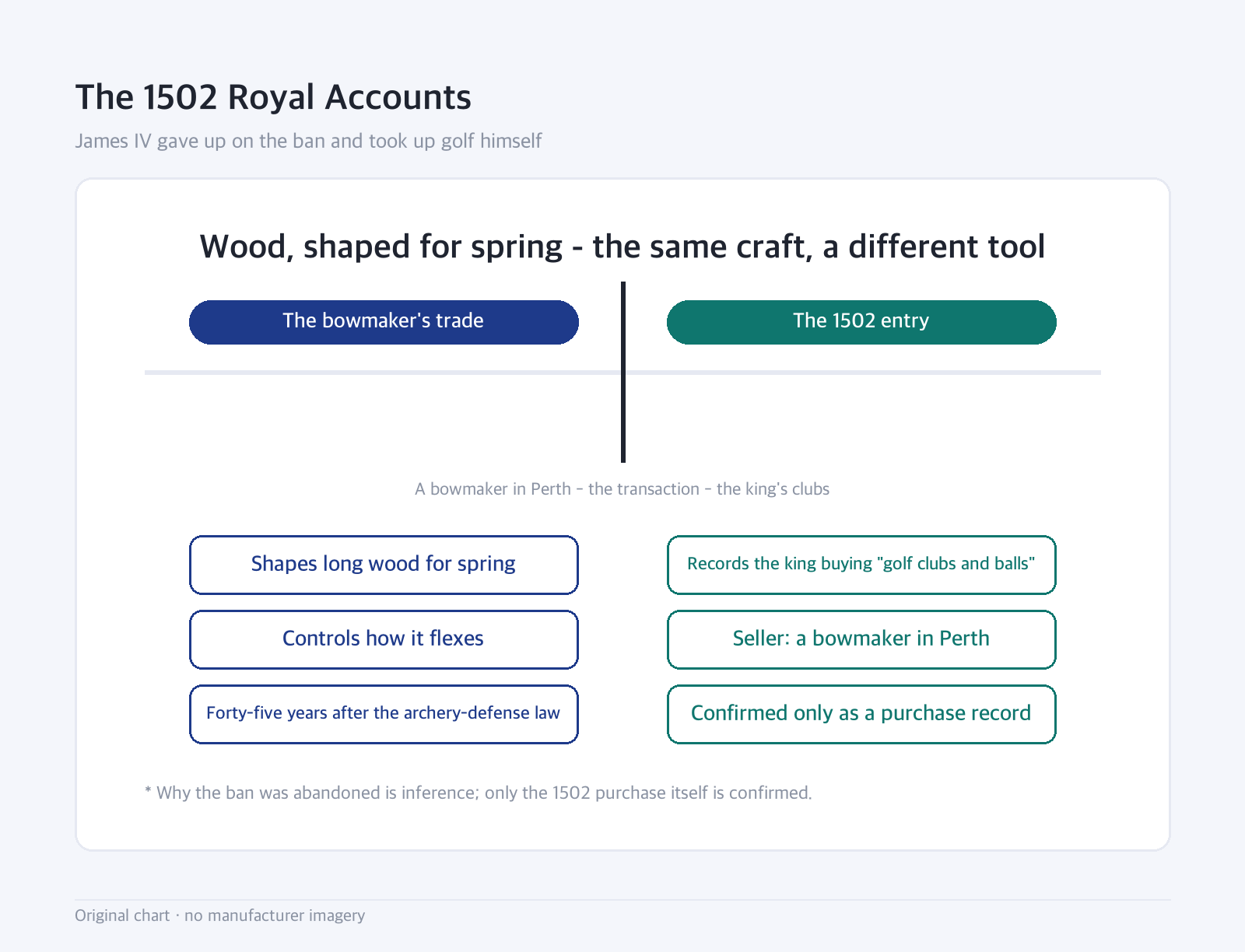
The evidence sits in the royal treasurer's accounts. A 1502 entry records the king purchasing "golf clubs and balls."
The seller is notable too — a bowmaker in Perth.
There's something fitting about a craftsman who made bows selling golf clubs. Forty-five years after a law said "golf must be banned because we need archery," here was a bow craftsman selling golf clubs to the king.
It's not technically strange, either. Bows and golf clubs are both made by shaping long pieces of wood to create spring. Choosing wood and controlling how it flexes are overlapping skills. A move from bowmaking into clubmaking would have been a natural transition.
3. Why the ban was abandoned
From here on, this is inference, and it's flagged as such.
Military technology was changing. Moving from the late fifteenth into the sixteenth century, gunpowder weapons were taking on a larger role on the battlefield. The urgency behind archery practice may not have been what it once was.
It was also a policy that had failed three times. If a law is passed three times over 34 years and still doesn't work, changing approach is the reasonable move.
The king may simply have discovered he enjoyed the game. This can't be confirmed from any record, but the purchase itself is documented.
This paragraph is not built on confirmed evidence. What is confirmed is the 1502 purchase record — nothing beyond that.
4. From ban to royal pastime
Once the king started playing golf, everything that followed moved quickly.
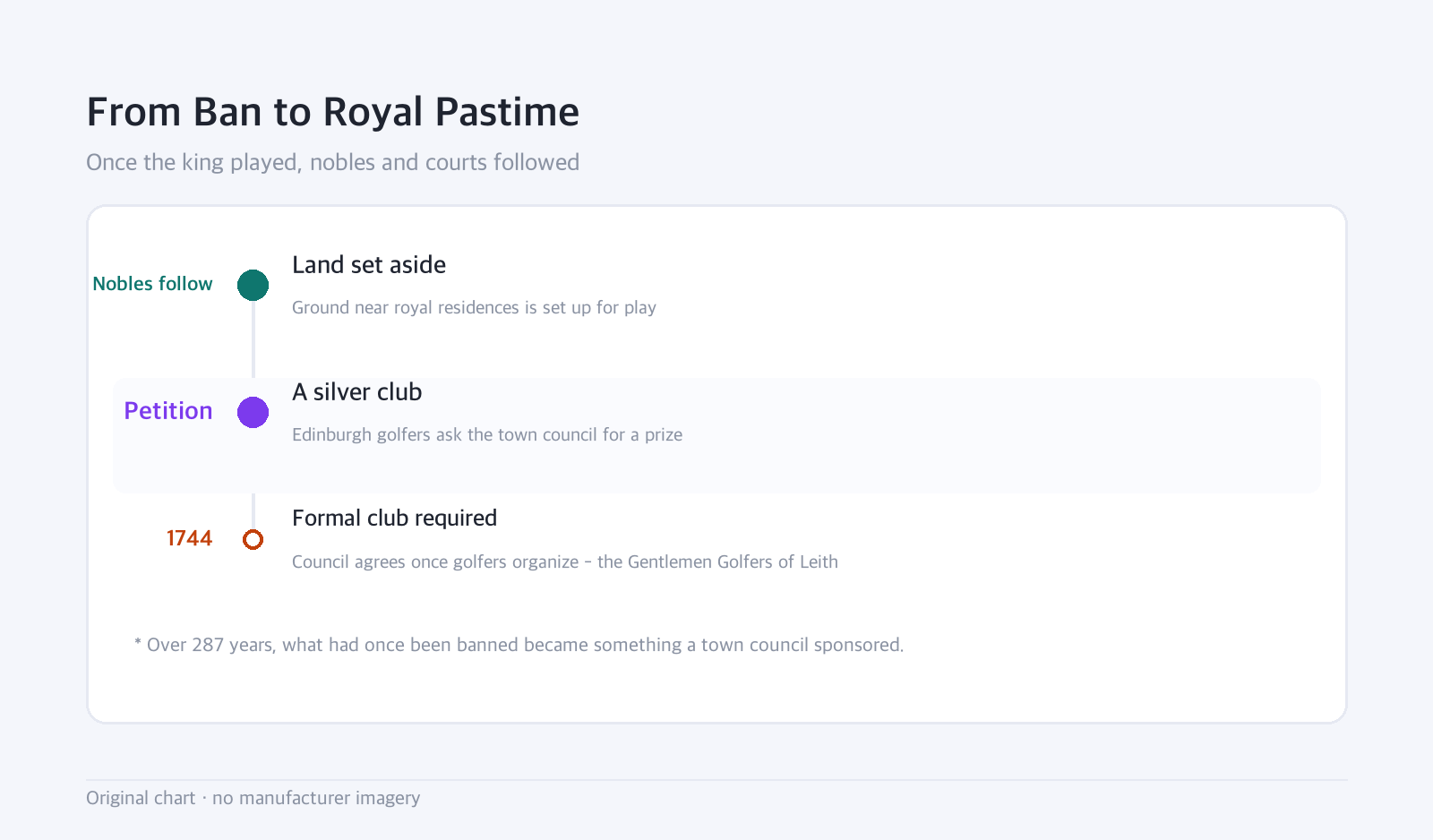
Nobles followed suit, land near royal residences was set up for play, and that eventually led to clubs and competitions.
The Gentlemen Golfers of Leith, who drew up the first written rules in 1744, sit on this same trajectory. They petitioned Edinburgh's town council for a silver club as a competition prize, and the council answered that it would sponsor them once the golfers organized themselves formally. That's how the world's first golf club came to exist.
Over 287 years, what had once been banned became something a town council sponsored.
And running that competition required rules. That's what produced the thirteen articles — covered in a separate piece.
5. The nature of the records shifts too
This shift also shows up in what kind of document survives.
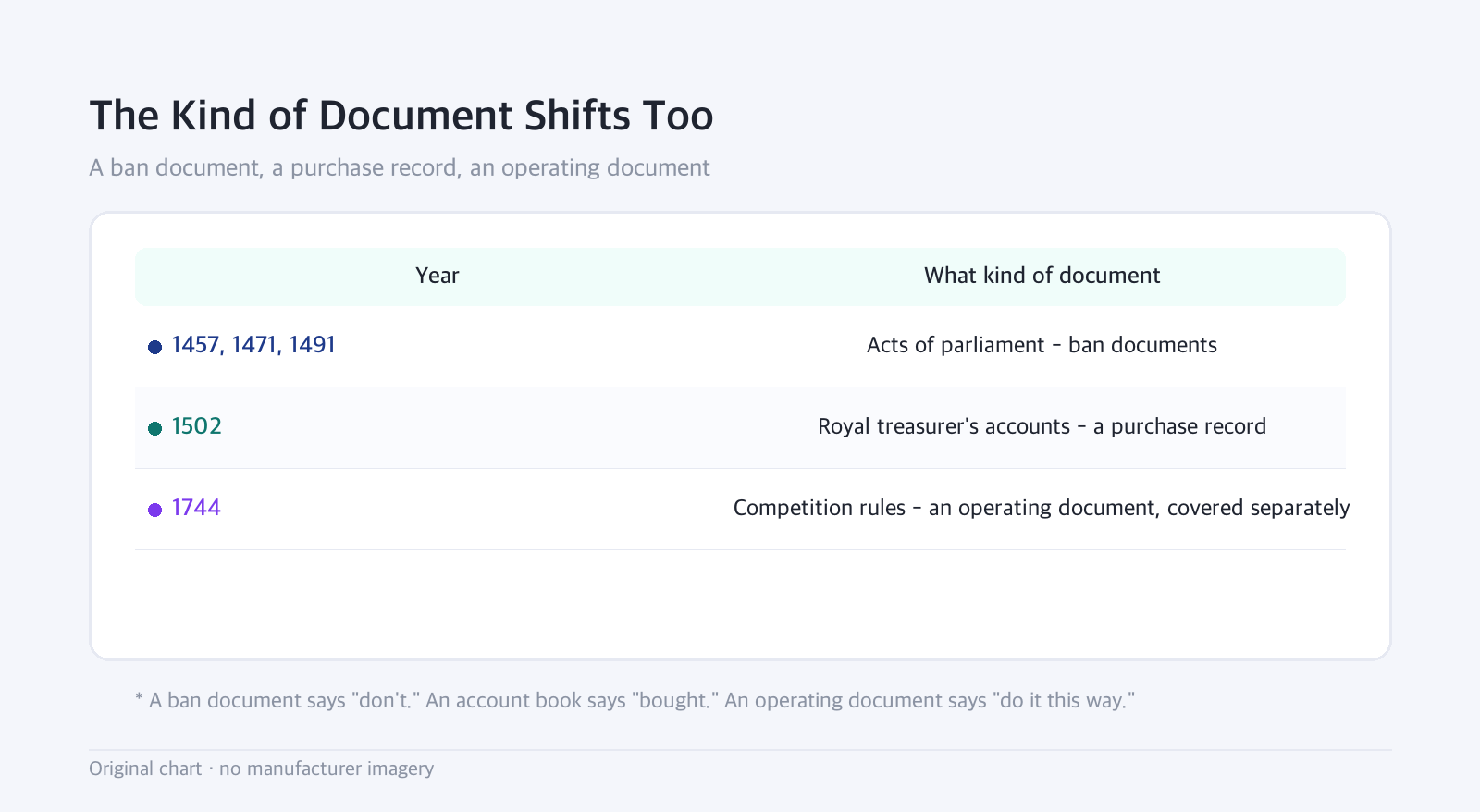
- 1457, 1471, 1491 — acts of parliament. Ban documents.
- 1502 — royal treasurer's accounts. A purchase record.
- 1744 — competition rules. An operating document.
Golf moved from being a problem, to a daily habit, to an institution — and that arc shows up in the type of document that recorded it.
A ban document says "don't." An account book says "bought." An operating document says "do it this way." Same subject, entirely different kind of sentence.
Reading history, what matters isn't only what got recorded, but what kind of document it was recorded in.
6. Who this is useful for
Based on what could be confirmed:
- Golfers curious about the origins of the game — the shift from a banned activity to a royal pastime is preserved on paper.
- Anyone planning a golf trip to Scotland — the tie between links land and the crown begins here.
- Readers of historical sources generally — the type of document itself reflects the attitude of its era.
- Golfers curious about the history of the rules — this is the background leading up to the first written rules of 1744.
This is less useful for:
- Golfers who only need the current rules — this piece is about origins.
- Anyone wanting a firm causal account — why the crown gave up is inference; what's confirmed stops at the purchase record.
7. What we could not confirm
- The formal end of the ban — whether the law was repealed or simply fell out of use, we could not confirm.
- The amount and quantity in the 1502 purchase record.
- How James IV came to take up golf.
- The original text of the 1471 and 1491 acts — we could confirm only that the ban was repeated.
- The relationship to changing military technology — the passage above is inference.
- How golf spread beyond the royal court.
In one line
The Scottish Parliament banned golf three times — in 1457, 1471, and 1491. All three times, it went unfollowed.
Then, in 1502, James IV bought golf clubs and balls from a bowmaker in Perth, according to the royal treasurer's accounts.
Forty-five years after the law said "golf must be banned because we need archery," a bow craftsman sold the king a set of golf clubs.
The dates and records here come from confirmed sources; anything inferred is marked as such.
This piece summarizes general instruction concepts and is not personalized coaching advice. Ball flight fixes depend on individual swing mechanics — a launch monitor session or certified instructor can confirm what applies to you.