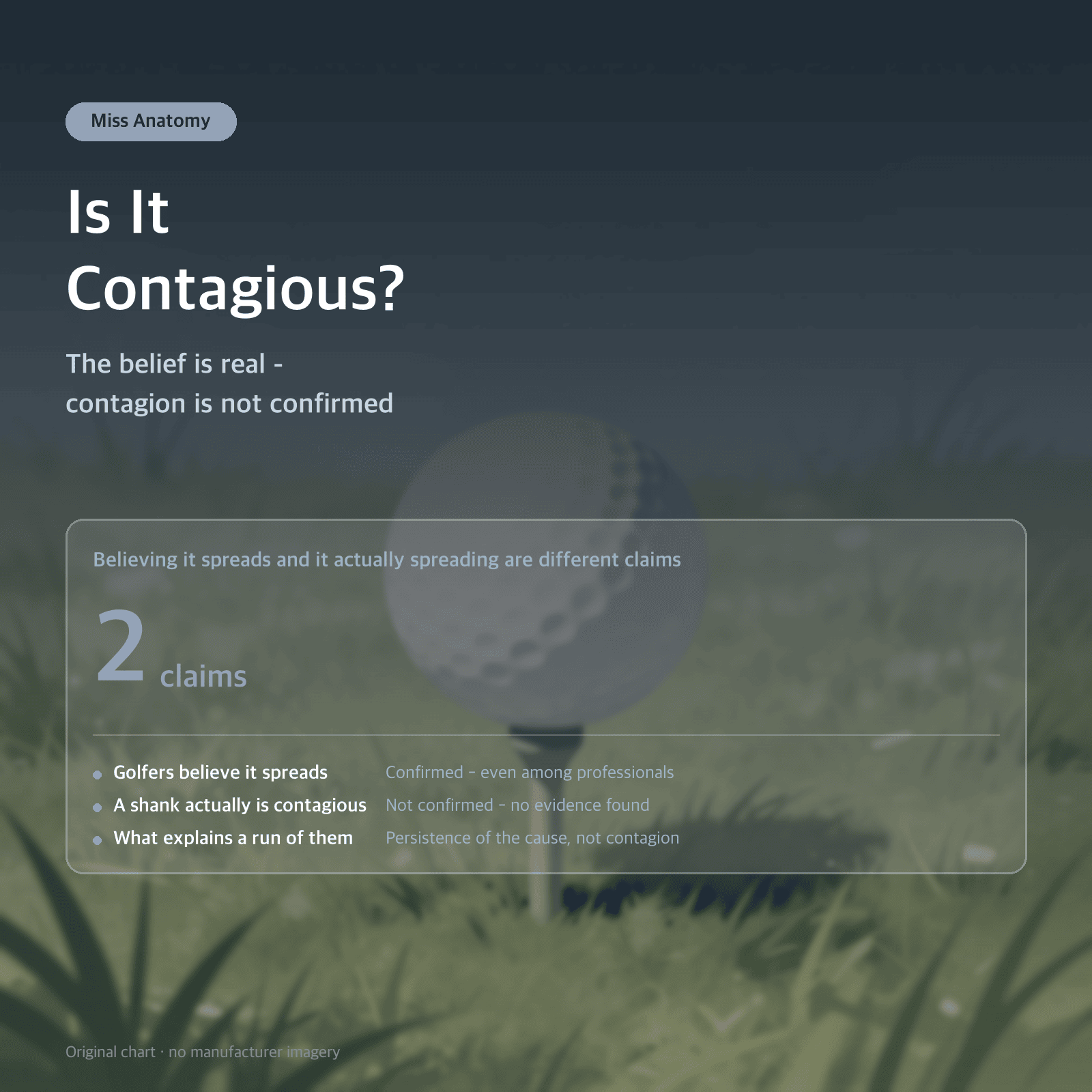
This is the point set aside in the first piece of this material.
A shank is close to the only miss in golf whose name people avoid saying. Many golfers won't say the word on the course.
The reason given is that it spreads — say it, or even watch it happen, and it's supposed to catch on.
This piece checks that claim.
1. The belief itself is real
Starting with what's confirmed.
The existence of this belief is a fact. Even among professionals, there's a documented reluctance to talk about or witness a shank, on the idea that if one player in a group hits one, others in the same group tend to follow.
The phrase "spreads like a virus" is actually used.
The same belief attaches to the yips — the idea that saying the word alone can infect the round.
This much is confirmed: golfers believe this, and act on it.
2. But contagion itself is a separate claim
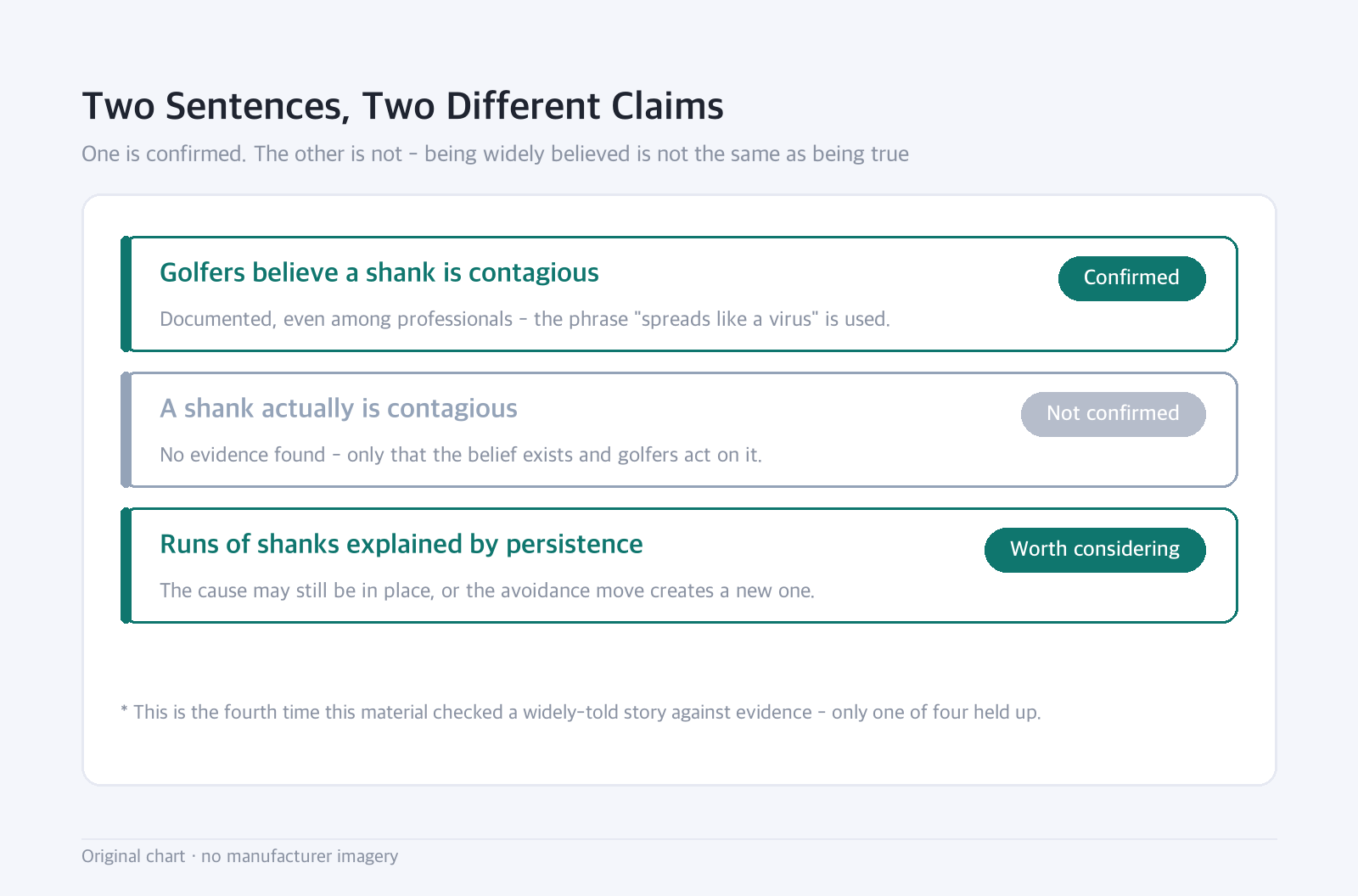
Two sentences need to be split apart here.
"Golfers believe a shank is contagious" — confirmed.
"A shank actually is contagious" — not confirmed.
These are different claims. And this is exactly the distinction this material has repeated throughout.
The same pattern showed up with the story that the Schenectady putter's ban stemmed from personal spite. The story being widely told is a fact. Whether it actually happened is a separate, unconfirmed claim.
Being widely believed doesn't make something true.
3. So why does it look like they cluster together
In practice, a shank does sometimes come in a run, one after another. This experience itself is common among golfers.
From here, this is inference. We separate it clearly from what's confirmed.
Explanations worth considering:
One — the cause is still there. As shown in the earlier pieces, a shank has an underlying cause: swing path or setup. If the same condition is still in place, it's unsurprising that it happens again. That's persistence, not contagion.
Two — the avoidance move creates a new cause. Pull the hands in to avoid the hosel, and now contact shifts toward the toe, or another miss shows up. Revert back to normal, and the shank returns.
Three — tension changes the motion. The lunge covered elsewhere shows up more under strong intent, and "not again" is exactly that — strong intent.
These three explain the pattern without invoking contagion.
4. The psychological angle is genuinely studied
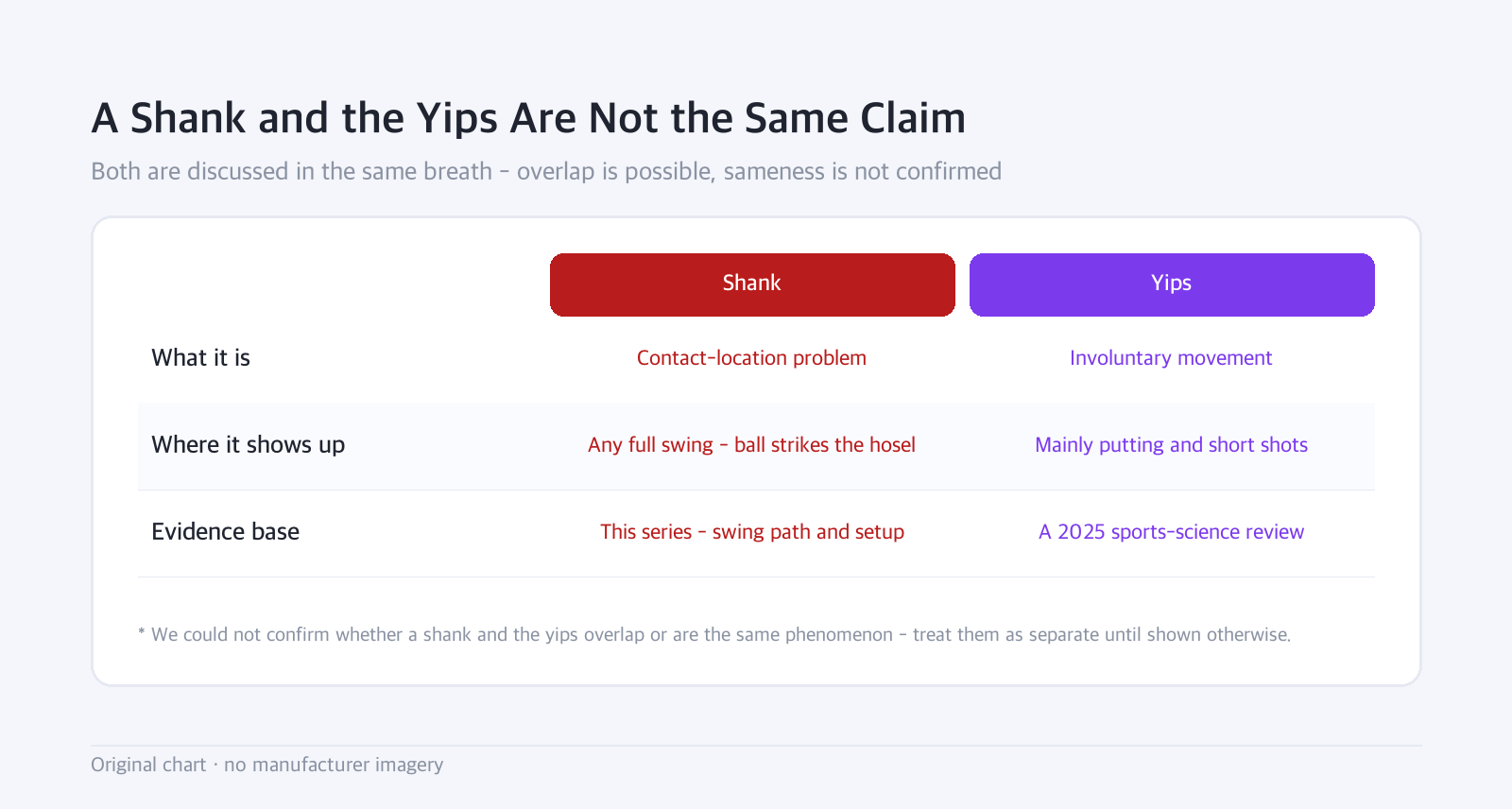
None of this is to dismiss the psychological side.
The yips is a genuine subject of research. A 2025 sports-science journal published a review covering its causes and treatment. It's not purely a folk topic.
That review discusses factors including performance anxiety, fear of a specific task, and choking. These are described as factors that can worsen symptoms.
One caution, though.
We won't group a shank and the yips together as the same thing. The yips mainly refers to involuntary movement in putting and short shots, while a shank is a matter of contact location. There may be overlap, but we could not confirm that they're the same phenomenon.
5. What to actually do about it
Psychological advice tends to collapse into "just relax." That's not a usable standard. Here's something you can actually use.
One — identify the cause. This is the most practical psychological countermeasure available. Not knowing why it happens keeps every shot uncertain; knowing the branch gives you something to check. Uncertainty grows in the absence of knowledge.
Two — switch clubs mid-round. If it's coming from the wedge, there's the option of running an 8 or 9 iron for the day instead. As covered elsewhere, conditions differ club by club.
Three — back off the intensity. If a lunge is the cause, this genuinely reduces it.
Four — don't try to fix it on the course that day. This is a miss where guessing the wrong branch makes things worse, and it's hard to sort out mid-round.
Separating first aid from an actual correction — the same theme running through this material.
6. Who this is useful for
- Golfers who've had shanks come in a run — it may be persistence, not contagion.
- Golfers who've avoided saying the word — the belief existing and contagion being real are different claims.
- Golfers anxious enough to avoid the wedge — knowing the cause is the most practical countermeasure.
- Golfers who've heard of the yips — it's a studied topic, and not the same thing as a shank.
This is less useful for:
- Golfers looking for a psychological prescription — this piece doesn't go there.
- Golfers still working through the cause — the earlier three pieces are the main content.
7. What we could not confirm
- Whether a shank actually is contagious — we found no confirmed evidence, only confirmation that the belief exists.
- The actual cause behind runs of shanks — the three explanations above are worth considering, not verified.
- The relationship between a shank and the yips — we could not confirm whether they overlap or are distinct.
- How long this superstition has existed
In one line
It's a fact that golfers believe a shank is contagious. It is not confirmed that a shank actually is contagious.
The two sentences are different. This is the distinction this material has kept making throughout.
Runs of shanks are explained by persistence of conditions, not contagion: the cause is still there, the avoidance move creates a new problem, and tension changes the motion.
So the most practical psychological countermeasure is identifying the cause. Uncertainty grows in the absence of knowledge.
This piece summarizes general instruction concepts and is not personalized coaching advice. Ball flight fixes depend on individual swing mechanics — a launch monitor session or certified instructor can confirm what applies to you.