Golf balls went through two earlier changeovers: the featherie, hand-packed with feathers, gave way to gutta-percha, pressed from tree sap, which dropped the price to a quarter and helped turn golf into a popular sport.
Fifty years later, it changed again.
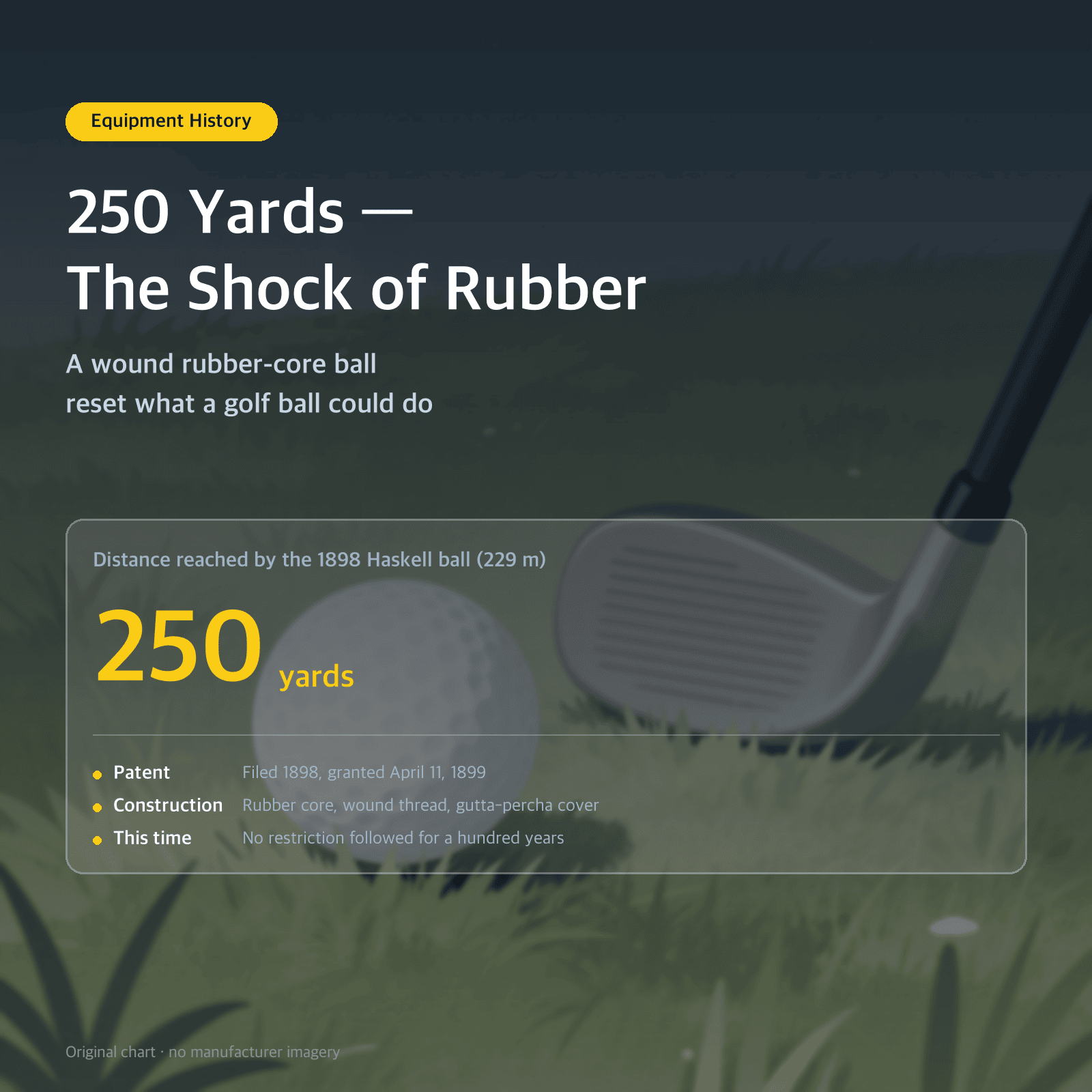
This time the shift wasn't about price — it was about distance. The new ball flew 250 yards (229 m).
1. A ball wound with rubber thread
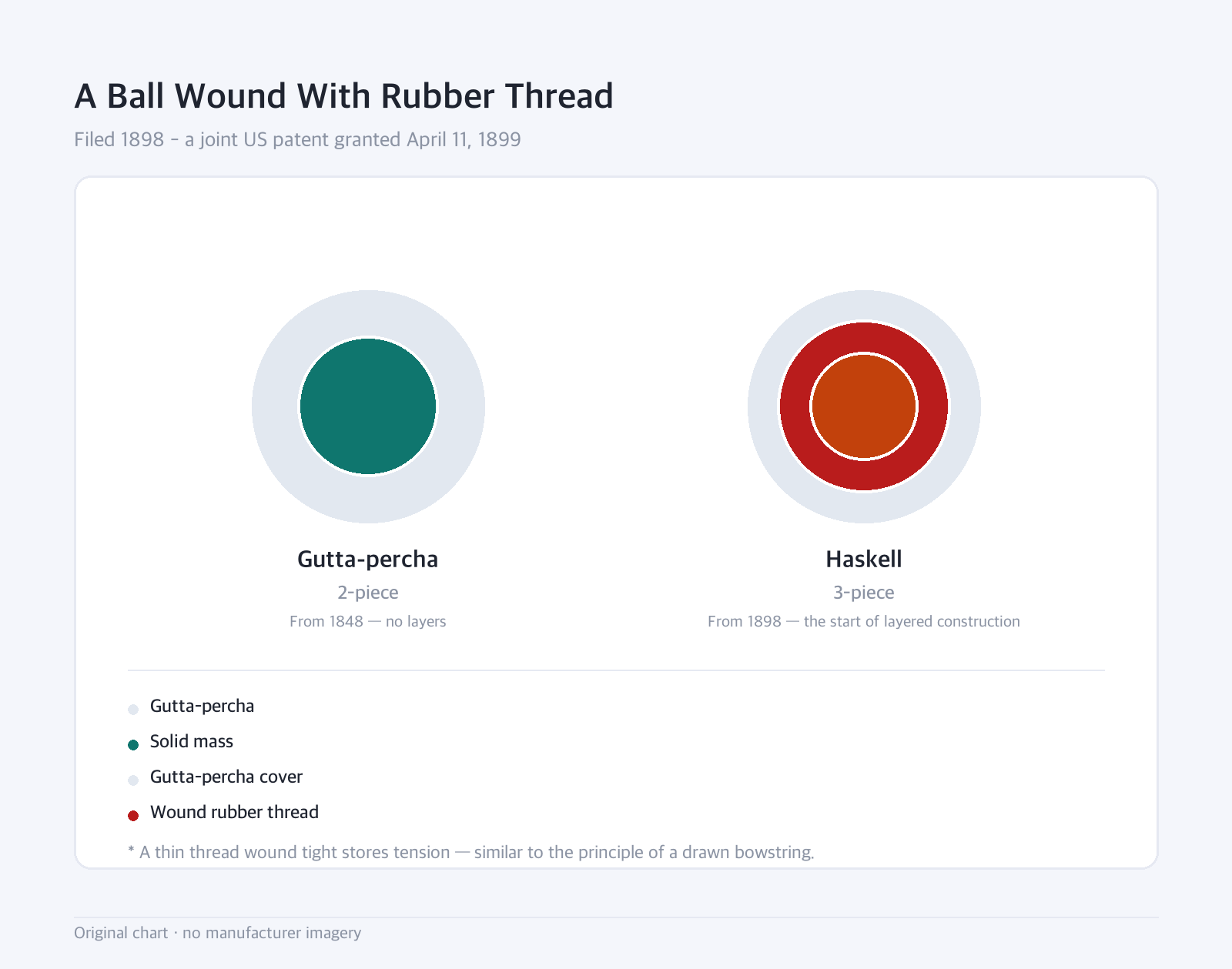
In 1898, Coburn Haskell and Bertram Work filed a patent for a new ball. The following year, on April 11, 1899, they were granted a joint patent by the US Patent Office.
The construction was completely different from what came before:
- a rubber core at the center
- rubber thread wound tightly around it
- a gutta-percha cover on the outside
Gutta-percha balls had been a solid mass. This new ball stored energy in the wound thread. The force of the rebound on impact was correspondingly greater.
This is where the modern idea of ball "layers" starts — a separate core and cover, with something else wound in between.
The idea of winding thread is itself worth noting. Instead of using a larger mass of rubber, the design wound a thin thread tightly to store tension — similar to the principle of a drawn bowstring.
2. Distance jumped
The result was clear. It flew up to 250 yards (229 m).
Spin control also improved. Adjusting the tension of the wound thread let makers change the ball's characteristics.
After 1902, this ball became established. Dimple patterns were optimized on the surface, and the cover material shifted from gutta-percha to balata, pushing gutta-percha balls out entirely.
Fifty years, and the generation had turned over again.
3. But this time, there was no restriction
This is the part worth pausing on.
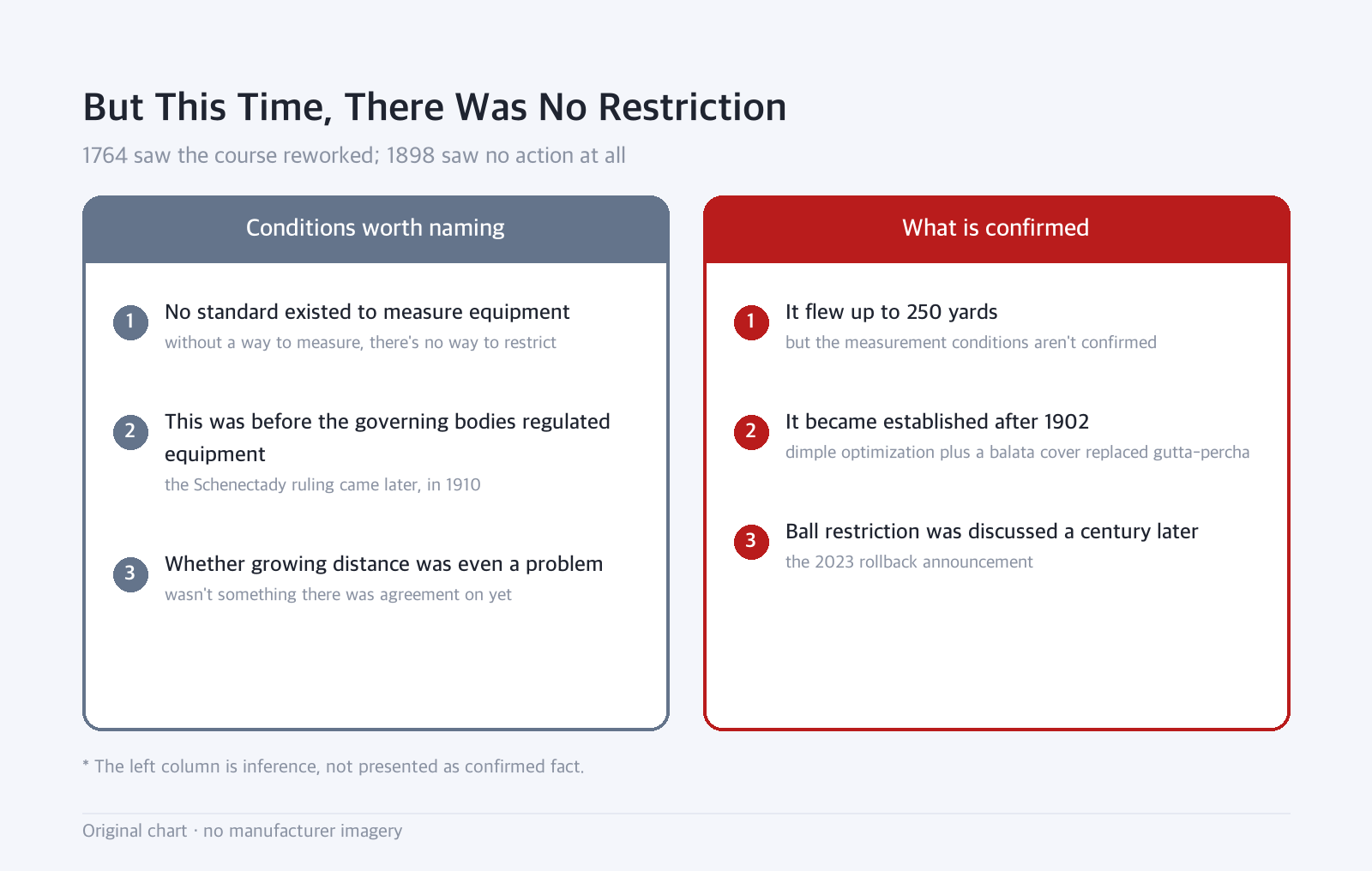
In 1764, when the ball started flying farther, the course itself was changed — St Andrews reducing twenty-two holes to eighteen is that story.
In 1898, distance jumped noticeably again, but no restriction on the ball itself followed.
This piece can't settle why. A few plausible conditions are worth naming:
- At the time, no standard existed for measuring equipment specifications. Without a way to measure something, there's no way to restrict it.
- The two governing bodies had not yet begun regulating equipment in earnest — the Schenectady putter ruling came in 1910, later than this.
- Whether growing distance was even a problem wasn't something there was agreement on yet.
This is inference, not something presented as confirmed.
4. Restriction came much later
Measures drawing a line on balls and clubs began in earnest in the late 20th century.
- 1998 — driver face coefficient of restitution capped at 0.830
- 2010 — wedge groove specifications changed to reduce spin from the rough
- 2023 — a reset of ball distance standards announced
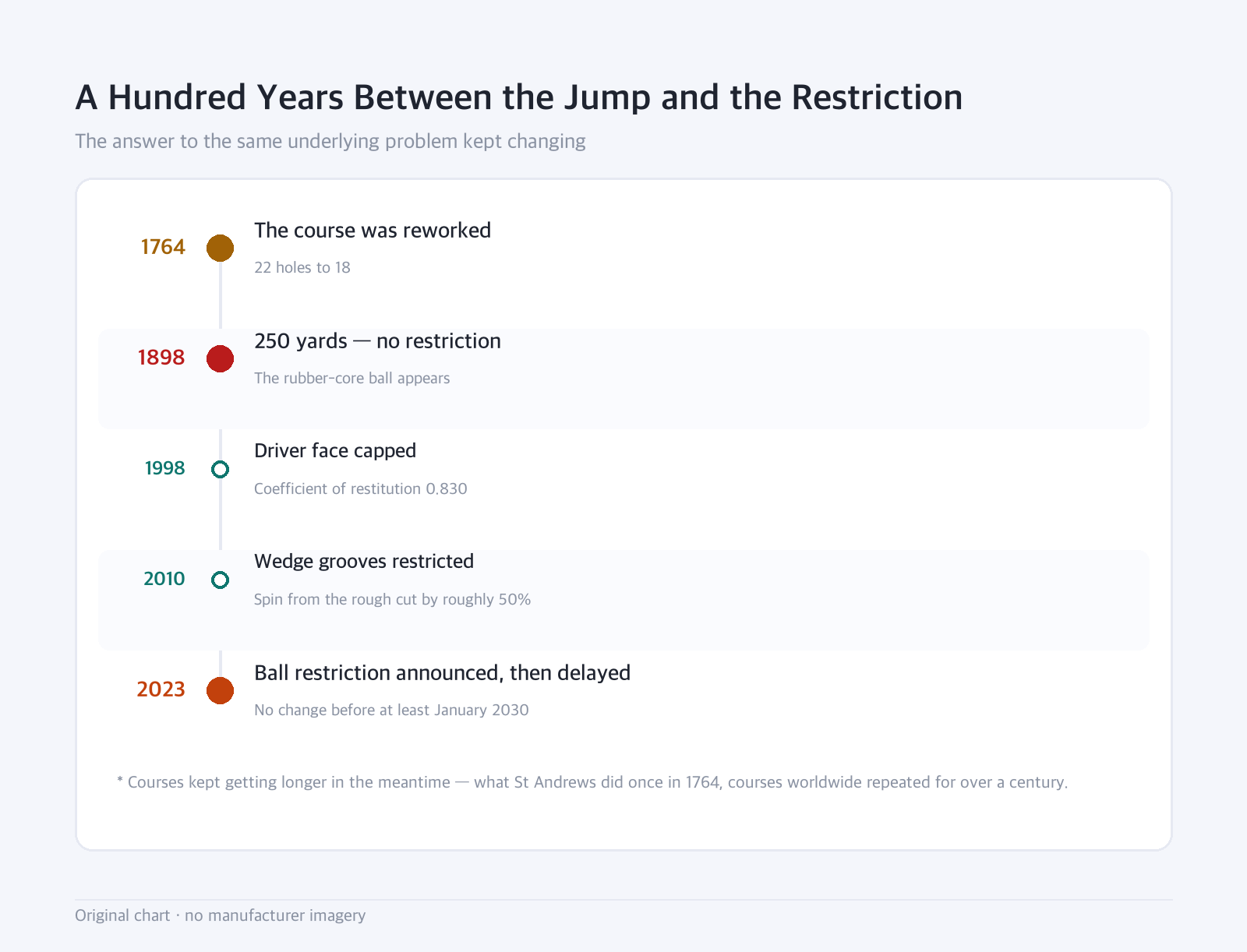
It took roughly a hundred years after the Haskell ball appeared before anyone proposed touching the ball itself.
Distance kept climbing in the meantime, and courses kept getting longer. What St Andrews did once in 1764, courses worldwide repeated for over a century.
5. What this changeover left behind
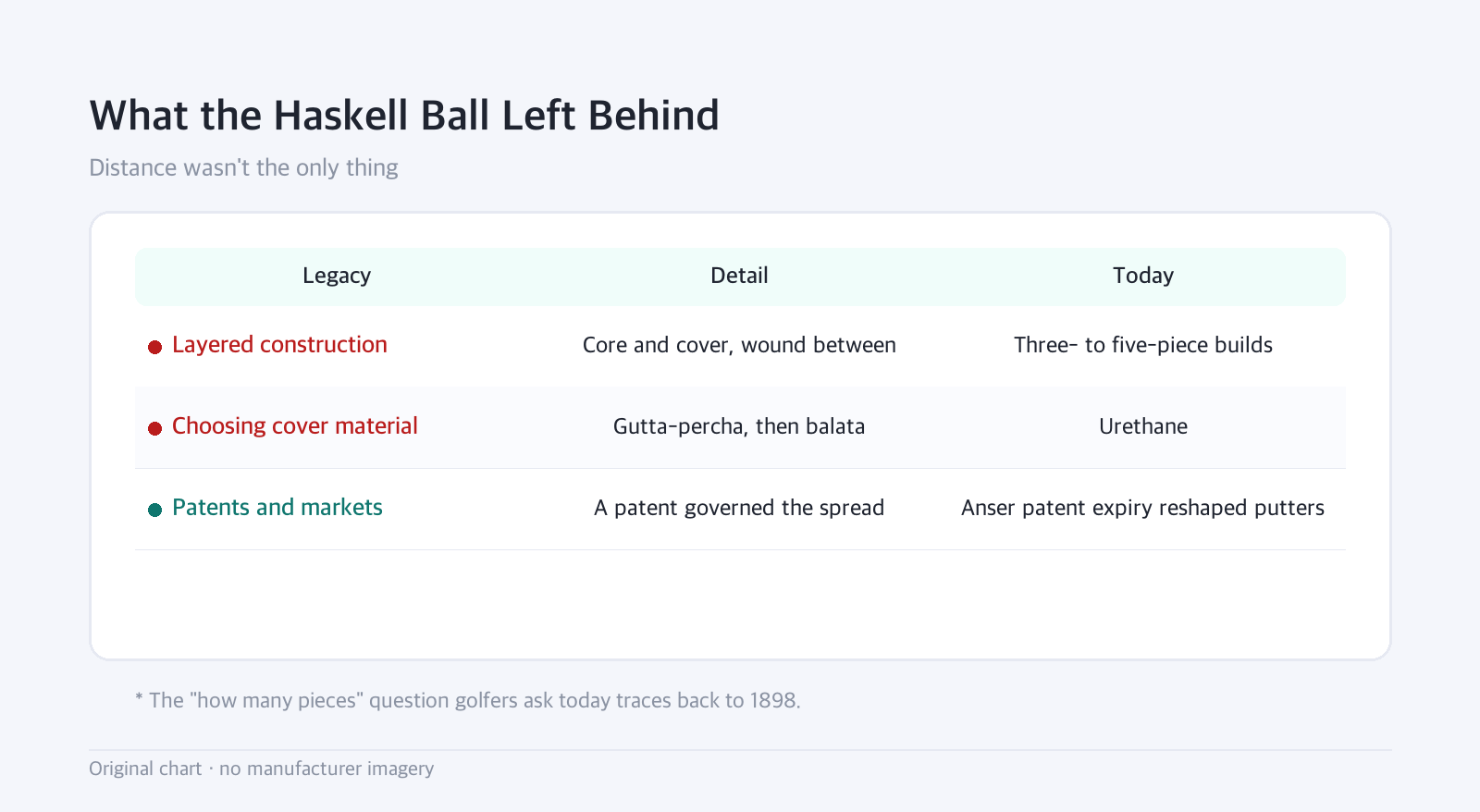
The Haskell ball's legacy isn't just distance.
Layered construction became the standard — a core and cover with material wound in between, a design that persists to this day. The 2026 balls covered elsewhere still split into three-piece through five-piece constructions on this same principle.
Choosing the cover material separately also starts here — from gutta-percha to balata, and later to today's urethane.
It also confirms that a patent can shape a market. Haskell held a patent, and it governed how the ball spread. The same structure recurs later, when the Ping Anser putter's patent and its eventual expiration reshape the putter market.
6. Who this is useful for
Based on what could be confirmed:
- Golfers curious about ball layer construction — the three-piece, four-piece, five-piece distinction traces back to 1898.
- Golfers following the distance debate — a hundred years separate when distance jumped and when regulation followed.
- Golfers interested in equipment history — centuries from featherie to gutta-percha, then fifty years to rubber core. The cycle keeps shortening.
- Golfers curious about the relationship between patents and markets — the Haskell patent is a case study.
This is less useful for:
- Golfers shopping for a modern ball — this is history, not a product comparison.
- Anyone needing precise distance data — 250 yards (229 m) is a period description, and the measurement conditions aren't documented.
7. What we could not confirm
- The measurement conditions behind the 250-yard (229 m) figure — who hit it, and under what conditions, isn't confirmed.
- Why no restriction followed — what's written above is inference, not confirmed fact.
- The original patent text and claims.
- The actual pace of the shift from gutta-percha to the Haskell ball — only "established after 1902" was confirmed.
- The exact date balata covers were introduced.
- How the patent affected other manufacturers.
In one line
In 1898, a rubber-core ball wound with thread flew 250 yards (229 m). This is where the idea of layered construction begins, and it still holds today.
But this time, no restriction followed. It took a hundred years before anyone proposed drawing a line on the ball.
In 1764, the course was reworked. In 1898, nothing was done. From 1998, equipment restriction began. The answer to the same underlying problem has kept changing.
The dates and figures here come only from confirmed sources, and inference is labeled as inference.
This piece summarizes general instruction concepts and is not personalized coaching advice. Ball flight fixes depend on individual swing mechanics — a launch monitor session or certified instructor can confirm what applies to you.