
The featherie was a golf ball made by hand-packing boiled feathers into a stitched cowhide pouch — roughly enough feathers to fill a top hat per ball. A skilled maker produced only three or four a day, and the finest examples cost more than a club.
That whole structure collapsed in 1848.
The new ball sold for one shilling — about a quarter of the featherie's price.
1. Made from the sap of a Malaysian tree
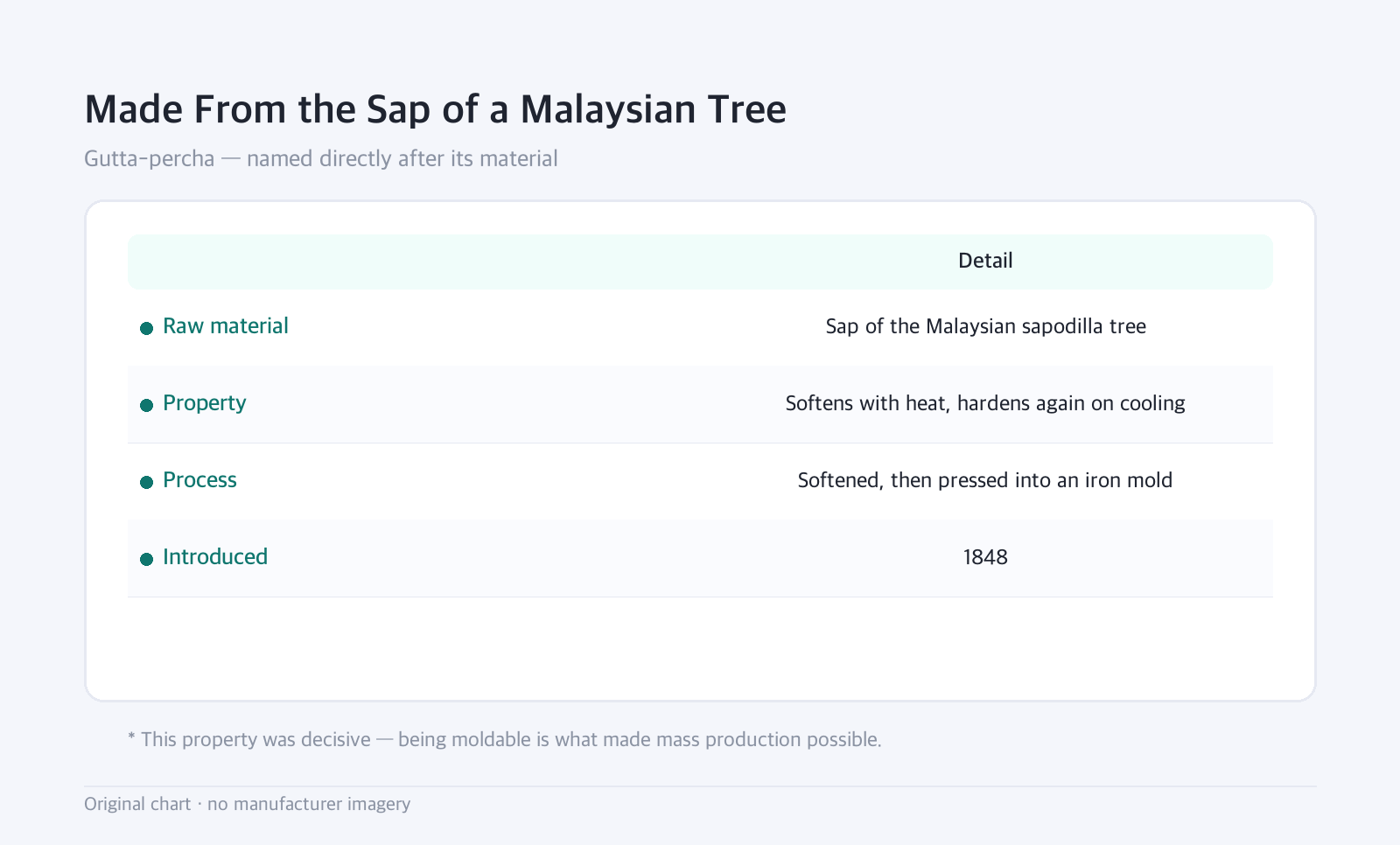
The new ball's name was gutta-percha — named directly after its material.
It's a substance made by hardening sap from the sapodilla tree, native to Malaysia, with rubber-like properties. Heat softens it; cooling hardens it again.
That property was decisive: soften it, press it into a mold, and you have a ball.
2. The manufacturing process changed completely
Compared with the featherie, the difference is stark.
- Featherie — stitch leather, boil feathers, force them in with an awl. Three or four a day.
- Gutta-percha — heat the material and press it in an iron mold.
Mass production became possible.
And that changed the price. The finest featherie sold for five shillings; gutta-percha sold for one shilling. Moving from handcraft to molding made the outcome predictable.
3. It was durable too
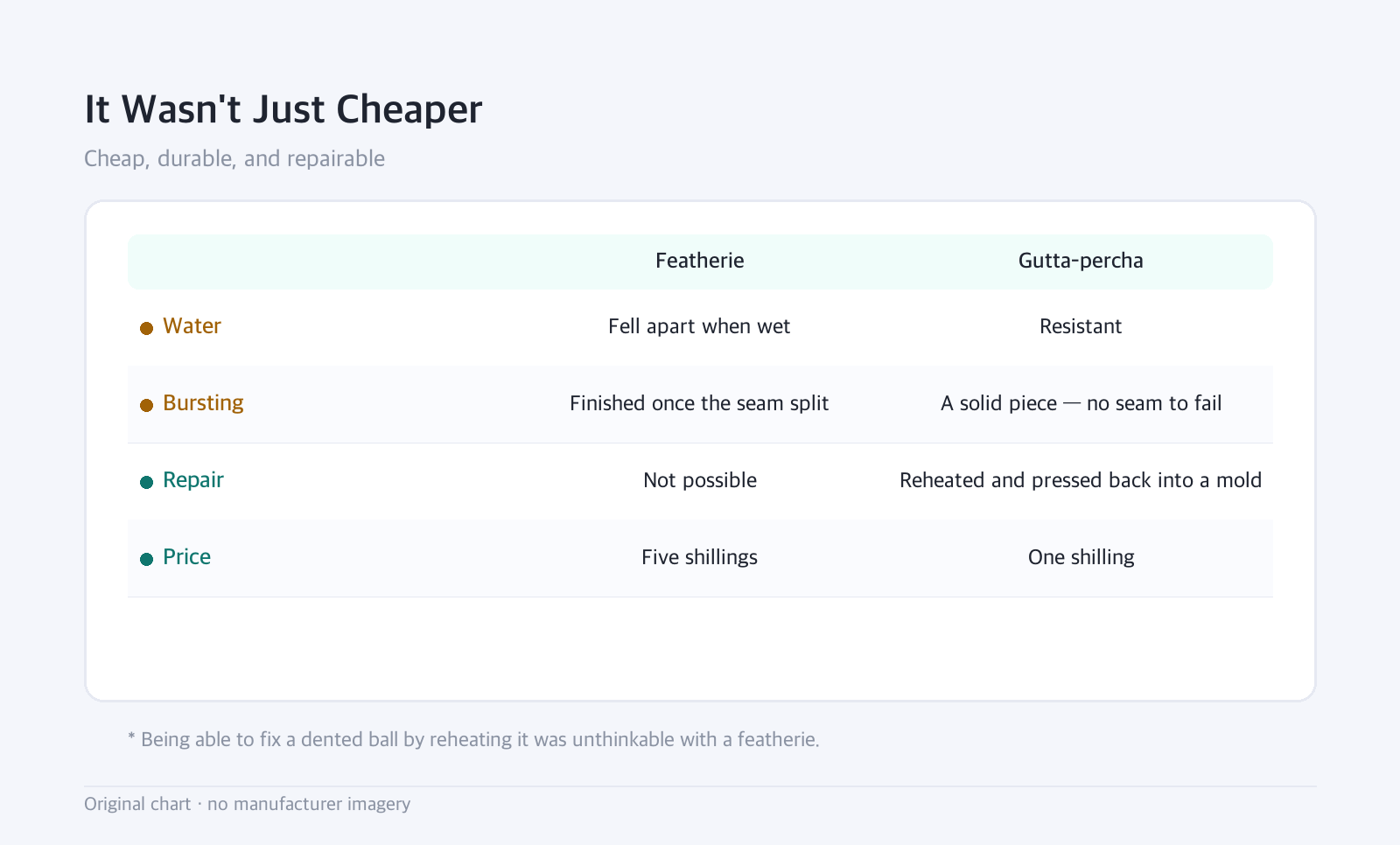
It wasn't just cheaper.
A featherie fell apart when wet and was finished once a seam split. Gutta-percha had no such weakness — a solid material with no seam to fail, and more resistant to water.
It could even be reheated and reshaped if it got dented. Soften a damaged ball with heat, press it back into a mold, and it's usable again — something unthinkable with a featherie.
Cheap, durable, and repairable.
4. But at first, it flew worse
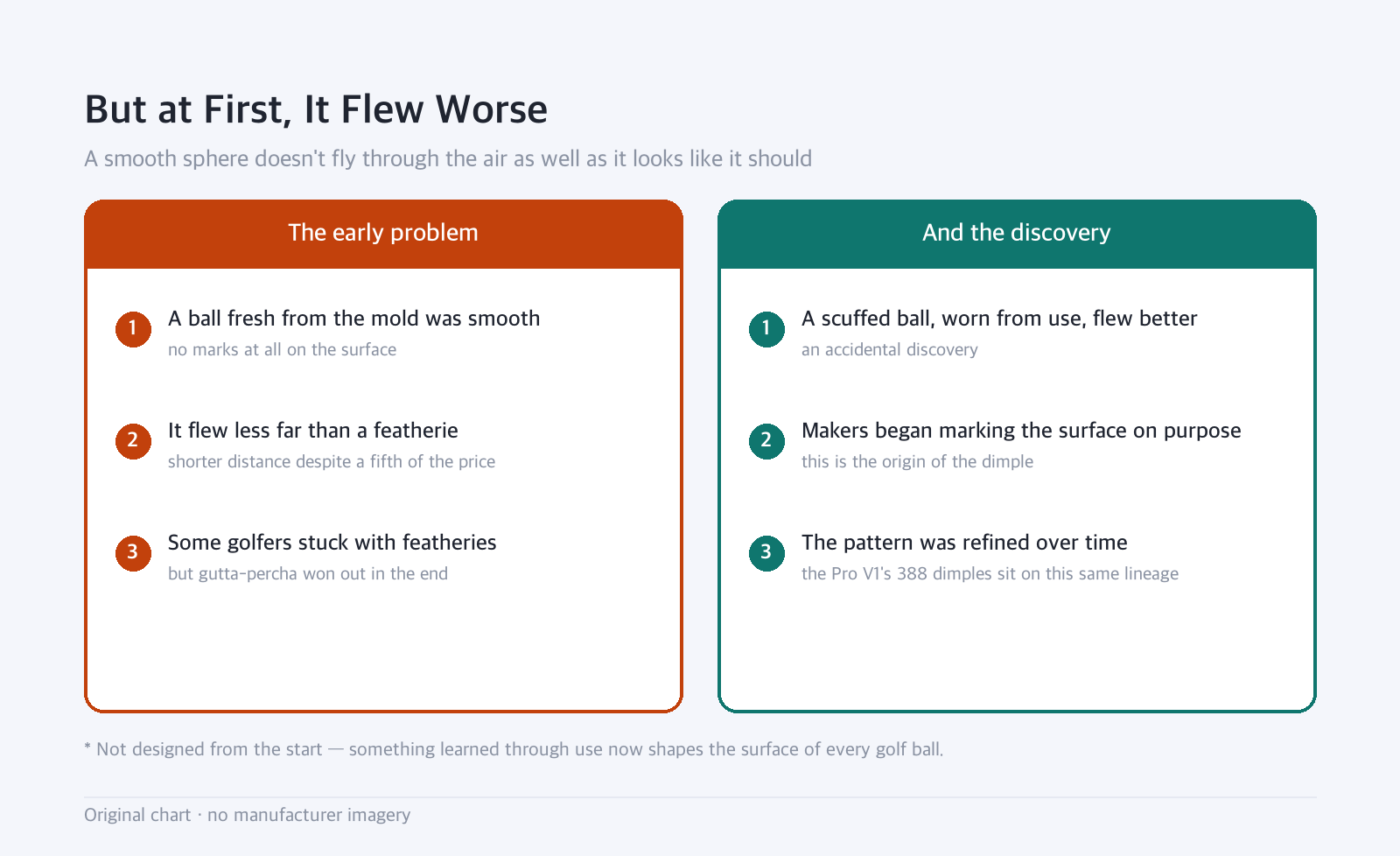
Here's an unexpected part of the story: early gutta-percha balls flew less far than featheries.
The reason was the surface. A ball fresh out of the mold was smooth, and a smooth sphere doesn't fly as well as it might seem through the air.
So some golfers kept using featheries in the early years — five times the price, but a longer ball.
Then a discovery changed things: a scuffed ball, worn from play, flew better than a new one.
This is the origin of the dimple. Manufacturers began deliberately marking the surface, and as the pattern was refined it became today's dimple. The 388 dimples on a modern Titleist Pro V1, covered elsewhere, sit on this same lineage.
It's a case of an accidental discovery becoming a standard — not a designed feature, but something learned through use that now shapes the surface of every golf ball made.
5. Golf became a mass sport
The consequence of the price dropping to a quarter was clear.
From the 1850s, as gutta-percha replaced the featherie, golf became a popular sport.
When a single ball could cost more than a club, only certain people could play. Once that barrier dropped, more people took up the game, more courses were built, and clubs and competitions followed.
The first Open Championship was played in 1860 — shortly after gutta-percha had taken hold. This piece can't confirm a causal link between the two, but the timing overlaps.
6. And fifty years later, it changed again
Gutta-percha's era wasn't permanent either.
In 1898, a wound rubber-core ball appeared, flying 250 yards (229 m). Gutta-percha was displaced in turn.
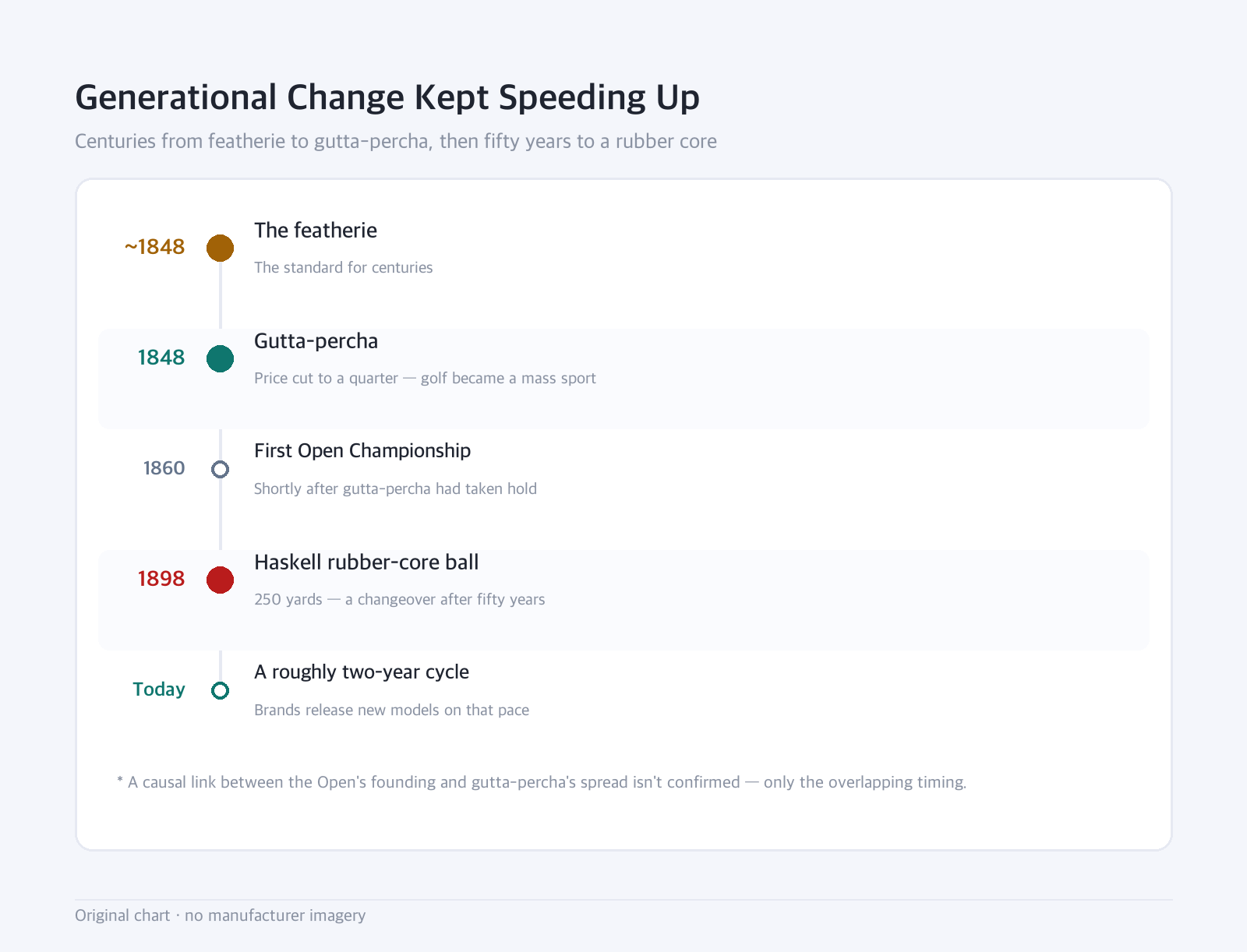
Two changeovers in fifty years. The move from featherie to gutta-percha took centuries; the move from gutta-percha to a rubber core took fifty. And the pace kept accelerating after that.
Today, brands release new models roughly every two years. Most of the 2026 balls covered elsewhere sit on that same cycle.
That story is covered separately.
7. Who this is useful for
Based on what could be confirmed:
- Golfers curious how golf became a mass sport — the drop in price was decisive; performance wasn't what lowered the barrier, cost was.
- Golfers curious why dimples exist — the discovery that a smooth ball flies worse is the starting point.
- Golfers interested in the arc of equipment technology — a new technology doesn't win on every front from the start. Gutta-percha won on price and durability, not performance.
- Golfers curious about manufacturing methods — moving from handcraft to molding is what changed the price.
This is less useful for:
- Golfers shopping for a modern ball — this is history; layer count and compression comparisons are covered separately.
- Anyone needing precise year-by-year pricing — this piece confirms only two data points, five shillings and one shilling.
8. What we could not confirm
- Who first made a gutta-percha ball, and the exact circumstances — only the 1848 date was confirmed.
- The actual flight distance of early gutta-percha balls — only the description "flew less far than a featherie" was confirmed.
- The timing and circumstances of the discovery that scuffing helps flight.
- Whether the one-shilling and five-shilling figures are directly comparable in time — we did not confirm whether they're from the same period.
- A causal link between the founding of the Open Championship and gutta-percha's spread — only the overlapping timing was confirmed.
- Regional differences in how quickly it spread.
In one line
Gutta-percha was a ball made by pressing sap from a Malaysian tree into a mold. It sold for one shilling, a quarter of the featherie's price, was durable, and could be reheated and reshaped if dented.
At first, it actually flew less far. It won anyway — price and durability outweighed performance.
And the discovery that a scuffed ball flies better than a smooth one is what led to the dimples on golf balls today.
The figures and dates here come only from confirmed sources, and anything unconfirmed is marked as such.
This piece summarizes general instruction concepts and is not personalized coaching advice. Ball flight fixes depend on individual swing mechanics — a launch monitor session or certified instructor can confirm what applies to you.