
Driving irons, hybrids (utility irons), and fairway woods are all designed to fill the long-game distance gap (roughly 185–240+ yards / 170–220+ m), but their head structure, center of gravity, shaft length, and resulting launch behavior differ completely.
Based on professional fitting data (TrackMan and similar launch monitors) and the underlying design differences, here's a breakdown of how each club works, its tradeoffs, and how to choose between them.
1. Launch data by club type
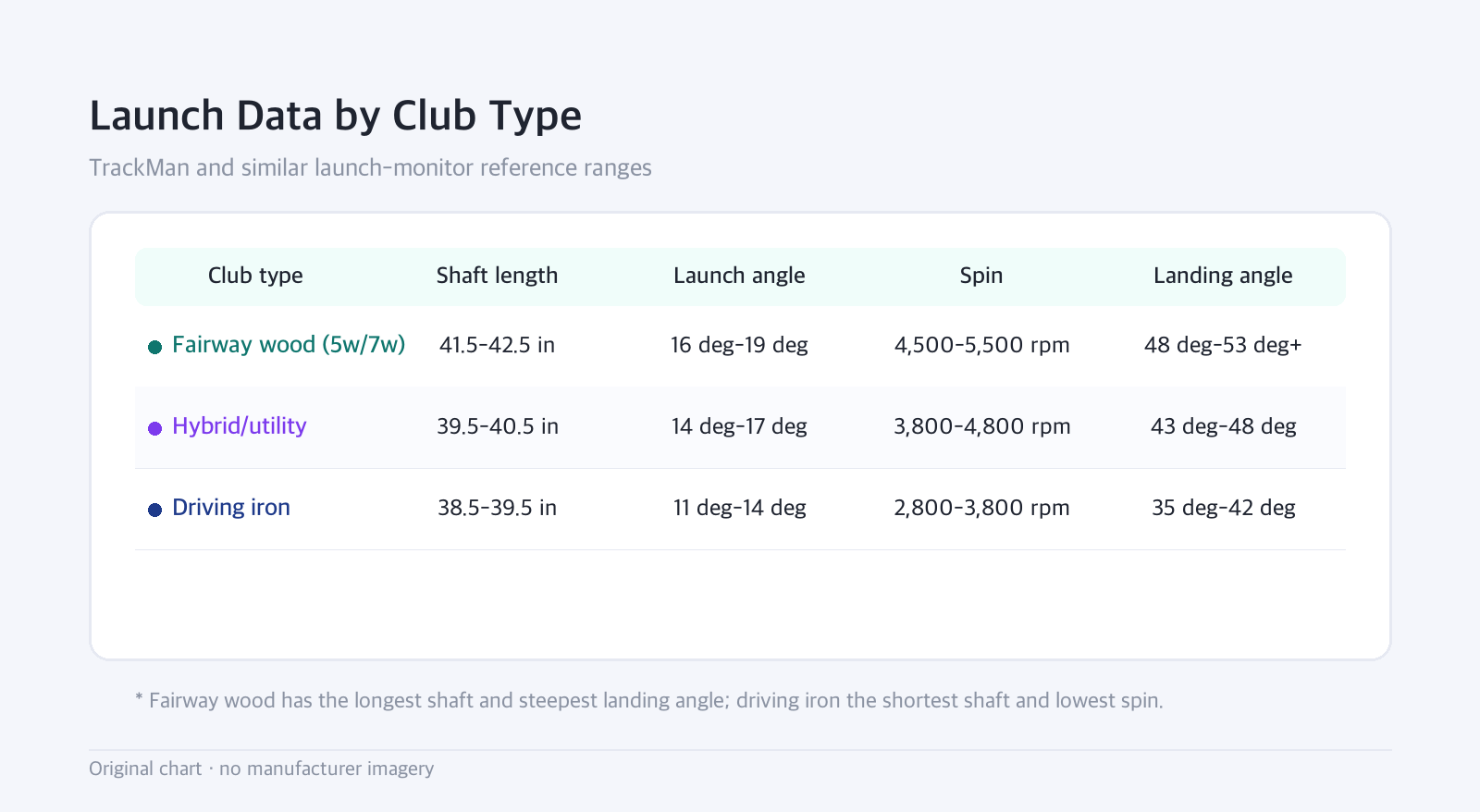
Fairway wood (5-wood/7-wood)
- Shaft length: 41.5–42.5 in (longest of the three)
- Launch angle: high (16°–19°)
- Spin: high (4,500–5,500 rpm)
- Landing angle: steep (48°–53°+) — best greenside stopping power
- Distance profile: carry-dominant, minimal roll
Hybrid/utility
- Shaft length: 39.5–40.5 in (middle)
- Launch angle: mid-high (14°–17°)
- Spin: mid (3,800–4,800 rpm)
- Landing angle: moderate (43°–48°)
- Distance profile: balanced trajectory, carry plus moderate roll
Driving iron (utility iron)
- Shaft length: 38.5–39.5 in (shortest)
- Launch angle: trajectory-controlled (11°–14°)
- Spin: low (2,800–3,800 rpm)
- Landing angle: shallow (35°–42°)
- Distance profile: significant roll-out, strong into headwinds
2. Structure and tradeoffs by club type
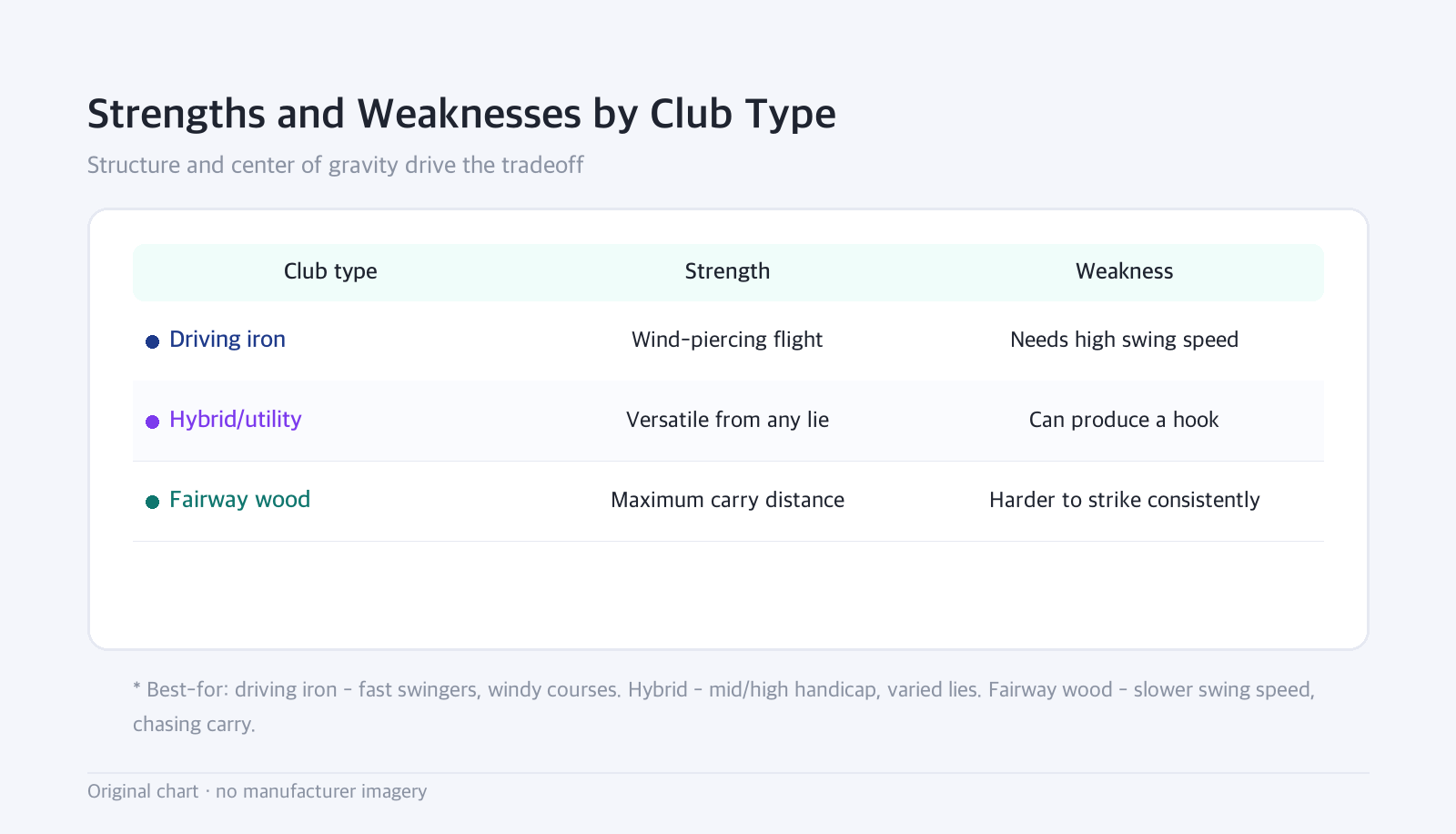
Driving iron (utility/driving iron)
"A weapon for a precise, hard-swinging player who wants tight dispersion."
- Strengths:
1. Wind-piercing, penetrating trajectory: low spin minimizes the effect of headwinds and crosswinds. 2. Tight left-right dispersion: often the tightest of the three off the tee, improving fairway accuracy.
- Weaknesses:
1. Requires high swing speed: carry drops off sharply at slower clubhead speeds. 2. Limited greenside stopping power: the shallow landing angle makes it hard to hold the green.
- Best for: faster-swinging low-handicap players, tight tee shots, windy courses.
Hybrid/utility
"An all-purpose club that's easy to hit from any lie and highly forgiving."
- Strengths:
1. Excellent lie versatility: the head releases cleanly through rough, divots, and fairway bunkers. 2. High MOI: distance and direction loss on mishits is smaller.
- Weaknesses:
1. Can produce a hook: the closing tendency of the design can cause a hook for faster-swinging players.
- Best for: mid-to-high handicap golfers who struggle with long irons, players needing to handle varied lies.
Fairway wood
"A high-launching club built for maximum carry and a soft landing."
- Strengths:
1. Maximum carry distance: the combination of a long shaft and high launch angle sends it farthest. 2. Steep landing angle: descending at 50°+ makes it well suited for holding the green on a par-5 second shot.
- Weaknesses:
1. Harder to strike consistently: the long shaft makes solid contact harder to repeat. 2. Limited in deep rough: the wide head meets more resistance.
- Best for: golfers with a slower swing speed, players chasing carry distance and going for the green in two on par 5s.
3. Decision framework
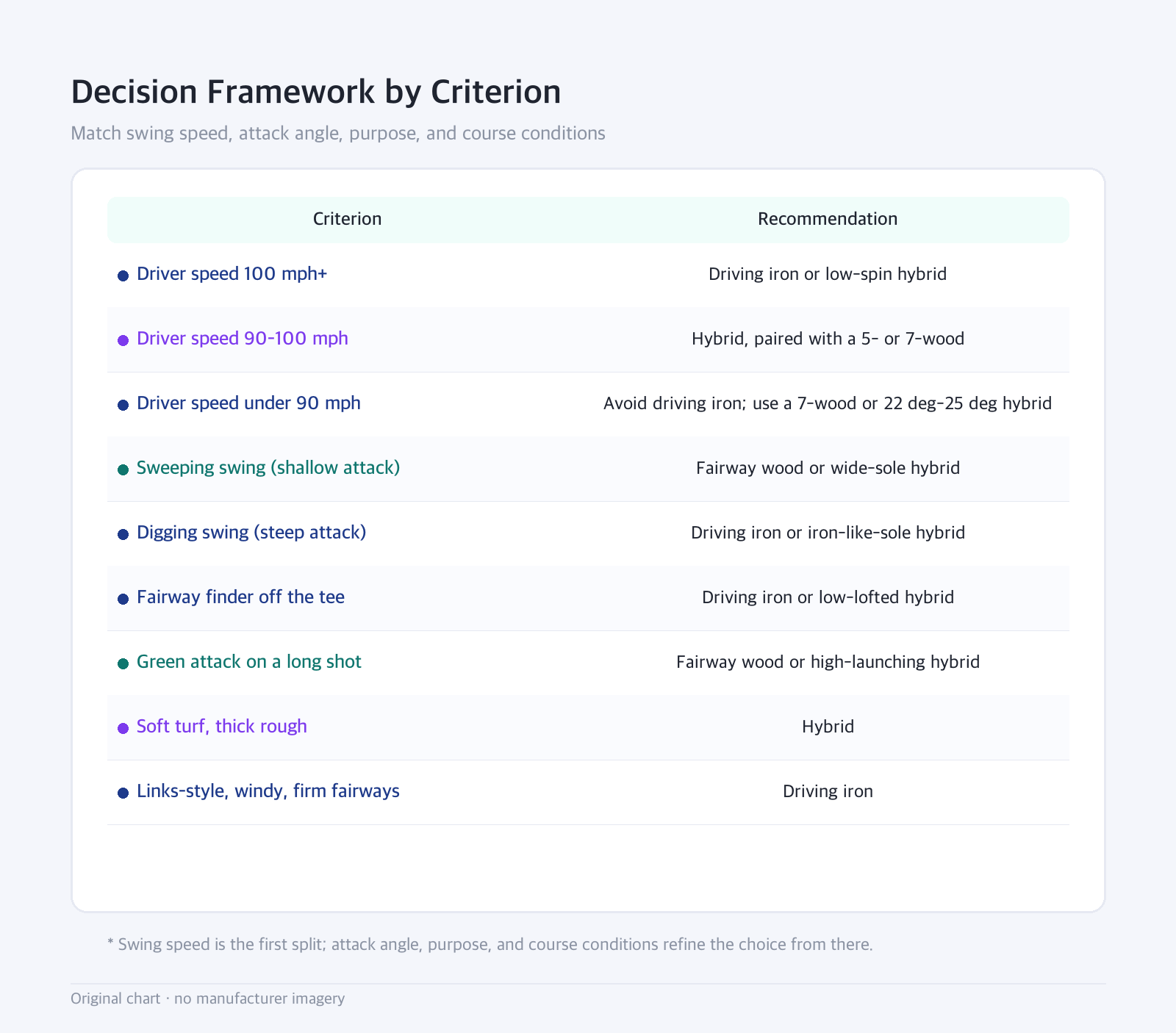
Match your swing profile, typical course conditions, and scoring goals against the framework below.
``` ┌───────────────────────┐ │ Measure Swing Speed │ └───────────┬───────────┘ │ ┌──────────────────┴──────────────────┐ ▼ ▼ [Driver speed 100 mph+] [Driver speed 95 mph or below] │ │ ┌─────────┴─────────┐ ┌─────────┴─────────┐ ▼ ▼ ▼ ▼ [Low trajectory/ [Rough control/ [Easy launch/ [Maximum wind control] soft landing] lie forgiveness] carry] │ │ │ │ ▼ ▼ ▼ ▼ Driving iron Hybrid Hybrid Fairway wood ```
Criterion 1: Swing speed
- Driver speed 100 mph+ (carry 250 yd / 230 m+): spin can be controlled well enough that a driving iron or low-spin hybrid works best.
- Driver speed 90–100 mph (carry 219–251 yd / 200–230 m): a hybrid is the most stable choice; pairing it with a 5- or 7-wood works well for approach shots.
- Driver speed under 90 mph (carry under 219 yd / 200 m): a driving iron won't get the ball airborne and should be avoided. A 7-wood or a higher-lofted hybrid (22°–25°) is strongly recommended instead.
Criterion 2: Attack angle and swing style
- Sweeping swing (shallow attack angle): a player who doesn't take a deep divot gets the most consistent contact from a fairway wood or hybrid with a wide sole.
- Digging swing (steep attack angle): a player who takes an iron-like divot pairs well with a driving iron or a hybrid with an iron-like sole.
Criterion 3: Primary purpose (off the tee vs. green attack vs. trouble shots)
- Fairway finder off the tee: when the driver is unreliable on a tight hole → driving iron or a low-lofted hybrid.
- Green attack: holding the green on a par-5 second shot or a long par 3 → fairway wood or a high-launching hybrid.
- Trouble shots: escaping the rough after missing the fairway → hybrid.
Criterion 4: Course conditions (wind and turf)
- Soft turf, thick rough, hilly terrain: a hybrid, which releases cleanly through the turf and launches easily, has a clear advantage.
- Links-style courses, windy coastal courses, firm fairways: a driving iron, which uses the wind and maximizes roll, is most efficient here.
4. Recommended setups by skill level
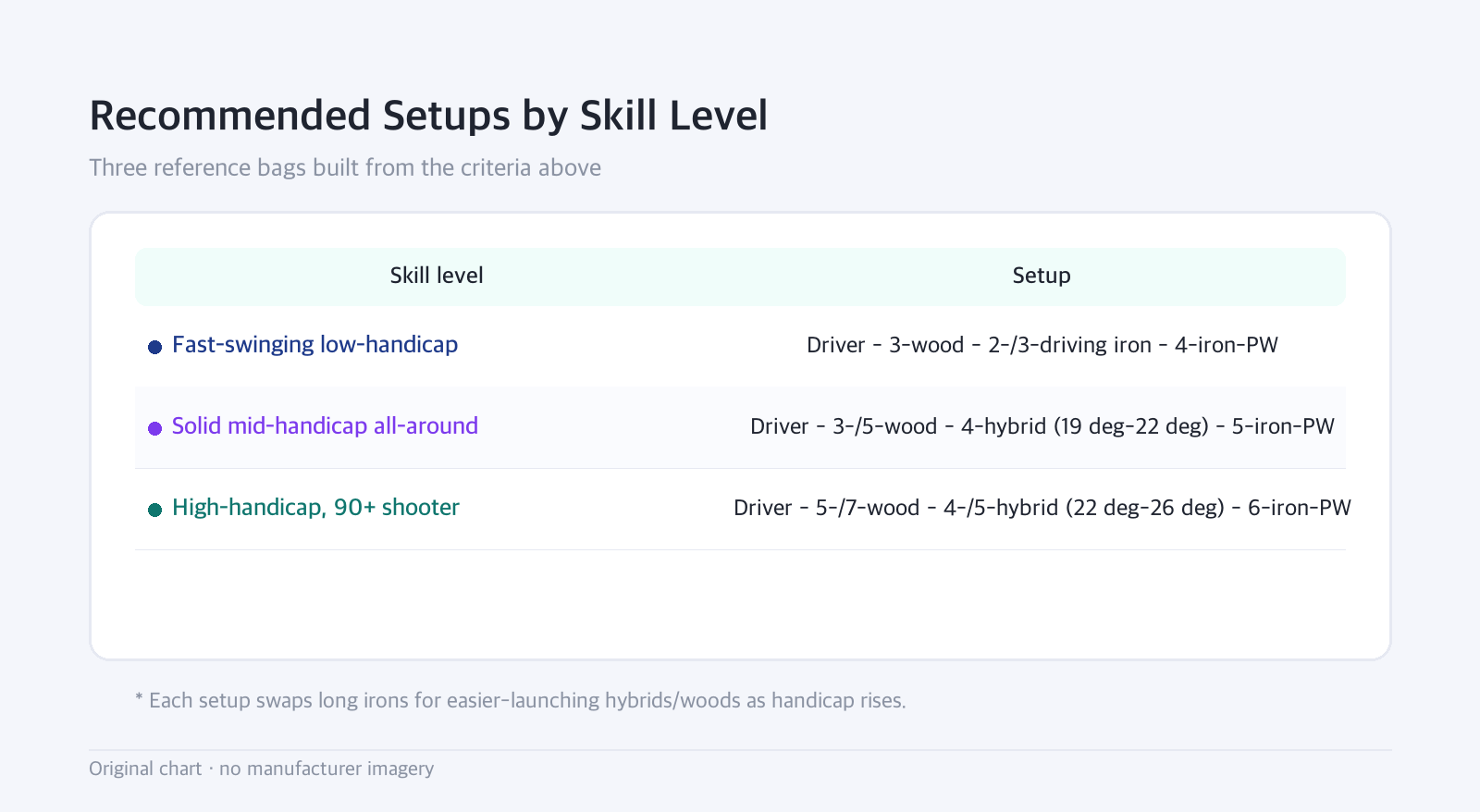
Fast-swinging low-handicap player
Setup: driver – 3-wood – 2-/3-driving iron – 4-iron through PW Character: maximum control off the tee, a low, penetrating ball flight into the wind.
Solid mid-handicap all-around golfer
Setup: driver – 3-/5-wood – 4-hybrid (19°–22°) – 5-iron through PW Character: a versatile combination that covers long-game distance and rough recovery.
High-handicap player prioritizing ease and forgiveness (90+ shooter)
Setup: driver – 5-/7-wood – 4-/5-hybrid (22°–26°) – 6-iron through PW Character: drops the difficult long irons (4, 5) in favor of an easier-launching 7-wood and hybrids, prioritizing trajectory and carry.
5. Who this guide is useful for
Judgment calls based on the criteria above.
- Golfers who've been choosing clubs by feel without ever measuring swing speed — Criterion 1 (100 mph+ / 90–100 mph / under 90 mph) splits the field sharply, and measuring first cuts the options by more than half
- Golfers who hook hybrids often — Criterion 2 (attack angle) points at head structure and swing-type fit as a possible cause
- High-handicap golfers unsure what to put in place of their long irons — the mid-handicap setup (4-/5-hybrid plus 7-wood) is a reference point
It may be less suited for:
- Golfers with a swing speed under 90 mph considering a driving iron — Criterion 1 flags this combination as one to avoid outright, since getting the ball airborne is the core problem
- Golfers looking to match the TrackMan figures above one-for-one against their own numbers — these are general reference ranges, not a substitute for personal fitting data
In brief
- Trajectory too low and losing distance? → Switch to a wood or hybrid.
- Hybrid producing a hook or pulling left? → Consider a driving iron or a low-spin fairway wood.
- Need to hold the green from around 200 yards (183 m)? → Choose a hybrid or fairway wood with a landing angle of 45° or steeper.
This piece summarizes general instruction concepts and is not personalized coaching advice. Ball flight fixes depend on individual swing mechanics — a launch monitor session or certified instructor can confirm what applies to you.