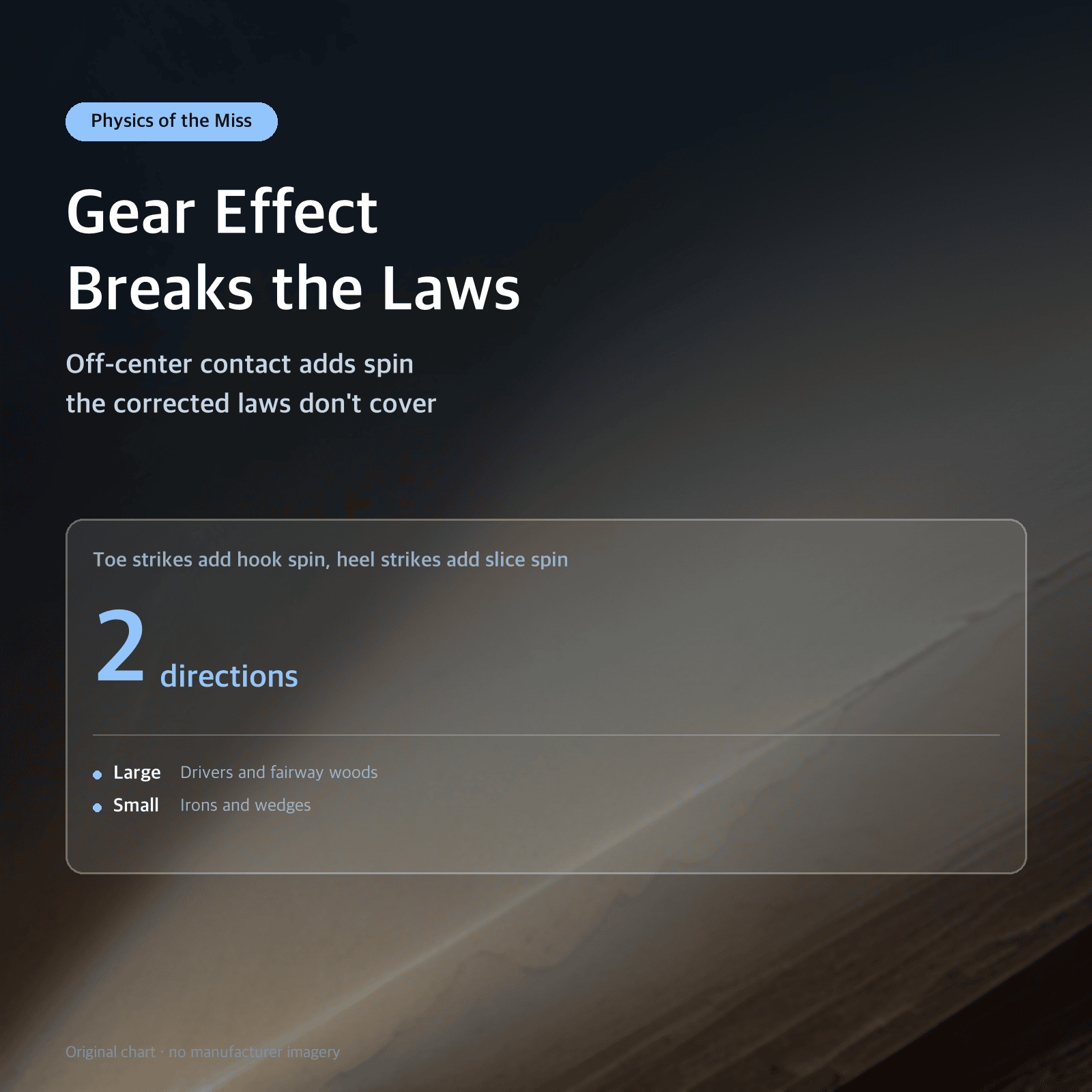
The corrected ball-flight laws covered separately carry one condition attached to them: they assume center contact.
Drop that condition and the laws travel as misinformation. In practice, this qualifier is frequently left out.
This piece is about what happens on a mishit.
1. Face and ball mesh like gears
That's where the name gear effect comes from — gears are toothed wheels.
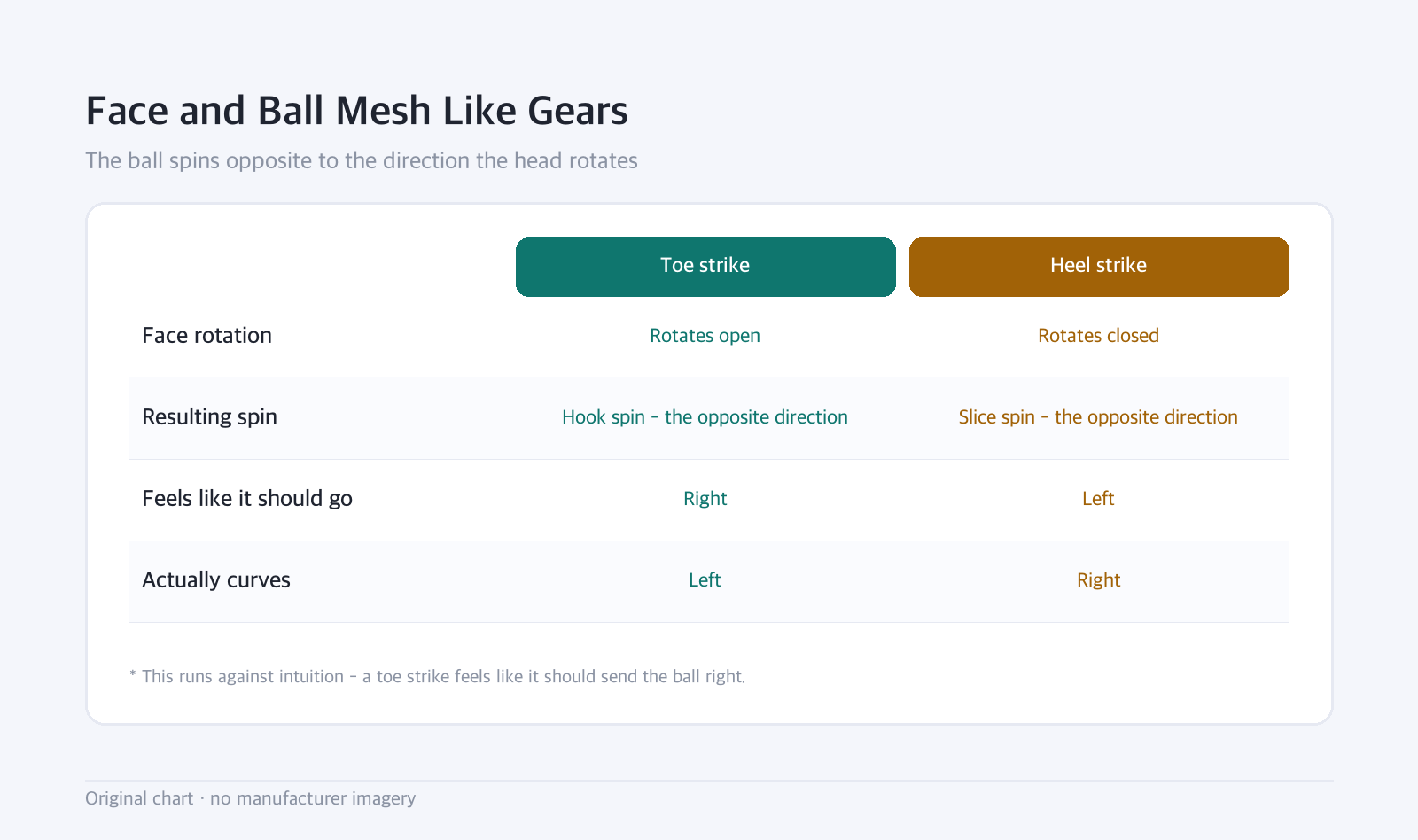
At impact, if the ball contacts the clubface away from the center of gravity, the head rotates around that off-center point. But the face and the ball are locked together by friction during contact.
Two meshed gears turn in opposite directions from each other. The same thing happens here: the ball picks up spin in the direction opposite to the head's rotation.
For a right-handed golfer, the direction splits like this:
- Contact toward the toe rotates the face open, and the ball picks up hook spin — the opposite direction.
- Contact toward the heel rotates the face closed, and the ball picks up slice spin.
This runs against intuition. A toe strike feels like it should send the ball right, but the spin it actually adds curves it left.
2. Which means the laws stop holding
This is where a hole opens up in the diagnostic framework covered separately.
That framework read a rightward curve as the path being left of the face. True, if contact was centered.
But on a heel strike, path and face can match perfectly and the ball will still curve right. Gear effect has added spin on its own.
There are real cases where the swing is fine but the shot pattern still looks like a slice.
So one step needs to go in front of the diagnostic sequence: check where contact happened, first.
3. How to check contact location
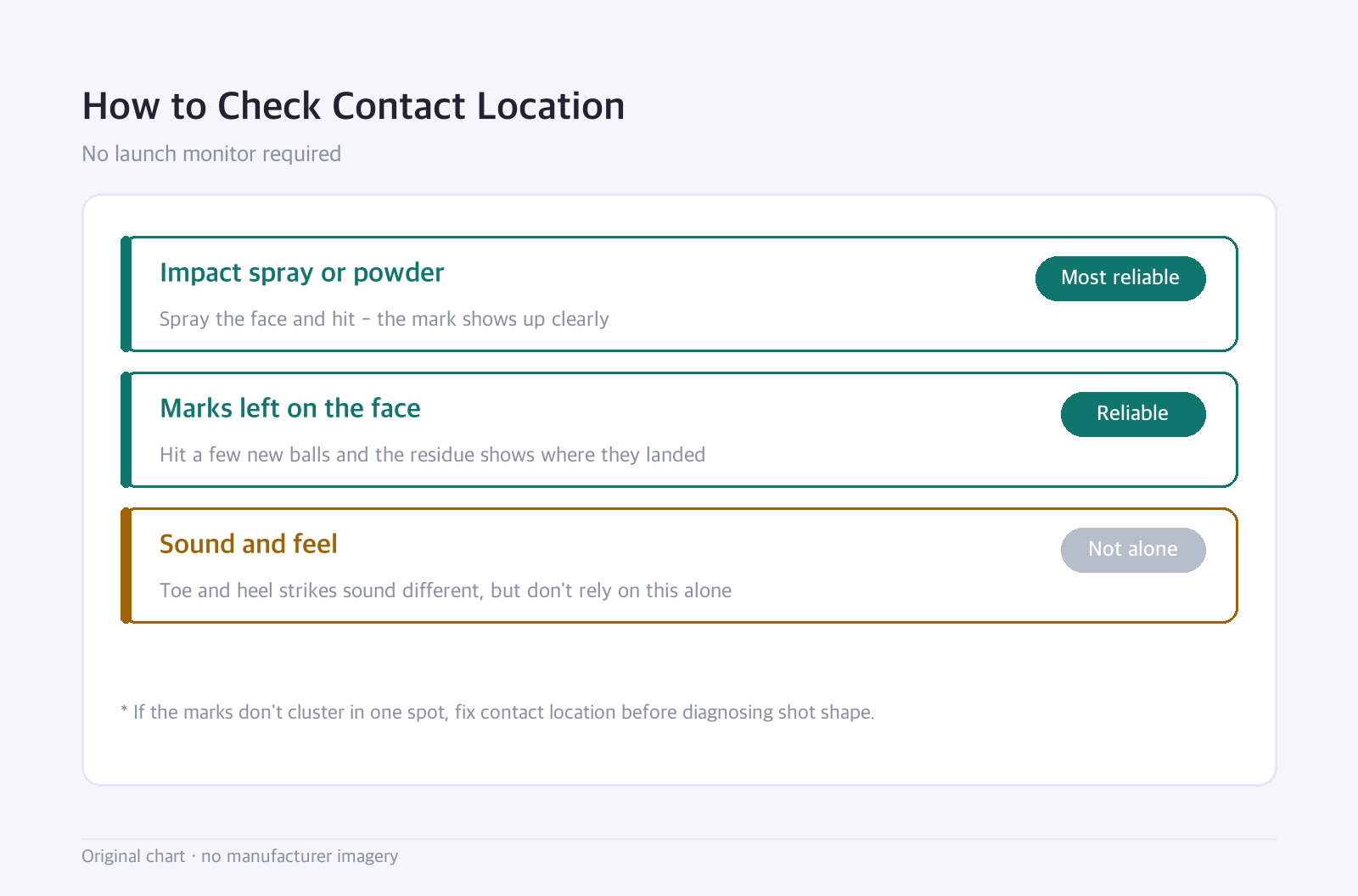
No launch monitor is required.
- Impact spray or powder — spray the face and hit; the mark shows up clearly. This is the most reliable method.
- Marks left on the face — hit a few new balls and the residue shows where they landed.
- Sound and feel — toe and heel strikes sound different, but don't rely on this alone.
If the marks don't cluster in one spot, contact location, not shot-shape diagnosis, is the thing to fix first. With contact scattered, no amount of matching face to path will produce a consistent result.
4. Large with a driver, small with an iron
This is the most practical section in this piece.
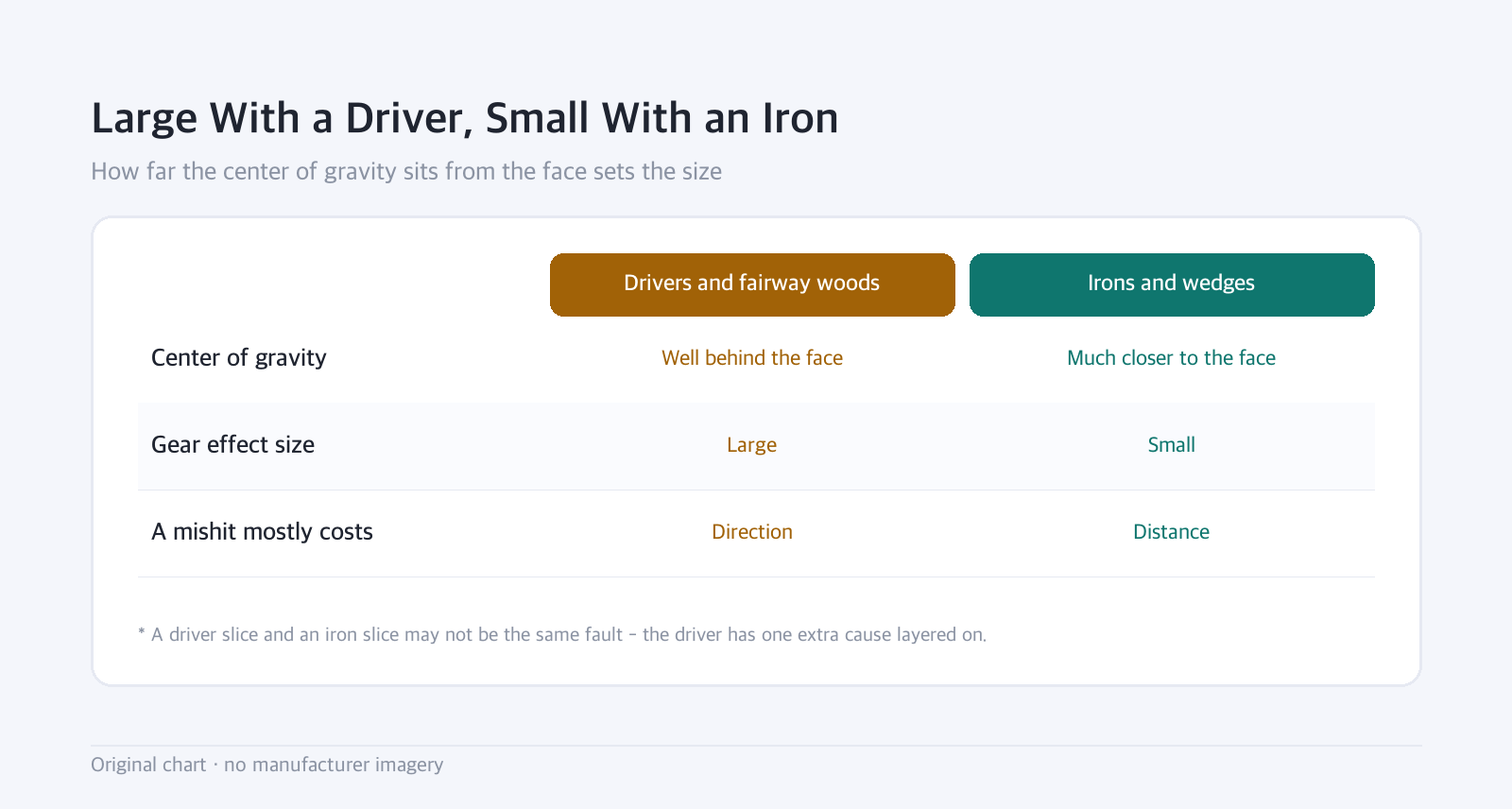
The size of gear effect depends on how far the center of gravity sits from the face.
- Drivers and fairway woods — large, hollow heads put the center of gravity well behind the face. The longer lever makes gear effect large.
- Irons and wedges — the center of gravity sits much closer to the face. So even on a mishit, gear effect stays small.
That gap produces a practical conclusion.
A mishit iron mostly costs distance; a mishit driver mostly costs direction.
Which leads to the point this series keeps returning to: a driver slice and an iron slice may not be the same fault. The driver slice has one extra cause layered on — contact location.
If only the driver slices while irons are fine, heel contact is worth suspecting before the swing itself.
5. What to actually do
The sequence:
First, check the marks. See whether they cluster in one spot.
Second, if scattered, fix contact first. Don't work on shot shape at this stage — with causes mixed together, the result can't be read cleanly.
Third, if the marks cluster, move to the three questions covered separately: where it started, which way it curved, by how much.
Fourth, look at clubs separately. If driver and iron results differ, the causes may differ too.
No prescription without diagnosis — the principle running through this whole series applies here as well.
6. Who this is useful for
- Golfers who only slice with the driver — checking contact location first is worth doing.
- Golfers whose shot shape won't settle even after swing changes — the cause may not be the swing at all.
- Golfers with inconsistent iron distances — an iron mishit tends to show up as distance loss, not direction.
- Golfers heading into a club fitting — impact marks are usually the first thing a fitter checks.
This is less useful for:
- Golfers whose contact is already consistent — this piece's caveat doesn't apply; the earlier framework works as written.
- Golfers working on putting or the short game — gear effect concerns full-swing clubs.
7. What we could not confirm
- How precisely gear effect's magnitude can be predicted numerically — it varies by club, and we could not confirm published formulas.
- The actual distribution of contact location among amateurs — no statistics on heel-versus-toe frequency turned up.
- How much modern drivers' higher MOI has reduced this effect.
- The accuracy of judging contact location by sound alone.
In one line
The corrected ball-flight laws describe center contact.
Off-center contact meshes face and ball like gears and adds spin the laws don't account for. Toe strikes add hook spin, heel strikes add slice spin, and the direction runs against intuition.
And this effect is large with a driver, small with an iron. How far the center of gravity sits from the face determines the size.
So check the marks before reading the shot shape.
This piece summarizes general instruction concepts and is not personalized coaching advice. Ball flight fixes depend on individual swing mechanics — a launch monitor session or certified instructor can confirm what applies to you.