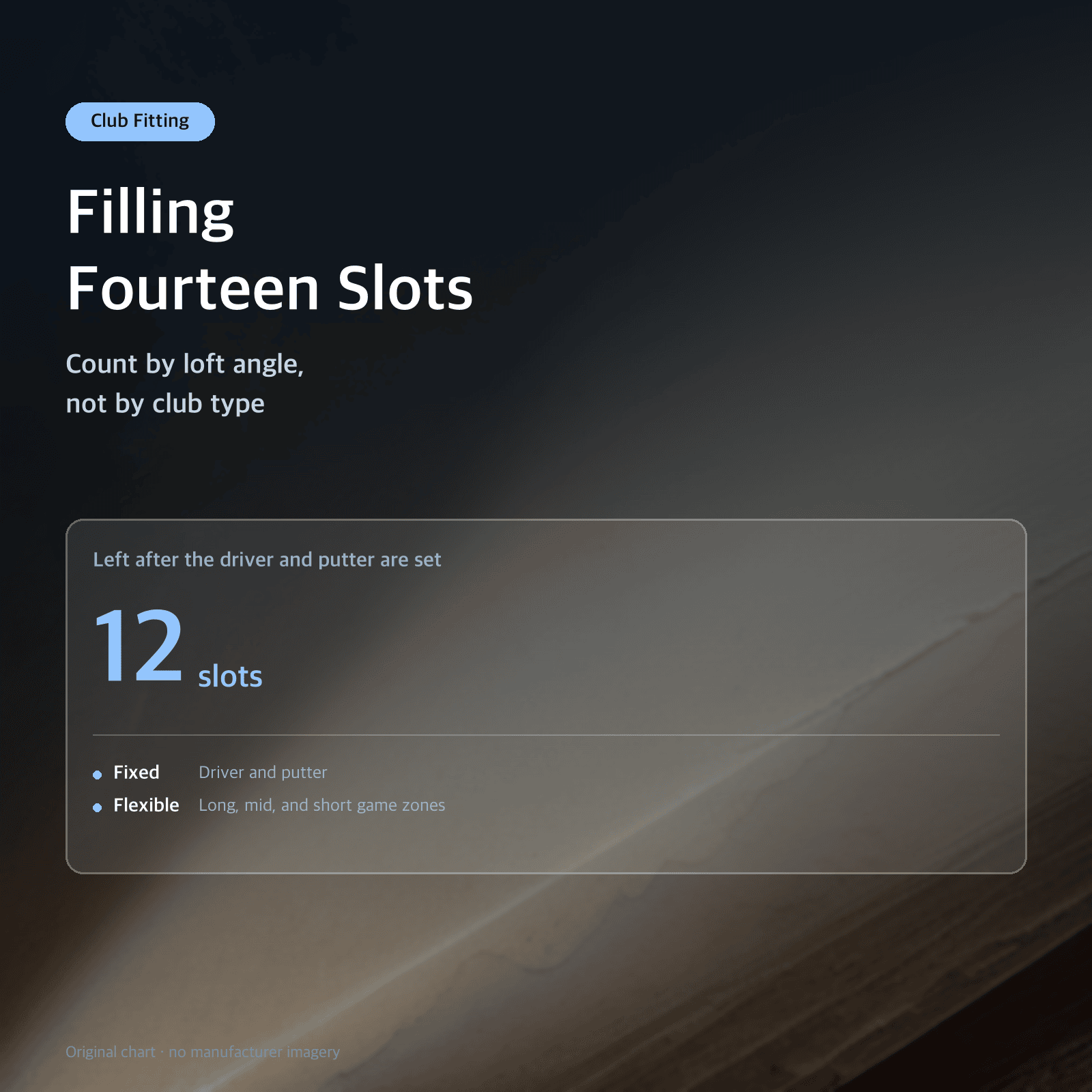
The limit is fourteen clubs. This piece is about the practical question that follows: how do you fill those fourteen slots?
1. Start with two fixed slots
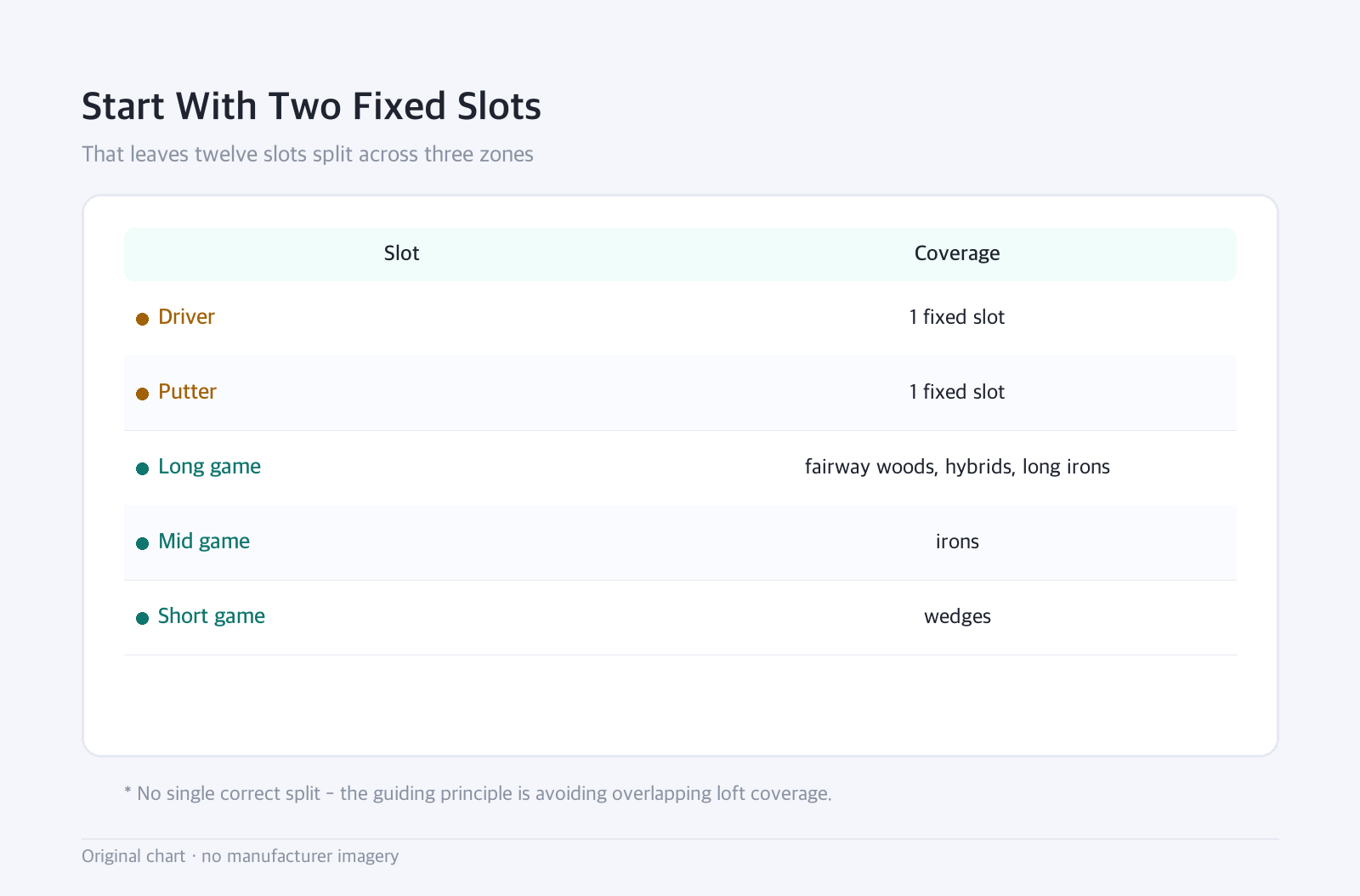
For most golfers, two slots are effectively settled from the start:
- Driver — 1
- Putter — 1
That leaves 12 slots. How to divide those twelve is the real question.
2. Split into three zones
The remaining twelve slots roughly split into three zones:
Long game — fairway woods, hybrids, long irons Mid game — irons Short game — wedges
There's no single correct split. The guiding principle is to avoid overlapping loft coverage between zones.
Manufacturer hybrid spec sheets typically list a matching iron and matching wood for each hybrid — a 2-hybrid might correspond to both a 2-iron and a 5-wood, a 3-hybrid to both a 3-iron and a 7-wood.
In other words, more than one club type can cover the same slot. So count by loft angle, not by club category — that's what makes overlap visible.
3. Two common overlaps
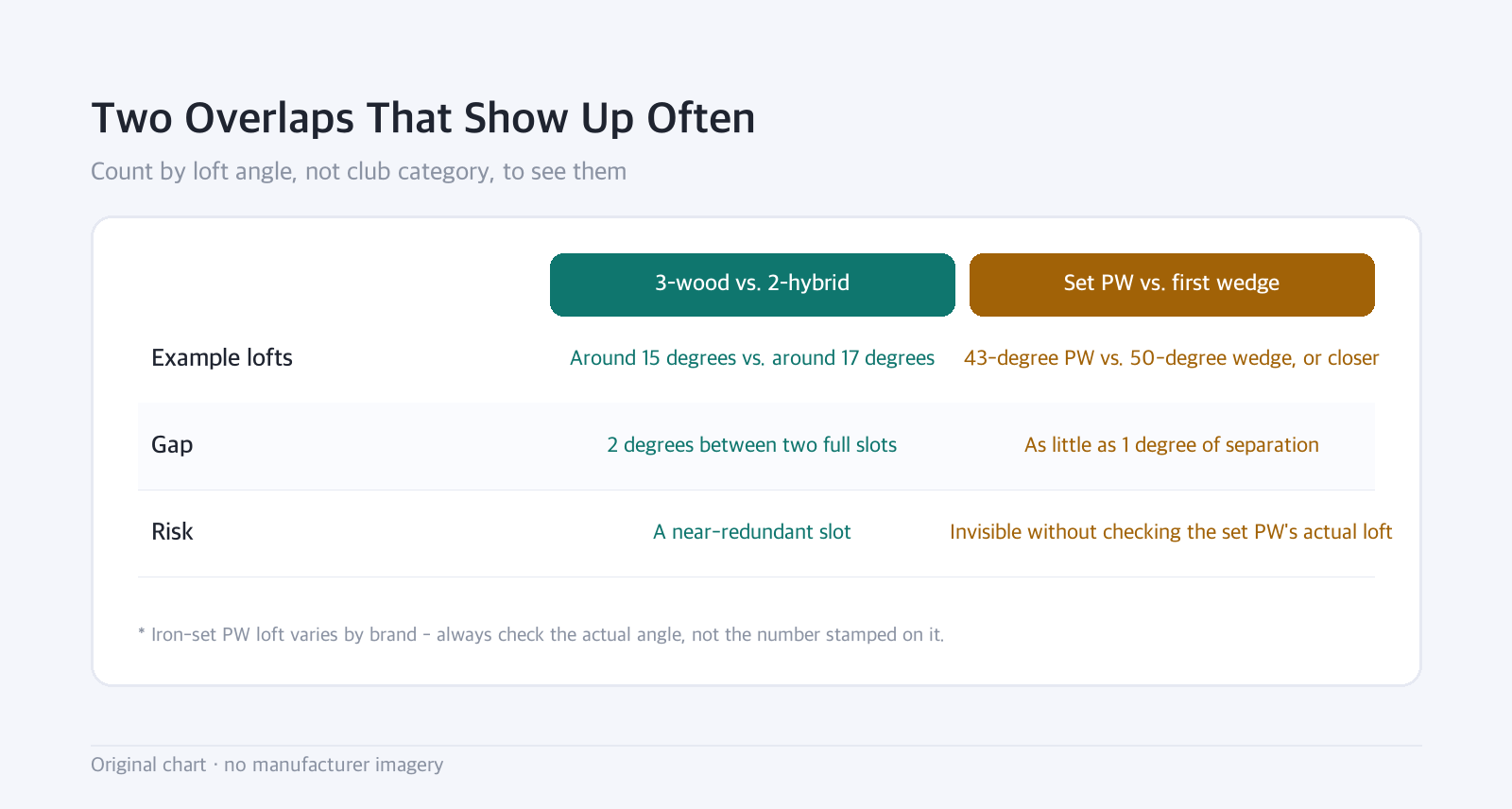
Two overlaps show up often in practice.
First, the 3-wood and a hybrid.
A 3-wood runs around 15 degrees; a 2-hybrid runs around 17. Carry both and you have a 2-degree gap between two full slots — not much distance difference for two spots in the bag.
Second, the pitching wedge and gap wedge.
Iron-set PW loft varies by brand. It's common for a gap or an overlap to open up between a set's PW and the first dedicated wedge.
A 43-degree PW paired with a 50-degree wedge leaves a 7-degree gap. A 47-degree PW paired with a 48-degree wedge leaves only 1 degree of separation.
Without checking the set PW's actual loft, this problem is invisible.
4. Above roughly 26 degrees, choices narrow
One practical fact matters here: above roughly 26 degrees, fairway woods effectively stop being an option. A 9-wood runs around 24 degrees, and higher-lofted fairway woods aren't a normal retail product.
So that range becomes a choice between iron or hybrid.
And hybrid range varies by brand — some hybrid lines stop around 24 degrees, while others extend well past 30.
If you need something above 26 degrees and pick the brand first, the part you need may not exist in that brand's lineup.
5. A working order
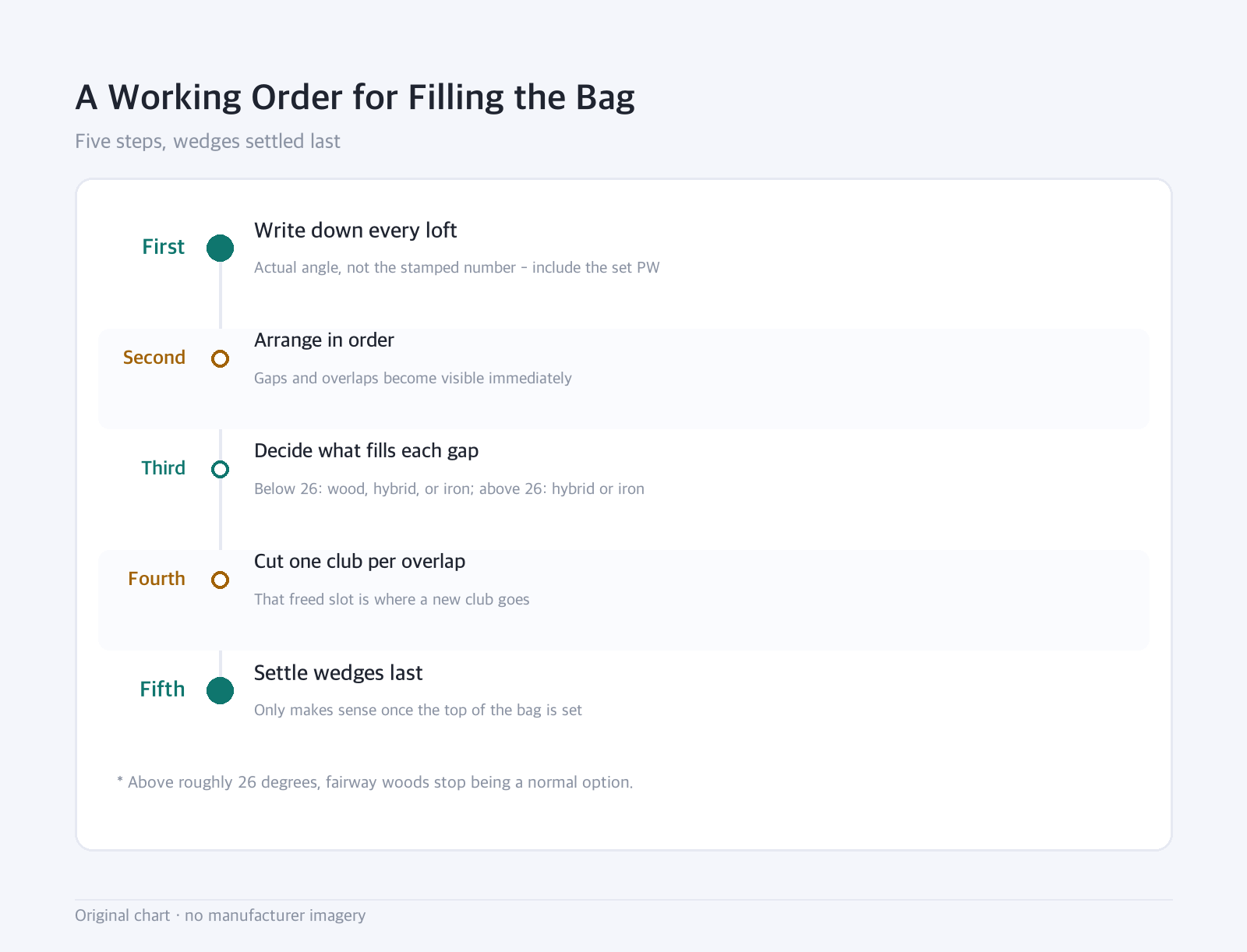
First, write down the loft of every club currently in your bag. Use the actual angle, not the number stamped on it — including your set's PW.
Second, arrange those angles in order. Gaps and overlaps become visible immediately.
Third, decide what fills each gap. Below roughly 24 degrees, wood, hybrid, and iron are all candidates; above 26, it's hybrid or iron.
Fourth, cut one club from each overlap. That freed slot is where a new club goes.
Fifth, settle wedges last. The gaps at the bottom only make sense once the top of the bag is set.
6. What to cut
If all 14 slots are full and you want to add something, you need to decide what comes out. A few criteria:
How often you actually use it in a round. A club you never pull is a candidate.
Whether something else can cover it. If a nearby-loft club exists, swing length can bridge the gap.
Whether it's simply hard to hit well. It's common to keep a club you don't hit well on the theory that practice will fix it. Swapping that slot for something easier can move your actual score more than the practice would.
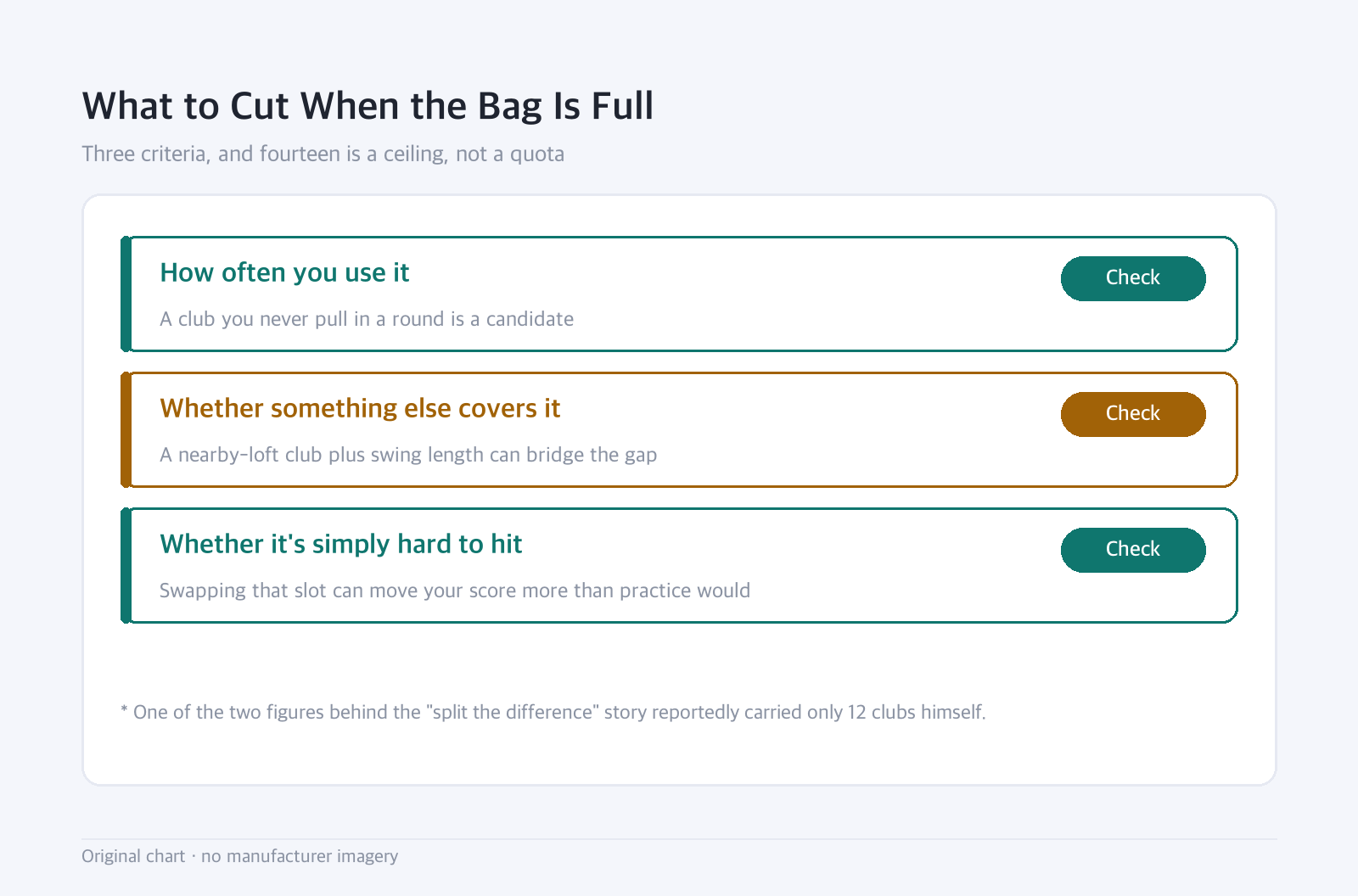
You don't have to fill all fourteen. It's a ceiling, not a quota. Reportedly, one of the two figures in the "split the difference" story behind the number 14 carried only 12 clubs himself.
Leaving a slot empty makes the bag lighter and cuts down on decisions. Fewer clubs means simpler choices — which was arguably the point of the limit in the first place.
7. Who this is useful for
- Golfers wanting to add a club — find the slot to cut before you buy.
- Golfers rebuilding a set — counting by angle, not category, reveals overlap.
- Golfers who struggle with long irons — above 26 degrees, a hybrid is close to the only real alternative.
- Golfers deciding on wedge count — start by checking the set PW's actual loft.
Less useful for:
- Casual round players — the club-count limit is a competition rule.
- Golfers who've already been fit — a fitting will be more precise than this.
8. What we could not confirm
- An ideal split across the three zones — there's no single answer, and none is offered here.
- A recommended loft gap between clubs — distance impact varies too much to generalize.
- Official per-number fairway wood lofts — the figures here are back-calculated from hybrid matching charts.
- The full range of set PW lofts across brands.
- What share of golfers actually carry all fourteen.
- Actual tour-level bag composition.
In one line
Take fourteen slots, remove the driver and putter, and 12 slots remain.
The working order: write down current club lofts as angles, line them up in order, find the gaps and the overlaps, and cut a club from each overlap.
Count by angle, not by club number, to see it. A 3-wood and a 2-hybrid can be 2 degrees apart. A set PW and a first wedge can be 1 degree apart.
And you don't need to fill all fourteen. It's a ceiling, not a requirement.
The loft figures here come from confirmed manufacturer specifications.
This piece summarizes general instruction concepts and is not personalized coaching advice. Ball flight fixes depend on individual swing mechanics — a launch monitor session or certified instructor can confirm what applies to you.