
A dozen golf balls today runs somewhere in the range of an ordinary consumer purchase — annoying to lose, but not enough to end a round.
Two hundred years ago it was different. A single ball often cost more than a club.
Understanding how it was made explains why.
1. Feathers packed into a leather pouch
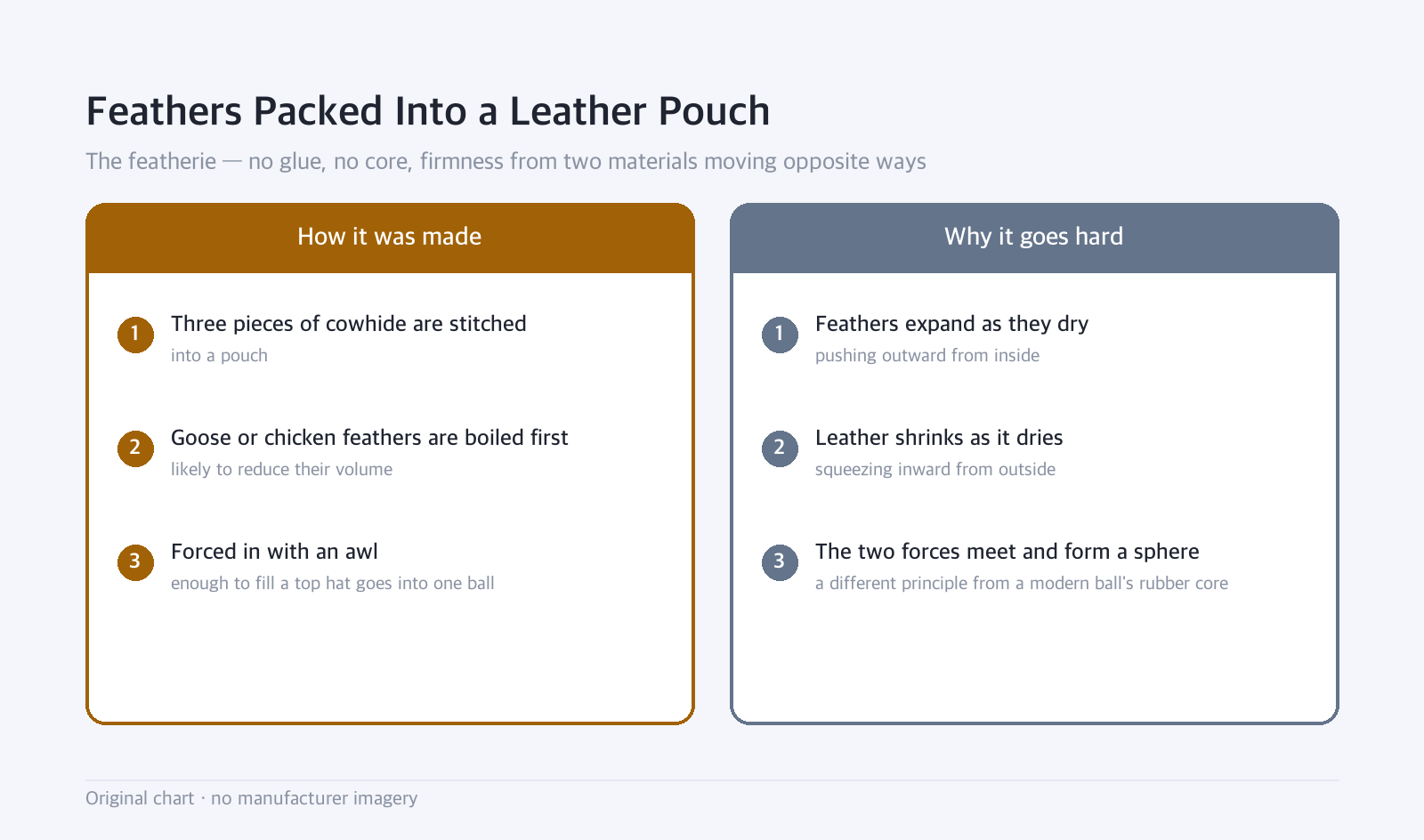
This ball is called the featherie. It was made in this order:
- Three pieces of cowhide were stitched into a pouch.
- Goose or chicken feathers were boiled first.
- The feathers were then forced into the pouch with an awl.
- Once packed tight, the opening was sealed.
The amount of feathers involved is striking: enough to fill a top hat went into a single ball.
Boiled feathers shrink in volume. Once forced in, they expand again as they dry. Leather, meanwhile, shrinks as it dries. The inward push and the outward squeeze meet and produce a hard sphere.
No glue, no core material — just two materials moving in opposite directions as they dried, producing firmness. That's a completely different principle from a modern ball, which gets its rebound from a rubber core's elasticity.
2. A skilled maker produced three or four a day
This was work that could only be done by hand, and it took a long time.
A skilled maker turning out three or four a day was doing well.
Forcing feathers in with an awl was the hardest part. Once the pouch was mostly full, packing more in required real force — accounts describe braced against the chest, pushed in with the whole body.
A full day's work, three or four balls. That's what set the price.
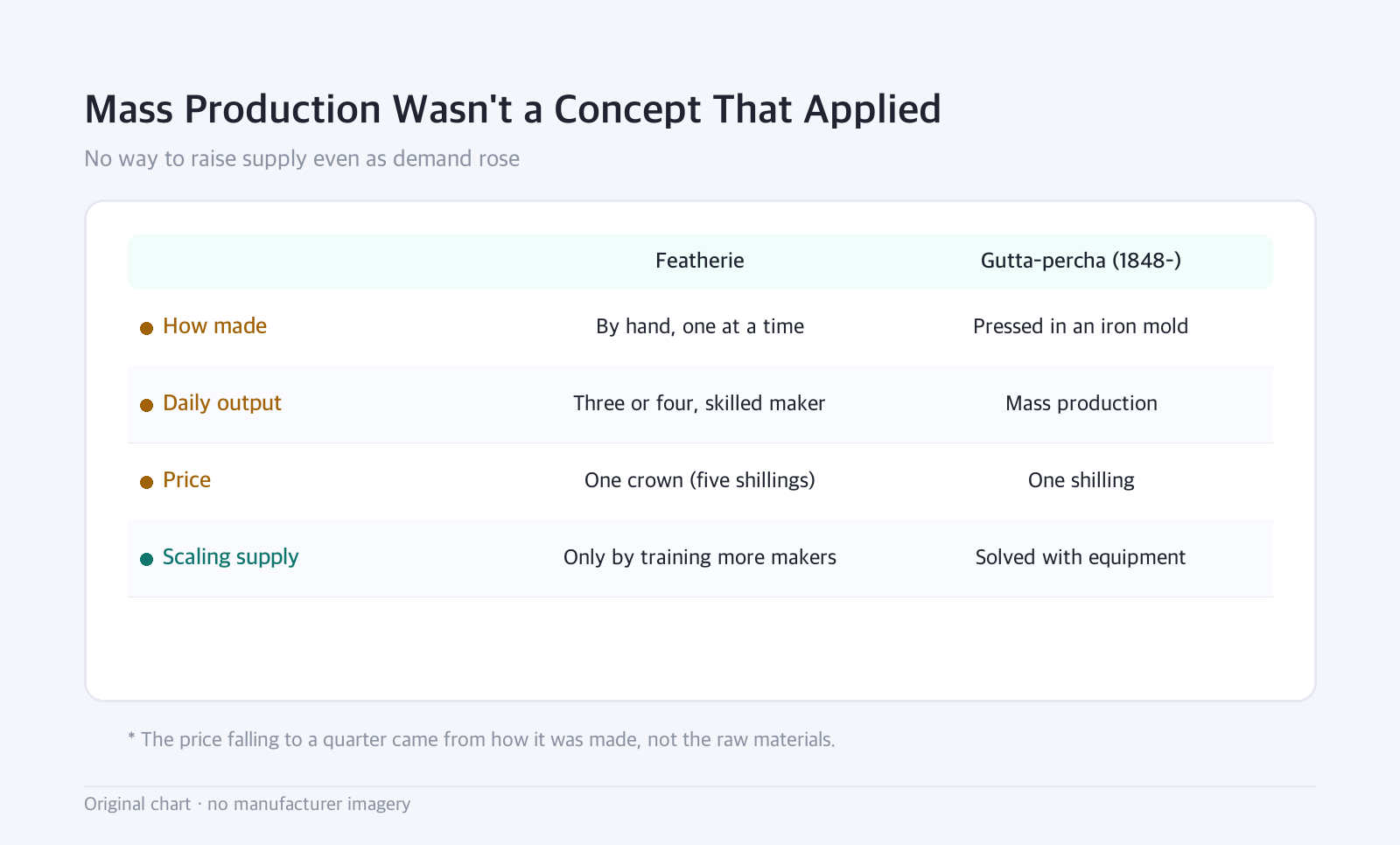
Mass production wasn't a concept that applied here. Even if demand rose, there was no way to increase supply — the only lever was training more craftsmen, and that takes time.
3. The best sold for a crown — more than a club
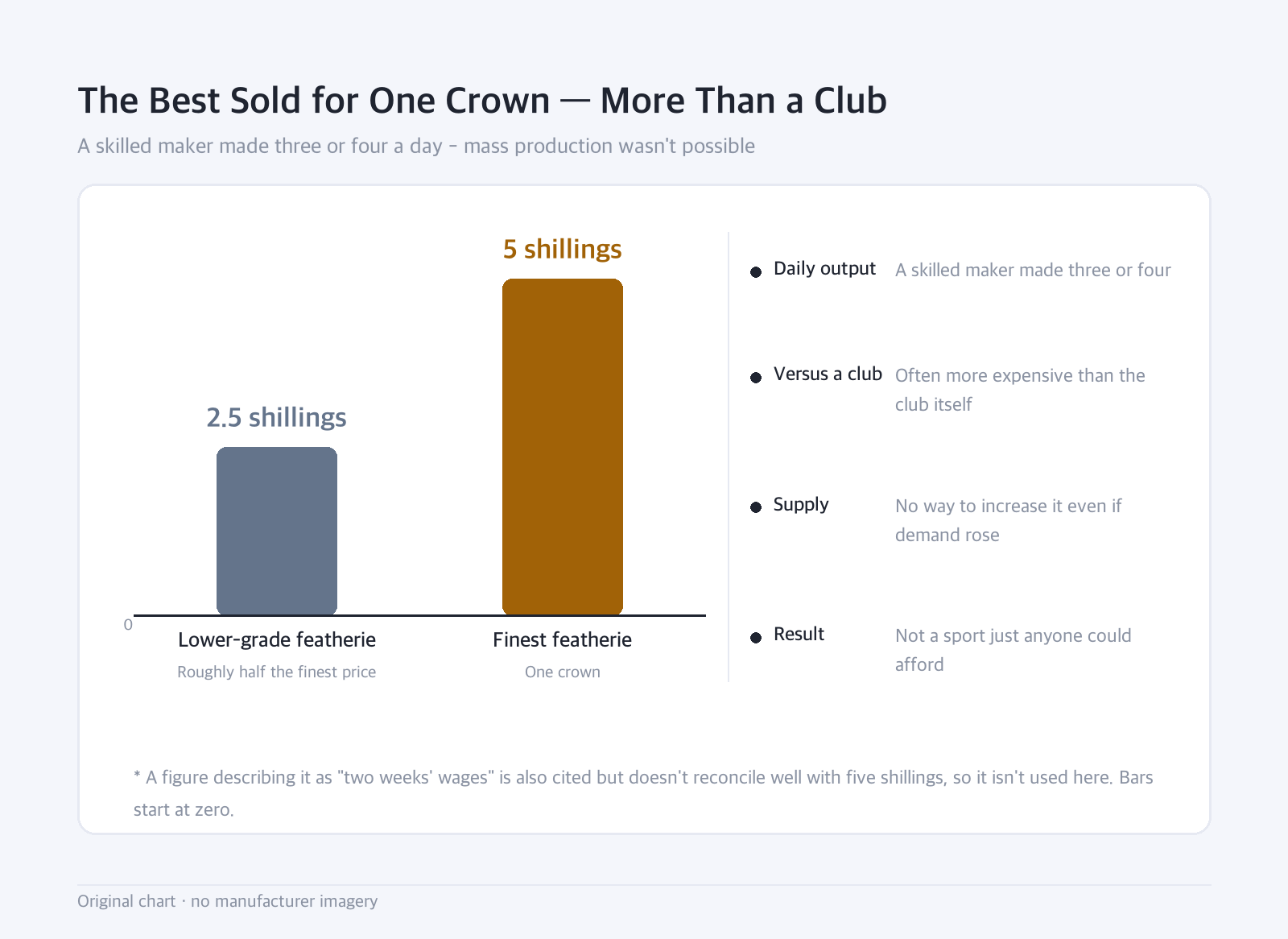
The finest featheries sold for one crown — five shillings. Lower grades went for roughly half that.
And multiple sources make the same point: it was often more expensive than a golf club.
In today's terms, that's a single ball costing more than a driver. It's easy to imagine what losing a ball mid-round meant.
What this price meant for who could play golf is also clear. This wasn't a game just anyone could take up.
The earliest written rules, from 1744, came out of a group called the "Gentlemen Golfers" — a name that isn't unconnected to this backdrop. A sport where a single ball cost more than a club had a defined class attached to it.
4. It had performance limits too
It wasn't just expensive — it was also fragile.
- It fell apart when wet. Made of leather and feathers, it changed character in the rain.
- It burst. Once a seam gave way, that was the end of it.
- A perfect sphere was hard to achieve. Packed by hand, no two were quite the same shape.
Expensive, fragile, and inconsistent — three problems at once.
That's why golf changed completely once something replaced it. The gutta-percha ball that arrived in 1848 is covered separately.
5. Even so, it flew well
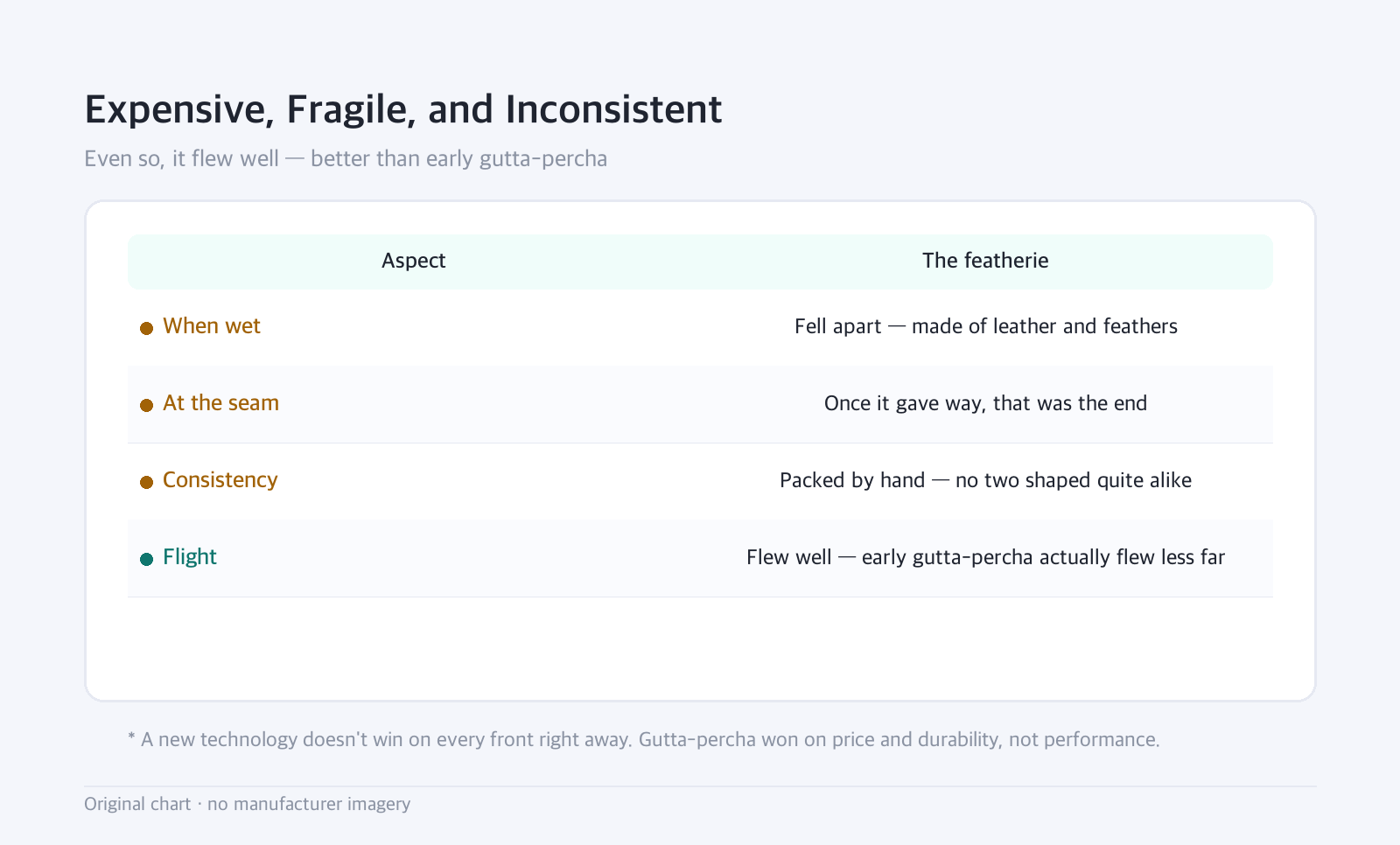
One thing worth adding: the featherie flew well.
Its successor, gutta-percha, is described as actually flying less far in its early form — a smooth surface is poor for airflow. Some golfers kept using featheries into the early gutta-percha years for that reason.
That's the interesting part. A new technology doesn't necessarily win on every front right away. Gutta-percha won on price and durability, not performance.
Performance caught up later. The discovery that a scuffed surface flies better became the origin of dimples, and the generation after that — the rubber-core ball — went on to fly 250 yards (229 m).
6. Who this is useful for
Based on what could be confirmed:
- Golfers curious how golf became a mass sport — the drop in ball price was decisive.
- Golfers shopping for balls today — the quality and consistency available for a dozen balls at today's prices would have been unimaginable two centuries ago.
- Golfers interested in equipment history — new technology doesn't always win on performance. Price and durability can come first.
- Golfers curious why dimples exist — the discovery that a scuffed surface helps flight is where that starts.
This is less useful for:
- Golfers who only need modern ball specs — this is history; layer count and compression comparisons are covered separately.
- Antique collectors — appraisal and market value aren't covered here.
7. What we could not confirm
- A price comparison against period wages — one account describes a ball costing "two weeks' wages," but that doesn't reconcile well with a five-shilling price. Wages varied by era, region, and trade, so we did not use this figure.
- The featherie's actual flight distance — no measurement record was found.
- When it first started being made — we could not confirm an exact starting date.
- Why the feathers were boiled — likely to reduce volume, but not confirmed.
- The scale of the makers themselves — how many craftsmen there were is unclear.
- Regional price differences.
In one line
The featherie was made by forcing boiled feathers, roughly enough to fill a top hat, into a stitched cowhide pouch. A skilled maker produced three or four a day, and the finest sold for one crown (five shillings) — often more than a club.
It was expensive, fragile, and inconsistent. So when a replacement appeared, golf changed completely.
And the reason that replacement won wasn't that it flew better — it was cheaper and more durable.
The figures here come only from confirmed sources, and where sources disagreed, the figure was left out.
This piece summarizes general instruction concepts and is not personalized coaching advice. Ball flight fixes depend on individual swing mechanics — a launch monitor session or certified instructor can confirm what applies to you.