
A separate piece looks at how, in 1898, a rubber-core ball started flying 250 yards and no restriction followed.
A century later, that changed. Golf's governing bodies began drawing lines around equipment.
But it started with the club, not the ball — the driver face in 1998, wedge grooves in 2010.
1. 1998 — how much bounce is allowed
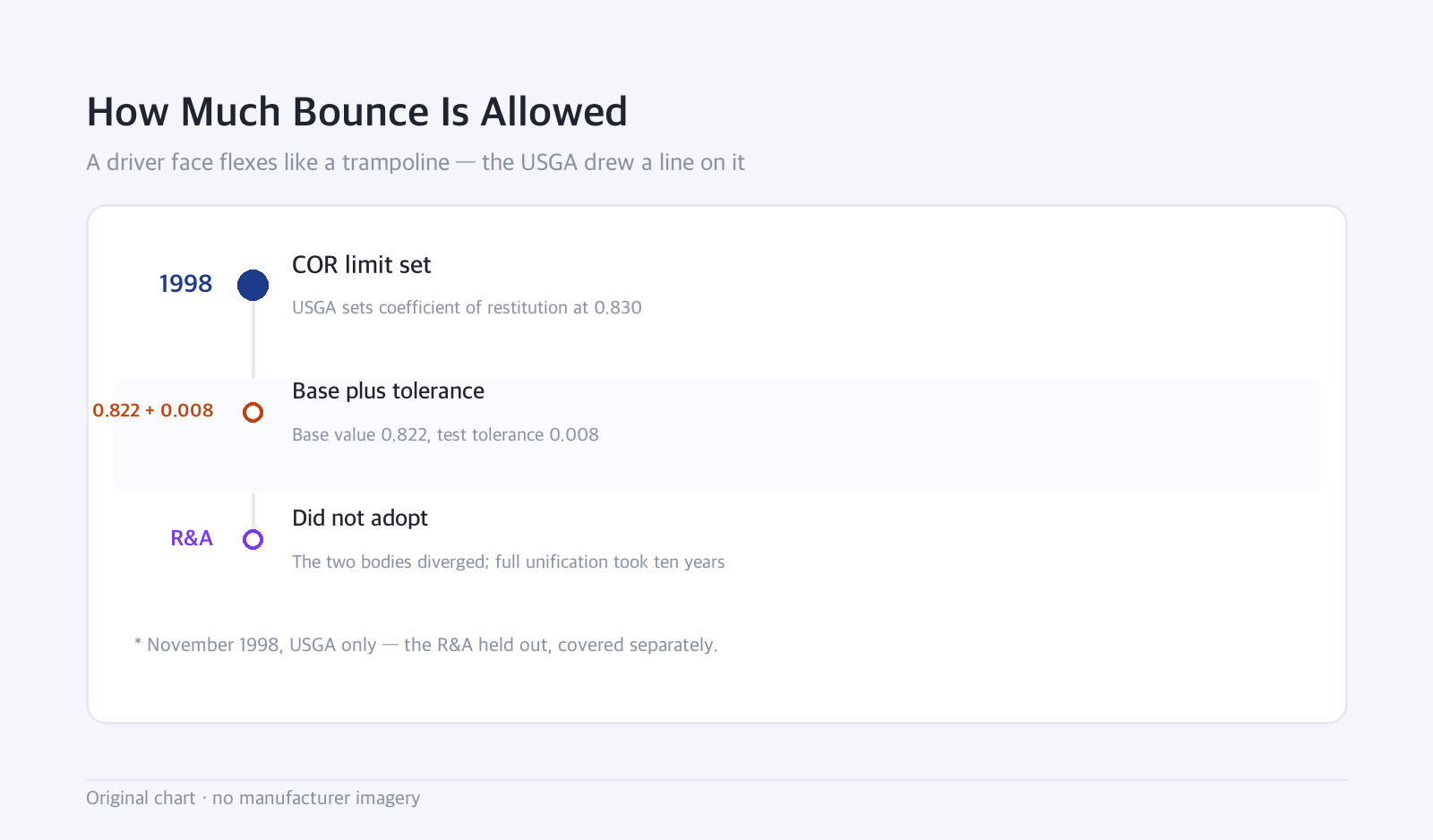
A driver face compresses inward on impact and springs back. That spring effect adds energy to the ball. It's the same principle as a trampoline.
The thinner the face, the larger the effect. As manufacturing improved, faces could be made thinner and thinner, which raised an obvious question: how much is too much?
In November 1998, the USGA set a coefficient-of-restitution (COR) limit of 0.830.
The number breaks down as:
- Base value: 0.822
- Test tolerance: 0.008
- Effective limit: 0.830
The R&A did not adopt this limit. The two bodies diverged, and full unification took ten years. That story is covered separately.
2. 2010 — two lines drawn on grooves
The second line concerned wedge grooves.
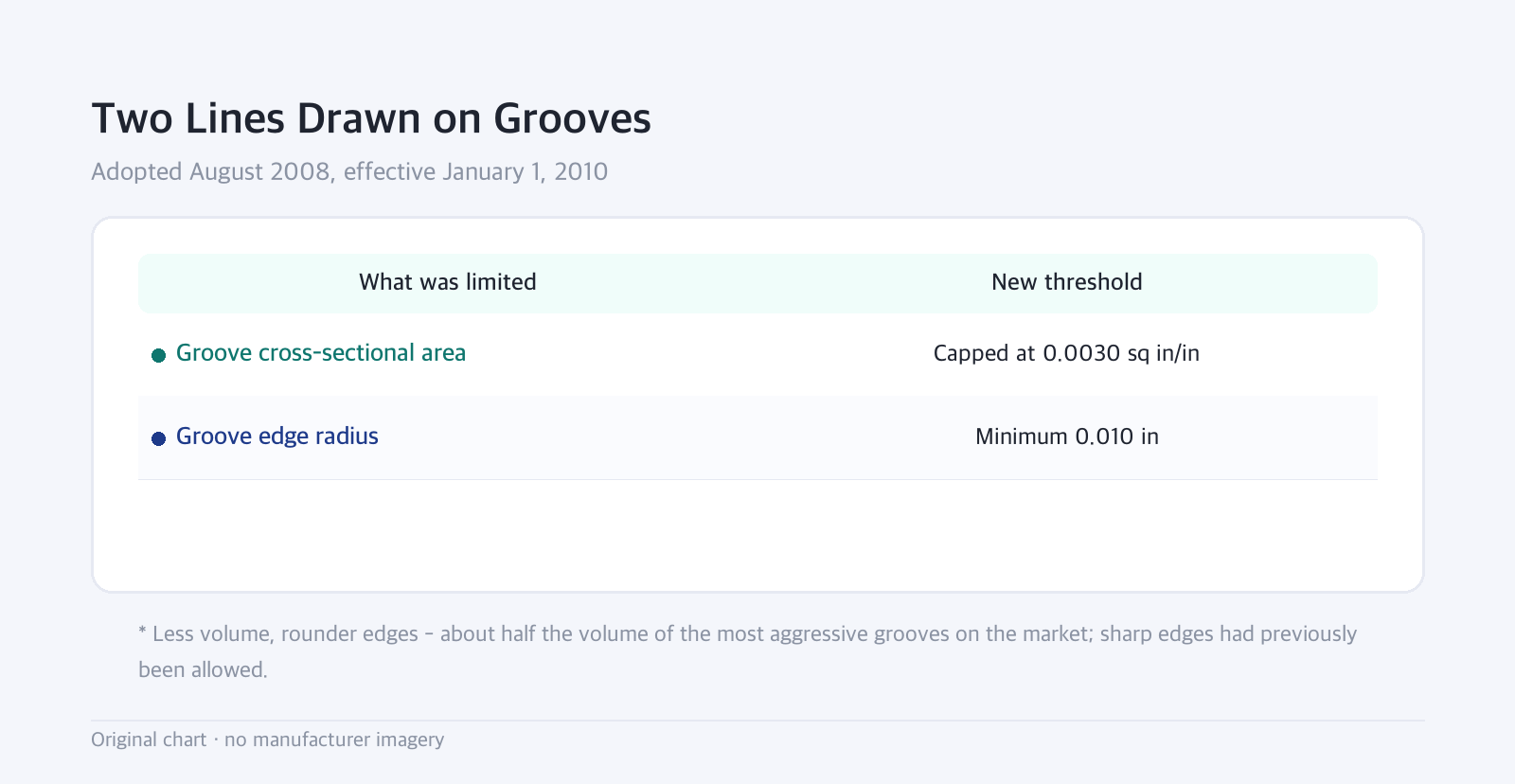
The revised specification was adopted in August 2008 and took effect January 1, 2010 for newly submitted clubs.
Two things were limited:
- Groove cross-sectional area — capped at 0.0030 square inches per inch, roughly half the volume of the most aggressive grooves on the market at the time.
- Groove edge radius — a minimum of 0.010 inches. Sharp edges had previously been allowed.
In short: less volume, rounder edges.
3. The target was the rough
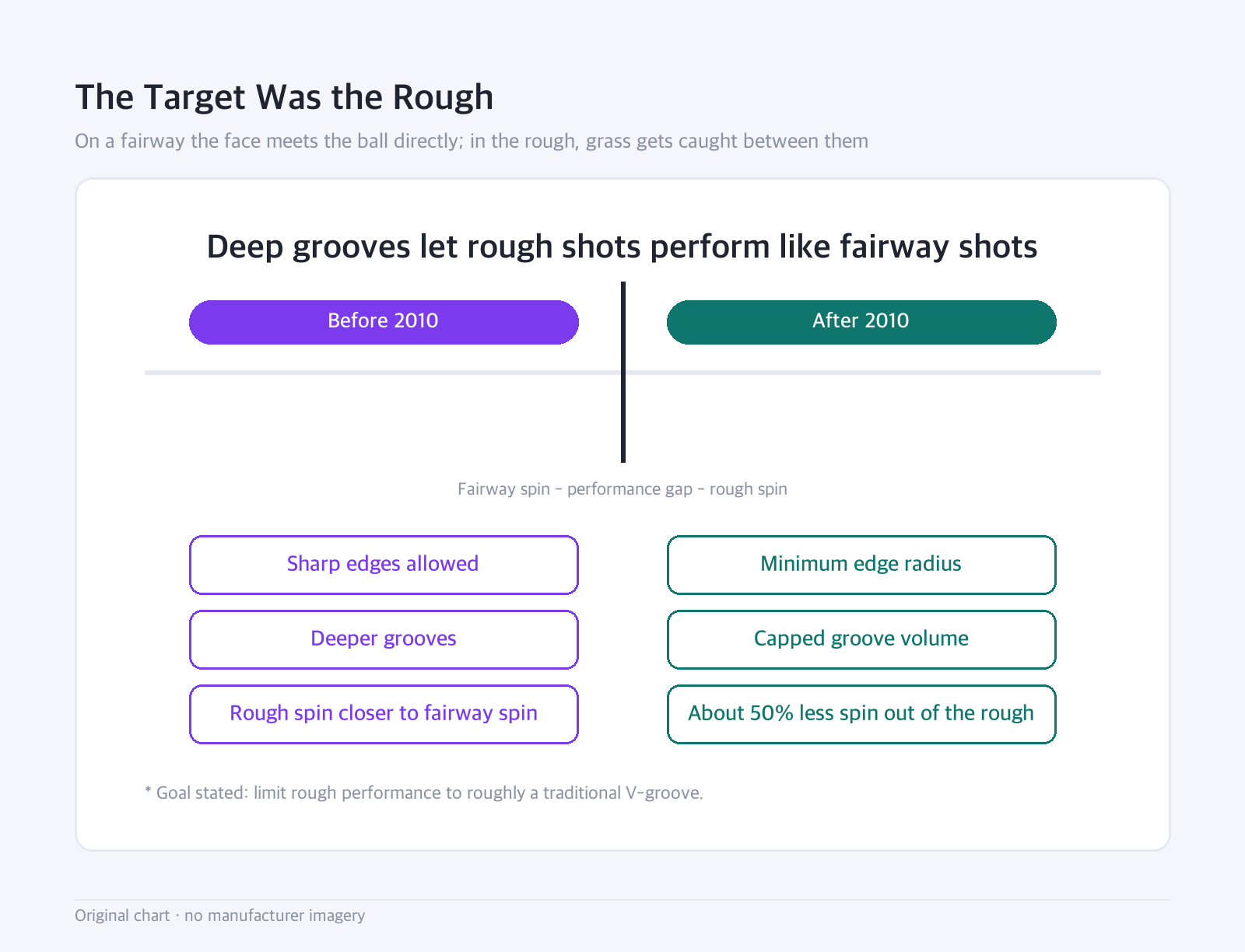
The purpose was explicit: to stop excessive spin out of the rough.
On a fairway, the clubface contacts the ball directly. In the rough, grass gets caught in between. That was originally meant to reduce spin — the cost of missing the fairway.
But if grooves are deep and edges are sharp, spin can still be generated even with grass in the way. When rough shots start performing like fairway shots, accuracy loses some of its meaning.
The stated goal was to limit rough performance to roughly the level of a traditional V-groove, and the combined effect of the two changes was described as a 50 percent reduction in rough spin.
4. The roots go back to 1987
The 2010 specification did not appear out of nowhere.
In June 1987, the USGA ruled that the groove spacing on Ping's Eye 2 irons fell short of the rulebook. Ping disputed this, arguing the groove shape gave no advantage and that spacing depended entirely on how it was measured.
The dispute went to court.
- 1990 settlement — Ping agreed to modify its tooling to match USGA's measurement method going forward, and the USGA retroactively recognized clubs produced from 1984 to 1990.
- The PGA Tour lawsuit ended out of court in April 1993, with neither side admitting fault.
This is a case where a governing body pushed against a manufacturer and had to back off — and it was roughly twenty years later that the 2010 specification followed.
5. What the two measures share
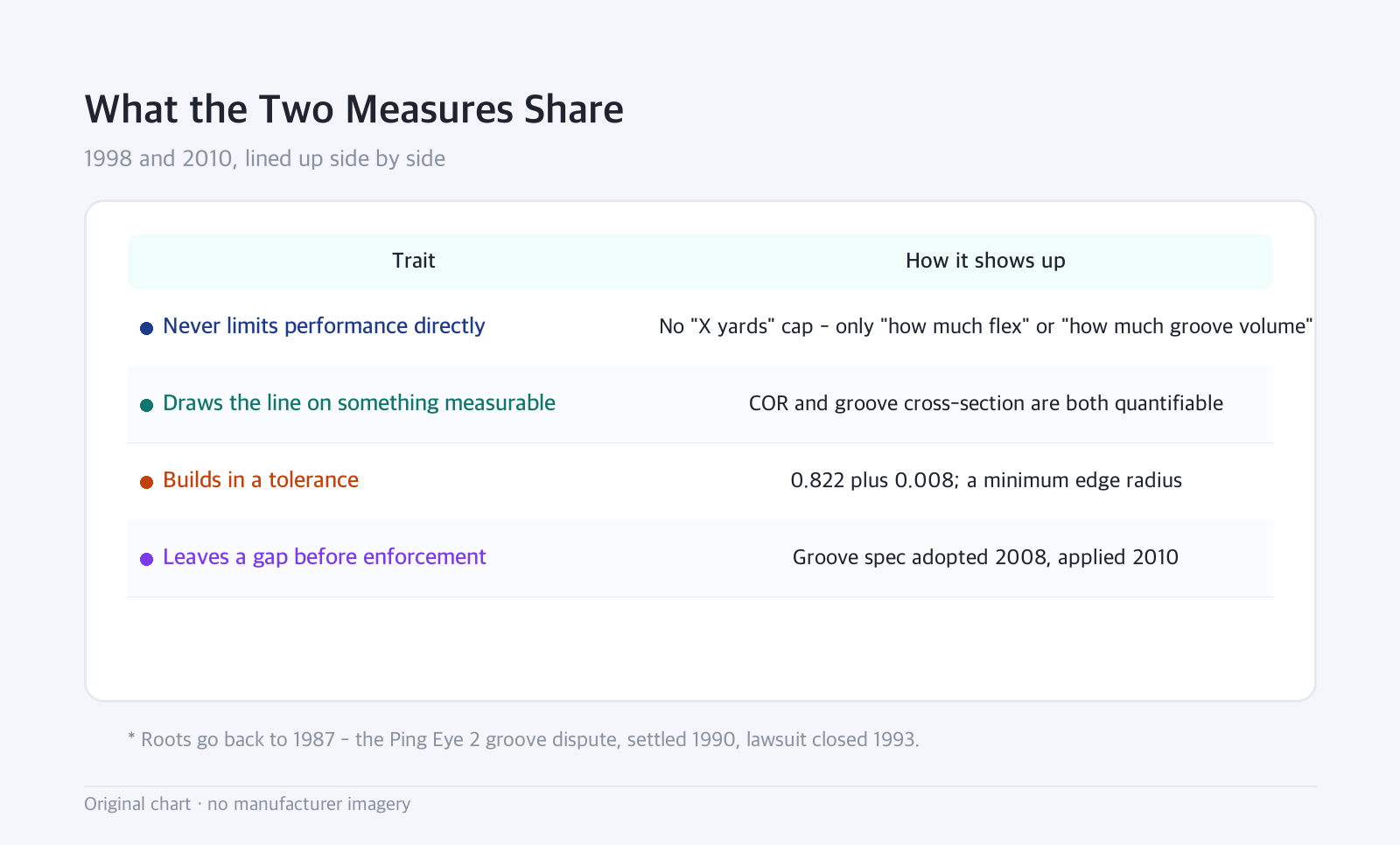
Lined up side by side, 1998 and 2010 share the same structure.
- Neither limits performance directly. They don't say "no more than X yards" — they set values like "how much does the face flex" or "how much groove volume."
- Both draw the line on something measurable. COR and groove cross-section are both quantifiable.
- Both build in a tolerance. 0.822 plus 0.008, and a minimum edge radius on grooves.
- Both leave a gap between announcement and enforcement. The groove spec was adopted in 2008 and applied in 2010.
Being able to draw a line only on what can be measured is the important part. "This club gives an advantage" isn't enough on its own to make a rule. There has to be something specific to measure, and a threshold not to cross.
Ping's 1987 argument — that spacing "depended on how you measured it" — struck exactly at this point. If the measurement method is unsettled, so is the specification.
6. Who this is useful for
Based on what could be confirmed:
- Golfers shopping for a wedge — anything made since 2010 falls within the same groove specification. Grooves won't be the deciding factor.
- Golfers looking at used clubs — some pre-2010 models may not meet the current spec.
- Golfers who feel like they don't get spin out of the rough — that is the intended effect of the rule.
- Golfers shopping for a driver — every current retail model is built within the COR limit.
This is less useful for:
- Golfers trying to compare club performance — since the specs are shared, this value won't distinguish clubs.
- Anyone needing tour-specific competition conditions — grooves are sometimes governed by separate conditions of competition.
7. What we could not confirm
- The basis for the 0.0030 square inch and 0.010 inch figures — we could not confirm how these thresholds were derived.
- The conditions behind the "50 percent" spin reduction figure — which rough, which club, we could not confirm.
- The specific measurements and readings involved in the Ping Eye 2 ruling.
- How retroactive treatment of pre-2010 clubs applies to ordinary golfers.
- When the R&A adopted the groove specification.
- The timing of adoption in amateur competitions.
In one line
Equipment went untouched for a century until the driver face in 1998 and wedge grooves in 2010.
Both measures drew the line not on performance but on what could be measured: a COR of 0.830, a groove cross-section of 0.0030 square inches, an edge radius of 0.010 inches.
And the groove specification has roots in a manufacturer's dispute with a governing body that ended up in court.
The figures here come from confirmed sources; anything we could not confirm is marked as such.
This piece summarizes general instruction concepts and is not personalized coaching advice. Ball flight fixes depend on individual swing mechanics — a launch monitor session or certified instructor can confirm what applies to you.